Monday, August 2, 2021

A DIY (Do-It-Yourself) Valuation of Zomato

Just over a week ago, I valued Zomato ahead of its market debut, and as with almost every valuation that I do on this forum, I heard from many of you. Some of you felt that I was being far too generous in my assumptions about market share and profitability, for a company with no history of making money, and that I was over valuing the company. Many others argued that I was understating the growth in the Indian food market and the company's potential to enter new markets, and thus undervaluing the company, a point that the market made even more emphatically by pricing the stock at about three times my estimated value. A few of you posited that I was missing the point entirely, and that Zomato is a trader's game, and that there are plenty of reasons for traders to be optimistic about its future prospects.  In this post, rather than impose my story (and value) on you, I offer a template for telling your own story about Zomato, and arriving at your own estimate of value.

The Prelude

After I posted my valuation last week, I did find some of the portrayals of my post to be a little unsettling. Some started by describing me as some kind of valuation luminary, and then proceeding to describe what I did to arrive at value as the result of deeply insightful research. Let me dispel both delusions. First, there is nothing in valuation that merits the use of “expert” or “guru” as a descriptor, since it is for the most part, common sense, layered with a few valuation basics. Second, while valuation practitioners have created their own buzzwords to create an aura of mystery, and added complexities, often with no reason other than to intimidate outsiders, I believe that anyone should be able to value a company, as I hope to show later in this post.  There was also some who misread my post to imply that I disliked Zomato as a company, or that I was trying to talk others out of investing in the company. Neither assertion is true, and since they relate to what I view as fundamental truths about investing, let me elaborate:

  1. Good Company versus Good Investment: While it is true that, at least in my assessment, Zomato is over priced, making it a bad investment, it does not follow that it is a bad company. I have written about the contrast between good investments and good companies before, but the picture below captures the essence:

    In short, your assessment of whether a company is good, average or bad is based upon how you see their business model playing out in future earnings and cash flows, but your assessment of whether it is a good investment depends upon whether your expectations for the company are more positive or negative than the market expectations for that company. My story for Zomato is a very positive one, where the company not only maintains its market share of a growing Indian market, but preserves its profitability, in the face of competition. That is one reason that I emphasized that unlike some, who have concluded that its money-losing status and big ambitions make it a "bad" company, my conclusion is that it is a good company. That said, the market seems to be pricing in the expectation that it will be a great company, and in my view, that judgment is premature.
  2. Taking ownership of investment decisions: I value companies for an audience of one, and that audience member is forgiving and understanding, because I see him in the mirror every day. It has always been my belief that as investors, each of us needs to take ownership of our investment decisions, and that buying or selling a company because someone else is doing so, even if that person has legendary investment credentials, is a dereliction of investment due diligence. Thus, if you find Zomato to be cheap and buy it, I have no desire to talk you out of your decision, since it is your money that you are investing, and that decision should be based upon your assessment of the company's prospects, not mine.
If investing is all about market price and how it relates to your assessment of value, it follows that there will never be consensus, and that disagreement is not only part and parcel of the process, but a healthy component in good valuation.

Valuation Storytelling: The Feedback Loop

In my valuation of Zomato, I laid out the story that I was telling about the company and how it played out in valuation numbers. It is part of a broader theme that I have harped on for years, which is that a good valuation is a bridge between story and numbers, and in my book on how to build that bridge, I talked about a five-step process:

In my last post on Zomato, you saw much of this process play out, but I want to focus on the fifth step, i.e., keeping the feedback loop open, and what it requires:
  1. Talk to a diverse audience: We live in a world of specialization, in almost every aspect of life, and that trend comes with mixed blessings. On the plus side, we now have experts who have spent their entire lives delving into an extraordinarily narrow slice of a discipline, often at the expense of the rest of that discipline. On the minus side, this expertise creates tunnel vision, where these experts often lose the forest for the trees. To make things worse, we have created workplaces, where these specialists often interact only with each other, making their isolation almost complete. I am lucky that I am able to interact with people with very different backgrounds (bankers, VCs, founders, CFOs, regulators), from different geographies and with very different perspectives, through my teaching and writing, and my suggestion is that you hang out less with people who think just like you do (often because they have the same training and credentials) and more with people who do not.
  2. Transparency over opacity: You have all heard the old saying about economists (and market gurus) needing three hands, because they constantly seem to have two of them busy, with their "on the one hand, and the other" prevarications about the future, that leave listeners confused about what they are predicting. I start with my valuation classes with the motto that I would rather be transparently wrong than opaquely right. Consequently, when I value companies, I try to take a stand on value, and be open about process, data and mechanics, so that anyone can not only replicate what I did, but  also find their own points of disagreement, and reflect those changes in their own assessed values. I am also well aware of the risk that by putting out valuation details, I will be proven wrong in the future, but I like the accountability that comes with disclosure. In commenting on my Zomato valuation, some of you pointed to how wrong I have been in valuing Uber and Tesla in the past, and while that is fair game, I have made peace (really) with my mistakes.
  3. Listen to those who disagree with you: I try to listen to those who disagree with me on any forum, whether it be social media or snail mail, for a very selfish reason. On every company that I value, I know that there are people out there who know more than I do about some aspect of the company (its products, market or competition) that I am valuing, and I can learn from them. With Zomato, for instance, I have learned about online food delivery and restaurants in India in the two weeks since I posted my Zomato valuation. I have some understanding of why Zomato Pro has not caught on as quickly as the company thought it would, why some of you prefer Swiggy, and even what you like to order from restaurants. (Biryani seems to a much bigger draw, for Indian diners, than it was in the days that I was growing up in India.)
  4. Be willing to change: The three most freeing words in investing and valuation are “I was wrong”, and I would be lying if I said they comes easily to me. That said, I find it easier to say those words now that I have had practice, and while some view this as an admission of weakness, saying it releases you to tell a better, and sometimes different, story. Bill Gurley’s critique of my narrow definitions of total market in my first Uber valuation significantly changed not only my valuation of that company, but has played a role in how I estimate total market size and value sharing economy companies.
The feedback that I have received on Zomato has already had tangible effects on my valuation. For instance, some of you noted that the corporate tax rate in India is 25%, not 30%, and while the Indian tax code with its predilection to add in surcharges that seem to last forever, and exceptions, still leaves me confused, I will concede on this point (pushing up my value per share marginally from 41 INR/share to about 43 INR/share). I have had pushback on my story’s focus on Indian food delivery, with some pointing to the potential for Zomato to expand its market globally, and others to the expansion possibilities in Indian grocery deliveries and from cloud kitchens. While I believe that the networking advantage that works to Zomato’s benefits will stymie them if they try to expand to large foreign markets and that the grocery delivery market, at least for the moment, offers too small a slice of revenues to be a game changer for the company, those are legitimate points.

A DIY Valuation of Zomato

 If, as you read my Zomato valuation, you found yourself disagreeing with me, I would like to offer you a way of valuing the company, with your disagreements incorporated into the value. Put simply, I will take care of the background work and the valuation mechanics, if you can supply the story. So, if you are ready, let’s go!

1. Total Addressable Market & Scaling Growth

The first and biggest part of the Zomato story is the total market that it can go after, since it defines how big a story you can tell, and by extension, how big your value can be. In my valuation, I assumed that Zomato’s primary revenues would continue to come from customers ordering food from restaurants for pickup and delivery, and that notwithstanding its global ambitions, India will remain its main market. That assumption led to my base case estimate of about 2,000 billion rupees (just over $25 billion) for the total market. This was the assumption that got the most pushback, on two fronts, first that I was ignoring the possibility that Zomato’s global reach could expand that market and second that adding grocery deliveries could make the market bigger. Some also mentioned the potential for growth from cloud kitchens, i.e., restaurants (small and large) that offer food only for delivery. So, with no further ado, here are your choices:

DIY Valuation Spreadsheet

For pessimists about Indian growth and eating habits, I offer the possibility that the total market will grow to only 1,125 billion ($15 billion) in ten years. For optimists, allowing for more growth in the Indian market or adding global growth makes the market bigger, and adding grocery deliveries to the total market more than doubles the market. In addition, you can make a judgment on whether the growth will be front ended (more growth in the early years) or spread evenly over time:

DIY Valuation Spreadsheet

This choice will be tied to how quickly you think that the Indian economy and food delivery market will develop over time.

2. Market Share

Zomato is currently one of the two largest companies in the Indian food delivery market, with a market share that is just above the the 40%. In my valuation, I assume that the food delivery market, following a pattern that seems to be forming globally, will remain dominated by a couple of players, and leave the market share at 40%. Many of you suggested that the Indian market’s diversity, across regions and income classes, would result in a more splintered market, with lower market share, but a few argued that Zomato’s capital raise would allow it to dominate the market, earning an even higher market share:

DIY Valuation Spreadsheet

In making this judgment, keep in mind that the more expansively you define the total market, the more you may have to pull back on market share. Also, if you do choose a dominant market share (60% or higher), consider the potential for legal and regulatory pushback. 

3. Revenue Slice

The driver for the online food delivery business remains the slice of the total food order that accrues to them as base revenues, and this slice is what has to use to pay delivery personnel, cover operating costs and be used to acquire new customers. In my base case valuation, I assumed that Zomato would get to keep the 22% of gross order value in the future, a little higher than its COVID-affected FY 2021 numbers and a little lower than its FY 2020 numbers. As Zomato tries to maintain its leading market share of the Indian market, this number will be the one that will come under the most pressure, since an aggressive competitor (like Amazon Food) may be willing to settle for a lower percentage. Note that there is also the possibility that the Indian food delivery market will end up dominated by two or three companies, and that these companies could come to an implicit agreement to leave the GOV slice untouched. That would be unfair to restaurants, but will improve the bottom line for the online delivery companies:

DIY Valuation Spreadsheet

In making a choice on revenue slice, recognize that it will be affected by your choices on market size and market share. Thus, if your total market is much bigger, because you have added in grocery deliveries, you should also be using a lower revenue slice, since grocery stores, with their lower profit margins, are reluctant to let delivery companies keep more than 10% of the order. In the US, for instance, large grocers have pushed back against Instacart’s cut (about 9%) of gross order value, and have started their own delivery services.

4. Operating Margins & Pathway to Profitability

In my valuation of Zomato, I noted that one of the advantages of being an intermediary is that the gross and operating margins tend to be high, once growth subsides that the expenses (selling and advertising costs) associated with  delivering that growth scale down. In my base case, I assumed a pre-tax target operating margin of 35%, but that margin will depend on how the competitive landscape evolves. If you have only two or three players, with a live-and-let-live attitude, margins will be high for all of the competitors, but if they continue to try to aggressively claw back from market share, through advertising and discounting, they will decline for all of the players.

DIY Valuation Spreadsheet

In my Zomato valuation, I also assumed that the company would continue to lose money in the near term, but that operating margins would converge on the target value in year 7. This assumption implicitly stands in for your views on how smooth the pathway to profitability will be for Zomato, with rockier pathways leading to a longer time period before you reach the target margin:

DIY Valuation Spreadsheet

Here again, the assumptions about margins will depend on the businesses that you believe that Zomato can enter, using its platform capabilities. In the last week, I have heard arguments that Zomato can go beyond food delivery into running cloud kitchens, enter the health/fitness market and even be a lender to restaurants. While all of these are possible, these are businesses with very different profitability profiles, and are unlikely to earn operating margins even remotely close to the margins that can be earned in the online food delivery business.

5. Reinvestment

The key ingredient connecting value to growth is the reinvestment needed to sustain that growth. Put simply, a company that has to reinvest large amounts to deliver a specific growth rate will have lower cash flows and be worth less than an another company with the same growth rate, but lower reinvestment needs. The input that I used in the Zomato valuation to bring in reinvestment is the sales to  capital ratio, a metric measuring how much revenue is generated for each dollar of capital invested, with reinvestment defined broadly to include net capital expenditures (capital expenditures minus depreciation), working capital needs, technology investments in the platform and acquisitions, with a higher number reflecting more efficient reinvestment. In my story, I see a continuation of their historical pattern of reinvesting in acquisitions and technology, albeit with more efficient growth in the near term, as the company bounces back from the COVID effect; my sales to capital ratio for next year is 5.00, dropping to 3.00 in years 2-5, before settling into 2.50 in steady state. Here again, there is room for debate, since you could argue for less reinvestment in the future (than I am assuming), based upon past acquisitions paying off, or for more reinvestment, if the company tries to buy its way into new markets and businesses.

DIY Valuation Spreadsheet

Since the sales to capital ratio is not one that is widely reported, you may find yourself lacking perspective on what comprises a high, low or typical number.

6. Risk 

There are two risk parameters in intrinsic valuation, the cost of capital accounting for the risk or variability in expected cash flows and the failure probability incorporating the risk that your company will not make it as a going concern. In the Zomato valuation, I attached a 10% chance of failure, with the large cash balance (especially after the IPO) offsetting concerns from the company's money losing, cash burning status. For the cost of capital, I followed the traditional route of estimating the company's costs of equity (based upon its exposure to market risk) and after-tax cost of debt, to arrive at an initial cost of capital of 10.25%, which I lowered over time to 8.97%, with both numbers in Indian rupees. For those of you who may disagree with my estimates on these numbers, I will make the confession that in this valuation, this input is not on my top ten list of key inputs. To see why, consider this histogram of costs of capital (that I computed) for publicly traded Indian companies in July 2021:

My Data Update from 2021
Note that 80% of Indian companies have costs of capital between 8.01% and 13.16%, and that half have costs of capital between 9.50% and 12.06%. To estimate a cost of capital for Zomato, consider this simplistic (but effective) approach, based on these estimates:
DIY Valuation Spreadsheet
Thus, if you feel that I have underestimated Zomato's risk in my valuation, consider going with an initial cost of capital of 12.06% (the third quartile), whereas if you believe that I have overestimated the risk, go with 9.50% (the first quartile). Then, move on to the inputs that really matter, since, in my view, this is not one of them.

Possible, Plausible and Probable

A common pushback against story telling is that it allows investors, analysts and appraisers to let their imaginations run riot, creating fairy tale valuations. It is to counter that possibility that I argue that every valuation story has to go through a three part test:

As you navigate your way through the choices, you may be tempted as an optimist to go with the most positive (for Zomato's value) choices on each variable (biggest market, highest market share, highest margin, lowest cost of capital) or the most negative (smallest market, lowest market share, lowest margin, highest cost of capital). In fact, the former if often labeled a "best case" and the latter a "worst case" valuation, when in fact, neither passes the possible/plausible/probable test, since assuming that you will go after the biggest market will mean accepting lower margins and higher reinvestment. Thus, I could tell you that the best case value is ₹423 and that my worst case value is ₹0, but that would be both useless and misleading. That said, you can already see, no matter what your priors, that there is a whole range of stories for Zomato that pass the test, and that they can yield values per share that are very different:

No failure risk in juggernaut stories, 10% risk in others

The most upbeat story that passes the plausibility test, albeit barely, is the one where Zomato targets the food and grocery delivery markets, while maintaining its revenue slice at 25% and margins at 45% (duopoly levels) and a low risk profile, and even with that unlikely combination of assumptions, the value per share is ₹150, about 10% higher than its stock price of ₹140, on August 2nd. Most of the plausible stories fall between ₹30 and ₹60, with your views about growth in the Indian economy & delivery market, revenue slice, margins and risk determining where you fall in the spectrum. This table contains only a small subset of the stories that can be told about Zomato, and I would encourage you to try your hand at the DIY valuation. Once you are done, please go to this Google shared spreadsheet and stake out your value. In a world where we trust crowds to get things right on every aspect of our lives from what restaurant to eat at to what movies to watch, let's get a crowd valuation of Zomato going.

Playing the Zomato Game

I am sure that there are some of you are wondering whether any of this discussion matters, if the market pricing is based upon mood and momentum. After all, if enough buyers line up to buy Zomato shares, perhaps drawn to it by the success of others, there is no reason why the price cannot continue to rise, no matter what the value. I don't disagree with that sentiment, and it goes back to the contrast I draw not just between value and price, but between investing and trading. As an investor, I am having trouble finding a pathway to justify paying 140 INR per share, for Zomato, even with the most upbeat stories that I come up with, for the company. That may of course reflect a failure of imagination on my part, and you may be able to find a narrative for the company that allows you to invest in the company. As a trader, the question of whether you should buy Zomato comes down squarely to how good you are at playing the momentum game, knowing when to get on, and more importantly, when to get off. For you, the value of Zomato may be irrelevant, and you will need a different set of metrics (charts, price and volume indicators) to make your decisions. I wish I could help you on that front, but trading is not my game, and I have neither the tools nor the inclination to play it. I wish you the best!

YouTube Video

Spreadsheets

  1. A DIY Valuation of Zomato
  2. Google Shared Spreadsheet (Crowd Valuation)


Thursday, July 22, 2021

The Zomato IPO: A Bet on Big Markets and Platforms!

Zomato, an Indian online food-delivery company, was opened up to public market investors on July 14, 2021,  and its market debut is being watched for clues by a number of other online ventures in India, waiting in the wings to go public. The primary attraction of the company, to investors, comes not from its current standing (modest revenues and big losses), but from its positioning to take advantage of the potential growth in the Indian food delivery market. In this post, I will value Zomato, and rather than just make a value judgment (which I will), I will also tie the value per share to macro expectations about the overall market. In short, I will argue that a bet on Zomato is as much a bet on the company’s business model, as it is a bet on Indian consumers not only acquiring more buying power and digital access, but also changing their eating behavior.

Setting the Stage

As a lead in to valuing Zomato, it makes sense to look not just at the company’s history, but also at its business model. In addition, since so much of the excitement about the stock comes from the potential for growth in the Indian food delivery market, I set the stage for that analysis by comparing the Indian market to food delivery markets in other parts of the world, as a prelude to forecasting its future path.

History and Business Model

Zomato was founded in 2008 by Deepinder Goyal and Pankaj Chaddah, as Foodiebay, in response to the difficulties that they noticed that their office mates were having in downloading menus for restaurants. Their initial response was a simple one, where they uploaded soft copies of menus of local restaurants, in Delhi, on to their website, initially for people in their office, and then to everyone in the city. As the popularity grew, they expanded their service to other large Indian cities, and in 2010, they renamed the company "Zomato", with the tagline of "never have a bad meal". The business model for the company is built upon intermediation, where customers can connect to restaurants on the platform, and order food, for pick up or delivery, and advertising. Along the way, the company has transitioned from an almost entirely an advertising company to one that has become increasingly focused on food delivery, and in 2021, the company derived its revenues primarily from four sources:

  1. Transaction Fees: The bulk of Zomato's revenues come from the transactions on its platform, from food ordering and delivery, as the company keeps a percentage of the total order value for itself. While Zomato's revenue slice varies across restaurants, decreasing with restaurant profile and reach, it remains about 20-25% of gross order value. It is worth noting that Swiggy, Zomato's primary competitor in India, also takes a similar percentage of order revenues, but Amazon Food, a new entrant into the market, aims to take a smaller portion (around 10%) of restaurant revenues.
  2. Advertising: Restaurants that list on Zomato have to pay a fixed fee to get listed, but they can  also spend more on advertising, based upon customer visits and resetting revenues, to get additional visibility. 
  3. Subscriptions to Zomato Gold (Pro): Zomato also offers a subscription service, and subscribers to Zomato Gold (now Zomato Pro) get discounts on food and faster deliveries. The service was initiated in 2017 and it had 1.5 million plus members in 2021, delivering subscription revenues of 600 million rupees (a little less than $ 10 million, and less than 5% of overall revenues) in 2021.
  4. Restaurant Raw Material: In 2018, Zomato introduced HyperPure, a service directed at restaurants, offering groceries and meats that are source-checked for quality. While direct measures of revenues from HyperPure are difficult to come by, the revenues that the company shows under traded goods (which include HyperPure revenues) suggests that it accounts for about 10% of the total revenues.
In conjunction with the other services it offers to restaurants, including consulting and data, it suggests that while food delivery and advertising are the company's primary revenue generators today, it has ambitions extending into the broader food business. Zomato has grown at exponential rates for much of the last decade, with a surge in the number of cities that it serves in India, especially in the last few years, from 38 in 2017 to 63 in 2018 to more than 500 in 2021, extending its reach into smaller urban settings.

Revenues did drop in 2020, as COVID restrictions put a crimp on the restaurant business, but the quarterly data suggests that business is coming back.  Along the way, the company has expanded its business outside India, with the United Arab Emirates being its biggest foreign market. That revenue growth has been driven partly by acquisitions that the company has made along the way:

Source: Crunchbase

To fund these acquisitions and other internal growth investments, the company has been reliant on venture capitalists, who have supplied it with capital in multiple rounds since 2011:

Source: Crunchbase

These capital infusions created a diverse ownership structure at the company, even prior to its going public: 

Source: Zomato Prospectus

The share of the equity owned but the original founders of the company has dropped dramatically over time, as the company has had to raise capital to fund its ambitious growth agenda, and Deepinder Goyal owns only 5.55% of the company's shares, prior to the IPO. Uber's ownership in Zomato is a result of Zomato's acquisition of Uber Eats India, where Uber received a share of Zomato's equity in exchange. As revenues have grown, the business model for the company has been slower to evolve, as the company has reported extensive losses along the way, as you will see in the next section.  

The Market

Zomato's business model is neither innovative, nor groundbreaking, resembling other online food delivery companies in other parts of the world, like DoorDash, which had its initial public offering in 2020. The allure to investors comes from Zomato's core market in India, and the potential for growth in that market. To get a measure of this potential, I start by comparing the size of food delivery markets in India to the food delivery markets in China, the United States and the EU. 

Zomato Prospectus and Other Sources for EU data

The Indian food delivery market is small, relative to markets elsewhere in the world, and especially compared to China,  the only other market of equivalent size in terms of population. There are three reasons for the smaller food delivery market in India, and they are highlighted in the table above:

  1. Lower per-capita income: Eating out and prosperity don't always go hand in hand, but you are more likely to eat out, as your discretionary income rises. Thus, it should come as no surprise that the number of restaurants increases with per capita GDP, and that one reason for the paucity of restaurants(and food delivery) in India is its low GDP, less than a fifth of per capital GDP in China and a fraction of per capital GDP in the US & EU.
  2. Less digital reach: To use online restaurant services, you first need to be online, and digital reach in India, in spite of advances in recent years, lags digital reach in China, and is about half the reach in the US and the EU.
  3. Eating habits: Looking across the regions, it seems clear that there is a third factor at play, a pre-disposition on the part of the populace, to eat out. Looking at the number of restaurants in China and the size of its food delivery market, it is quite clear that Chinese consumers are far more willing to eat out (either in person at or with delivery from restaurants) than people living in the US and EU, especially if you control for per capita income differences. 
The Zomato story, or at least the upbeat version of it, is that the Indian food delivery/restaurant market will grow, as Indians become more prosperous and have increased online access. A simplistic way to illustrate the difference is to adjust the size of the market for per-capita income and digital reach, and I attempt to do that, relative to the Chinese market, in the table below:
Used 2019 food delivery market number for India, and 2020 numbers for every thing else, in scaling up; COVID effect on 2020 Indian food delivery market very different from the rest of the world

Put simply, even if Indians had the same per-capita income and digital reach as Chinese consumers, the food delivery market in India would be far smaller than the Chinese market, perhaps because eating out is not as much as entrenched in Indian eating behavior. You can find multiple flaws with these comparisons, but the core fundamentals that will determine the size of the Indian food delivery market are clear. The size of the market in future years will be determined by how robustly the Indian economy will grow in the next few years, how quickly digitization continues its advance in the country and if and whether Indians become more open to eating out than they have historically.

Zomato: Story and Valuation

With the lead in on Zomato's history and business model, I can start constructing a story and valuation for the company, with the recognition that the biggest part of the story is in its macro elements. It stands to reason that disagreements about the story will be largely on those macro components, rather than in the company-specific components.

The Prospectus

To get the assessment of the company started, I began by looking at Zomato's prospectus and all of the concerns I noted about excessive and distracting disclosure that I laid out in last week's post on the topic, came rushing back to me. The Zomato IPO clocks in at 420 pages, much of it designed to bore readers into submission. Let's start with the useless or close to useless parts:

  1. Definitions and abbreviations: The prospectus starts, and I wonder whether this is by design, with 17 pages of abbreviations of terms, some of which are obvious and need no definition (board of directors, shareholders), some of which are meaningless even when expanded (19 classes of preferred shares, all of which will be replaced with common shares after the IPO) and some of which are just corporate names.
  2. Risk Profile: If you did not believe my assertions about the pointlessness of risk sections in IPOs, please do read all 30 pages of Zomato's risk profile (pages 39-68 of the prospectus). The company lists 69 different risks investors may face from investing in the company, and after you have read them all, I dare you to list three on that list that you would remember. The risk profile starts with a statement that the company has a history of net losses and anticipates increased expenses in the future and goes on to add invaluable nuggets such as the "COVID-19 pandemic, or a similar public health hazard, has had an impact on the our business". 
  3. Subsidiary/Holdings Mess: I find it mind boggling that a company that is only thirteen years old has managed to accumulate as many subsidiaries, both in India and overseas, as Zomato has done. Since Zomato owns 100% of most of these subsidiaries, there may be legal or tax reasons for this structure, but there is no denying that it adds complexity (and pages) to the prospectus, with no real information benefits. 
If you do make your way through this mush, there is useful information in the prospectus about the company's economics:
  1. Growth & Profitability trends: The company provides three years of financial statements in the prospectus (2018-19, 2019-20 and 2020-21) and you can get a sense of the company's growth and profitability trends by looking at the annual numbers:
    Zomato Prospectus

    Since the numbers for 2020 are distorted by the COVID shutdown, the company provides quarterly numbers for the most recent quarters to argue that the growth reversal in 2020 will be quickly put in the rearview mirror: 
    Zomato prospectus, with 2020 Q1 & Q2 numbers estimated
    Note the sharp and predictable drops in gross orders in the first two quarters of the 2021 fiscal year, but also the increase in gross orders in the last quarter of FY 2021 (the first quarter of the 2021 calendar year), as the shut downs ease up.
  2. Unit Economics: The company does provide a sprinkling of unit economics to suggest that the underlying business is moving towards profitability. The lead in their argument is the contribution margin, i.e., the slice of the a typical order that is left as profits, after covering the costs of catering to that order:
    Zomato Prospectus

    While the graph shows improvement, it is worth noting that the improvement is based upon a single year's (2021) numbers. There are, however, other facts about the unit economics that lend to optimism on the story. In particular, there is some evidence in the cohort table, where Zomato customers are broken down by how long they have been using the platform, that usage increases for more long-standing customers:
    Zomato Prospectus
    The users who joined the Zomato platform in 2017 were not only ordering three times more than they were initially by the time they had been on the platform four years, but were also more likely to continue ordering at those levels in the 2021 fiscal year, when COVID put a dent in the Indian food delivery business. This is good news, but to make full sense of it, it would have been informative to see what percent of each year's users stayed active on the platform in subsequent years, but I could not find that statistic in the prospectus.
  3. Competitive Advantages: The competitive advantage section could have been cut and pasted from a dozen Silicon Valley companies in the last decade, with the networking benefit captured in a loop, where the more a platform gets used, the more benefits it provides to those on it, thus creating more usage:
    Zomato Prospectus and Uber Prospectus

    Note the similarities between the picture to the left, from the Zomato prospectus, and the picture to the right is from the Uber prospectus, from 2019. That said, there is an element of truth in these pictures about how growth can lead to more growth, but neither picture addresses the fundamental business question of how to monetize this growth, since neither ride sharing nor food delivery has figured out how to be profitable. 
  4. Proceeds: The company's plans for what it intends to do with the proceeds are mixed. A portion of the initial offering will represent the cashing out of Info Edge, one of the first venture capital providers to Zomato, and that has no direct effect on the valuation. Another portion, amounting to approximately 9 billion INR will remain in the firm, to cover future cash needs. 
It would be churlish on my part to take issue with the bloat and selective disclosure in Zomato's prospectus, since they are following the script that other technology companies around the world have written for going public, but it is frustrating to read through 420 pages, and still be left in the dark on key numbers.

The Story & Valuation

    The story that I will tell for Zomato has several moving parts to it, but it can be broken down into the following components:

  1. Total Market: This is the assumption that will make or break Zomato as a company, since so much of the potential in the company is dependent on how the food delivery/restaurant market in India evolves over the next decade. As I noted in an earlier section, even allowing for robust growth in India and improved digital access, I find it hard to see the total market exceeding $40 billion, with US $25 billion, in ten years, being a more likely outcome. (In rupee terms, this will translate into a market that is roughly 1800-2000 billion INR.)
  2. Market Share: The Indian food delivery market is dominated by two big players, Zomato and Swiggy, with a third player, Amazon Foods, that is unlikely to fade away. In my story, I will assume that the market will continue to be dominated by two or three large players, albeit with lots of localized and niche competitors who will continue to command a significant slice of the market. Expecting any company to have a market share that exceeds 40% of this market is a reach, and I will assume that Zomato will be one of the winners/survivors. In making this judgment, it is worth noting that the online food delivery markets in other parts of the world (US, China) seem to be also approaching a steady state of a few large players.
  3. Revenue Share: While the market share and total market yield the gross order value for Zomato, the company posts only its share of these orders, as revenues. That number was 23.13% in FY 2020, but dropped to 21.03% in FY 2021, as shut downs put a crimp on business. I will assume a partial bounce back to 22% of GOV, starting in 2022, but the presence of Amazon Food will prevent a return to higher values in the future.
  4. Profitability: The profitability of intermediary businesses (ride sharing, apartment renting, food delivery) that use platforms to connect users to service or product providers is still being worked out, but the contours of how this will play out are visible. The biggest expenses at these companies are often on customer acquisition and marketing, and as growth scales down, these expenses should decrease, as a percent of revenues, delivering a profitability bonus. The biggest challenge that these businesses face are in the absence of stickiness and exclusivity, since users can have multiple food delivery apps on their devices and pick the cheapest one, and in balancing the competing needs of users and service/product providers with very different needs. For a food delivery service, restaurants and customers are integral to the business, and providing a better deal for one may come at the expense of the other. Online food delivery businesses around the world, and Zomato is no exception, are facing backlash from restaurants and delivery personnel, who believe that they are getting the short end of the stick, as the company seeks to offer lower prices and better delivery deals from customers. I will assume that pre-tax operating margins will trend towards 30%, largely because I believe that the market will be dominated by a few big players, but with the very real possibility that one rogue player that is unwilling to play the game can upend profitability. The scariest part of the food delivery market for Zomato is the identity of its new entrant (Amazon Food), since Amazon is the most fearsome competitor on the planet, willing to out-wait any company, if its intent is to capture a market. 
  5. Reinvestment: One of the advantages of being an intermediary business is that you can grow with relatively little capital investment, defined in conventional form (as plant, equipment or manufacturing facilities). That said, reinvestment takes a different form for companies like Zomato, with investments in technology and in acquisitions, driving future growth. I highlighted the acquisitions that Zomato has made over its lifetime, with UberEats India as its most recent and most expensive illustration, but also noted that the company has burned through billions in cash to get to where it is today. I will assume that this need will continue in the near future, with a lightening up in later years, as growth declines.
  6. Risk: In terms of operating risk, the company, in spite of its global ambitions, is still primarily an Indian company, dependent on Indian macroeconomic growth to succeed, and my rupee cost of capital will incorporate the country risk. Zomato is a money losing company, but it is not a start-up, facing imminent failure. On the plus side, its size and access to capital, as well as its post-IPO augmented cash balance, push down the risk of failure. On the minus side, this is a company that is still burning through cash and will need access to capital in future years to continue to survive. Overall, I will attach a likelihood of failure of 10%, reflecting this balance.  

With the story in place, and the inputs that come out of it, the valuation, in a sense, does itself, and you  can see the summary of the numbers below:

Download spreadsheet

With my upbeat story of growth and profitability, the value that I derive for equity is close to 394 billion INR (about $5.25 billion), translating into a value per share of 41 INR. That may seem like a lot to pay for a money-losing company with less than 20 billion INR in revenues in the most recent year, but promise and potential have value, especially when you have a leader in a market of immense size. That said, the stock's pricing (72-75 INR, per share) makes it too expensive, notwithstanding my story.

Facing up to Uncertainty

If you who are wondering whether the assumptions that underlie my Zomato valuation could be wrong, let me set your mind at rest by assuring you that they most certainly are, and it does not bother me in the least. The reason that they are wrong is simple. I do not control the future, and no matter how many tools and current information I bring to the process, there will be surprises down the road. The reason it does not bother me is because, as I have said many times before, you don't have to be right to make money, just less wrong than everyone else. I do think there is a benefit to being open about uncertainty and facing up to it, rather than viewing it as something to be avoided or acting as if it is not there. I will use one of my favorite tools, a Monte Carlo simulation, and quantify the uncertainty I foresee in three of my most critical assumptions.

  • Total Market Size: A major driver of Zomato's value is the expected evolution of the Indian food delivery market. While I projected the market to increase to about $25 billion in my base case, that is based upon assumptions about economic growth and digital reach in India that could be wrong. In the simulation, I allow for a market size of between $10 billion (about 750-800 billion rupees) to $40 billion (3000-3200 billion INR).
  • Market Share: In the base case, I assume that Zomato's share of the market will stabilize around 40% by year 5, premised on the belief that this will be a market with two or three big players, a a multitude of niche businesses. Given the regional diversity of the Indian market, it is possible that there may be more players in the market, in steady state, resulting in a  lower market share (as low as 20%) or that the niche players will get pushed out, because of economies of scale, yielding a higher market share (up to 50%).
  • Operating Margin: The operating margin of 30% that I predicted in my base case for Zomato is built on the presumption that the status quo will prevail, and that the delivery companies will be able to continue to see economies of scale, while holding their slice of the order value stable. If one of the players decides to aggressively go for higher market share (by offering discounts or bidding more for delivery personnel), operating margins will tend lower (15% is my low end). If, on the other hand, Zomato is able to keep its advertising business intact as it moves forward, it could delivery higher margin (45% is my upper end).
Notice that there are two assumptions that analysts often lose sleep over that I am ignoring. The first is the reinvestment each year, that I estimate using a sales to capital ratio that varies across time. It affects my cash flows, but its effect on value is dwarfed by changes in assumptions about market size and share. The second is the cost of capital, a number that most valuation classes and books (including mine) belabor to the point of diminishing returns. Raising or lowering the cost of capital has an effect on value, but changing my assumptions about risk premiums, betas or debt ratios has a much smaller effect that changing assumptions that alter cash flows. The results of the simulations that I ran with distributions replacing point estimates for market size, share and operating margin are shown below:

Put simply, I think it is hubris to dismiss those who invested in Zomato at 72 INR per share or higher, as speculators or ill-informed, since there are plausible stories that get you to values higher than 100 INR per share. That said, given my story and valuation for the company, I think that at a  70-75 INR per share price, the stock looks over valued to me.

Add ons and Distractions

The most dangerous moments, when valuing a company, are after you think you are done, as those who disagree with your valuation (on either side) come up with reasons for adding premiums for positives about the company that you may have missed, if they want a higher value, or discounts for negatives about the company that you should have incorporated, if they want a lower value. In this section, I will start with the argument that a platform with millions of users offers optionality, a reasonable basis for a premium, but one where it can be difficult to attach a number to the value. Second, I will consider whether the fact that India is a big market makes Zomato deserving of a premium, and make a case that it is not. Third, I will confront the oft used contention that value is in the eye of the beholder, i.e., that Zomato is worth a lot because other investors believe it to be worth a lot, and examine a pricing rationale for Zomato. Finally, dismissing Zomato as an investment,  just because it does not make money now, or fails to meet some conventional value tests on pricing (PE, Price to Book), is investing malpractice.

1. Platform Optionality

    As a company with millions of users on its platform, there is an added layer to value for Zomato or any other platform-based company, that goes beyond the intrinsic valuation above. In effect, if Zomato can deliver other products and services to the users of the platform, it can augment its earnings and value. This is the "optionality" that some investors highlight in companies with large user bases (Amazon Prime, Uber, Netflix), but while I see the basis for the argument, I would offer some caveats.

  • First, not all platforms are created equal, in terms of being adding value, with platforms with more intense users and proprietary data having more value than platforms where users are transitory and there is little exclusive data being collected. One reason that I bought Facebook shares in 2018, after the Cambridge Analytica scandal, was my belief that its platform has immense value because of its reach (more than 2 billion users in its ecosystem), their engagement (Facebook users stay in the ecosystem for long periods) and the data that Facebook collects, through their engagement (posts, comments etc.). 
  • Second, even if you believe that there is optionality, attach a numerical value to that option is one of the most difficult tasks in investment. While there are option pricing models that can be adapted to do the valuation, getting the inputs for these models, especially before the optionality takes form, is difficult to do. With Facebook, in 2018, I arrived at an intrinsic value that was only modestly higher than the price (<10%), but used the optionality as the argument for pulling the buy trigger.
Zomato's platform has the benefit of large numbers, but it falls short on both intensity and proprietary data. Thus, Zomato app users are on the system only when they order food, and the engagement is often restricted to food ordering and delivery. If Zomato plans to expand its offerings to its platform-users, it is very likely that these add-on businesses will be food-related, perhaps extending into grocery shopping, creating some option value. 

2. A Big Market Premium?

Indian and Chinese companies, especially in young and nascent businesses, have an advantage that they often play to, which is immense local markets. It is not surprising that companies play up this advantage, when marketing themselves to investors, with some analysts attaching premiums to value, just because of market size. I believe that this is a distraction, because that market size should already by incorporated into the intrinsic value, through growth and margin expectations. In my base case valuation of Zomato, I assume that revenues will increase almost ten-fold over the next 10 years, because the Indian market is expected to grow so strongly.  In fact, the danger to investors, when faced with Indian and Chinese companies, is not that they will under value these companies, but that they will over value them, precisely because the markets are so big. In a post and companion paper, I describe this as the big market delusion, where investors do not factor in the competition that will come from existing and new players, drawn into the business by the size of the market, and the resulting drop in profitability.

3. A Pricing Rationale

When you value young companies with promise, the most common push back that you will get is that value is whatever people perceive it to be, and young companies can therefore have any value that investors will sustain. This is a distortion of the word value, but it is true that young companies are more likely to be priced than valued, and the pricing will be based upon a simple pricing metric (anything from PE to EV/Sales) and what investors perceive to be the peer group. With Zomato, for instance, there are two ways in which investors may attach a pricing to the company. 

  1. VC Pricing: The first is to look at venture capitalists priced the company at, in their most recent funding rounds, and extrapolating from that number. In its February 2021 VC round, Zomato was priced at close to 400 billion INR ($5.4 billion) by a group of venture capitalists (including Fidelity and Tiger Global), who invested almost 50 billion INR (about $660 million) in the company. 
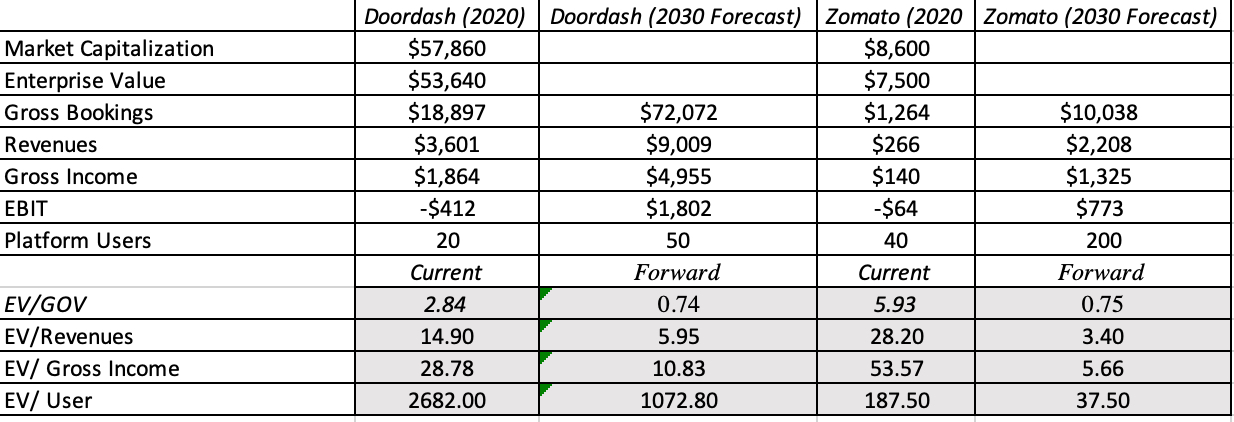
  2. Comparable companies: The only direct comparable that Zomato has in India is Swiggy, which is still privately funded, At the risk of stretching the definition of "comparable firm", I compare Zomato's pricing (using the projected 72-75 INR share price on the IPO) to the pricing of Doordash, which went public in 2020:

One of the perils of pricing is that you can find almost always find a way to back up your preconceptions, if you try hard enough. Thus, if you are a Zomato bull, you could point to the EV/User and argue that it is cheap, relative to Doordash, whereas if you are a bear, you can point to Current revenue and GOV multiples, to make the case that Doordash is cheaper. To make the argument even messier, using forward multiples, where you scale the current enterprise value to expected revenues or earnings in 2031, make the Zomato case stronger, since it has higher expected growth than Doordash does.

The bottom line is that pricing is not a panacea for uncertainty or a cure for bias, since the uncertainty is just pushed into the background and there is plenty of room for biases to play out, in how you standardize price (which multiple you use) and and what your comparable are. 

4. It is a money loser

There are good arguments to be made against investing in Zomato at is proposed offering price, but one of the emptiest, and laziest, is that it is losing money right now. I know that for some value investors, trained to believe that anything that trades at more than 10 or 15 times earnings or at well above book value, this argument suffices, but given how badly this has served them over the last two decades, they should revisit the argument.  The biggest reason that Zomato is losing money is because it is a young company that is trying to take advantage of a market with immense growth potential, not because it cannot make money. In fact, if Zomato cut back on customer acquisitions and platform investments, my guess is that it could show an accounting profit, but if it did so, it would be worth a fraction of what it is today. 

Conclusion

In investing and valuation, there is the presumption that rules and even the first principles of investing change as you go from one market to another, and this is particularly true when comparisons are made between developed and emerging markets. I believe that the first principles of valuation are the same in all markets, and I hope that I have stayed true to that belief in this post. I valued Zomato, using the same process that I used to value Doordash, with the country-specific effects being incorporated into my growth and risk projections. While I did take issue with some of the holes and over reach in Zomato's disclosures, I ran into the same challenges, when I valued Doordash.  Zomato is a money-losing, cash burning enterprise now, but it has immense market potential and is on track to delivering on a viable business model. It will face plenty of challenges on that path, both at the micro level (management, competition) and at the macro level (economic and political developments in India).  I believe that the company is currently over priced, given its potential, but I would have no qualms about investing in the stock, if the price drops in the near future, with the full understanding that this is a joint wager on a company, a sector and a country.

YouTube Video

Data & Spreadsheets

  1. Zomato Prospectus
  2. Zomato Valuation Spreadsheet
Posts/Papers
  1. The Big Market Delusion (Post and Paper)

Wednesday, July 14, 2021

Disclosure Dilemma: When more (data) leads to less (information)!

In the last few decades, as disclosure requirements for publicly traded firms have increased, annual reports and regulatory filings have become heftier. Some of this surge can be attributed to companies becoming more complex and geographically diversified, but much of it can be traced to increased disclosure requirements from accounting rule writers and market regulators. Driven by the belief that more disclosure is always better for investors, each market meltdown and corporate scandal has given rise to new reporting additions. In this post, I look at trends in corporate reporting and filings over time, and why well-meaning attempts to help investors have had the perverse effect of leaving them more confused and lost than ever before.

Time Trends in Reporting

   Publicly traded firms have always had to report their results to their shareholders, but over time, the requirements on what they need to report, and how accessible those reports are to the public (including non-shareholders) has shifted. Until the early 1900s, reporting by public companies was meager, varied widely across firms, and depended largely on the whims of managers, with smaller, closely held firms among the most secretive. Between 1897 and 1905, for instance, Westinghouse Electric & Manufacturing neither published an annual report, not held a shareholder meeting. In the years before the First World War, the demands for more disclosure came from critics of big business, concerned about their market power, but few companies responded. It took the Great Depression for the New York Stock Exchange to wake up to the need for improved and standardized disclosure requirements, and for the government to create a regulatory body, the Securities and Exchange Commission (SEC). The SEC was created by the Securities Act of 1933, which was characterized as "an act to provide full and fair disclosure of the character of the securities sold in interstate and foreign commerce", and augmented by the Securities Exchange Act of 1934, covering secondary trading of securities. Almost in parallel, accounting as a profession found its footing and worked on creating rules that would apply to reporting, at least at publicly traded companies, with GAAP (Generally Accepted Accounting Principles) making its appearance in 1933. In the years since, disclosure requirements have changed and expanded, with companies in foreign markets creating their own rules in IFRS (International Financial Reporting Standards), with many commonalities and a few differences from GAAP. To get a measure of how disclosures have changed over time, I will focus on two filings that companies have been required to make with the SEC for decades. The first is the 10-K, an annual filing that all publicly traded companies have to make, in the United States. The second is the S-1, a prospectus that private companies planning to go public have to file, as a prelude to offering shares to public market investors.

The 10-K (Annual Filing)

    The Securities Exchange Act of 1934 initiated the rule that companies of a certain size and number of shareholders have to file company information with the SEC both annually and quarterly. The threshold levels of company size and shareholder count have changed over time (it currently stands at $10 million in  assets and 2000 shareholders), as have the information requirements for the filing. In the early years, the SEC summarized the company filings in reports to Congress, but the general public and investors had little access to the filings, relying instead on annual reports from the companies, for their information. It was the SEC's institution of an electronic filing system (EDGAR) in 1994 that has made both annual (10-K) and quarterly (10-Q) filings easily and more freely accessible to investors, leveling the playing field.

    I valued my first company in 1981, using an annual report as the basis for financial data, but my usage of 10-Ks did not begin until the 1990s. I have always struggled with both the language and the length of these filings, but I must confess that these struggles have become worse over time. Put simply, there is less and less that I find useful in a 10-K filing, and more verbiage that seems more intended to confuse rather than inform. Let me start with how this filing has evolved at one company, Coca Cola, between 1994 and 2020, using the most simplistic metric that I can think of, i.e., the number of pages in the filing:

Coca Cola Investor Relations

This is clearly anecdotal evidence, and may reflect company-specific factors, but there is evidence to indicate that Coca Cola is not alone in bulking up its SEC filings. In a research paper focused almost entirely on how 10-K disclosures have evolved over time, Dyers, Lang and Stice-Lawrence count not just the words in 10-K filings (one advantage of having electronic filings is that this gets easier), but also what they term redundant, boilerplate and sticky words (see descriptions below chart):

Dyers, Lang and Stice-Lawrence
Redundant words: Number of words in sentence repeated verbatim in other portions of report
Boilerplate words: Words in sentences with 4-word phrases used in at least 75% of all firms' 10Ks
Sticky words: Words in sentences with 8-word phrase used in prior year's 10K
While this paper goes only through 2013, a more updated study suggests that the word count has continued to climb in recent years:
Lesmy, Muchnik & Mugerman
Both studies referenced to above also point to another troubling trend in the 10-K filings, which is that they have become less readable over time. Lesmy, Muchnik and Mugerman use two popular measures of readability, the Gunning-Fog Index and the Flesch-Kincaid readability test on 10-Ks, and find that not only are 10-Ks much less readable than most texts (they use the Corpus of Contemporary English or COCA Academic texts) and the newspapers (they use the financial and general section of The Daily Telegraph, a UK paper), but that the gap is also getting wider:
Lesmy, Muchnik & Mugerman

To be honest, I think that the authors are being charitable in their assessment of 10-Ks, by linking their reading to higher education. The complexity in the filings does not come from using bigger words or advanced language, but from using a mix of legalese, double-talk and buzzwords to leave readers, no matter how educated they are, in a complete fog. Why have 10-Ks become longer and less readable? Dyers, Lang and Stice-Lawrence make a creative attempt to answer this question, by first breaking down the filing information into thirteen topic categories and graphing how 
Dyers, Lang and Stice-Lawrence

After placing the lion’s share of the blame for bloat on the SEC and rule writers,  Dyers et al, also note three topics account not just for much of the verbosity, but also the redundancy, stickiness and lack of readability: risk factors, internal control and fair value/impairment
Dyers, Lang and Stice-Lawrence

While the risk factor section may provide employment for lawyers, internal control for auditors and fair value/impairment for accountants, I have always found these sections to be, for the most part, useless, as an investor. The risk factors are legalese that state the obvious, the internal controls section (a special thanks to Sarbanes-Oxley for this add-on) is a self-assessment of management that they are "in control", and the fair value/impairment by accountants happens too late to be helpful to investors; by the time accountants get around to impairing or fairly valuing assets, the rest of the world has moved on. 

The S-1 (Prospectus)

The S-1 is a prospectus filing that companies that plan to go public in the US have to make, and it plays multiple roles, a recording of the company’s financial history, a descriptor of its business models and risks and a planner for its offerings and proceeds. As with the 10-K, the requirements for the prospectus go back to the Securities Exchange Act of 1934, but the disclosure requirements have become more expansive over time. To provide a measure of how much the S-1 has bulked up over time, consider the table below, where I compare the number of pages in the prospectus filings of two high profile companies from each decade, from the 1980s to today:

SEC Filings

Consider two high profile offerings from the 1980s, Apple and Microsoft, and contrast them with the filings from IPOs in more recent years. Apple’s prospectus from 1980 was considered long, running 73 pages, and Microsoft’s prospectus in 1986 was 69 pages long, with the appendices containing the financials. In contrast, Uber’s prospectus in 2019 was 285 pages long, with a separate section of 94 pages for the financial statements and other disclosures, itself an increase on the Facebook prospectus from 2012, which was 150 pages, with 36 pages added on for financial statements and other add-ons. Along the way, prospectuses have become more complex and less readable, and there are three forces that have caused these changes. 
  • The first is that the added verbiage on key inputs has made them more difficult to understand, rather than provide clarity. Consider, for instance, the disclosure requirements for share count, which have not changed substantially since the 1980s, but share structures have become more complex at companies, creating more confusion about shares outstanding. Airbnb, in its final prospectus, before its initial public offering asserted that there would 47.36 million class A and 490.89 million class B shares, after its offering, but then added that this share count excluded not only 30.87 million options on class A shares and 13.79 million options on class B shares, but also 37.51 million restricted stock units, subject to service and vesting requirements. While this is technically "disclosure", note that the key question of why restricted stock units are being ignored in share count is unanswered.
  • The second is that companies have used the SEC's restrictions on making projections to their advantage, to tell big stories about value, while holding back details. For some companies, a key metric that is emphasized is the total addressable market (TAM), a critical number in determining value, but one that can be stretched to mean whatever you want it to, with little accountability built in. In 2019, Uber claimed that its TAM was $5.2 trillion, counting in all car sales and mass transit in that number, and Airbnb contended that its TAM was $3.4 trillion, five times larger than the entire hotel market's revenues in that year.
  • Finally, while most companies, that are on the verge of going public, lose money and burn through cash, they have found creative ways of recomputing or adjusting earnings to make it look like they are making money. Thus, adding back stock-based compensation, capitalizing expenses that are designed to generate growth (like customer acquisition costs) and treating operating expenses as one-time or extraordinary, when they are neither, have become accepted practice.
In sum, prospectuses like 10-Ks have become bigger, more complex and less readable over time, and as with 10-Ks, investors find themselves more adrift than ever before, when trying to price initial public offerings.

The Investor Perspective

As companies disclose more and more, investors should be becoming more informed and valuing/pricing companies should be getting easier, right? In my view, the answer is no, and I think that investors are being hurt by the relentless urge to add more disclosures. I am not the first, nor will I be the last one, arguing that the disclosure demon is out of control, but many of the arguments are framed in terms of the disclosure costs exceeding benefits, but these arguments cede the high ground to disclosure advocates, by accepting their premise that more disclosure is always good for investors and markets. On the contrary, I believe that the push for more disclosure is hurting investors and creating perverse consequences, for many reasons:

  1. Information Overload: Is more disclosure always better than less? There are some who believe so, arguing that you always have the option of ignoring the disclosures that you don't want to use, and focusing on the disclosures that you do. Not surprisingly, their views on disclosure tend to be expansive, since as long as someone, somewhere, can find a use for disclosed data, it should be. The research accumulating on information overload suggests that they wrong, and that more data can lead to less rational and reasoned decision for three reasons. First, the human mind is easily distracted and as filings get longer and more rambling, it is easy to lose sight of the mission on hand and get lost on tangents. Second, as disclosures mount up on multiple dimensions, it is worth remembering that not all details matter equally. Put simply, sifting though the details that matter from the many data points that do not becomes more difficult, when you have 250 pages in a 10-K or S-1 filing. Third, behavioral research indicates that as people are inundated with more data, their minds often shut down and they revert back to "mental short cuts", simplistic decision making tools that throw out much or all of the data designed to help them on that decision. Is it any surprise that potential investors in an IPO price it based upon a user count or the size of the total accessible markets, choosing to ignore the tens of pages spent describing the risk profile or business structures of a company? 
  2. Feedback loop: As companies are increasingly required to disclose details about corporate governance and environmental practices in their filings, some of them have decided to use this as an excuse for adopting unfair rules and practices, and then disclosing them, operating on the precept that sins, once confessed, are forgiven.. This trend has been particularly true in corporate governance, where we have seen a surge in companies with shares with different voting rights and captive boards, since the advent of rules mandating corporate governance disclosure. For a particularly egregious example of overreach, with full disclosure, take a look at WeWork's prospectus and especially the rules that it explicitly laid out for CEO succession.
  3. Cater to your audience: Company disclose data to multiple groups, to governments to meet regulatory requirements and for taxes, to consumers about the goods and services they they sell, to their bankers about loan obligations due and to shareholders about their overeat financial performance. Rule writers on disclosure sometimes seem to forget that each of these groups need different information, and trying to meet all their needs in one disclosure is a disservice to all of them.  It is worth remembering that the reason that we have 10-Ks and S-1s at companies is for shareholders, interested in investing in the company, not regulators, consumers, accountants or lawyers. That said, it is also worth remembering that not everyone investing in a  company is an investor and that many are traders. Drawing on a contrast that I have used many times before, investors are interested in the value of a stock, which, in turn, is determined by cash flows, growth and risk, and buying stocks that they believe trade at a price less than the value. Traders, on the other hand, have little interested in fundamentals, focusing  instead on mood and momentum, and how those forces can lead to prices increase.
    Much of the regulatory disclosure has been focused on what investors need to value companies, albeit often with an accounting bias. However, there are for more traders than investors in the market, and their information needs are often simpler and more basic than investors. Put simply, they want metrics that are uniformly estimated across companies and can be used in pricing, whether it be on revenues or earnings. With young companies, they may even prefer to use user or subscriber counts over any numbers on the financial statements. 
  4. Make it about the future, not just the past: While I don't think that anyone would dispute the contention that investing is always about the future, not the past, the regulatory disclosure rules in the US and elsewhere seem to ignore it. In fact, much of regulatory rule making is about forcing companies to reveal what has happened in their past, and while I would not take issue with that, I do take issue with the restrictions that disclosure laws put on forecasting the future. With the prospectus, for instance, I find it odd that companies are tightly constrained on what they can say about their future, but that they can wax eloquently about what has happened in the past. Given that much or all of the value of these companies comes from their future growth, what is the harm in allowing companies to be more explicit about their beliefs for the future? Is it possible that they will exaggerate their strengths and minimize their weaknesses? Of course, but investors know that already and can make their own corrections to these forecasts. More importantly, stopping companies from making these forecasts does not block others (analysts, market experts, sales people), often less scrupulous and less informed than the companies, from making their own forecasts.
  5. Mission Confusion: Should disclosures be primarily directed at informing investors or protecting them? While it is easy to argue that you should do both, regulators have to decide which mission takes primacy, and from my perspective, it looks like protection is often given the lead position. Not surprisingly, it follows that disclosures become risk averse and lawyerly, and that companies follow templates that are designed to keep them on the straight and narrow, rather than ones that are more creative and focused on telling their business stories to investors.

Disclosure Fixes

The nature of dysfunctional processes is that they create vested interests that benefit from the dysfunction, and the disclosure process is no exception. I am under no illusions that what I am suggesting as guiding principles on disclosure will be quickly dismissed by the rule writers, but I am okay with that. 

  1. Less is more: I do think that most regulators and investors are aware that we are well past the point of diminishing returns on more disclosure, and that disclosures need slimming down. That is easier said than done, since it is far more difficult to pull back disclosure requirements than it is to add them. There are three suggestions that I would make, though there will be interest groups that will push back on each one. First, the risk profile, internal control and fair value/impairment sections need to be drastically reduced, and one way to prune is to ask investors (not accountants or lawyers) whether they find these disclosures useful. A more objective test of the value to investors of these disclosures is to look at the market price reaction to them, and if there is none, to assume that investors are not helped. (If you apply that test on goodwill impairment, you would not only save dozens of pages in disclosures, but also millions of dollars that are wasted every year on this absolutely useless exercise) Second, I would use a rule that has stood me in good stead, when trying to keep my clothes from overflowing my limited closet space, in the disclosure space. When a new disclosure is added, an old one of equivalent length has to be eliminated, which of course will set up a contest between competing needs, but that is healthy. Third, any disclosures that draw disproportionately on boilerplate language (risk sections are notorious for this) need to be shrunk or even eliminated.
  2. Don't forget traders: Almost all of the disclosure, as written today, is focused on investor needs for information. Thus, there is almost no attention paid to the pricing metric being used in a sector, and to peer group comparisons. Rather than adopt a laissez fare approach, and let companies choose to provide these numbers, often on their own terms and with little oversight, it may make more sense that disclosure requirements on pricing and peer groups be more specific, allowing for different metrics in different sectors. Just to provide one illustration, I believe that the prospectus for a company aspiring to go public should include details of all past venture capital rounds, with imputed pricing in each round. While investors may not care much about this data, it is central for traders who are interested in pricing the company. 
  3. Let companies tell stories and make projections: The idea that allowing companies to make projections and fill in details about what they see in their future will lead to misleading and even fraudulent claims does not give potential buyers of its shares enough credit for being able to make their own judgments.With the S-1, the disclosure status quo is letting young companies off the hook, since they can provide the outlines of a story (TAM, multitude of users, growth in subscribers) without filling in the details that matter (market share, subscriber renewal and pricing).
  4. With triggered disclosures: To the extent that some companies want to tell stories built around non-financial metrics like users, subscribers, customers or download, let them. That said, rather than requiring all companies to reveal unit economics data, given the misgivings we have about disclosures becoming denser and longer, we would argue for triggered disclosure, where any company that wants to build its story around its user or subscriber numbers (Uber, Netflix and Airbnb) will have to then provide full information about these users and subscribers (user acquisition costs, churn/renewal rates, cohort tables etc.)
I hope that we can keep these principles in mind, as we embark on what is now almost certain to become the next big disclosure debate, which is what companies should be required to report on environmental, social and governance (ESG) issues. You are probably aware of my dyspeptic views of the entire ESG phenomenon, and I am wary about the disclosure aspects as well. If we let ESG measurement services and consultants become the arbiters of what aspects of goodness and badness need to be measured and how, we are going to see disclosures become even more complex and lengthy than they already are. If you truly want companies to be good corporate citizens, you should fight to keep these disclosures in financial filings limited to only those ESG dimensions that are material, written in plain language (rather than in ESG buzzwords) and focused on specifics, rather than generalities. Speaking from the perspective of a teacher, put a word limit on these disclosures, take points off for obfuscation and then think of what existing disclosures should be removed to make room for it!

YouTube Video

Company Filings
  1. EDGAR Company Filings (US companies)
  2. Companies House (UK company filings)
Research