Showing posts with label Brand name premium. Show all posts

Tuesday, October 1, 2024

Just do it! Brand Name Lessons from Nike'sTroubles!

     I have spent the last week reading "Shoe Dog", Phil Knight's memoir of how  a runner on the Oregon University track team built one of the great shoe companies in the world, in Nike. In addition to its entertainment value, and it is a fun book to read, I read it for two storylines. The first is the time, effort and grit that it took to build a business, in a world where risk capital was more difficult to access than it has been in this century, and in a business where scaling up posed significant challenges. The second is the building of a brand name, with a mix of happy accidents (from the naming of the company to the creation of the swoosh as the company's symbol to its choice of slogan), good timing and great merchandising all playing a role in creating one of the great brand names in apparel and footwear. The latter assessment led a more general consideration of what constitutes a brand name, what makes a brand name valuable and what causes brand name values to deplete and disappear. Of course, since my attention was drawn to Nike in the first place, because of a change at the top the company and talk of brand name malaise, I tried my hand at valuing Nike in 2024, along the way.

Brand Name - What is it?

    The broadest definition of a brand name is that it is recognized (by employees, consumers and the market) and remembered, either because of familiarity (because of brand name longevity) or association (with advertising or a celebrity). That definition, though, is not particularly useful since remembering or recognizing a brand, by itself, tells you nothing about its value. After all, almost everyone has heard or recognizes AT&T as a brand/corporate name, but as someone who is a cell service and internet customer of AT&T, I can assure you that neither of those choices were driven by brand name.  The essence of brand name value is that the recognition or remembrance of a brand name changes how people behave in its presence. With customers, brand name recognition can manifest itself in buying choices (affecting revenues and revenue growth) or willingness to pay a higher price (higher profit margins). With capital providers, it may allow for lower funding costs, with equity investors pricing equity higher and lenders accepting lower interest rates and/or fewer lending covenants. For the moment, this may seem abstract and subjective, but in the next section, we will flesh out brand name effects on operating metrics and value more explicitly.

Corporate, Product and Personal Brand Names

    Brand names can attach to entire companies, to particular products or brands, or even to personnel and people. With a company like Coca Cola, it is the corporate brand name that has the most power, but the soft drink beverages marketed by the company (Coca Cola, Fanta, Sprite, Dasani etc.) each have their own brand names. With companies like Unilever, the corporate brand name takes a back seat to the brands names of the dozens of products controlled by the company, which include Dove (soap), Axe (deodorant), Hellman's (mayonnaise) and Close-up (toothpaste), just to name a few. There are clearly cases of people with significant brand name value, in sports (Ohtani in baseball, Messi in soccer, Kohli in cricket) and entertainment (Taylor Swift, Beyonce), with a spill over to the entities that attach themselves to these people. In fact, a critical component of Nike's brand name was put in place in 1984, when the company signed on Michael Jordan, in his rookie season as a basketball player, and reaped benefits as he became the sport's biggest star over the next decade.

Brand names and other Competitive Advantages

    One reason that brand name discussions often lose their focus is that companies are quick to bundle a  host of competitive advantages, each of which may be valuable, in the brand name grouping. The table below, where I have loosely borrowed from Morningstar and Michael Porter is one way to think about both the types and sustainability of competitive advantages:

Companies like Walmart and Aramco have significant competitive advantages, but I don't think brand name is on the top five list. Walmart's strengths come from immense economies of scale and bargaining power with suppliers, and Aramco's value derives from massive oil reserves, with far lower costs of extraction, than any of its competitors. Google and Facebook control the advertising business, because they have huge networking benefits, i.e., they become more attractive destinations for advertisers as they get bigger, explaining why they were so quick to change their corporate names, and why it has had so little effect on value. The pharmaceutical companies have some brand name value, but a bigger portion of their value added comes from the protection against competition they get from owning patents. While this may seem like splitting hairs, since all competitive advantages find their way into the bottom line (higher earnings or lower risk), a company that mistakes where its competitive advantages come from risks losing those advantages.

Brand Name Value

    At the risk of drawing backlash from marketing experts and brand name consultants, I will start with my "narrow" definition of brand name. In arriving at this definition, I will fall back on a structure where I connect the value of a business to key drivers, and look at how brand name will affect these drivers:

Put simply, brand name value can show up in almost every input, with a more recognizable (and respected) brand name leading to more sales (higher revenues and revenue growth), more pricing power (higher margins), and perhaps even less reinvestment and less risk (lower costs of capital and failure risk). That said, the strongest impact of brand name is on pricing power, with brand name in its purest form allowing it's owner to charge a higher price for a product or service than  a competitor could charge for an identical offering. To illustrate, I walked over to my neighborhood pharmacy, and compared the prices of an over-the-counter pain killer (acetaminophen), in its branded form (Tylenol) and its generic version (CVS) :

The ingredients, in case you are wondering, are exactly the same, leading to the interesting question, more psychological than financial, of why anyone would pay an extra $2.50 for a product with no differentiating features. If you are wondering how this plays out at the business level, the operating margins of pharmaceutical companies that own the "brand names" are significantly higher than the brand names of companies that make just the generic substitutes.

    The Tylenol example also serves to illustrate when it is easiest to value brand name, i.e., when it is the only competitive advantage, and when it will become difficult to do, i.e., when it has many competitive advantages. It is for that reason that valuing brand name is easier to do at a beverage or cereal company, such as Coca Cola or Kellogg's, where there is little to differentiate across products other than brand name, and you can attribute the higher margins almost entirely to brand name. It is at the basis for my valuation of Coca Cola's brand name in the picture below, where I value the company with its current operating margin:

Coca Cola valuation
Note that while the company comes in as slightly overvalued, it is still given a value of $281.15 billion, with much of that value coming from its pre-tax operating margin of 29.73%. We estimate the value of Coca Cola's brand name in two steps, first comparing to a weighted average margin off 16.75% for soft-drink beverage companies, where many of the largest companies are themselves branded (Pepsi, Dr. Pepper etc.), albeit with less pricing power than Coca Coal and then comparing to the median operating margin of 6.92%, skewed towards smaller and generic beverage companies listed globally:

Coca Cola valuation

This is undoubtedly simplistic, since it assumes that the brand name value shows up entirely in the margin, and it likely understates the value of Coca Cola's brand name. That said, valuing Coca Cola at the median beverage company margin yields a value of $51 billion, suggesting that 82% of the company's intrinsic value comes from its brand name. Comparing to other beverage company and valuing at the weighted average operating margin still yields a differential brand value of $131.4 billion for Coca Cola, indicating that having a premium brand name has significant value.

    Brand names become more difficult to isolate and value, when a company has multiple competitive advantages, since the higher margins or growth or returns on capital will reflect the composite effect of all of the advantages. With companies like Apple, where brand name is a factor, as is a proprietary operating system, a superior styling and a unique app ecosystem, the higher margin can be attributed to a multitude of factors, making it more difficult, perhaps even impossible, to isolate the brand name value. When valuing Birkenstock, at the time of its IPO, I wrestled with this problem, and with the help of a series of assumptions along the way, did find a way to break the value of the four intangibles that I saw in the company: a world-recognized brand name, a quality management team, free celebrity advertising and the buzz created by Margot Robbie wearing pink Birkenstock in the Barbie movie.

Download Birkenstock valuation at the time of IPO

The pricing premium effect of brand name also becomes an effective device to strip companies that hold on to the delusion that their brand name values have value, long after they have lost their shine. If a company has margins that trail that of other companies in its industry grouping, it has lost brand name bragging rights (and value), and it is time to either accept that reality or rebrand to acquire pricing power again. Applying this test, you will find that nine out of ten companies that claim to have brand values have really nothing to show for that claim.

    Nike, in my view, falls somewhere between the two extremes. It is not as pure a brand play as Coca Cola, since athletic footwear, in particular, has physical differentiation that may lead some to prefer one brand over another. At the same time, it is not as complex as Apple, insofar as even a Nike aficionado can find a relatively close substitute in another brand. To measure how Nike's brand name has played out in its operating metrics, we compared the company's operating margins to the weighted operating margin of the two businesses (two thirds footwear and one third apparel) that Nike has operated in for much of the last two decades:

Other than 2023, Nike has consistently earned a higher operating margin (1.5% to 3% higher) than the rest of the industry, and since much of this industry is composed of brand name companies, it would suggest that Nike has a premium brand name, not surprisingly. If you are a Nike-pessimist, though, the drop off in the margin differential in the last five years is troubling, but almost all of that drop can be attributed to the company's troubles in 2023. Clearly, the company is taking the decline seriously, bringing back a Nike employee of long standing in Elliott Hill to replace John Donahoe, who cut his teeth in tech companies (ServiceNow, eBay and PayPal). 
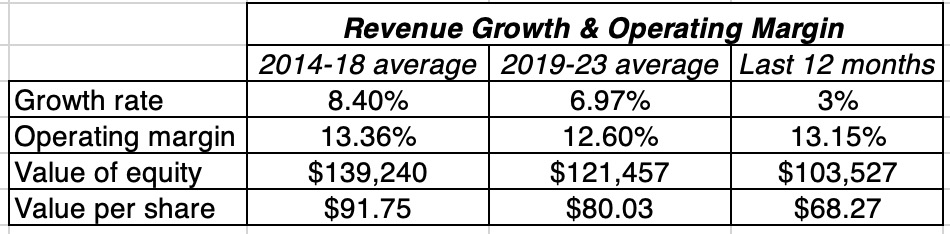
    I valued Nike, using its compounded annual growth rate and average operating margin over three period - 2014-2108, 2019-2023 and just the last twelve months:
Nike valuation
You can see why Nike acted swiftly to change its CEO, since its value will dip substantially, if its growth stays down and margins do not bounce back. At the $71 stock price that the stock was trading at, just six weeks ago, the investing odds would have been in your favor, but the bounce back in the stock price to $88, after the new CEO hire, suggests that the market is pricing in the expectation that the company will bounce back to higher growth and better margins.

Brand Name Creation

    Brand name does add value, if it gives the company that owns it pricing power, but how does a company end up with a valuable brand name? There are facile answers and they include longevity, with long-lived companies having more recognizable brand names, and advertising, where more spending is assumed to result in a more valuable brand name. To see why I attach the "facile" prefix to these answers, consider again the example of AT&T, a company that has been around for more than a century and remains one of the ten largest spenders on advertising in the United States. None of that spending has translated into a significant brand name value, thought there may other benefits that the company accrues. 

   I am sure that someone who immerses themselves in in this topic, perhaps in marketing and advertising, may be able to provide a deeper answer, but here is what I see as ingredients that go into developing a valuable brand name:

  1. Attachment to an emotional factor/need: As marketing has recognized through the ages, the key to a powerful brand name is a tie to a human emotion. Rational or not, consumers may reach for a branded product, because they associate the product with freedom, reliability, happiness, patriotism or aspiration, if that association exists in their minds. The challenge, of course, is to find an emotion that attaches well to your product, either because of its history or its make-up, but the association, once made, can be powerful and long-lasting.
  2. Celebrity connection: Earlier, we talked about personal brand names, and argued that Nike benefited from its association with Michael Jordan, in building its brand name. In fact, Apple (in its streaming service) and Major League Soccer benefited mightily from Lionel Messi playing Inter Miami, with the former adding hundreds of thousands of subscribers to it soccer streaming service, and the latter increasing attendance in stadiums around the country. Here again, there are perils, since attaching a brand name to a person also exposes the company to the failings and foibles of that person, as Nike found out in its associations with both Tiger Woods and Colin Kaepernick.
  3. Fortuitous events/ choices: There is a third factor that is not covered in most brand name management classes, and for good reason, and that is the effect of luck. In an alternate universe, Phil Knight might have stayed with Dimension Six, his initial choice for the company name, picked a different symbol than the swoosh (for which Nike paid $35 to the designer) and even a different slogan ( than the "Just do it" picked by the advertising team), and the end result could have been very different.
  4. Advertising: While there may be little or no link between overall advertising spending and brand name, it is undeniable that there are ads that catch people's attention and alter perceptions of a product. I was an Apple user already in 1984, when it ran its famous 1984 ad during the Super Bowl, setting itself apart from the PC makers, and while that ad yielded little monetary benefit to Apple in the immediate aftermath, it contributed to creating the brand name that now allows the company to charge $1600 for a new smart phone. Nike has had its share of iconic commercials, and I still remember this Nike ad, with Michael Jordan, from 1997, showing how long the shelf life can be for a great ad.

If asked to advice a company that was intent on creating a brand name, my suggestion would be to start with a product or service that is differentiated from the competition, and to give the brand name time to build around that differentiation. That may require sacrifices on scaling up (accepting less growth to preserve the product differential), a higher cost structure (if it is a quality difference) and perhaps even more reinvestment, but trade offs are inherent to almost everything of value in business. If the expected costs of building a brand name exceed its benefits, though, it may be worth asking whether brand name is the competitive advantage that the company should be aspiring for, since there are other competitive advantages that can add as much or much more value in the business the company operates in.

Brand Name Destruction

    The benefit of building a strong brand name is that it remains one of the most sustainable competitive advantages in business, with the advantages often lasting decades. However, even brand names eventually lose their luster, but the reasons they do so vary:

  1. Aging brand/consumer base: In my posts and book on corporate life cycle, I talk about how and why companies age, and how aging is inevitable. The same can be said of brand names, since even the most highly regarded brand names eventually age, and no matter how much managers try to resurrect them, they never recover their mojo. When valuing Kraft Heinz in 2015, when the most venerable name in value investing (Warren Buffett) teamed up with one of the shrewdest players in private equity (3G Capital) to buy the company because it was under valued, I wondered whether the reason the market was turning down on the company was because the portion of the population that were drawn to the company's products (fifty seven types of ketchup, all of which taste bad, and cheese that stays liquid through a nuclear winter) to be tasty was getting smaller and older. In hindsight, it is clear that Kraft Heinz will not reclaim its former glory, because its products and customer base have aged.
  2. Benign neglect: Brand names may provide sustainable competitive advantages, but only if they are cared for and maintained. There are legendary brand names that have been neglected, treated as cash cows with no new investment or sprucing up needed, and have faded in value. Quaker Oats, a longstanding mainstay of the US cereal business, not only allowed itself to pushed to the sidelines by aggressive cereal companies, but failed to take advantage of the rise in demand for oatmeal as a heart-healthy substitute. 
  3. Cultural changes: There are products and services that have lost their allure over time, because the cultural mores or social norms of the consumers have changed. If you binge watch Mad Men, the television series about advertising in the 1960s, you should not be surprised to see ads for products and services that you would now view in a very different light. 
  4. Changing tastes: There are some businesses, where the demand for products is transient and fad-driven, and new brands replace old ones, as tastes shift. This has generally been the case with  apparel retail in the United States, with the Gap's reign at the top lasting about a decade, with newer and cooler retail brands like Abercrombie and Fitch and Tommy Hilfiger replacing them, and then were themselves being displaced by H&M and Uniqlo. 
  5. Toxic connections: A brand name that is built up over time can sometimes very quickly fall back to earth, if the company or its personnel bring toxic connections. Abercrombie and Fitch, for instance, which became a hot destination for the young in the first decade of this century, found its brand name devastated by accusations of racism and sexism in its ranks. 
  6. Brand overreach: There are cases where a company with a valuable brand name may dilute or even destroy that brand name by overreaching, and putting it on products that cut agains the brand name narrative. A good argument can be made that Disney, usually masterful at managing its brands, diluted the value of both its Avengers and Star Wars franchises by rushing headlong into the streaming business, with new series.
While all of these forces can cause a once valuable brand name to lose its value, it is worth noting that there are companies that have redeemed brand name value, sometimes by remaking the product or service, sometimes by repackaging it and sometimes by repositioning it. Crocs, whose brand name soared in the 2000s, but crashed by the end of the decade, repackaged itself around celebrity endorsements to become a successful brand again. Lego, a venerable brand name in the toy business, sold off its theme parks, and refocused attention on its core product, while redirecting its offerings to adults. In general, though, reincarnating a brand becomes easier for niche brands than for mass market ones, for product brands than for company brands, and for younger brands than for older ones.
    I believe that 2023 was a wake up call for Nike, as it awoke multiple disruptions. First, in the post-COVID years, Nike moved from store sales to digital sales, with Nike Digital, accounting for almost 43% of revenues in 2022. While that shift does reflect a change in consumer preferences towards shopping online, there is a question of whether bypassing shoe stores, which over the decades have contributed to the Nike brand, by highlighting their most iconic shoes, has undercut the brand. Second, while the footwear business has been more resistant to fads than the apparel business, Nike;'s mass market strategy of being all things to all people is exposing it to disruption. The company is losing market share, especially among younger customers, to newcomers in the space like On and Hoka, and among runners (Nike's original core market) to older companies like New Balance that have rediscovered their mojo. Third, in an age where celebrities come with problems, and politics divides us on even the most trivial of issues, Nike's celebrity-driven advertising campaigns may hurt more than help the company. In short, Nike's new CEO has his work cut out for him!

YouTube Video


Links


Wednesday, February 27, 2019

The Perils of Investing Idol Worship: The Kraft Heinz Lessons!

On February 22, Kraft Heinz shocked investors with a trifecta of bad news in its earnings report: sub-par operating results, a mention of accounting irregularities and a massive impairment of goodwill, and followed up by cutting dividends per share almost 40%. Investors in the company reacted by selling their shares, causing the stock price to drop more than 25% overnight. While Kraft is neither the first, nor will it be the last company, to have a bad quarter, its travails are noteworthy for a simple reason. Significant portions of the stock were held by Berkshire Hathaway (26.7%) and 3G Capital (29%), a Brazil-based private equity group. Berkshire Hathaway’s lead oracle is Warren Buffett, venerated by some who track his every utterance, and try to imitate his actions. 3G Capital might not have Buffett’s name recognition, but its lead players are viewed as ruthlessly efficient managers, capable of delivering large cost cuts. In fact, their initial joint deal to bring together Heinz and Kraft, two of the biggest names in the food business, was viewed as a master stroke, and given the pedigree of the two investors, guaranteed to succeed. As the promised benefits have failed to materialize, the investors who followed them into the deal seem to view their failure as a betrayal.

The Back Story
You don’t have to like ketchup or processed cheese to know that Kraft and Heinz are part of American culinary history. Heinz, the older of the two companies, traces its history back to 1869, when Henry Heinz started packing and selling horseradish, and after a brief bout of bankruptcy, turned to making 57 varieties of ketchup. After a century of growth and profitability, the company hit a rough patch in the 1990s, and was targeted by activist investor, Nelson Peltz, in 2013. Shortly thereafter, Heinz was acquired by Berkshire Hathaway and 3G Capital for $23 billion, becoming a private company. Kraft started life as a cheese company in 1903, and over the next century, it expanded first into other dairy products, and then widened its repertoire to includes other processed foods. In 1981, it merged with Dart Industries, maker of Duracell batteries and Tupperware, before it was acquired by Philip Morris in 1988. After a series of convulsions, where parts of it were sold and rest merged with Nabisco, Kraft was spun off by Philip Morris (renamed Altria), and targeted by Nelson Peltz (yes, the same gentleman) in 2008. Through all the mergers, divestitures and spin offs, managers made promises of synergy and new beginnings, deal makers made money, but little of substance actually changed in the products.

In 2015, the two companies were brought together, with Berkshire Hathaway and 3G playing both match makers and deal funders, as Kraft Heinz, and the merger was completed in July 2015. At the time of the deal, there was unbridled enthusiasm on the part of investors and market observers, and part of the unquestioning acceptance that the new company would become a force in the global food business was the pedigree of the main investors. In the years since the merger, though, the company has had trouble delivering on expectations of revenue growth and cost cutting:

The bottom line is that while much was promised in terms of revenue growth, from expanding its global footprint, and increased margins, from cost cutting, at the time of the deal, the numbers tell a different story. In fact, if investors were surprised by the low growth and declining margins in the most recent earnings report, they should not have been, since this has been a long, slow bleed.

The Earnings Report
The earnings report that triggered the stock price collapse, for Kraft-Heinz, was released on February 22, and it contained bad news on many fronts:
  1. Flatlining Operations: Revenues for 2018 were unchanged from revenues in 2017, but operating income dipped (before impairment charges) from $6.2 billion in 2017 to $5.8 billion in 2018; the operating margin dropped from 23.5% in 2017 to 22% in 2018.
  2. Accounting Irregularities: In a surprise, the company also announced that it was under SEC investigation for accounting irregularities in its procurement area, and took a charge of $25 million to reflect expected adjustments to its costs.
  3. Goodwill Impairment: The company took a charge of $15.4 billion for impairment of goodwill, primarily on their US Refrigerated and Canadian Retail segments, an admission that they paid too much for acquisitions in prior years.
  4. Dividend Cuts: The company, a perennial big-dividend payer, cut its dividend per share from $2.50 to $1.60, to prepare itself for what it said would be a difficult 2019.
While investors were shocked, the crumb trail leading up to this report contained key clues. Revenues had already flattened out in 2017, relative to 2016, and the decline in margins reflected difficulties that 3G faced in trying to cut costs, after the deal was made. The only people who care about impairment charges, a pointless and delayed admission of overpayment on acquisitions, are those who use book value of equity as a proxy for overall value. The dividend cuts were perhaps a surprise, but more in what they say about how panicked management must be about future operations, since a company this attached to dividends cuts them only as a last resort.

The Value Effects
With the bad news in the earnings report still fresh, let’s consider the implications for the story for, and the value of, Kraft Heinz. The flat revenues and the declining margins, as I see them, are part of a long term trend that will be difficult, if not impossible, to reverse. While Kraft-Heinz may have a quarter or two with positive blips, I see more of the same going forward. In my valuation, I have forecast a revenue growth of 1% a year in perpetuity, less than the inflation rate, reflecting the headwinds the company faces. That downbeat revenue growth story will be accompanied by a matching “bad news” story on operating margins, where the company will face pricing pressures in its product markets, leading to a drop (though a small and gradual one) in operating margins over time, from 22% in 2018 (already down from 2017) to 20% over the next five years. The company’s cost of capital is currently 6%, reflecting the nature of its products and its use of debt, but over time, the benefits from the latter will wear thin, and since that is close to the average for the industry (US food processing companies have an average cost of capital of 6.12%), I will leave it unchanged. Finally, the mistakes of the past few years will leave at least one positive residue in the form of restructuring charges, that I assume will provide partial shelter from taxes, at least for the next two years.
Spreadsheet with valuation
The good news is that, even with a stilted story, Kraft Heinz has a value ($34.88) that is close to the stock price ($34.23). The bad news is that the potential upside looks limited, as you can see in the results of a simulation that I did, allowing expected revenue growth, operating margin and cost of capital to be drawn from distributions, rather than using point estimates.
Simulation Results
The finding the value falls within a tight range, with the first decile at about $26 and the ninth at close to $47 should not surprise you, since the ranges on the inputs are also not wide. As an investor, here are the actions that would follow this valuation. 
  • If you owned Kraft Heinz prior to the earnings report (and I thankfully did not), selling now will accomplish little. The damage has been done already, and the stock as priced now, is a fair value investment. I know that 3G sold almost one quarter of its holding in September 2018, good timing given the earnings report, but any attempts to sell now will gain them nothing. (I made a mistake in an earlier version of the post, and I thank those of you who pointed it out.)
  • If you don’t own Kraft Heinz, the valuation suggests that the stock is fairly valued, at today’s price, but at a lower price, it would be a good investment. I have a limit buy on the stock at a $30 price (close the 25th percentile of the distribution), and if it does hit that price, I will be a Kraft Heinz stockholder, notwithstanding the fact that I think its future does not hold promise. If it does not drop that low, there are other fish to catch and I will move on.
There are two concerns, though, that investors looking at this stock have to consider. The first is that when companies claim that they have discovered accounting irregularities, but that they have cleaned up their acts, they are often dissembling and that there are more shocks to come. With Kraft Heinz, the magnitude of the irregularity is small, and given that they have no history of playing accounting games, I am willing to given them the benefit of the doubt. The second is that the company does carry $32 billion in debt, and while that debt has no toxic side effects today, that is because the company is perceived to have stable and positive cash flows. If the margin decline that I forecast becomes a margin rout, the debt will expose the company to a clear and present danger of default. Put simply, it will make the bad case scenarios that are embedded in the simulation worse, and perhaps threaten the company’s existence. 

The Lessons
There are lessons in the Kraft-Heinz blow-up, but I will tread carefully, since I risk offending some, with talk that you may view as not just incorrect but sacrilegious:
  1. It is human to err: At the risk of stating the obvious, Warren Buffett and 3G’s key operators are human, and are prone to not only making mistakes, like the rest of us, but also to have blind spots in investing that hurt them. In fact, Buffett has been open about his mistakes, and how much they have cost him and Berkshire Hathaway shareholders. He has also been candid about his blind spots, which include an unwillingness to invest in businesses that he does not understand, a sphere that only grows as he gets older and the economy changes, and an excessive trust in the managers of the companies that he invests in. While he is, for the most part, an excellent judge of character, his investments in Wells Fargo, Coca Cola and Kraft-Heinz show that he is not perfect. The fault, in my view, is not with Buffett, but with the legions of investors, analysts and journalists who treat him as an investment deity, quoting his words as gospel and tarring and feathering anyone who dares to question them. 
  2. Stocks are not bonds: In my data posts, I looked at how companies in the United States have moved away from dividends to buybacks, as a way of returning cash. That trend, though, has not been universally welcomed by investors, and there remains a significant subset of investors, with strategies built around buying stocks with big dividends. One reason that stocks like Kraft  Heinz become attractive to conservative value investors is because they offer high dividend yields, often much higher than what you could earn investing in treasury or even safe corporate bonds. In effect, the rationale that investors use is that by buying these shares, they are in effect getting a bond (with the dividends replacing coupons), with price appreciation. From the Dogs of the Dow to screening based upon dividend yields, the underlying premise is that investors can count more on dividends than on buybacks. While it is true that dividends are stickier than buybacks, with many companies maintaining or increasing dividends over time, these dividend-based strategies become delusional when they treat dividends as obligated payments, rather than expected ones. After all, much as companies do not like to cut dividends, they are not contractually obligated to pay dividends. In fact, when a stock carries a dividend yield that looks too good to be true, it is usually almost always an unsustainable dividends, and it is only a question of time before dividends are cut (or even stopped) or the company drives itself into a financial ditch. 
  3. Brand Names last a long time, but nothing lasts forever: A major lodestone of conventional value investing is that while technology, cost efficiencies and new products are all competitive advantages that can generate value, it is brand name that is the moat that has the most staying power. Again, that statement reflects a truth, which is that brand names last long, often stretching over decades, but even brand name benefits fade, as customers change and companies seek to become global. The troubles at Kraft-Heinz are part of a much bigger story, where some of the most recognized and valued brand names of the twentieth century, from Coca Cola to McDonalds, are finding that their magic fading. Using my life cycle terminology, these companies are aging and no amount of financial engineering or strategic repositioning is going to make them young again. 
  4. Cost cutting can take you far, but no further: For the last few decades, we have cut a great deal of slack for those who use cost cutting as their pathway for creating value, with many leveraged buyouts and restructurings built almost entirely on its promise. Don’t get me wrong! In firms with significant cost inefficiencies and bloat, cost cutting can deliver significant gains in profits, but even with these firms, those gains will be time limited, since there is only so much fat to cut out. Worse, there are firms that find themselves in trouble for a myriad of reasons that have little to do with cost inefficiencies and cutting costs as these firms is a recipe for disaster. It is true that 3G did a masterful job, cutting costs and increasing margins at Mexico's Grupo Modelo, the Mexican brewer that they acquired through Inbev, but that was because Modelo’s problems lent themselves to a cost-cutting solution. It may even have worked at Kraft-Heinz initially, but at this point, the company’s problems may have little to do with cost inefficiencies, and much to do with a stable of products that is less appealing to customers than it used to be, and cost cutting is the wrong medicine for whatever ails them.
Conclusion
I hope that you do not read this as a hit piece on Warren Buffett and/or 3G. I admire Buffett’s adherence to a core philosophy and his willingness to be open about his mistakes, but I think he is ill served by some of his devotees, who insist on putting him on a pedestal and refuse to accept the reality that his philosophy has its limits, and that like the rest of us, he has an ego and makes mistakes. If you have faith in value investing, you should be willing to have that faith tested by the mistakes that you and the people you admire make in its pursuit. If your investment views are dogma, and you believe that your path is only the correct one to success, I wish you the best, but your righteousness and rigidity will only set you up for more disappointments like Kraft Heinz.

YouTube Video

Data

Thursday, October 15, 2015

The Ferrari IPO: A Price Premium for the Prancing Horse?

I live in a prosperous suburb, sustained largely by financial service businesses, but as far I know, there is only one Ferrari in my town. Much of the week, the car sits in a garage which has its own security system, more secure than the one protecting its owner's house, and on a nice weekend, you see the owner drive it around town. It is a remarkably inefficient transportation mode, too fast for suburban roads, too expensive to be parked at a grocery story or pharmacy, and too cramped for car pool. All of this comes to mind, for two reasons. The first is the imminent initial public offering of the company, with all the pomp and circumstance that surrounds a high-profile offering. The second is that this offering has set in motion the usual talk of brand names and the price premiums that we should pay to partake for investing in them.

Ferrari: A Short History and Background
The Ferrari story started with Enzo Ferrari, a racing car enthusiast, starting Scuderia Ferrari in 1929, to assist and sponsor race car drivers driving Alfa Romeos. While Enzo manufactured his first racing car (Tipo 815) in 1940,  Ferrari as a car making company was founded in 1947, with its manufacturing facilities in Maranello in Italy. For much of its early existence, it was privately owned by the Ferrari family, though it is said that Enzo viewed it primarily as a racing car company that happened to sell cars to the public. In the mid-1960s, in financial trouble, Enzo Ferrari sold a 50% stake in the company to Fiat.  That holding was subsequently increased to 90% in 1988 (with the Ferrari family retaining the remaining 10%). Since then, the company has been a small, albeit a very profitable, piece of Fiat (and FCA).

The company acquired its legendary status on the race tracks, and holds the record for most wins  (221) in Formula 1 races in history. Reflecting this history, Ferrari still generates revenues from Formula 1 racing, with its share amounting to $67 million in 2014. Much as this may pain car enthusiasts everywhere, some of Ferrari's standing comes from its connection to celebrities. From Thor Batista to Justin Bieber to Kylie Jenner, the Ferrari has been an instrument of misbehavior for wealthy celebrities all over the world.

The Auto Business
In earlier posts, where I valued Tesla, GM and Volkswagen, I argued that the auto business bore the characteristics of a bad business, where companies collectively earn less than their cost of capital and most companies destroy value. In fact, I used the words of Sergio Marchionne, CEO of Fiat Chrysler (and the parent company to Ferrari) to make the case that the top managers at auto companies were delusional in their belief that the business would magically turn around. Looking at the business broadly, here are three characteristics that reveal themselves:

1. It is a low growth business: The auto business is a cyclical one, with ups and downs that reflect economic cycles, but even allowing for this cyclicality, the business is a mature one. That is reflected in the growth rate in revenues at auto companies.

YearRevenues ($)% Growth Rate
20051,274,716.6
20061,421,804.2 11.54%
20071,854,576.4 30.44%
20081,818,533.0 -1.94%
20091,572,890.1 -13.51%
20101,816,269.4 15.47%
20111,962,630.4 8.06%
20122,110,572.2 7.54%
20132,158,603.0 2.28%
20142,086,124.8 -3.36%
During this period, the emerging market economies in Asia and Latin America provided a significant boost to sales, but even with that boost, the compounded annual growth rate in aggregate revenues at auto companies between 2005 and 2014 was only 5.63%.

2. With poor profit margins: A key point that Mr. Marchionne made about the auto business is that operating margins of companies in this business were much too slim, given their cost structures. To illustrate this point (and to set up my valuation of Ferrari), I computed the pre-tax operating margins of all auto companies globally, with market capitalizations exceeding $1 billion, and the graph below summarizes my findings.

Source: S&P Capital IQ
3. And high reinvestment needs: The auto business has always required significant investments in plant and equipment, but in recent years, the advent of technology has also pushed up R&D spending at auto companies. One measure of the drag this puts on cash flows is to look at net capital expenditures (capital expenditures in excess of depreciation) and R&D, as a percent of sales, for the entire sector:

It is this combination of anemic revenue growth, slim margins and increasing reinvestment that is squeezing the value out of the auto business. (You can download the data for all auto companies, with profitability measures and pricing ratios by clicking here.)

The Super Luxury Automobile Business
If, as has been said before, the only difference between the rich and the rest of us is that the rich have more money, the difference between the rich and the super rich is that super rich have so much money that they have stopped counting. The super luxury car manufacturers (Ferrari, Aston Martin, Lamborghini, Bugatti etc.), with prices in the nose bleed segment, cater to the super rich, and have seen sales grow faster than the rest of the auto industry. Much of the additional growth coming from newly minted rich people in emerging markets, in general, and China, in particular. Like the rest of the companies in the super luxury segment, Ferrari is less auto company and more status symbol, and draws its allure from four key characteristics:
  1. Styling: I am not a car lover, but even I can recognize that a Ferrari is a work of art. That is not accidental, since the company spends substantial amounts on styling and the little details that go into every Ferrari.
  2. Speed: There is no absolutely no chance that you will test the upper limits of the car's engine capacity, but you could get from LA to San Francisco in about 3 hours, if you could maintain the car at its top speed (I am not recommending this). So, if you grew up with dreams of being a Formula 1 driver, and now have the money to fulfill them, a Ferrari is probably as close as you are going to get to these dreams.
  3. Story: The car comes with a story that draws as much from its celebrity connections as it does from  its speed exploits. 
  4. Scarcity: Notwithstanding the first three points, it would be just another luxury car if everyone had one. So, it has to be kept scarce to command the prices that it does, both as a new car and in its used versions.
To illustrate how exclusive the Ferrari club is, in all of 2014, the company sold only 7255 cars, a number that has barely budged over the last five years. (The Lamborghini club is even more exclusive, with only 2000 cars sold annually.)  The company has its roots in Italy but is dependent on a super- rich clientele globally for its sales:

Note that a significant slice of the revenue pie comes the Middle East and that Ferrari, like many other global companies, is becoming increasingly dependent on China for growth.

Valuing Ferrari
As many of you reading this blog are aware, I am a believer that all valuations start with stories and that different stories can yield different valuations. With Ferrari, there are two plausible stories that you can offer for the future of the company, with valuations to back them up:

1.The Status Quo (Super Exclusive, Low Production, High Margin)
The story: Ferrari remains a extra-exclusive automobile company, keeping production low and prices high. The benefits of this strategy are high operating margins (Ferrari has among the highest in the auto business) partly because of the high prices, and partly because the company does not have to spend much on expensive ad campaigns or selling. It also will keep reinvestment needs to a minimum, since capacity expansion will not be necessary, though the company will continue spending on R&D to preserve its edge (on speed and styling). In addition, by focusing on a very small group of super rich people around the world, Ferrari may be less affected by macroeconomic forces than other luxury auto companies.
The inputs: The inputs into my valuation reflect the story, with low revenue growth, high margins and low reinvestment driving value:

The valuation: With these assumptions, the value for equity of 6,310 million Euros (approximately $7 billion). You can download the spreadsheet here.

2. Rev it Up (Increase production, Introduce a lower-priced model)
The story: Ferrari tries to broaden its customer base, perhaps by introducing a lower-priced version; this would mirror what Maserati did with its Ghibli model. That will allow for higher revenue growth but like Maserati, Ferrari will have to yield some of its operating margin, since this strategy will require lower prices and higher selling costs. Seeking a larger market will also expose it to more market risk, pushing its cost of capital in high growth to 8.5% and its cost of capital beyond to 7.5%.
The inputs: This strategy will generate higher sales (doubling number of units sold in next ten years) but at the expense of lower margins (from lower prices and higher selling costs) and higher risk (as the clientele will be more sensitive to economic conditions).

The valuation: With this strategy, the value for equity of 6,042 million Euros (approximately $6.75 billion). You can download the spreadsheet here.

At least based on my estimates, it is more sensible for Ferrari to stick with its low-growth, high price strategy and keep itself above the fray of the auto business, a bad business where most companies seem to have a tough time earning their cost of capital.

The Brand Name Premium
There is a lot of casual talk about how Ferrari will command a premium because of its name and some have suggested that you should add that premium on to estimated value. In an intrinsic valuation, it is double counting to add a premium and the reason is simple. The values that I have estimated already incorporate the premium. If you are wondering how, take a look at the operating margin of 18.20% that I have used for Ferrari, a number vastly in excess of the margins earned by other auto companies. That high margin, in conjunction with limited growth in cars sold, also allows Ferrari to earn a return on capital of 14.56%, well above its cost of capital. These inputs yield a value premium, with the magnitude varying across multiples:

Ferrari (my estimated value)Auto SectorReason for difference
EV/Sales2.100.94Ferrari's operating margin is 18.2% versus Industry average of 6.58%.
EV/Invested Capital1.971.02Ferrari earns a much higher return on capital (14.56%) than the sector (6.68%)
EV/EBITDA12.579.05Ferrari EBITDA/Invested capital is 15.68% versus Industry average of 14.45%.
PE22.8710.00Ferrari has a debt ratio of 9.43% versus Industry average of 39.06%.
PBV2.561.29Ferrari has a slightly higher ROE and lower equity risk (because of less debt)

Thus, the intrinsic value estimates already are building in a hefty premium for the effects that Ferrari's brand name has on its operating margins and return on capital.

Is it possible that the brand name can be utilized better? That is always possible but there is nothing to indicate that the brand is being mismanaged or that it can be easily exploited to generate additional value. In fact, the consolidation of voting power in the hands of the existing owners suggests that there the firm will remain largely unchanged after the IPO.

IPO Related Issues
An initial public offering does create a host of issues that can affect valuation, sometimes tangentially and sometimes directly. In the case of Ferrari, the three issues that merit the most attention are whether the proceeds from the offering will affect value, what the value per share will be, and how the augmentation of voting rights for the existing stockholders will play out.
  1. Use of proceeds: The proceeds from an IPO can have a feedback effect on value, but only if the IPO proceeds are kept in the firm to cover current or future investment needs. In this IPO, the billion dollars expected to be raised from the offering will go to Fiat for cashing out some of its ownership stake, and thus not benefit Ferrari stockholders. There is therefore no need to add these proceeds back to the cash balance (as I would have, if the IPO proceeds had been retained by the firm).
  2. Number of shares/IPO price per share: Note that in both my valuations, I have focused on the value of equity, rather than a per share value, for two reasons. The first is that the number of shares is still in flux (notice all the empty spaces in the prospectus). The second is that the per share value will be a function of the number of shares created in the company. Thus, if the value of equity is 6.3 billion Euros, Ferrari can create 100 million shares at 63 Euros per share or 2 billion shares at 3.15 Euros per share, with the same end result. The number of units and offering price will be set jointly, because setting one will also determine the other. The talk of the town is that the company will be valued at 50 Euros per share and the value of equity will be 10 billion Euros. At least based on those rumors, it seems like the Ferrari will create 200 million shares, and if that is the correct number, the value per share that I arrive at is about 31.5 Euros per share (based on my 6.3 billion Euro status quo value).
  3. Control: After the IPO, Ferrari will become an independent firm but control will still remain concentrated in the hands of its current owners, Fiat and the Ferrari family. In fact, the existing owners will get twice the voting rights on their shares, relative to the those who buy shares in the IPO, for their loyalty. The two big owners, Exor (the investment fund for the Agnelli family) and the Ferrari family will control 49% (Update: I erroneously stated the they would control 51% of the voting rights, but with the rest of the holdings dispersed, that is effectively majority control) of the voting rights with about 33% of the shares. The shares that you and I will have a chance to buy at the IPO will be the low-voting right shares, I guess because we are disloyal investors. I don't see much of a discount on these shares since even without the additional voting rights, it is unlikely that anyone can force the company to change its operations, if that change is against the wishes of the Agnelli/Ferrari clan.
Conclusion
It will be interesting to see this game play out, as the offering gets closer. There is a push to attach a valuation of 11 billion Euros for the Ferrari shares, both because it will get more cash for Fiat from the offering, and more importantly, because the increased value of its remaining holdings in Ferrari will then feed into Fiat's market capitalization. The push may succeed because investors seem eager to buy these shares, at least according to this story, and the price premium will be justified with the argument that Ferrari is a premium brand that caters to the rich. Off to the races!

YouTube Video


Data Attachments
  1. Ferrari Prospectus
Spreadsheets 
  1. Auto Industry: Company Data
  2. Ferrari Valuation (Status Quo)
  3. Ferrari Valuation (Rev it up)
  4. Google Shared Spreadsheet: Ferrari Valuations