Showing posts with label CEO. Show all posts

Wednesday, May 6, 2026

An Ode to Restraint: Lessons from the Tim Cook Legacy

    Through time, we have glorified conquerors and empire builders in politics, civic life and business, from Alexander the Great and Genghis Khan to the tech titans of today. That is no surprise, since these individuals have oversized personas and often change the course of history, but it is also true that this glorification of empire building has shortcomings. The first is the deification of these heroes comes with whitewashing of the dark sides and the costs of empire building. The second is that we discount and undervalue those who make contributions to societal or business advances, but do so quietly and with little fanfare. It is in this context that I was drawn to the story of Tim Cook stepping down as Apple CEO, after a tenure of fifteen years atop a company that has been among the top market cap companies in the world for much of that period. While Steve Jobs, his predecessor as CEO at Apple, has now been deified in business circles, as an unparalleled visionary and business builder, and deservedly so, I think that Tim Cook, in many ways, has played just as significant a role in molding the company into its current day standing, with far less recognition.

Apple's CEOs: From Scott to Jobs to Cook!

    Unfair though this may seem, the Tim Cook story at Apple has to start with Steve Jobs. Jobs co-founded the company in 1976, with Steve Wozniak, and while the company went through a series of CEOs in the next two decades, Jobs was the face of the company in its early years. While it is easy, with the benefit of hindsight, to view these as good years for the company, those early years reflected both Job's strengths and weaknesses. His vision and force of personality gave rise to the personal computer in its current form, as a tool for everyone to use, not just tech geeks, and as someone who bought his first Mac (the 128K without a hard drive) in 1984, and has stayed a Mac user since, I am grateful. That said, the dark side of Jobs, manifested in impatience with underlings and an obstinate belief that he knew what customers needed better than they did, led to the Lisa, the only Mac I regretted buying almost immediately after my purchase, and a loss of business markets to Microsoft. Those failures led Apple to the brink of failure, and to Jobs being cast out of the company by its board in 1985, though the CEOs that followed had neither the strategic vision nor the business-building capacity to rescue the company.

    In 1997, Apple looked like it was a company heading into oblivion, as Windows became the dominant operating system for personal computers, and it seemed like Apple had lost its purpose. The August 1997 return of Steve Jobs,, who had used his years in the wilderness to build Pixar, a company that revolutionized animated movie making, is now the stuff of legend, as he rebuilt Apple in the ensuing years into a powerhouse, around the iPod, the iPad and most of all the iPhone. While there are books and movies chronicling the Steve Jobs success story, it is worth asking what the difference was between the first iteration of Steve Jobs at Apple (from founding to leaving in 1985), where Apple lost ground to Microsoft, and the second iteration of Steve Jobs (from his return in late 1997 until his resignation in 2011). The first was that he was older, and to the extent that with age comes some wisdom, it helped, but it is unlikely to have been the change maker. The second was that in his period away from Apple, Jobs created and built up other companies, with Pixar being the biggest, where he learned to deal with people better and perhaps compromise a bit more than he used to. The third was that he benefited from the presence of Tim Cook, first as an executive in Apple sales and operations, and more importantly, as chief operating officer (COO) for Apple, starting in 2005. If Steve's skill was vision, where he showcased Apple's next "big innovation" at meetings in his trademark black turtleneck, Cook's skill was building manufacturing hubs and supply chains to convert the vision to products. That separation of vision from business building created the Apple juggernaut in the first decade of this century. While that division of labor clearly was in the company's best interests, Jobs deserves credit for being willing to set his ego aside and delegate the powers to make it happen.

    Tim Cook has been CEO for fifteen years, and when he retires on September 1, 2026, he will have been the longest serving CEO at Apple. It cannot have been easy, especially in the early years, as the comparisons to Steve Jobs were front and center, and there was pressure on him to continue in the same path. To Cook's credit, he never tried to be Jobs, and he created a very different template for himself, one that fit him and the company well, and served as a testimonial to his self assurance. In one of my talks about a decade ago about Apple, I described Cook, perhaps harshly, as a man without a visionary bone in his body, but one who would make sure that the trains ran on time (or the iPhones were delivered as promised), and I think that he has used that strength to good effect during his years as CEO of the company.

Apple's Finances in the Twenty First Century: The Steve Jobs and Tim Cook Years!

    Steve Jobs handed over a company to Tim Cook in 2011, that was extraordinarily profitable, and at the time of his leaving, already the largest market cap company in the world. While that fact leads some to discount what Cook has done at Apple since, I think it is worth going back in history and looking at corporate handoffs of great companies, and how often they become tangled messes, as new CEOs overreach and overpromise. 

    The place to begin our comparison of the Jobs and Cook tenures is by charting Apple's market capitalization, with the delineation into the Jobs years (1998-2011) and the Cook years (2012-2026):

Looking across the aggregated years across both CEOs, it has been an extraordinary time. Apple began the Jobs tenure as CEO with a market cap of $1.68 billion, and by the end of 2025, its market cap had risen to over $4 trillion, and its performance burnishes the reputations of both Jobs and Cook. Jobs provided the foundational boost for the company and the innovations he presided over delivered a compounded annual price appreciation of 47.19% between 1997 and 2011, a period when US equities were struggling and Apple reached the top of the market cap table in 2011. With Tim Cook at the helm, Apple added an astounding $3.64 trillion in market cap, but a strong equity market provided strong tailwinds, and the company's annual returns were more modest.  On a percentage return basis, the Jobs years were better, but in my view, the fact that the annual returns in the Cook years were just as impressive, because they had to be earned on a much larger firm. 

    The reasons for Apple's sustained increase in market capitalization were simple - solid revenue growth and a profit machine that delivered high margins, even as the company scaled up:

As with the market capitalization comparisons, this chart yields metrics that are favorable to both Jobs and Cook. Under Jobs, the company scaled up its revenues significantly, with a compounded annual revenue growth rate of 23.67% between 1997 and 2011, and just as significantly, went from posting subpar margins and a net loss in 1997 to becoming one of the most profitable tech companies in the world, Under Cook, revenue growth rates came down (to a compounded annual average of 8.52% between 2012 and 2025), but on a much larger scale, and the company preserved and grew its profit margins.

    There was one corporate finance dimension on which Cook deviated from Jobs, and that was on cash return or dividend policy. In the chart below, I look at the cash returned to shareholders by Apple during the tenures of the two CEOs:


During Job's tenure at Apple, the company paid no dividends and initiated only modest cash buybacks, mostly to cover stock-based compensations. With Tim Cook as CEO, Apple was one of the greatest corporate cash success stories of all time, initiating dividends in 2012 and increasing them over time, and supplementing those dividends with cash buybacks that, in the aggregate, were the largest in corporate history. In sum, the company has bought back almost $800 billion between 2012 and 2025, and the most astonishing feature was that, while returning all of this cash, the company also accumulated one of the largest corporate cash balances in history.

    To the question of how Apple was able to return this much cash, increase its cash balance and still grow itself, the answers are three fold. The first is that the iPhone, perhaps the most valuable single product in business history, continued to deliver for the company, with modest reinvestment needed on its upgrades. 


While much of the credit for the iPhone is still given to Steve Jobs, and rightly so for fostering the innovation, credit is also due to Cook, who has taken the franchise handed to him, and grown it on steroids. The second is that the company borrowed $17 billion in 2013, a Cook departure from a Jobs practice of avoiding debt, and it has added to that debt load over time, though it remains a small slice of overall value:

While much is made of Apple's debt foray, it is worth recognizing that Apple is still a very lightly indebted company on any debt metric, and that if you net the company's considerable cash balance out against its total debt, its net debt has always been negative (cash exceeds debt). In fact, Apple's use of debt is so light that the only rationale for its existence is creating a presence in the bond market, just in case it needs to use it more in the future. The third feature is that the company has been cautious in its forays into new products and markets, especially outside its domain, and this shows  up in two data series.

  • The first is that while Apple has acquired more than a hundred companies, almost all of them are small, private technology companies with small price tags, with the intent being bringing their products and services into the Apple ecosystem after the acquisition. In fact, its largest acquisitions during this century are so small that they represent petty cash, relative to its cash balance as a company. Beats, for instance, which was one of Apple's biggest acquisitions cost the company about $3 billion, a number dwarfed by its cash balance that year, which was more than $100 billion.
  • The second is that in the last five years, as big tech companies have gone on an AI capital expenditure binge, Apple has been the outlier, holding back on its AI investments, and this can be seen in the chart below, where I compare Apple's capital expenditures to those of the rest of the Mag Seven:

    As the rest of the group has ramped up its capital investments, with much of it going into AI, Apple has held back, and its share of the total cap ex at the companies has fallen from 8.04% to 3.02% over the period.
In sum, looking at the changes at Apple over the last fifteen years, the company has changed from the growth engine, driven by disruptions, in the Jobs years to a mature, cash-returning and more cautious company under Cook. I have posted more about Apple than about any other company in the world (and I have a sampling of some of those posts at the end of this post) and have been a shareholder in the company for significant portions of both the Jobs and Cook tenures. I have not always agreed with either man, on choices that they have made at the company, but I respected both of them enough to view them as good stewards of my investment. In a world full of CEOs who are quick to herd to what the consensus view is, I admire both men for their willingness to stand on their beliefs.

Vision or Restraint: A Life Cycle Perspective
    If you were to create a profile of Tim Cook, the manager, based upon the choices that he has made at Apple during his tenure as CEO, two very divergent views emerge. To his admirers, his actions on some fronts (initiating dividends, massive stock buybacks, borrowing money) and inaction on other fronts (no big acquisitions, diffidence on AI investments), represent an exercise in discipline and restraint,  preserving the company's crown jewel (the iPhone) and fending off the bankers and consultants, with their false promises.  To his critics, and there are quite a few, Cook's caution has cost Apple its disruptor status, when it could have used its ample cash reserves to buy its way or invest in into almost every new business that has bloomed in the last fifteen years. In fact, they point to chances that Apple has had to buy some of the biggest stars in the market, from Tesla and Netflix more than a decade ago to Anthropic, Mistral and Perplexity in more recent years. 
        It is impossible to argue that one side is right and the other side wrong, but it is undeniable that both pathways (the restrained pathway that Apple adopted and the more aggressive pathway that it could have taken) include trade offs. It is true that Apple's restraint has led it to miss out on some of the biggest trends in technology over the last decade, but it has also avoided the overpayment that is so common with high profile acquisitions of big companies. The argument that Apple would be worth a lot more today if it had bought Netflix or Tesla a decade ago falls flat for two reasons. The first is the selection bias in picking two companies that, in hindsight, have emerged as winners, when in fact there were at least a dozen other worse-performing companies that were also on Apple's radar. The second is the presumption that companies like Tesla or Netflix would have been just as successful, owned by Apple, as they were as stand alone enterprises. The clash of corporate cultures that would have ensued if Apple had bought either Tesla, a company that reinvents its business narrative every few hours, or Netflix, an entity that makes content in quantity with the hope that some it sticks, would have been epic, with the risk that both Apple and its acquired target would have gone down in flames.
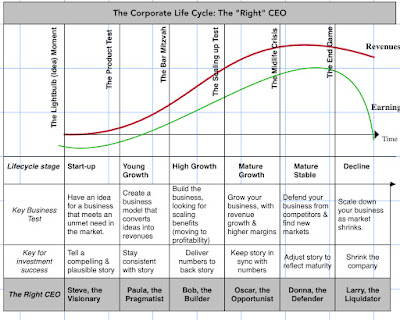
    More generally, though, the question of whether you want a visionary or a disciplined business builder at the top of a firm is not one that has an easy answer, since it depends on the firm in question. In my work on corporate life cycles, I focus on the management skills that are needed most in a company, based upon where it is the life cycle, and that may help address the choice between vision and restraint:

With young companies, vision dominates, as managers work to sway investors, employees and nascent customers that their product or service will find a market. As the vision takes hold, converting it into commercial products and services requires trading off some portions of vision for pragmatism, in the interest of getting the business going. As products and services find demand among customers, business building becomes a key difference-maker, with the grunt work of marketing, production facilities and supply chains coming into play. Assuming that you have made it through these three stages, the trade offs of scaling up come into focus, and as you hit market limits, success depends on being opportunistic in finding new products and markets, but only if they exist. In corporate middle age, pathways to easy growth, especially at scale, become difficult to find, and to the extent that value comes from moats and core products, playing defense against competitors takes priority. Finally, in decline, a phase that no company ever wants to enter, but is inevitable at some point, you need to be willing to shrink a firm, shutting down businesses that no longer deliver value and selling other assets to high bidders.
    Given these very divergent management functions, it should come as no surprise that there is no prototype for the perfect CEO, McKinsey and Harvard Business School blueprints notwithstanding. Viewed in this framework, I would argue that Apple has been lucky with its last two CEOs, both in terms of persona and in terms of sequence. When Steve Jobs rejoined Apple in 1997, the company had hit rock bottom, and with little to offer in liquidation, his vision allowed for a reincarnation, with disruptions leading the way, and as we noted earlier in this post, having a strong chief operating officer in Tim Cook made the difference. The Apple that Tim Cook inherited, when he became CEO, was a very different entity, already the world's largest market cap company, with a superlative franchise in the iPhone. In corporate life cycle terms, Apple was a mature growth company, and what Cook lacked in opportunism , he made up for by defending Apple's biggest product line(iPhone) and augmenting value with increments like the app store and devices. That said, while each of these men created value for shareholders, I don't think that either would be regarded as highly, if you swapped their tenures in terms of timing. I don't think Tim Cook would have been able to bring Apple from its near-demise to being on top of the corporate universe, if he had become CEO in 1997, and I think Steve Jobs would have been ill-suited to the Apple that was in existence in 2011. 

Aging, Management Mismatches and Corporate Governance
    In a post from a few years ago, I used the connection between CEO type and corporate lifecycle to examine why management mismatches occur at firms, and the consequences of that mismatch. Specifically, there are three confounding factors that can make matching up CEO to company, given where it is in the life cycle, complicated:
  1. Like humans, companies age, but unlike humans, the rates at which different companies go through the life cycle can be wildly different. An infrastructure or manufacturing company can take decades to become operational, followed by extended phases of growth and maturity, before going into decline. In contrast, a tech company can have explosive growth early in its life, spend a brief period enjoying the fruits of its success as a mature company before declining precipitously. As a consequence, managers and investors who use chronological age as their corporate aging metric can misjudge where they are on the life cycle.
  2. While aging is inevitable for both humans and businesses, some mature or even declining businesses can find pathways, either through happenstance or management choices, to rediscover their youth. These businesses become the stuff of legend, and they are the subjects of books and business school case studies, and their CEOs are elevated to management deities. 
  3. The narratives built around companies that reincarnate and the CEOs atop these companies also feed into management incentives and behavior. The story of Steve Jobs at Apple has been told and retold, but it is worth remembering that for every story of reincarnation, there are a hundred stories you can tell about other CEOs who tried to follow the Apple playbook, spending billions on reinventing their companies, with little to show in terms of payoffs. (See my posts on Marissa Mayer at Yahoo! and on Blackberry.) In essence, the glorification of CEOs who bet big on turnarounds at mature or declining companies, and win, sets up CEOs facing similar circumstances to behave like riverboat gamblers, when making management choices at their firms. After all, if their bets pay off, they join the legend crowd, and if they do not, they contend that they did their best, and that circumstances conspired to bring them down.
The bottom line is that there are a number of ways in which you can end up with CEO mismatches - a CEO who cannot adapt to the changing demands of an aging business, a hiring mistake or even changes in the macro environment, and when those mismatches occur, is is inevitable that there will be friction between the CEO and shareholders. In a sense, almost all corporate governance challenges can be traced back to management mismatches, and the power (or the absence of it) that shareholders have to fix those mismatches:
While Tim Cook's time as CEO of Apple is now seen through rose-colored lens, it is worth remembering that Apple was targeted repeated early in his tenure by activist investors. While some of the changes that these activists were pushing for were warranted, some were not, and Cook deserves credit for not capitulating. Carl Icahn, for instance, wanted Apple to increase its debt substantially, borrowing hundreds of billions, but I took issue with his argument that Apple could borrow this money at the low rates that he was extrapolating. A couple of years later, David Einhorn made his play, arguing that Apple should issue preferred shares with a 4% dividend yield, and I noted that preferred stock could bring with it all of the cashflow commitments of debt, with none of the tax advantages. I have long argued that the best defense a management has against activist investors is delivering superior performance and returns, and Tim Cook delivered on both dimensions, and faced little more than sniping from disgruntled investors in his later years as CEO. In the last four years, the criticism has come primarily from analysts who fault his caution, and argue that Apple risks falling behind its more aggressive competitors in the AI race, but here again, Cook has stood his ground.

Management Transitions, Past and Present - The Mag Seven
    I don't envy John Ternus, who is Cook's heir apparent, because he is following two CEOs who were immensely successful, albeit in different ways. If there are lessons he can learn from both Jobs and Cook, they include the following:
  • Find your own path: There will be pressure from some investors to be just like Jobs, and go for big disruptions, or from others to imitate Tim Cook, and leave Apple as a cash machine. While it may take time, Ternus has to find his own path as CEO, based on not only what he brings to the table, given his background in computer hardware, but on what Apple's strengths are as a company in 2026 and the markets it is facing right now.
  • Adapt to the company you are managing: Just as the Apple that Jobs took over in 1997 was very different from the Apple that he handed over to Cook in 2011, the company that Ternus takes over is different from the ones handed over in either of the prior iterations. When you are at the helm of one of the largest market cap companies in the world, you have to start with the recognition that any new product or service that you introduce will have to be huge to make a dent in the operating metrics (revenues and profits) or market capitalization. In addition, the franchise that holds up the company's cash machine is the iPhone, and Ternus cannot afford to take his eyes of that prize. 
  • Keep the feedback loop open: When you are a company worth trillions, with legions of shareholders, and hundreds of analysts, you will have advice meted to you constantly on what you should or should not do. Much of that advice will be bad, and should be dismissed, but some of it is worth listening to and perhaps converted into policy. In addition, as CEO, I hope that Ternus views the market price as a crowd judgment on Apple's actions rather than the product of speculation, and accepts that while that judgment can be wrong, it should be taken seriously. 
I wish Mr. Ternus the best, for purely selfish reasons. As a Mac and Apple device user, I want the company to prosper and continue to make products that I can continue to use on a daily basis, and as a shareholder, I want my investment to do well. 
    The attention, in this post has been on the management transition at Apple, but management transitions are part and parcel of every company, with the changes sometimes forced on the company and sometimes voluntary. Expanding the discussion of management to the other companies in the Mag Seven can provide us with an opportunity to examine management transitions that have either already happened or that will happen in the future, and the ensuing frictions:
  • At Microsoft, the only company in this group that traces its vintage back to Apple, there have been two CEO transitions, from Bill Gates to Steve Ballmer in 2000, and from Ballmer to Satya Nadella in 2014. While Gates built Office and Windows into cash cows, and Ballmer preserved them, Nadella created his own pathway to reincarnation by building up a cloud business that is now the dominant source of revenues for the company. By partnering early with OpenAI on LLMs, and investing massively in data centers, Nadella is now making a bet that AI can provide a further boost to the company's operations, perhaps setting the stage for a second rebirth.
  • Amazon has seen a management transition, where a legendary founder (Bezos) left the firm in 2021, and his successor (Andy Jassy) has taken the reins, with remarkably little fanfare. Like Nadella, though, Jassy is betting big on AI being a growth and value driver, and the success or failure of that bet will largely determine how his stint as CEO gets judged.
  • Alphabet offers a case study of a company that tried to split the difference, by separating its cash cow (Google advertising) from its other businesses, naming Sundar Pichai as the CEO for Google, while remaining atop the other Google businesses (the bets in Alphabet). That experiment has struggled to deliver, as the other businesses remained earth-bound and in 2019, and Pichai took over as CEO of Alphabet as well. Over its lifetime, Alphabet has been immensely successful in coming up with products and services that catch public attention, whether it be its development of the Android operating system or its work on Waymo or Gemini, but it has struggled to convert those successes into revenues and operating profits.
  • In three of the companies (Tesla, Meta and Nvidia), founders remain CEOs, though they bring very different perspectives and personalities into their roles. As I noted in my last post on SpaceX, Musk has veered between genius and eccentricity in his stewardship, but shareholders at Tesla have largely benefited from the rollercoaster ride. At Meta, Zuckerberg has been a shrewd businessperson in his management of his social media holdings, with savvy acquisitions of Instagram and Whatsapp boosting his ad-driven ecosystem, but he has also been headstrong in his pursuit of ventures that he feels are the "next big thing".  His expensive failed bet on the Metaverse led some investors to question his governance, and many of these investors worry that his bet on AI will play out similarly. Finally, on Nvidia, the company's soaring market capitalization and huge success with AI chips has pushed Jensen Huang into the spotlight, but less than a decade ago, there were questions about his management as well.
The fact that all six of these companies have invested heavily in AI is a lead-in to what could be the key test for management at all of them. If the AI investments pay off and deliver value, Nadella will cement his legend status, Jassy will have created his own legacy at Amazon, the Alphabet experiment will finally pay off, and the founder-run companies will have more room to run. If the AI investments fail, though, Nadella's reincarnation reputation will take a hit and Jassy's position atop Amazon will be at-risk. The AI failure will also raise doubts about Alphabet's capacity to grow beyond advertising and the rumblings about Zuckerberg's big bets will get louder, but at these two companies, it is unclear what investors, no matter how large their holdings are, can do, since they have acquiesced to a voting share structure at these two companies that has reduced them to bystander status. At Alphabet, Brin and Page control 51% of the voting rights, with less than 10% ownership, and at Meta, Zuckerberg controls 57% of the voting rights, with about 13% of share ownership.
  
An Ode to Restraint
    While there are many who compare to Tim Cook to Steve Jobs and find him wanting on vision and flair, I am grateful, as an investor in Apple, for the restraint and discipline that he brought to the job. That gratitude will stay intact even if Apple's caution on AI turns out to be a mistake, since the restraint and rectitude that Cook brought to his job are management qualities that significantly undervalued. I don't teach from or write cases, but I would love to see more business school cases about CEOs like Cook who are not easily swayed by the temptation of more growth and ego-driven acquisitions. I loved the Steve Jobs movie, but I don't expect to see a Tim Cook movie anytime soon, and while that is understandable, it also explains why we will continue to have too many CEOs at companies viewing themselves as saviors, gambling shareholder money on turnarounds and rescues, when the better pathway would be acceptance and shrinkage. I believe that investors lose more money from companies trying to do too much rather than from them doing too little, and from overreaching than from underachieving.

YouTube Video

My posts on Apple
  1. Apple: Thoughts on Bias, Value, Excess Cash & Dividends (March 1, 2012)
  2. Apple: Know when to hold 'em, know when to fold 'em (April 3, 2012)
  3. Emotions, Intrinsic value and Dividend Clienteles: The Apple postscript (April 6, 2012)
  4. Apple's Crown Jewel: Valuing the iPhone Franchise (August 29, 2012)
  5. The Year in Review: Apple's Universe (December 2012)
  6. Are you a value investor? Take the Apple Test! (January 2013)
  7. Back to Apple: Thoughts on value, price and the confidence gap (February 7, 2013)
  8. Financial Alchemy: David Einhorn's value play for Apple (February 8, 2013)
  9. Apple: News, Noise and Value (April 30, 2013)
  10. Love the company! Love the product! Love the stock! (September 9, 2013)
  11. Watch the Gap: Apple's Long and Twisted Journey (April 2014)
  12. The Race to the Top: The Duel between Alphabet and Apple (February 2016)
  13. Icahn exits, Buffett enters: Whither Apple (June 2016)
  14. Apple: The Greatest Cash Machine in History (February 2017)
  15. Investor Whiplash: Looking for Closure with Apple and Alphabet (December 2018)
My book on the corporate life cycle


Friday, December 10, 2021

Managing across the Corporate Life Cycle: CEOs and Stock Prices!

One of the big news stories of last week was Jack Dorsey stepping down as CEO of Twitter, and the market's response to that news was to push up Twitter's stock price by almost 10%. That reaction suggested, at least for the moment, that investors believed that Twitter would be better off without Dorsey running it, a surprise to those in the founder-worship camp. As the debate starts about whether Dorsey's hand-picked successor, Parag Agrawal, is the right person to guide Twitter through its next few years, I decided to revisit a broader question of what it is that makes for a "great CEO" and how there is no one right answer to that question, because it depends on the company, and where it stands in its life cycle. In the process, I will also look at the thorny issue of what happens when there is a mismatch between a company and its CEO, either because the board picks the wrong candidate for the job or because the company has changed over time, and the CEO has not. Finally, I will use the framework to look at the relationships between founders and their companies, and how mishandling management transitions can have damaging, perhaps even devastating, consequences for value.

The "Right" CEO: A Corporate Life Cycle Perspective

   The notion that there is a collection of characteristics that makes a person a great CEO for a company, no matter what its standing, is deeply held and fed into by both academics and practitioner. In this section, I will begin by looking at the mythology behind this push, and why it does not hold up to common sense questioning. 

The Mythology of the Great CEO

    Are there a set of qualities that make for a great CEO? To answer the question, I looked at two institutions, one academic and one practice-oriented, that are deeply invested in that idea, and spend considerable time advancing it. 

  • The first is the Harvard Business School, where every student who enters the MBA program is treated as a CEO-in-waiting, notwithstanding the reality that there are too few openings to accommodate that ambition. The Harvard Business Review, over the years, has published multiple articles about the characteristics of the most successful CEOs, and this one for instance, highlights four characteristics that they share in common: (a) deciding with speed and conviction, (b) engaging for impact with employees and the outside world (c) adapting proactively to changing circumstances and (d) delivering reliably.
  • The second is McKinsey, described by some as a CEO factory, because so many of its consultants go on to become CEOs of their client companies. In this article, McKinsey lists the mindsets and practices of the most successful CEOs in the following picture: 

Given how influential these organizations are in framing public perception, it is no surprise that most people are convinced that there is a template for a great CEO that applies across companies, and that boards of directors in search of new CEOs should use this template. 
    That perspective also gets fed by books and movies about successful CEOs, real or imagined. Consider Warren Buffett, Jack Welch and Steve Jobs, very different men who have been mythologized in the literature, as great CEOs. Many of the books about Buffett read more like hagiographies than true biographies, given how star struck the writers of these books are about the man, but by treating him as a deity, they do him a disservice. The fall of GE has taken some of the shine from Jack Welch's star, but at his peak, just over a decade ago, he was viewed as someone that CEOs should emulate. With Steve Jobs, the picture of an innovative, risk-taking disruptor comes not just from books about the man, but from movies that gloss over his first, and rockier, stint as founder-CEO of Apple in the 1980s.
    The problem with the one-size-fits-all great CEO model is that it does not hold up to scrutiny. Even if you take the HBR and McKinsey criteria for CEO success at face value, there are three fundamental problems or missing pieces. First, even if all successful CEOs share the qualities listed in the HBR/McKinsey papers, not all people or even most people with these qualities become successful CEOs. So, is there a missing ingredient that allowed them to succeed? If so, what is it? Second, I find it odd that there are no questionable qualities listed on the successful CEO list, especially given the evidence that over confidence seems to be a common feature among CEOs, and that it is this over confidence that allows them to take act decisively and adopt long term perspectives. When those bets, often made in the face of long odds, pay off, the makers of those bets will be perceived as successful, but when they do not, the decision makers are consigned to the ash heap of failure. Put simply, it is possible that the quality that binds together successful CEOs the most is luck, a quality that neither Harvard Business School nor McKinsey can pass on. Third, there are clearly some successful CEOs who not only do not possess many of the listed qualities, but often have the inverse. If you believe that Elon Musk and Marc Benioff, CEOs of Tesla and Salesforce, are great CEOs, how many of the Harvard/McKinsey criteria would they possess?

The Corporate Life Cycle

    I believe that the discussion of what makes for a great CEO is flawed for a simple reason. There is no one template that works for all companies, and one way to see why is to bring in the notion that companies go through a life cycle, from start-ups (at birth) to maturity (middle age) to decline (old age). At each stage of the life cycle, the focus in the company changes, as do the qualities that top managers have to bring for success:

Early in the life cycle, as a company struggles to find traction with a business idea that meets an unmet demand, you need a visionary as a CEO, capable of thinking outside the box, and with the capacity to draw employees and investors to that vision. In converting an idea to a product or service, history suggests that pragmatism wins out over purity of vision, as compromises have to be made on design, production and marketing to convert an idea company into a business. As the products/services offered by the company scale up, the capacity to build businesses becomes front and center, as production facilities have to be built, and supply chains put in place, critical for business success, but clearly not as exciting as selling visions. Once the initial idea has become a business success, the needs to keep scaling up may require coming up with extensions of existing product lines or geographies to grow, where an opportunistic, quick-acting CEO can make a difference. As companies enter the late phases of middle age, the imperative will shift from finding new markets to defending existing market share, in what I think of the trench warfare phase of a company, where shoring up moats takes priority over new product development. The most difficult phase for a company is decline, as the company is dismantled and its sells or shuts down its constituent parts, since any one who is put in charge of this process has only pain to mete out, and bad press, to go with it. Have you ever read a book or seen a movie about a CEO who shrunk his or her company, where that person is painted as anything but a villain? In fact, I used "Larry the Liquidator" as my moniker for that CEO, to pay homage to one of my favorite movies of all time, "Other People's Money":


As you watch the video, note that the CEO of the company, under activist attack, is played by Gregory Peck (the distinguished gray-haired gentleman who sits down at the start of the video), who presumably embodies all the qualities that Harvard and McKinsey believe embody a great CEO, and Danny DeVito plays "Larry the Liquidator". Talk about type casting, but this company needs more DeVito, less Peck!

Mismatches, Transitions and Turnover

    If you buy into my structure of a corporate life cycle, and how the right CEO for a company will change as the company ages, you can already see the potential for mismatches between companies and CEOs, for three reasons. 

  • A Hiring Mistake: The first is that the board of directors for a company seeking a new CEO hires someone who is viewed by many as a successful CEO, but whose success came at a company at a very different stage in its life cycle. I think Uber dodged the bullet in 2017, when they decided not to hire Jeff Immelt as CEO for the company. Even if you had believed that Immelt was successful at his prior job as CEO for GE, and that is arguable, he would have been a horrifically bad choice as CEO at Uber, a company that is as different from GE as you can get, in every aspect, not just corporate age. 
  • A Gamble on Rebirth: The second is when a board of director picks a mismatched CEO intentionally, with the hope that the CEO characteristics rub off on the company. This is often the case when you have a mature or declining company that thinks hiring a visionary as a CEO will lead to reincarnation as a growth company. While the impulse to become young again is understandable, the odds are against this gamble working, leaving the CEO tarnished and company worse off, in the aftermath. It was the reason that Yahoo! hired Marissa Mayer as a CEO in 2012, hoping that her success at Google would rub off on the company, an experiment that I argued would not end well for either party (and it did not).
  • A Changing Business; The third is a more subtle problem, where a company is well matched to its CEO at a point in time, but then evolves across the life cycle, but the CEO does not. Using the Uber example again, Travis Kalatnick, a visionary and rule breaker, might have been the best match for Uber as a company, in early years, when it was disrupting a highly regulated business (taxi cabs), but even without his personal missteps, he was ill-suited to a company that faced a monumental task of converting a model built on acquiring new riders into one that generated profits in 2017.
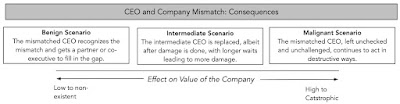
In NY case, a CEO/company mismatch is a problem, though the consequences can range from benign to malignant. 
In the most benign case, a mismatched CEO recognizes the mismatch, sets ego aside and finds a partner or co-executive with the skills needed for the company. In my view, and many of you may disagree with me, the difference between the first iteration of Steve Jobs, where he let his vision run riot and almost destroyed Apple as a company, and the second iteration, where he led one of the most impressive corporate turnarounds in history, was his choice of Tim Cook as his chief operating officer in his second go-around and his willingness to delegate operating authority. In short, Jobs was able to continue to put his visionary skills to work, while Cook made sure that the promises Jobs made were delivered as products on the ground. In the most malignant form, a badly mismatched CEO is entrenched in his or her position, perhaps because the board of directors has become a rubber stamp or by tilting voting rules (shares with different voting rights) in favor of incumbency, and continues on a pathway that takes the company to ruin. In the intermediate case, the board of directors, perhaps with a push from activist investors and large stockholders, engineers a CEO change, albeit after some or a great deal of damage has been done.

The Compressed Life Cycle: Implications for Founder CEOs

    It is a testimonial to how much technology companies have changed the economy and the market that some of the best-recognized names in business are those of the founders of successful technology company. I would wager that almost everyone has heard of Bill Gates, Jeff Bezos and Elon Musk, and that very few would recognize the names of Mary Barra (CEO of GM) or Darren Woods (CEO of Exxon Mobil). While there are some who venerate these founders, in what can only be called founder worship, there are others who have a more jaundiced view of them, both as human beings and as CEOs. The corporate life cycle framework provides a useful structure to think about how the technology companies, that dominate the twenty first century business landscape, are different from the manufacturing companies of the last century, and why these differences can create more management tensions at these companies.

Aging in Dog Years?

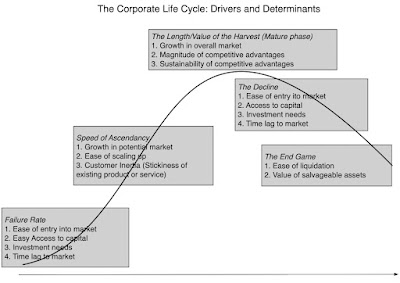
    While every company goes thought the process of starting up, aging and eventually declining, the speed at which it does will vary depending on the business it is in. More specifically, the more capital it takes to enter a business and the more inertia there is among the existing players (producers, customers) are, the longer it will take for a company to get from start up to mature growth, but the same forces will play out in reverse, allowing the company to stay mature for a lot longer and decline a lot more gradual:

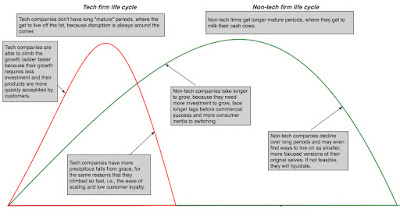
The great companies of the twentieth century took decades to ramp up, facing big infrastructure investments and long lags before expansion, had long stints as mature firms, milking cash flows, before embarking on long and mostly gradual declines. To illustrate, Sears and GE had century-long runs as successful companies, before time and circumstances caught up with them, and GM and Ford struggled for three decades setting up manufacturing capacity and tweaking their product offerings, before enjoying the fruits of their success. In contrast, consider Yahoo!, a company that was founded in 1994, that managed to reach a hundred billion in market capitalization by the turn of the century, enjoyed a few years of dominance, before Google's arrival and conquest of the market, before finally being acquired by Verizon in 2017. This compression of the life cycle has played out in tech company after tech company and the graph below captures the difference:

In short, tech companies age in dog years, with a 20-year tech company often resembling a hundred-year old manufacturing company, with creaky business models and facing disruption.

Implications for Founder CEOs and Management Turnover

    Companies have always had founders, and while the conflict between founders and others in the company have been around for decades, the compressed life cycle has exacerbated these tensions and magnified problems. In particular, the research on founder CEOs has yielded two disparate findings. The first is that in the early stages of companies, founder CEOs either step down or are pushed out at much higher rates than in more established companies. The second is that those founder CEOs who nurse their companies to more established status, and to public offerings, are more entrenched that their counterparts at mature companies.

    To understand the first phenomenon, i.e., the high displacement rate among founder CEOs of very young companies, I will draw on the work of Noah Wasserman at Harvard Business School who has focused intensively on this topic. Using data on top management turnover at young firms, many of them non-public, he concludes that almost 30% of CEOs at these firms are replaced within a few years of inception, usually at the time of new product development or fresh financing. Much of this phenomenon can be explained by venture capitalists, with large stakes, pushing for change in these companies, but a portion of it is voluntary, and to explain why a founder CEO might willingly step down, Wasserman uses the concept of the founder's dilemma, where founders trade off full control of a much less valuable firm (with themselves in control) for lesser control of a much more valuable firm (with someone else at the helm). In the corporate life cycle structure, it is a recognition on the part of founders or capital providers that the skills needed to take a company forward require a different person at the top of the organization, especially as a firm transitions from one stage of the life cycle to the next.

    The founders who do manage to stay at the helm of companies that make it through to early growth status are put on a pedestal, relative to CEOs of established companies. While that may be understandable, in some cases, it can take the form of founder worship, where founders are viewed as untouchable, and any challenge to their authority is viewed as bad, leading to efforts to change the rules of the game to prevent these challenges. In the United States, where prior to 2004, it was unusual to see shares with different voting rights in the same firm, it is now more the rule than the exception in many tech companies. 

    Endowing CEOs with increased powers to fend off challenges seems like a particularly bad idea at tech companies, since their compressed life cycles are likely to create more, rather than less, mismatches between companies and their founder/CEOs, and sooner, rather than later. To see, why consider how corporate governance played out at Ford, a twentieth century corporate giant. Henry Ford, undoubtedly a visionary, but also a crank on some dimensions, was Ford's CEO from 1906 to 1945. His vision of making automobiles affordable to the masses, with the Model T, was a catalyst in Ford's success, but by the end of his tenure in 1945, his management style was already out of sync with the company. With Ford, time and mortality solved the problem, and his grandson, Henry Ford II, was a better custodian for the firms in the decades that followed. Put simply, when a company lasts for a century, the progression of time naturally takes care of mismatches and succession. In contrast, consider how quickly Blackberry, as a company, soared, how short its stay at the top was and how steep its descent was, as other companies entered the smart phone business. Mike Lazaridis, one of the co-founders of the company, and Jim Balsillie, the CEO he hired in 1992 to guide the company, presided over both its soaring success, gaining accolades for their management skills for doing so, and over its collapse, drawing jeers from the same crowd. By the time, the change in top management happened in 2012, it was viewed as too little, too late.

    In my view, the next decade will bring forth more conflict, rooted in the compressed life cycle of companies. If I were a case study writer, and thank God I am not, I would not rush to write case studies or books about successful tech company CEOs, because many of those same CEOs will become case studies of failure within a few years. If I am an investor, I would worry more than ever before about giving up voting power to founder/CEOs, even if they are well regarded, because today's star CEO can become tomorrow's problem. I wonder whether the way Facebook has dealt with its privacy and related problems over the last few years would have been different, if investors had not allowed Mark Zuckerberg to effectively control 57% of the voting rights with less than 20% of the outstanding shares. It is worth noting that Twitter was one of the few social media companies that chose not to split its voting rights across shares, and that may explain the Jack Dorsey departure.

Implications for Investors
   I have long argued that when investing in young tech companies, you are investing in a story about the company, not an extrapolation of numbers.  The compressed corporate life cycle, and the potential for CEO/company mismatches that it creates, adds a layer of additional uncertainty to valuation. In short, when assessing the value of a young company's story, you are also assessing the capacity of the management of the company to deliver on that story. To the extent that the founder is the lead manager, and the narrative-setter, any concerns you have about the founder's capacity to convert that story into business success will translate into lower value. Let me illustrate using three examples, the first being Amazon in my early valuations of the company between 1997 and 2000, the second being Twitter, especially in the context of Jack Dorsey's departure and Paytm, the Indian online company, whose recent IPO was a dumpster fire.
  • I have always liked Amazon, as a company, and one reason for that was Jeff Bezos. Many younger investors are surprised when I tell them that Bezos was not a household name for much of Amazon's early rise, and that it was The Washington Post acquisition in 2013 that brought him into public view. One reason that I attached lofty values to Amazon as a company, even when it was a tiny, money-losing company was that Bezos not only told the same story, one that I described as Field of Dreams story, where if you build it (revenues), they (profits) will come. but acted consistently with that story. He built a management team that believed that story and trusted them to make big decisions for the company, thus easing the transition from small, online book retailer to one of the largest companies in the world. It is a testimonial to Bezos' success in transitioning management that Amazon's value as a company today would be close to the same, with or without him at the helm, explaining why the announcement that he was stepping down as CEO on July 5 created almost no impact on the stock price.
  • I valued Twitter for the first time, just ahead of its IPO in 2013, and built a model premised on the assumption that the company would find a way to monetize its larger user base and build a consistently money-making enterprise. In the years since, I have been frustrated by its inability to make that happen, and in this post in 2015, I laid the blame at least partially at the feet of Twitter's management, contrasting its failure to Facebook's success. I don't know Jack Dorsey, and I wish him well, but in my view, his skill set seemed ill suited to what Twitter needed to succeed as a business, especially as he was splitting his time as Square's CEO, and talking about taking a six-month break in Africa.  In fact, eight years after going public, Twitter's strongest suit remains that it has lots of users, but its capacity to make money of these users is still questionable. One reason why the market responded so positively, jumping 10% on the news that Dorsey was leaving, is indicative of the relief that change was coming, and the reason that it has fallen back is that it is not clear that Parag Agrawal has what the company needs now. He has time to prove investors wrong, but he is on probation, as investors look to him to reframe Twitter's narrative and start delivering results.
  • A few weeks ago, I valued one of India's new unicorns, Paytm, an online payment processing company built on the promise of a huge and growing online payment market in India. In my valuation, I told an uplifting story of a company that would not only continue to grow its user base and services, but also that it would increase its take rate (converting users to revenues) and benefit from economies of scale to become profitable over the course of the next decade.

    I valued Paytm at about 2,200, but in telling that story, I noted one big area of concern with existing management, that seemed to be more intent on adding users and services than on converting them into revenues, and pre-disposed to grandiosity in its statement of purpose and forecasts. In the months since, the company has gone public, and while the offering price, at 2150, was close to my value, the stock price collapsed in the days after to less than 1400 and has languished at about 1600-1700 since. It is always dangerous to try to explain why markets do what they do over short periods, but I do think that the company's founders and spokespeople did not do themselves any favors, ahead of the IPO. Specifically, if you were concerned about Vijay Sharma's capacity to convert the promise of Paytm into eventual profits, before the IPO, you would have been even more concerned after listening to him in the days leading into the IPO. It is still too early to conclude that there is a company/CEO mismatch, but if I were top management of the firm, I would talk less about users and gross merchandise value, and focus more on improving the abysmally low take rate at the firm. 
If there is a general lessons for investors from this post, it is that when a founder CEO leaves his position, or is pushed out, the value change can be positive or negative, and that  good founders will work at making themselves less central to their company's stories over time and thus less critical to its value. It should also be a cautionary note for those investors who have looked the other way as venture capitalists, founders and insiders have fixed the corporate governance game in their favor, in young tech companies that go public, ensuring that mismatches from companies and CEOs, if they occur in the future, will persist. 

Family Group Companies: The Life Cycle Effect
    In much of the world, businesses, even if they are publicly traded, are run by family groups. To the extent that the top management of these businesses are members of the family, these companies are uniquely exposed to company/CEO mismatches, especially as second or third generations of a family enter the management ranks, and these families enter new businesses.

Family Group Companies: The Life Cycle Effect?
    Much of Asian and Latin American business is built around family groups, which have roots that go back decades. Using a combination of connections and capital, these family groups have lived through economic and political changes, and as many of the companies that they own have entered public markets, they have stayed in control. In some cases, this control has come from dominant shareholdings, but more often, it is exercised by using holding company structures and corporate pyramids that effectively leave the family in control, even as the public acquires a larger stake in equity.
    To see how the corporate life cycle structure story plays out in family group companies, it is worth remembering that family groups often control companies that spread across many different business, effectively resembling conglomerates in their reach, but structured as individual companies. Consequently, it is not only possible, but likely, that a family group will control companies at different stages in the corporate life cycle, ranging from young, growth companies at one end of the spectrum to declining companies at the other end of the spectrum. In fact, one of the reasons family groups survived and thrived in economies where public markets were under developed was their capacity to use cash generated in their mature and declining businesses to cover capital needs in their growing businesses. This intra-group capital market becomes trickier to balance, as family group companies go public, since you need shareholder assent for these capital transfers. With weak corporate governance, more the rule than the exception at family group companies, it is entirely possible that shareholders in the more mature and cash-generating companies in a family group are being forced to invest in younger, growth companies in that same group. 

Implications for CEOs and Management
    There is research on CEO turnover in family group companies, and the results are not surprising. In a recent study, researchers looked at 4601 CEOs in companies, classifying them based on whether they were family CEO or outside CEOs, and found the forced turnover was much less frequent in the first group. In other words, family CEOs are less likely to be fired, and more likely to stay around until a successor is found, often within the family. While this is good news in terms of continuity, it is bad news if there is a company/CEO mismatch, since that mismatch will wreak havoc for far longer, before it is fixed. 
    What can family groups do about dealing with the mismatch, especially as the potential for that mismatch increases, as disruption turns some mature and growing businesses into declining ones and capital gets shifted to new businesses in the green energy and technology space? First, power has to become more diffuse within the family, away from a powerful family leader and more towards a family committee, to allow for the different perspectives needed to become successful in businesses at other stages in the life cycle. If, like me, you are a fan of Succession, the HBO series, you don't want to model yourself on Logan Roy, and the Roy family, if you are a family group company. Second, there has to be a serious reassessment of where different businesses, within the family group, are in the life cycle, with special attention to those that are transitioning from one phase to another. Third, if top management positions are restricted to family members, the challenge for the family will be finding people with the characteristics needed to run businesses across the life cycle spectrum. As many family groups enter the technology space, drawn by its potential growth, the limiting constraint might be finding a visionary, story teller from within the family, and if one does not exist, the question becomes whether the family will  be willing to bring someone from outside, and give that person enough freedom to run the young, growth business. Finally, if a mismatch arises between a family member CEO and the business he or she is responsible for running, there has to be a willingness to remove that family member from power, sure to raise family tensions and create fights.

Implications for Investors
   Are family group companies, in general, better or worse investments than investments in other publicly traded companies? The evidence, not surprisingly, is mixed, with some finding a positive payoff, which they attribute to a better alignment of long term investor and management interests at these companies, and others finding negative returns, largely as a result of management succession problems. 
    To address why family control can help in some cases, and hurt in others, it again helps to bring in the corporate life cycle.  In the portions of the corporate life cycle, where patience and a steady hand are required, the presence of a family member CEO may increase value, since he or she will be more inclined to think about long term consequences for value, rather than short term profit or pricing effects. On the other hand, if a family CEO is entrenched in a company that is transitioning from growth to mature, or from mature to declining, and is not adaptable enough to modify the way he or she manages the company, it is a negative for value. Family group companies composed primarily of companies in the former grouping will therefore trade at premiums, whereas family group companies that include a disproportionately large number of disrupted or new businesses will be handicapped. 

Conclusion
    I started this post by talking about Jack Dorsey leaving Twitter, and why the market celebrated that news, but I would like to end on a more general note. If there is a take away from bringing a life cycle perspective to assessing CEO quality, it is that one size cannot fit all, and that a CEO who succeeds at a company at one stage in the life cycle may not have the qualities needed to succeed at another. For boards of directors, in search of new CEOs, my suggestion is that you pay less attention to past track records of nominees, in their prior stints as employees or as CEOs of other companies) and more attention to the qualities that they possess, to see if they match what the company needs to succeed. 

YouTube Video


Wednesday, November 14, 2018

The GE End Game: Bataan Death March or Turnaround Play?

It seems like ancient history, but it was just 2001, when GE was the most valuable company in the world, commanding a market capitalization in excess of $500 billion. The quintessential conglomerate, with a presence in almost every part of the global economy, it seemed to have been built to withstand economic shocks and was the choice for conservative investors, scared of the short life cycles and the volatile fortunes of its tech challengers. Unlike other aging companies like Sears that have decayed gradually over decades, GE's fall from grace has been precipitous , with the rate of decline accelerating the in the last two years. As a new CEO is brought in, with hopes that he will be a savior, it is the right time to both look back and look forward at one of the globe's most iconic companies.

GE: A Compressed History
GE's roots can be traced back to Thomas Edison and his invention of the light bulb. The company that Edison founded in 1878, Edison General Electric, was combined with two other electric companies to create General Electric in 1892. The company established its first industrial lab in 1900 and it would not be an exaggeration to say that it revolutionized not just the American home, with its appliances, but changed the way Americans live. For much of of the twentieth century, though, GE remained an appliance company, though it made forays into other businesses. It was in 1980, when Jack Welch became the CEO of the company, that the company started its march towards what it has become today.

The Market History
The first place to start, when looking at GE, is to see how markets have viewed it, over its life. Skipping over the first half of GE's life, the graph below looks at the growth (and recent decline) of GE's market capitalization over time:

As you can see, GE was a solid but unspectacular investment from 1950 to 1980, and exploded in value in the 1980s and 1990s, with Jack Welch at its helm, and reached its most valuable company in the world status in 2001. Under Jeff Immelt, his successor, the stock continued to do well, but it dropped with the rest of the market as the dot com bubble burst, but then recovered leaving into the 2008 crisis. That crisis was devastating for the company and while it did recover somewhat in the years after, the bottom has clearly dropped out in the last two years, with Jeff Flannery at the top of the company.

The Operating History
To get operating perspective on how the company has evolved over time, we looked at how GE"s key operating metrics (revenues, EBITDA, net income) have evolved since 1950:

In keeping with our earlier market cap assessment, between 1950 and 1970, GE was a good but not exceptional company, delivering solid revenue growth and decent margins. Under two CEOS, Reginald Jones in the 1970s and Jack Welch in the two decades thereafter, the company transformed itself. Jones helped the company navigate through the turbulent period of high inflation and oil prices, holding margins steady and delivering double digit revenue growth. Welch made himself the stuff of legend, by doubling margins and pushing the company to the top of the market cap ranks by the time he left the firm. His successor Jeff Immelt faced the unenviable task of following Welch, but managed to keep revenues growing and delivered high margins until 2008, when the bottom fell out for the company. 

The Business Mix Shift
To understand GE's current plight, we have to go back to Welch's tenure as CEO, when he remade the firm, by moving it away from its domestic and manufacturing roots and giving it a global and multi-business focus. GE's biggest leap during that period was into the financial services business, and one reason Welch was attracted to the financial services business was its capacity to generate high profits with relatively little investment. By the late 1990s, GE Capital was the engine driving GE's growth, accounting for almost 48% of revenues in 1998 and as you can see in the graph below, it continued to do so for much of the first decade of Immelt's stewardship:

In 2008, when the crisis hit financial service firms had, GE was significantly exposed, and in the years since, GE has retreated not just from the financial services business but also from its entertainment bets (with the sale of NBC to Comcast) and from the appliance business (now owned by Haier). GE's current business mix, broken down into more detail, is shown in the pie chart below:
GE Annual Report for 2017 (Invested Capital, allocated based upon assets by business)
Today, GE is in three businesses (aviation, healthcare and transportation) that have low growth and high profitability (margins and returns on capital), in three energy-related businesses (power, renewable energy and oil) with higher growth but low profitability (margins & returns on capital), one business (lighting) that is fading quickly and one (capital) that is declining, but dragging value down with it. Note also that the collective profits reported across businesses is  before corporate expenses and eliminations of $3.83 billion (not counting a one-time restructuring charge of $4.1 billion) that effectively wipe out about half of the operating profits. When computing return on capital, I allocated these expenses to the businesses, based upon revenues, and used a 25% effective tax rate, and while GE as a whole did not deliver a return that meets its cost of capital requirements in 2017, aviation, healthcare and transportation clear their hurdle rates by plenty. Replacing 2017 income in each business with a normalized value (computed using the average margins in each business between 2013 and 2017) improves the return on capital at the power and renewable energy businesses, but the overall conclusion remains the same. GE, as a company, does not look good, but it does have significant value creating businesses.

Corporate Life Cycle
While there are different ways of framing GE's current standing, I will use the corporate life cycle, since it encapsulates the challenges facing the company.

GE's light bulb moment might have been in Thomas Edison's lab in 1878, but at an official corporate age of 126 years, GE is an ancient company and its problems reflect its age. Other than renewable energy, all of GE's businesses are mature or declining, and by the laws of mathematics, GE itself is a mature to declining company.  Any story that you tell about GE going forward has to reflect this reality, and there are three possible ones that can lead to different values.
1. Break it up: If GE at its peak represented the glory of conglomerates, its current plight is a sign of how far conglomerates have fallen in the world. Across the world, multi business companies are finding themselves under pressure to break up and in many cases, their stockholders will be better off if they do. To gain from a break up, though, here are some of the things that have to be true. 
  • Separable businesses: The different businesses have to be separable, since leakages and synergies across businesses can make it more difficult to cleave off pieces to sell or spin off. On this count, GE is probably on safe ground, since its businesses (other than GE Capital) are self standing, for the most part, with little in terms of cross business effects. 
  • Willing buyers: There have to be potential buyers who are willing to pay prices for the pieces that exceed what they will generate as value for the holding company, as going concerns, and those higher prices either have to come from potential synergies or changed management. None of GE's businesses seem alluring enough to attract multiple bidders, willing to pay premium prices, and given GE's shaky bargaining position, it is more likely than not that a rush to unload businesses will do more harm than good. 
  • Corporate Waste (at HQ):  A large chunk of the corporate overhead has to viewed as wasteful, with a big drop in corporate expenses accompanying the breakup. How much of the corporate expense of $3.8 billion that GE reported in 2017 is wasteful and could be eliminated with targeted cost cuts? Looking at the breakdown of these expenses, just about $2.2 billion in for covering pension obligations and breaking up the company will not relieve the company of its contractual obligations. Some of the remaining $1.6 billion may be fat that can be cut, but even cutting the entire amount (which would be a tall order) will not turn the company around.
Since GE will be trying to sell these businesses to buyers today, this is a pricing and not a valuation exercise, and I have estimate a pricing for GE's businesses below, using an EBITDA recomputed using the average operating margin in each business over the last five years to compute operating income and allocating corporate expenses to the divisions, based upon revenues. To convert the EBITDA to an estimated value, I used the EV/EBITDA multiples of the peer group:
Download spreadsheet
If GE is able to get buyers to pay industry-level multiples of EBITDA for each of these businesses, it will be able to net about $103 billion for its equity investors, higher than the market capitalization on November 14 of $72 billion. The problem, though, is that fire sales of entire companies almost never deliver the expected proceeds, as buyers, recognizing desperation, hold back. In fact, GE's attempts to extricate itself from a portion of its Baker-Hughes investment in the last few days show that these sales will occur at a discount.

2. Retrench and Reshape: The second choice for GE is to retrench and perhaps renew itself, not as a growth company, but as a stable, high margin company in businesses where it has a competitive advantage. In broad terms, the roadmap for GE to succeed in this path is a simple one,  shrinking or selling off pieces of its low-margin businesses, exiting the capital business and consolidating its presence in the aviation, healthcare and transportation businesses. To get a better sense of what the businesses would be worth, as continuing operations, I valued each of GE's business, using simplistic assumptions: I used the sector cost of capital for each business, set growth in the next five years equal to revenue growth in each of GE's businesses in the last five years and normalized operating income based upon the average operating margin that each of GE's businesses have delivered over the last five years:
Download spreadsheet
The value that I derive for equity is lower than the $103 billion that I estimated in the last section, but it does not require any near term fire sales at discounts. There are two big challenges that GE will face along the way. The first is that GE is saddled with a significant debt obligation, a legacy of GE Capital, that will not fade away quickly, and the debt obligations represent a clear and present danger to the firm.  One reason for the rapid drop in GE's stock price in the last few weeks has been the deterioration in the company's credit standing, as can be seen in the rising default spreads for the company in the CDS market.

The reason that GE is trying to sell some of its stake in Baker and Hughes to pay down debt, but bond markets are skeptical, with good reason. The second is that GE Capital is now more burden than benefit to investors. In the valuation table, note that the value that I have estimated for GE Capital's operations ($27 billion) is much lower than GE Capital debt ($51 billion); in fact, I derive very similar results in the pricing. Put differently, in my valuation, I foresee the cost of exiting GE capital to be $24 billion in today's terms, but spread out over time.  If GE can navigate its way through its debt payments to becoming a more focused company, with constrained ambitions, it could survive and reclaim its place as a holding for a conservative value investor.

3. Reincarnate (or the Bataan Death March): There is a third option that GE shareholders have to hope and pray that GE does not take, where the company tries to recapture its old glory, throwing caution to the winds and reinvesting large amounts in new businesses, or worse still, large acquisitions. While there is no indication that Larry Culp, GE's new CEO, has grandiose plans for the company, that may be because the company is in crisis today. If as the crisis passes, Culp is tempted to make himself the second coming of Jack Welch, the company will follow the path of other aging companies that refuse to act their age, spending billions on cosmetic surgery (acquisitions) before finally capitulating. If there is a role model that Mr. Culp should follow, it is less that of Steve the Visionary, and more that of Larry the Liquidator

General Lessons
Given its age, it should come as no surprise that GE has been the subject of more case studies than perhaps any other company in the world. In its earlier days, it was used as an example of professional management, and during Jack Welch's years, it was held up as an illustration of how aging manufacturing companies can remake themselves, with enlightened management at the top. Now that it is in trouble, I think that we look back at the last four decades and draw a different set of lessons:
  1. Conglomeration was, is and always will be a bad idea: I never understood the allure of conglomerates, even in their heyday. Only a corporate strategist could argue that combining companies in different businesses under one corporate umbrella, paying hefty premiums along the way to acquire these holdings, creates value, ignoring the logic that you and I as stockholders can create our own diversified and customized portfolios, without paying the same premium. If there is a lesson to learn from GE's fall from grace, it is that even the best conglomerates are built on foundations of sand. Note, though, that while this lesson may be learned for the moment, it will be forgotten soon, as are most other business lessons are, and we will surely repeat the cycle again in the future.
  2. Complexity has a cost: As I was going through GE's annual report, I was reminded again of why I have always described my vision of hell as having to value GE over and over and over again, for eternity. This company, through its actions and by design, made itself into one of the most complex companies in history, operating in dozens of businesses and across the world, with GE Capital acting as the cherry on the complexity cake, a gigantic financial service firm embedded in a large conglomerate. While that complexity served GE well in its glory days, allowing it to hide mistakes from sloppy acquisition practices and bets gone bad, it has bedeviled the company since 2008. Investors trying to navigate their way through the company's financials often give up and move on to easier prey. It may be too late for GE to do much about this problem, but as Asian companies rise in market capitalization, you are seeing new complex behemoths coming into play across the world.
  3. Easy money has a catch: I know that 20/20 hindsight is both easy and unfair, but GE's experiences with GE Capital bring home an age-old business truth that when a business looks like it can make you easy money, there is always a catch. Jack Welch initial foray into and subsequent expansion of GE Capital was built on the allure that it was a lot easier to make money in financial services than in manufacturing. From the perspective of having limited capital investment and growing quickly, that was true, but financial service firms through history have always had periods of plenty interspersed with bouts of gut-wrenching and intense pain, when borrowers start defaulting and capital markets freeze up. By making GE Capital such a big part of GE, Welch bet the farm on its continued success, and that bet went sour in 2008.
  4. The Savior CEO is a myth: I come to neither bury nor praise Jack Welch, but notwithstanding the fact that he has been gone almost two decades from the firm, GE remains the house that Jack built. Since Welch got the glory that came from GE's rise in the last twenty years of the last century, he deserves a portion of the blame for what has happened since. Don't get me wrong! Jack Welch was an inspirational top manager, a man with vision and drive, but he was also an imperial CEO, who made his board of directors a rubber stamp for his actions. As we look at a new generation of successful companies, this time in the technology space (the FANG stocks and the Chinese giants), with visionary founders at the top, it is worth remembering that power left unchecked in any person (no matter how smart and visionary) is dangerous.
The Bottom Line
As many of you know, I believe that every valuation has to have a story. With some companies, like Amazon and Google, the story is uplifting and optimistic, and the valuations follow, but they still might not be good investments, since their prices may be even higher. My story for GE is not an upbeat one, but if it (and its management) acts its age, accepts that slower or no growth is what lies in the future and does not over reach, it is a good investment. I believe that the market has over corrected for GE's many faults, and at the current stock price, that it is significantly under valued. I will buy GE, but I will do so with open eyes, not expecting (or wanting) dividends to be paid until the debt gets paid down and the company exits the capital business with as much grace (and as few costs) as it can muster. 

YouTube Video

Attachments