Showing posts with label Corporate Life Cycle. Show all posts

Wednesday, May 6, 2026

An Ode to Restraint: Lessons from the Tim Cook Legacy

    Through time, we have glorified conquerors and empire builders in politics, civic life and business, from Alexander the Great and Genghis Khan to the tech titans of today. That is no surprise, since these individuals have oversized personas and often change the course of history, but it is also true that this glorification of empire building has shortcomings. The first is the deification of these heroes comes with whitewashing of the dark sides and the costs of empire building. The second is that we discount and undervalue those who make contributions to societal or business advances, but do so quietly and with little fanfare. It is in this context that I was drawn to the story of Tim Cook stepping down as Apple CEO, after a tenure of fifteen years atop a company that has been among the top market cap companies in the world for much of that period. While Steve Jobs, his predecessor as CEO at Apple, has now been deified in business circles, as an unparalleled visionary and business builder, and deservedly so, I think that Tim Cook, in many ways, has played just as significant a role in molding the company into its current day standing, with far less recognition.

Apple's CEOs: From Scott to Jobs to Cook!

    Unfair though this may seem, the Tim Cook story at Apple has to start with Steve Jobs. Jobs co-founded the company in 1976, with Steve Wozniak, and while the company went through a series of CEOs in the next two decades, Jobs was the face of the company in its early years. While it is easy, with the benefit of hindsight, to view these as good years for the company, those early years reflected both Job's strengths and weaknesses. His vision and force of personality gave rise to the personal computer in its current form, as a tool for everyone to use, not just tech geeks, and as someone who bought his first Mac (the 128K without a hard drive) in 1984, and has stayed a Mac user since, I am grateful. That said, the dark side of Jobs, manifested in impatience with underlings and an obstinate belief that he knew what customers needed better than they did, led to the Lisa, the only Mac I regretted buying almost immediately after my purchase, and a loss of business markets to Microsoft. Those failures led Apple to the brink of failure, and to Jobs being cast out of the company by its board in 1985, though the CEOs that followed had neither the strategic vision nor the business-building capacity to rescue the company.

    In 1997, Apple looked like it was a company heading into oblivion, as Windows became the dominant operating system for personal computers, and it seemed like Apple had lost its purpose. The August 1997 return of Steve Jobs,, who had used his years in the wilderness to build Pixar, a company that revolutionized animated movie making, is now the stuff of legend, as he rebuilt Apple in the ensuing years into a powerhouse, around the iPod, the iPad and most of all the iPhone. While there are books and movies chronicling the Steve Jobs success story, it is worth asking what the difference was between the first iteration of Steve Jobs at Apple (from founding to leaving in 1985), where Apple lost ground to Microsoft, and the second iteration of Steve Jobs (from his return in late 1997 until his resignation in 2011). The first was that he was older, and to the extent that with age comes some wisdom, it helped, but it is unlikely to have been the change maker. The second was that in his period away from Apple, Jobs created and built up other companies, with Pixar being the biggest, where he learned to deal with people better and perhaps compromise a bit more than he used to. The third was that he benefited from the presence of Tim Cook, first as an executive in Apple sales and operations, and more importantly, as chief operating officer (COO) for Apple, starting in 2005. If Steve's skill was vision, where he showcased Apple's next "big innovation" at meetings in his trademark black turtleneck, Cook's skill was building manufacturing hubs and supply chains to convert the vision to products. That separation of vision from business building created the Apple juggernaut in the first decade of this century. While that division of labor clearly was in the company's best interests, Jobs deserves credit for being willing to set his ego aside and delegate the powers to make it happen.

    Tim Cook has been CEO for fifteen years, and when he retires on September 1, 2026, he will have been the longest serving CEO at Apple. It cannot have been easy, especially in the early years, as the comparisons to Steve Jobs were front and center, and there was pressure on him to continue in the same path. To Cook's credit, he never tried to be Jobs, and he created a very different template for himself, one that fit him and the company well, and served as a testimonial to his self assurance. In one of my talks about a decade ago about Apple, I described Cook, perhaps harshly, as a man without a visionary bone in his body, but one who would make sure that the trains ran on time (or the iPhones were delivered as promised), and I think that he has used that strength to good effect during his years as CEO of the company.

Apple's Finances in the Twenty First Century: The Steve Jobs and Tim Cook Years!

    Steve Jobs handed over a company to Tim Cook in 2011, that was extraordinarily profitable, and at the time of his leaving, already the largest market cap company in the world. While that fact leads some to discount what Cook has done at Apple since, I think it is worth going back in history and looking at corporate handoffs of great companies, and how often they become tangled messes, as new CEOs overreach and overpromise. 

    The place to begin our comparison of the Jobs and Cook tenures is by charting Apple's market capitalization, with the delineation into the Jobs years (1998-2011) and the Cook years (2012-2026):

Looking across the aggregated years across both CEOs, it has been an extraordinary time. Apple began the Jobs tenure as CEO with a market cap of $1.68 billion, and by the end of 2025, its market cap had risen to over $4 trillion, and its performance burnishes the reputations of both Jobs and Cook. Jobs provided the foundational boost for the company and the innovations he presided over delivered a compounded annual price appreciation of 47.19% between 1997 and 2011, a period when US equities were struggling and Apple reached the top of the market cap table in 2011. With Tim Cook at the helm, Apple added an astounding $3.64 trillion in market cap, but a strong equity market provided strong tailwinds, and the company's annual returns were more modest.  On a percentage return basis, the Jobs years were better, but in my view, the fact that the annual returns in the Cook years were just as impressive, because they had to be earned on a much larger firm. 

    The reasons for Apple's sustained increase in market capitalization were simple - solid revenue growth and a profit machine that delivered high margins, even as the company scaled up:

As with the market capitalization comparisons, this chart yields metrics that are favorable to both Jobs and Cook. Under Jobs, the company scaled up its revenues significantly, with a compounded annual revenue growth rate of 23.67% between 1997 and 2011, and just as significantly, went from posting subpar margins and a net loss in 1997 to becoming one of the most profitable tech companies in the world, Under Cook, revenue growth rates came down (to a compounded annual average of 8.52% between 2012 and 2025), but on a much larger scale, and the company preserved and grew its profit margins.

    There was one corporate finance dimension on which Cook deviated from Jobs, and that was on cash return or dividend policy. In the chart below, I look at the cash returned to shareholders by Apple during the tenures of the two CEOs:


During Job's tenure at Apple, the company paid no dividends and initiated only modest cash buybacks, mostly to cover stock-based compensations. With Tim Cook as CEO, Apple was one of the greatest corporate cash success stories of all time, initiating dividends in 2012 and increasing them over time, and supplementing those dividends with cash buybacks that, in the aggregate, were the largest in corporate history. In sum, the company has bought back almost $800 billion between 2012 and 2025, and the most astonishing feature was that, while returning all of this cash, the company also accumulated one of the largest corporate cash balances in history.

    To the question of how Apple was able to return this much cash, increase its cash balance and still grow itself, the answers are three fold. The first is that the iPhone, perhaps the most valuable single product in business history, continued to deliver for the company, with modest reinvestment needed on its upgrades. 


While much of the credit for the iPhone is still given to Steve Jobs, and rightly so for fostering the innovation, credit is also due to Cook, who has taken the franchise handed to him, and grown it on steroids. The second is that the company borrowed $17 billion in 2013, a Cook departure from a Jobs practice of avoiding debt, and it has added to that debt load over time, though it remains a small slice of overall value:

While much is made of Apple's debt foray, it is worth recognizing that Apple is still a very lightly indebted company on any debt metric, and that if you net the company's considerable cash balance out against its total debt, its net debt has always been negative (cash exceeds debt). In fact, Apple's use of debt is so light that the only rationale for its existence is creating a presence in the bond market, just in case it needs to use it more in the future. The third feature is that the company has been cautious in its forays into new products and markets, especially outside its domain, and this shows  up in two data series.

  • The first is that while Apple has acquired more than a hundred companies, almost all of them are small, private technology companies with small price tags, with the intent being bringing their products and services into the Apple ecosystem after the acquisition. In fact, its largest acquisitions during this century are so small that they represent petty cash, relative to its cash balance as a company. Beats, for instance, which was one of Apple's biggest acquisitions cost the company about $3 billion, a number dwarfed by its cash balance that year, which was more than $100 billion.
  • The second is that in the last five years, as big tech companies have gone on an AI capital expenditure binge, Apple has been the outlier, holding back on its AI investments, and this can be seen in the chart below, where I compare Apple's capital expenditures to those of the rest of the Mag Seven:

    As the rest of the group has ramped up its capital investments, with much of it going into AI, Apple has held back, and its share of the total cap ex at the companies has fallen from 8.04% to 3.02% over the period.
In sum, looking at the changes at Apple over the last fifteen years, the company has changed from the growth engine, driven by disruptions, in the Jobs years to a mature, cash-returning and more cautious company under Cook. I have posted more about Apple than about any other company in the world (and I have a sampling of some of those posts at the end of this post) and have been a shareholder in the company for significant portions of both the Jobs and Cook tenures. I have not always agreed with either man, on choices that they have made at the company, but I respected both of them enough to view them as good stewards of my investment. In a world full of CEOs who are quick to herd to what the consensus view is, I admire both men for their willingness to stand on their beliefs.

Vision or Restraint: A Life Cycle Perspective
    If you were to create a profile of Tim Cook, the manager, based upon the choices that he has made at Apple during his tenure as CEO, two very divergent views emerge. To his admirers, his actions on some fronts (initiating dividends, massive stock buybacks, borrowing money) and inaction on other fronts (no big acquisitions, diffidence on AI investments), represent an exercise in discipline and restraint,  preserving the company's crown jewel (the iPhone) and fending off the bankers and consultants, with their false promises.  To his critics, and there are quite a few, Cook's caution has cost Apple its disruptor status, when it could have used its ample cash reserves to buy its way or invest in into almost every new business that has bloomed in the last fifteen years. In fact, they point to chances that Apple has had to buy some of the biggest stars in the market, from Tesla and Netflix more than a decade ago to Anthropic, Mistral and Perplexity in more recent years. 
        It is impossible to argue that one side is right and the other side wrong, but it is undeniable that both pathways (the restrained pathway that Apple adopted and the more aggressive pathway that it could have taken) include trade offs. It is true that Apple's restraint has led it to miss out on some of the biggest trends in technology over the last decade, but it has also avoided the overpayment that is so common with high profile acquisitions of big companies. The argument that Apple would be worth a lot more today if it had bought Netflix or Tesla a decade ago falls flat for two reasons. The first is the selection bias in picking two companies that, in hindsight, have emerged as winners, when in fact there were at least a dozen other worse-performing companies that were also on Apple's radar. The second is the presumption that companies like Tesla or Netflix would have been just as successful, owned by Apple, as they were as stand alone enterprises. The clash of corporate cultures that would have ensued if Apple had bought either Tesla, a company that reinvents its business narrative every few hours, or Netflix, an entity that makes content in quantity with the hope that some it sticks, would have been epic, with the risk that both Apple and its acquired target would have gone down in flames.
    More generally, though, the question of whether you want a visionary or a disciplined business builder at the top of a firm is not one that has an easy answer, since it depends on the firm in question. In my work on corporate life cycles, I focus on the management skills that are needed most in a company, based upon where it is the life cycle, and that may help address the choice between vision and restraint:

With young companies, vision dominates, as managers work to sway investors, employees and nascent customers that their product or service will find a market. As the vision takes hold, converting it into commercial products and services requires trading off some portions of vision for pragmatism, in the interest of getting the business going. As products and services find demand among customers, business building becomes a key difference-maker, with the grunt work of marketing, production facilities and supply chains coming into play. Assuming that you have made it through these three stages, the trade offs of scaling up come into focus, and as you hit market limits, success depends on being opportunistic in finding new products and markets, but only if they exist. In corporate middle age, pathways to easy growth, especially at scale, become difficult to find, and to the extent that value comes from moats and core products, playing defense against competitors takes priority. Finally, in decline, a phase that no company ever wants to enter, but is inevitable at some point, you need to be willing to shrink a firm, shutting down businesses that no longer deliver value and selling other assets to high bidders.
    Given these very divergent management functions, it should come as no surprise that there is no prototype for the perfect CEO, McKinsey and Harvard Business School blueprints notwithstanding. Viewed in this framework, I would argue that Apple has been lucky with its last two CEOs, both in terms of persona and in terms of sequence. When Steve Jobs rejoined Apple in 1997, the company had hit rock bottom, and with little to offer in liquidation, his vision allowed for a reincarnation, with disruptions leading the way, and as we noted earlier in this post, having a strong chief operating officer in Tim Cook made the difference. The Apple that Tim Cook inherited, when he became CEO, was a very different entity, already the world's largest market cap company, with a superlative franchise in the iPhone. In corporate life cycle terms, Apple was a mature growth company, and what Cook lacked in opportunism , he made up for by defending Apple's biggest product line(iPhone) and augmenting value with increments like the app store and devices. That said, while each of these men created value for shareholders, I don't think that either would be regarded as highly, if you swapped their tenures in terms of timing. I don't think Tim Cook would have been able to bring Apple from its near-demise to being on top of the corporate universe, if he had become CEO in 1997, and I think Steve Jobs would have been ill-suited to the Apple that was in existence in 2011. 

Aging, Management Mismatches and Corporate Governance
    In a post from a few years ago, I used the connection between CEO type and corporate lifecycle to examine why management mismatches occur at firms, and the consequences of that mismatch. Specifically, there are three confounding factors that can make matching up CEO to company, given where it is in the life cycle, complicated:
  1. Like humans, companies age, but unlike humans, the rates at which different companies go through the life cycle can be wildly different. An infrastructure or manufacturing company can take decades to become operational, followed by extended phases of growth and maturity, before going into decline. In contrast, a tech company can have explosive growth early in its life, spend a brief period enjoying the fruits of its success as a mature company before declining precipitously. As a consequence, managers and investors who use chronological age as their corporate aging metric can misjudge where they are on the life cycle.
  2. While aging is inevitable for both humans and businesses, some mature or even declining businesses can find pathways, either through happenstance or management choices, to rediscover their youth. These businesses become the stuff of legend, and they are the subjects of books and business school case studies, and their CEOs are elevated to management deities. 
  3. The narratives built around companies that reincarnate and the CEOs atop these companies also feed into management incentives and behavior. The story of Steve Jobs at Apple has been told and retold, but it is worth remembering that for every story of reincarnation, there are a hundred stories you can tell about other CEOs who tried to follow the Apple playbook, spending billions on reinventing their companies, with little to show in terms of payoffs. (See my posts on Marissa Mayer at Yahoo! and on Blackberry.) In essence, the glorification of CEOs who bet big on turnarounds at mature or declining companies, and win, sets up CEOs facing similar circumstances to behave like riverboat gamblers, when making management choices at their firms. After all, if their bets pay off, they join the legend crowd, and if they do not, they contend that they did their best, and that circumstances conspired to bring them down.
The bottom line is that there are a number of ways in which you can end up with CEO mismatches - a CEO who cannot adapt to the changing demands of an aging business, a hiring mistake or even changes in the macro environment, and when those mismatches occur, is is inevitable that there will be friction between the CEO and shareholders. In a sense, almost all corporate governance challenges can be traced back to management mismatches, and the power (or the absence of it) that shareholders have to fix those mismatches:
While Tim Cook's time as CEO of Apple is now seen through rose-colored lens, it is worth remembering that Apple was targeted repeated early in his tenure by activist investors. While some of the changes that these activists were pushing for were warranted, some were not, and Cook deserves credit for not capitulating. Carl Icahn, for instance, wanted Apple to increase its debt substantially, borrowing hundreds of billions, but I took issue with his argument that Apple could borrow this money at the low rates that he was extrapolating. A couple of years later, David Einhorn made his play, arguing that Apple should issue preferred shares with a 4% dividend yield, and I noted that preferred stock could bring with it all of the cashflow commitments of debt, with none of the tax advantages. I have long argued that the best defense a management has against activist investors is delivering superior performance and returns, and Tim Cook delivered on both dimensions, and faced little more than sniping from disgruntled investors in his later years as CEO. In the last four years, the criticism has come primarily from analysts who fault his caution, and argue that Apple risks falling behind its more aggressive competitors in the AI race, but here again, Cook has stood his ground.

Management Transitions, Past and Present - The Mag Seven
    I don't envy John Ternus, who is Cook's heir apparent, because he is following two CEOs who were immensely successful, albeit in different ways. If there are lessons he can learn from both Jobs and Cook, they include the following:
  • Find your own path: There will be pressure from some investors to be just like Jobs, and go for big disruptions, or from others to imitate Tim Cook, and leave Apple as a cash machine. While it may take time, Ternus has to find his own path as CEO, based on not only what he brings to the table, given his background in computer hardware, but on what Apple's strengths are as a company in 2026 and the markets it is facing right now.
  • Adapt to the company you are managing: Just as the Apple that Jobs took over in 1997 was very different from the Apple that he handed over to Cook in 2011, the company that Ternus takes over is different from the ones handed over in either of the prior iterations. When you are at the helm of one of the largest market cap companies in the world, you have to start with the recognition that any new product or service that you introduce will have to be huge to make a dent in the operating metrics (revenues and profits) or market capitalization. In addition, the franchise that holds up the company's cash machine is the iPhone, and Ternus cannot afford to take his eyes of that prize. 
  • Keep the feedback loop open: When you are a company worth trillions, with legions of shareholders, and hundreds of analysts, you will have advice meted to you constantly on what you should or should not do. Much of that advice will be bad, and should be dismissed, but some of it is worth listening to and perhaps converted into policy. In addition, as CEO, I hope that Ternus views the market price as a crowd judgment on Apple's actions rather than the product of speculation, and accepts that while that judgment can be wrong, it should be taken seriously. 
I wish Mr. Ternus the best, for purely selfish reasons. As a Mac and Apple device user, I want the company to prosper and continue to make products that I can continue to use on a daily basis, and as a shareholder, I want my investment to do well. 
    The attention, in this post has been on the management transition at Apple, but management transitions are part and parcel of every company, with the changes sometimes forced on the company and sometimes voluntary. Expanding the discussion of management to the other companies in the Mag Seven can provide us with an opportunity to examine management transitions that have either already happened or that will happen in the future, and the ensuing frictions:
  • At Microsoft, the only company in this group that traces its vintage back to Apple, there have been two CEO transitions, from Bill Gates to Steve Ballmer in 2000, and from Ballmer to Satya Nadella in 2014. While Gates built Office and Windows into cash cows, and Ballmer preserved them, Nadella created his own pathway to reincarnation by building up a cloud business that is now the dominant source of revenues for the company. By partnering early with OpenAI on LLMs, and investing massively in data centers, Nadella is now making a bet that AI can provide a further boost to the company's operations, perhaps setting the stage for a second rebirth.
  • Amazon has seen a management transition, where a legendary founder (Bezos) left the firm in 2021, and his successor (Andy Jassy) has taken the reins, with remarkably little fanfare. Like Nadella, though, Jassy is betting big on AI being a growth and value driver, and the success or failure of that bet will largely determine how his stint as CEO gets judged.
  • Alphabet offers a case study of a company that tried to split the difference, by separating its cash cow (Google advertising) from its other businesses, naming Sundar Pichai as the CEO for Google, while remaining atop the other Google businesses (the bets in Alphabet). That experiment has struggled to deliver, as the other businesses remained earth-bound and in 2019, and Pichai took over as CEO of Alphabet as well. Over its lifetime, Alphabet has been immensely successful in coming up with products and services that catch public attention, whether it be its development of the Android operating system or its work on Waymo or Gemini, but it has struggled to convert those successes into revenues and operating profits.
  • In three of the companies (Tesla, Meta and Nvidia), founders remain CEOs, though they bring very different perspectives and personalities into their roles. As I noted in my last post on SpaceX, Musk has veered between genius and eccentricity in his stewardship, but shareholders at Tesla have largely benefited from the rollercoaster ride. At Meta, Zuckerberg has been a shrewd businessperson in his management of his social media holdings, with savvy acquisitions of Instagram and Whatsapp boosting his ad-driven ecosystem, but he has also been headstrong in his pursuit of ventures that he feels are the "next big thing".  His expensive failed bet on the Metaverse led some investors to question his governance, and many of these investors worry that his bet on AI will play out similarly. Finally, on Nvidia, the company's soaring market capitalization and huge success with AI chips has pushed Jensen Huang into the spotlight, but less than a decade ago, there were questions about his management as well.
The fact that all six of these companies have invested heavily in AI is a lead-in to what could be the key test for management at all of them. If the AI investments pay off and deliver value, Nadella will cement his legend status, Jassy will have created his own legacy at Amazon, the Alphabet experiment will finally pay off, and the founder-run companies will have more room to run. If the AI investments fail, though, Nadella's reincarnation reputation will take a hit and Jassy's position atop Amazon will be at-risk. The AI failure will also raise doubts about Alphabet's capacity to grow beyond advertising and the rumblings about Zuckerberg's big bets will get louder, but at these two companies, it is unclear what investors, no matter how large their holdings are, can do, since they have acquiesced to a voting share structure at these two companies that has reduced them to bystander status. At Alphabet, Brin and Page control 51% of the voting rights, with less than 10% ownership, and at Meta, Zuckerberg controls 57% of the voting rights, with about 13% of share ownership.
  
An Ode to Restraint
    While there are many who compare to Tim Cook to Steve Jobs and find him wanting on vision and flair, I am grateful, as an investor in Apple, for the restraint and discipline that he brought to the job. That gratitude will stay intact even if Apple's caution on AI turns out to be a mistake, since the restraint and rectitude that Cook brought to his job are management qualities that significantly undervalued. I don't teach from or write cases, but I would love to see more business school cases about CEOs like Cook who are not easily swayed by the temptation of more growth and ego-driven acquisitions. I loved the Steve Jobs movie, but I don't expect to see a Tim Cook movie anytime soon, and while that is understandable, it also explains why we will continue to have too many CEOs at companies viewing themselves as saviors, gambling shareholder money on turnarounds and rescues, when the better pathway would be acceptance and shrinkage. I believe that investors lose more money from companies trying to do too much rather than from them doing too little, and from overreaching than from underachieving.

YouTube Video

My posts on Apple
  1. Apple: Thoughts on Bias, Value, Excess Cash & Dividends (March 1, 2012)
  2. Apple: Know when to hold 'em, know when to fold 'em (April 3, 2012)
  3. Emotions, Intrinsic value and Dividend Clienteles: The Apple postscript (April 6, 2012)
  4. Apple's Crown Jewel: Valuing the iPhone Franchise (August 29, 2012)
  5. The Year in Review: Apple's Universe (December 2012)
  6. Are you a value investor? Take the Apple Test! (January 2013)
  7. Back to Apple: Thoughts on value, price and the confidence gap (February 7, 2013)
  8. Financial Alchemy: David Einhorn's value play for Apple (February 8, 2013)
  9. Apple: News, Noise and Value (April 30, 2013)
  10. Love the company! Love the product! Love the stock! (September 9, 2013)
  11. Watch the Gap: Apple's Long and Twisted Journey (April 2014)
  12. The Race to the Top: The Duel between Alphabet and Apple (February 2016)
  13. Icahn exits, Buffett enters: Whither Apple (June 2016)
  14. Apple: The Greatest Cash Machine in History (February 2017)
  15. Investor Whiplash: Looking for Closure with Apple and Alphabet (December 2018)
My book on the corporate life cycle


Monday, September 9, 2024

Dealing with Aging: Updating the Intel, Walgreens and Starbucks Stories!

      A few weeks ago, I posted on the corporate life cycle, the subject of my latest book. I argued that the corporate life cycle can explain what happens to companies as they age, and why they  have to adapt to aging with their actions and choices. In parallel, I also noted that investors have to change the way they value and price companies, to reflect where they are in the life cycle, and how different investment philosophies lead you to concentrated picks in different phases of the life cycle. In the closing section, I contended that managing and investing in companies becomes most difficult when companies enter the last phases of their life cycles, with revenues stagnating or even declining and margins under pressure. While consultants, bankers and even some investors push companies to reinvent themselves, and find growth again, the truth is that for most companies, the best pathway, when facing aging, is to accept decline, shrink and even shut down. In this post, I will look at three high profile companies, Intel, Starbucks and Walgreens, that have seen market turmoil and management change, and examine what the options are for the future.

Setting the stage

    The three companies that I  picked for this post on decline present very different portraits. Intel was a tech superstar not that long ago, a company founded by Gordon Moore, Robert Noyce and Arthur Rock in 1968, whose computer chips have helped create the tech revolution. Walgreens is an American institution, founded in Chicago in 1901, and after its merger with Alliance Boots in 2014, one of the largest pharmacy chains in the country.  Finally, Starbucks, which was born in 1971 as a coffee bean wholesaler in Pike Place Market in Seattle, was converted into a coffee shop chain by Howard Schultz, and to the dismay of Italians, has redefined espresso drinks around the world. While they are in very different businesses, what they share in common is that over the recent year or two, they have all not only lost favor in financial markets, but have also seen their business models come under threat, with their operating metrics (revenue growth, margins) reflecting that threat.

The Market turns

    With hundreds of stocks listed and traded in the market, why am I paying attention to these three? First, the companies are familiar names. Our personal computes are often Intel-chip powered, there is a Walgreen's a few blocks from my home, and all of us have a Starbucks around the corner from where we live and work. Second, they have all been in the news in the last few weeks, with Starbucks getting a new CEO, Walgreens announcing that they will be shutting down hundreds of their stores and Intel coming up in the Nvidia conversation, often as a contrast. Third, they have all seen the market turn against them, though Starbucks has had a comeback after its new CEO hire.

None of the three stocks has been a winner over the last five years, but the decline in Intel and Walgreen's has been precipitous, especially int he last three years. That decline has drawn the usual suspects. On  the one hand are the knee-jerk contrarians, to whom a drop of this magnitude is always an opportunity to buy, and on the other are the apocalyptists, where large price declines almost always end in demise. I am not a fan of either extreme, but it is undeniable that both groups will be right on some stocks, and wrong on others, and the only way to tell the difference is to look at each of the companies in more depth.

A Tech Star Stumbles: Intel’s Endgame

    In my book on corporate life cycles, I noted that even superstar companies age and lose their luster, and Intel could be a case study. The company is fifty six years old (it was founded in 1968) and the question is whether its best years are behind it. In fact, the company's growth in the 1990s to reach the peak of the semiconductor business is the stuff of case studies, and it stayed at the top for longer than most of its tech contemporaries. Intel's CEO for  its glory years was Andy Grove, who joined the company on its date of incorporation in 1968, and stayed on to become chairman and CEO before stepping down in 1998. He argued for constant experimentation and adaptive leadership, and the title of his book, "Only the Paranoid Survive", captured his management ethos. 

    To get a measure of why Intel's fortunes have changed in the last decade, it is worth looking at its key operating metrics - revenues, gross income and operating income - over time:


As you can see in this graph, Intel's current troubles did not occur overnight, and its change over time is almost textbook corporate life cycle. As Intel has scaled up as a company, its revenue growth has slackened and its growth rate in the last decade (2012-21) is more reflective of a mature company than a growth company. That said, it was a healthy and profitable company during that decade, with solid unit economics (as reflected in its high gross margin) and profitability (its operating margin was higher in the last decade than in prior periods). In the last three years, though, the bottom seems to fallen out of Intel's business model, as revenues have shrunk and margins have collapsed. The market has responded accordingly, and Intel, which stood at the top of the semiconductor business, in terms of market capitalization for almost three decades, has dropped off the list of top ten semiconductor companies in 2024, in market cap terms:

Intel's troubles cannot be blamed on industry-wide issues, since Intel's decline has occurred at the same time  (2022-2024) as the cumulative market capitalization of semiconductor companies has risen, and one of its peer group (Nvidia) has carried the market to new heights. 

    Before you blame the management of Intel for not trying hard enough to stop its decline, it is worth noting that if anything, they have been trying too hard. In the last few years, Intel has invested massive amounts into its chip manufacturing business (Intel Foundry), trying to compete with TSMC, and almost as much into its new generation of AI chips, hoping to claim market share of the fastest growing markets for AI chips from Nvidia. In fact, a benign assessment of Intel would be that they are making the right moves, but that these moves will take time to pay off, and that the market is being impatient. A not-so-benign reading is that the market does not believe that Intel can compete effectively against either TSMC (on chip manufacture) or Nvidia (on AI chip design), and that the money spent on both endeavors will be wasted. The latter group is clearly winning out in markets, at the moment, but as I will argue in the next section, the question of whether Intel is a good investment at its current depressed price may rest in which group you think has right on its side.

Drugstore Blues: Walgreen Wobbles

    From humble beginnings in Chicago, Walgreen has grown to become a key part of the US health care system as a dispenser of pharmacy drugs and products. The company went public in 1927, and in the century since, the company has acquired the characteristics of a mature company, with growth spurts along the way. Its acquisition of a significant stake in Alliance Boots gave it a larger global presence, albeit at a high price, with the acquisition costing $15.3 billion. Again, to understand, Walgreen's current position, we looked at the company's operating history by looking revenue growth and profit margins over time:

After double digit growth from 1994 to 2011, the company has struggled to grow in a business, with daunting unit economics and slim operating margins, and the last three years have only seen things worsen on all fronts, with revenue growth down, and margins slipping further, below the Maginot line; with an 1.88% operating margin, it is impossible to generate enough to cover interest expenses and taxes, thus triggering distress.

    While management decisions have clearly contributed to the problems, it is also true that the pharmacy business, which forms Walgreen's core, has deteriorated over the last two years, and that can be seen by comparing its market performance to CVS, its highest profile competitor. 


As you can see, both CVS and Walgreens have seen their market capitalizations drop since mid-2022, but the decline in Walgreens has been far more precipitous than at CVS; Walgreens whose market cap exceeded that of CVS in 2016 currently has one tenth of the market capitalization of CVS. In response to the slowing down of the pharmacy business, Walgreens has tried to find a pathway back to growth, albeit with acquired growth. A new CEO, Roz Brewer, was brought into the company in 2021, from Sam's Club, and wagered the company's future on acquisitions, buying four companies in 2021, with a majority stake in Village MD, a chain of doctor practices and clinics, representing the biggest one. That acquisition, which cost Walgreens $5.2 billion, has been more cash drain than flow, and in 2024, Ms. Brewer was replaced as CEO by Tim Wentworth, and Village MD scaled back its growth plans.

Venti no more The Humbling of Starbucks

    On my last visit to Italy, I did make frequent stops at local cafes, to get my espresso shots, and I can say with confidence that none of them had a  caramel macchiato or  an iced brown sugar oatmilk shaken espresso on the menu. Much as we make fun of the myriad offerings at Starbucks, it is undeniable that the company has found a way into the daily lives of many people, whose day cannot begin without their favorite Starbucks drink in hand. Early on, Starbucks eased the process by opening more and more stores, often within blocks of each other, and more recently, by offering online ordering and pick up, with rewards supercharging the process. Howard Schultz, who nursed the company from a single store front in Seattle to an ubiquitous presence across America, was CEO of the company from 1986, and while he retired from the position in 2000, he returned from 2008 to 2017, to restore the company after the financial crisis, and again from 2022 to 2023, as an interim CEO to bridge the gap between the retirement of Kevin Johnson in 2022 and the hiring of Laxman Narasimhan in 2023. To get a measure of how Starbucks has evolved over time, I looked the revenues and margins at the company, over time:


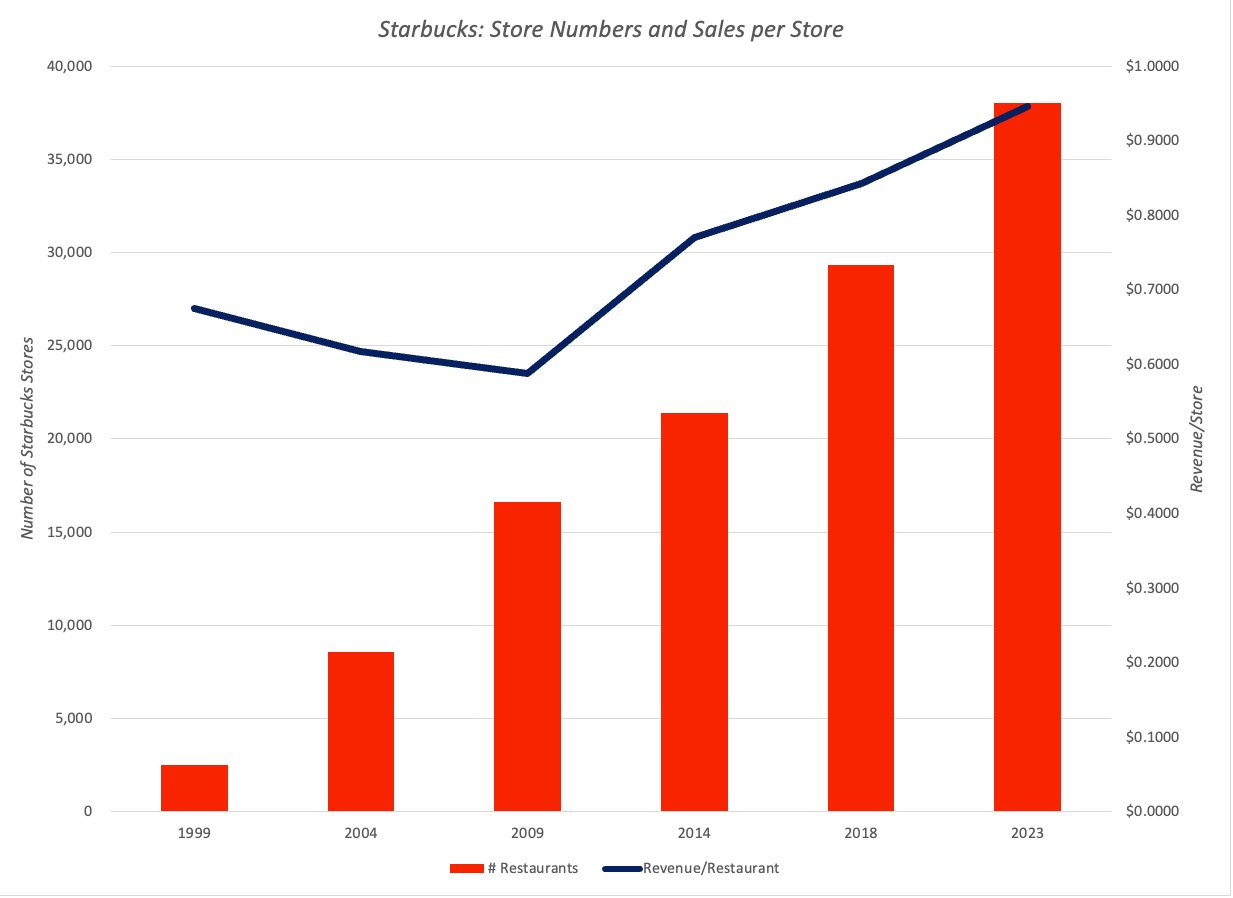
Unlike Intel and Walgreens, where the aging pattern (of slowing growth and steadying margins) is clearly visible, Starbucks is a tougher case. Revenue growth at Starbucks has slackened over time, but it has remained robust even in the most recent period (2022-2024). Profit margins have actually improved over time, and are much higher than they were in the first two decades of the company's existence. One reason for improving profitability is that the company has become more cautious about store openings, at least in the United States, and sales have increased on a per-store basis:

In fact, the shift towards online ordering has accelerated this trend, since there is less need for expansive store locations, if a third or more of sales come from customers ordering online, and picking up their orders. In short, these graphs suggest that it is unfair to lump Starbuck with Intel and Walgreens, since its struggles are more reflecting of a growth company facing middle age.

    So, why the market angst? The first is that there are some Starbucks investors who continue to hold on to the hope that the company will be able to return to double digit growth, and the only pathway to get there requires that Starbucks be able to succeed in China and India. However, Starbucks has had trouble in China competing with domestic lower-priced competitors (Luckin' Coffee and others), and there are restrictions on what Starbucks can do with its joint venture with the Tata Group in India. The second problem is that the narrative for the company, that Howard Schultz sold the market on, where coffee shops become a gathering spot for friends and acquaintances, has broken down, partly because of the success of its online ordering expansion. The third problem is that inflation in product and employee costs has made its products expensive, leading to less spending even from its most loyal customers.

A Life Cycle Perspective

    It is undeniable that Intel and Walgreens  are in trouble, not just with markets but operationally, and Starbucks is struggling with its story line. However, they face different challenges, and perhaps different pathways going forward. To make that assessment, I will more use my corporate life cycle framework, with a special emphasis on the the choices that agin companies face, with determinants on what should drive those choices.

The Corporate Life Cycle

    I won't bore you with the details, but the corporate life cycle resembles the human life cycle, with start-ups (as babies), very young companies (as toddlers), high growth companies (as teenagers) moving on to mature companies (in middle age) and old companies facing decline and demise:

The phase of the life cycle that this post is focused on is the last one, and as we will see in the next section, it is the most difficult one to navigate, partly because shrinking as a firm is viewed as failure., and that lesson gets reinforced in business schools and books about business success. I have argued that more money is wasted by companies refusing to act their age, and much of that waste occurs in the decline phase, as companies desperately try to find their way back to their youth, and bankers and consultants egg them on.

The Choices

    There is no more difficult phase of a company's life to navigate than decline, since you are often faced with unappetizing choices. Given how badly we (as human beings) face aging, it should come as no surprise that companies (which are entities still run by human beings) also fight aging, often in destructive ways. In this section, I will start with what I believe are the most destructive choices made by declining firms, move on to a middling choice (where there is a possibility of success) before examining the most constructive responses to aging.

a. Destructive 

  1. Denial: When management of a declining business is in denial about its problems, attributing the decline in revenues and profit margins to extraordinary circumstances, macro developments or bad luck, it will act accordingly, staying with existing practices on investing, financing and dividends. If that management stays in place, the truth will eventually catch up with the company, but not before more money has been sunk into a bad business that is un-investable. 
  2. Desperation: Management may be aware that their business is in decline, but it may be incentivized, by money or fame, to make big bets (acquisitions, for example), with low odds, hoping for a hit. While the owners of these businesses lose much of the time, the managers who get hits become superstars (and get labeled as turnaround specialists) and increase their earning power, perhaps at other firms.
  3. Survival at any cost: In some declining businesses, top managers believe that it is corporate survival that should be given priority over corporate health, and they act accordingly. In the process, they create zombie or walking dead companies that survive, but as bad businesses that shed value over time.
b. It depends
  1. Me-too-ism: In this choice, management starts with awareness that their existing business model has run out of fuel and faces decline, but believe that a pathway exists back to health (and perhaps even growth) if they can imitate the more successful players in their peer groups. Consequently, their investments will be directed towards the markets or products where success has been found (albeit by others), and financing and cash return policies will follow. Many firms adopt this strategy find themselves at a disadvantage, since they are late to the party, and the winners often have moats that are difficult to broach or a head start that cannot be overcome. For a few firms, imitation does provide a respite and at least a temporary return to mature growth, if not high growth.
c. Constructive
  1. Acceptance: Some firms accept that their business is in decline and that reversing that decline is either impossible to do or will cost too much capital. They follow up by divesting poor-performing assets, spinning off or splitting off their better-performing businesses, paying down debt and returning more cash to the owners. If they can, they settle in on being smaller firms that can continue to operate in subparts of their old business, where they can still create value, and if this is not possible, they will liquidate and go out of business.
  2. Renewals and Revamps: In a renewal (where a company spruces up its existing products to appeal to a larger market) or a revamp (where it adds to its products and service offering to make them more appealing), the hope is that the market is large enough to allow for a return to steady growth and profitability. To pull this off, managers have to be clear eyed about what they offer customers, and recognize that they cannot abandon or neglect their existing customer base in their zeal to find new ones.
  3. Rebirths: This is perhaps every declining company's dream, where you can find a new market or product that will reset where the company in the life cycle. This pitch is powered by case studies of companies that have succeeded in pulling off this feat (Apple with the iPhone, Microsoft with Azure), but these successes are rare and difficult to replicate. While one can point to common features including visionary management and organic growth (where the new business is built within the company rather than acquired), there is a strong element of luck even in the success stories.

The Determinants

    Clearly, not all declining companies adopt the same pathway, when faced with decline, and more companies, in my view, take the destructive paths than the constructive one. To understand why and how declining companies choose to do what they do, you may want to consider the following:

  1. The Business: A declining company in an otherwise healthy industry or market has better odds for survival and recovery than one that is in a declining industry or bad business. With the three companies in our discussion, Intel's troubles make it an outlier in an otherwise healthy and profitable business (semiconductors), whereas Walgreens operates in a business (brick and mortar retail and pharmacy) that is wounded. Finally, the challenges that Starbucks faces of a saturated market and changing customer demands is common to large restaurants in the United States.
  2. Company's strengths: A company that is in decline may have fewer moats than it used to, but it can still hold on to its remaining strengths that draw on them to fight decline. Thus, Intel, in spite of its troubles in recent years, has technological strengths (people, patents) that may be under utilized right now, and if redirected, could add value. Starbucks remains among the most recognized restaurant brands in the world, but Walgreens in spite of its ubiquity in the United States, has almost no differentiating advantages.
  3. Governance: The decisions on what a declining firm should do, in the face of decline, are not made by its owners, but by its managers. If managers have enough skin in the game, i.e., equity stakes in the company, their decisions will be often very different than if they do not. In fact, in many companies with dispersed shareholding, management incentives (on compensation and recognition) encourage decision makers to go for long-shot bets, since they benefit significantly (personally) if these bets pay off and the downside is funded by other people's money. 
  4. Investors: With publicly traded companies, it is the investors who ultimately become the wild card, determining time horizon and feasible options for the company. To the extent that the investors in a declining company want quick payoffs, there will be pressure for companies to accept aging, and shrink or liquidate; that is what private equity investors with enough clout bring to the table. In contrast, if the investors in a declining company have much longer time horizons and see benefits from a turnaround, you are more likely to see revamps and renewals. All three of the companies in our mix are institutionally held, and even at Starbucks, Howard Schultz owns less than 2% of the shares. and his influence comes more from his standing as founder and visionary than from his shareholding.
  5. External factors: Companies do not operate in vacuums, and capital markets and governments can become determinants of what they do, when faced with decline. In general, companies that operate in liquid capital markets, where there are multiple paths to raise capital, have more options than companies than operate in markets where capital is scare or difficult to raise. Governments too can play a role, as we saw in the aftermath of the 2008 crisis, when help (and funding) flowed to companies that were too large to fail, and that we see continually in businesses like the airlines, where even the most damaged airline companies are allowed to limp along.
  6. Luck: Much as we would like to believe that our fates are in our own hands, the truth is that even the best-thought through response to decline needs a hefty dose of luck to succeed. 

    In the figure below, I summarize the discussion from this section, looking at both the choices that companies can make, and the determinants:

With this framework in place, I am going to try to make my best judgments (which you may disagree with) on what the three companies highlighted in this post should do, and how they will play out for me, as an investor:

  1. Intel: It is my view that Intel's problems stem largely from too much me-too-ism and aspiring for growth levels that they cannot reach. On both Ai and the chip manufacturing business, Intel is going up against competition (Nvidia on AI and TSMC on manufacturing) that has a clear lead and significant competitive advantages. However, the market is large enough and has sufficient growth for Intel to find a place in both, but not as a leader. For a company that is used to being at the top of the leaderboard, that will be a step down, but less ambition and more focus is what fits the company, at this stage in the life cycle. It is likely that even if it succeeds, Intel will revert to middle age, not high growth, but that should still make it a good investment. In the table below, you can see that at its prevailing stock price of $18.89 (on Sept 8, 2024), all you need is a reversion back towards more normal margins for the price to be justified:
    Download Intel valuation
    With 3% growth and 25% operating margins, Intel's value per share is already at $23.70 and any success that the company is in the AI chip market or benefits it derives from the CHIPs act, from federal largesse, are icing on the cake. I do believe that Intel will derive some payoff from both, and I am buying Intel, to twin with what is left of my Nvidia investment from six years ago.
  2. Walgreens: For Walgreens, the options are dwindling, as its core businesses face challenges. That said, and even with its store closures, Walgreens remains the second largest drugstore chain in the United States, after CVS. Shrinking its presence to its most productive stores and shedding the rest may be the pathway to survival, but the company will have to figure out a way to bring down its debt proportionately. There is the risk that a macro slowdown or a capital market shock, causing default risk and spreads to widen, could wipe out equity investors. With all of that said, and building in a risk of failure to the assessment, I estimated the value per share under different growth and profitability assumptions: 
    Download Walgreens valuation
    The valuation pivots entirely on whether operating margins improve to historical levels, with margins of 4% or higher translating into values per share that exceed the stock price. I believe that the pharmacy business is ripe for disruption, and that the margins will not revert back to pre-2021 levels, making Walgreens a "no go" for me.
  3. Starbucks: Starbucks is the outlier among the three companies, insofar as its revenue growth is still robust and it remains a money-making firm. Its biggest problem is that it has lost its story line, and it needs to rediscover a narrative that can not only give investors a sense of where it is going, but will redirect how it is managed. As I noted in my post on corporate life cycle, story telling requires visionaries, and in the case of Starbucks, that visionary also has to understand the logistical challenges of running coffee shops. I do not know enough about Brian Niccol to determine whether he fits the bill. As someone who led Taco Bell and Chipotle, I think that he can get the second part (understanding restaurant logistics) nailed down, but is he a visionary? He might be, but visionary CEOs generally do not live a thousand miles from corporate headquarters, and fly corporate jets to work part time at their jobs, and Niccol has provided no sense of what he sees as the new Starbucks narrative yet. For the moment, thought, there seems to be euphoria in the market that change is coming, though no one seems clear on what that change is, and the stock price has almost fully recovered from its swoon to reach $91 on September 8, 2024. That price is well above any value per share that I can get for the company, even assuming that they go back to historic norms:
    I must be missing some of the Starbucks magic that investors are seeing, since there is no combination of historical growth/margins that gets me close to the current stock price. In fact, the only way my value per share reaches current pricing levels is if I see the company maintaining its revenue growth rates from 2002-2011, while delivering the much higher operating margins that it earned between 2012-2021. That, to me, is a bridge too far to cross.

The Endgame

    There is a reason that so many people want to be entrepreneurs and start new businesses. Notwithstanding the high mortality rate, building a new business is exciting and, if successful, hugely rewarding. A healthy economy will encourage entrepreneurship, providing risk capital and not tilting the playing field towards established players; it remains the strongest advantage that the United States has over much of the rest of the world. However, it is also true that the measure of a healthy economy is in how it deals with declining businesses and firms. If as Joseph Schumpeter put it, capitalism is all about creative destruction, it follows that companies, which are after all legal entities that operate businesses, should fade away as the reasons for their existence fade. That is one reason I critique the entire notion of corporate sustainability (as opposed to planet sustainability), since keeping declining companies alive, and supplying them with additional capital, redirects that capital away from firms that could do far more good (for the economy and society) with that capital.

    If there is a subtext to this post, it is that we need a healthier framing of corporate decline, as inevitable at all firms, at some stage in their life cycle, rather than something that should be fought. In business schools and books, we need to highlight not just the empire builders and the company saviors, i.e., CEOs who rescued failing companies and made their companies bigger, but the empire shrinkers, i.e., CEOs who are brought into declining firms, who preside over an orderly (and value adding) shrinkage or breaking of their firms. In investing, it is true that the glory gets reserved for the Mag Seven and the FANGAM stocks, companies that seem to have found the magic to keep growing even as they scale up, but we should also pay attention to companies that find their way to deliver value for shareholders in bad businesses. 

YouTube Video


Links

  1. Corporate Life Cycle (my blog post)
  2. Corporate Life Cycle (my book)

Valuations

  1. Intel in September 2024
  2. Walgreens in September 2024
  3. Starbucks in September 2024

Monday, August 19, 2024

The Corporate Life Cycle: Managing, Valuation and Investing Implications!

As I reveal my ignorance about TikTok trends, social media celebrities and Gen Z slang, my children are quick to point out my age, and I accept that reality, for the most part. I understand that I am too old to exercise without stretching first or eat a heaping plate of cheese fries and not suffer heartburn, but that does not stop me from trying occasionally. For the last decade or so, I have argued that businesses, like human beings, age, and struggle with aging, and that much of the dysfunction we observe in their decision making stems from refusing to act their age. In fact, the business life cycle has become an integral part of the corporate finance, valuation and investing classes that I teach, and in many of the posts that I have written on this blog. In 2022, I decided that I had hit critical mass, in terms of corporate life cycle content, and that the material could be organized as a book. While the writing for the book was largely done by November 2022, publishing does have a long lead time, and the book, published by Penguin Random House, will be available on August 20, 2024, at a book shop near you. If you are concerned that you are going to be hit with a sales pitch for that book, far from it!  Rather than try to part you from your money, I thought I would give a compressed version of the book in this post, and for most of you, that will suffice.

Setting the Stage

    The notion of a business life cycle is neither new nor original, since versions of it have floated around in management circles for decades, but its applications in finance have been spotty, with some attempts to tie where a company is in the life cycle to its corporate governance and others to accounting ratios. In fact, and this should come as no surprise to anyone who is familiar with his work, the most incisive piece tying excess returns (return on invested capital minus cost of capital) to the corporate life cycle was penned by Michael Mauboussin (with Dan Callahan) just a few months ago.
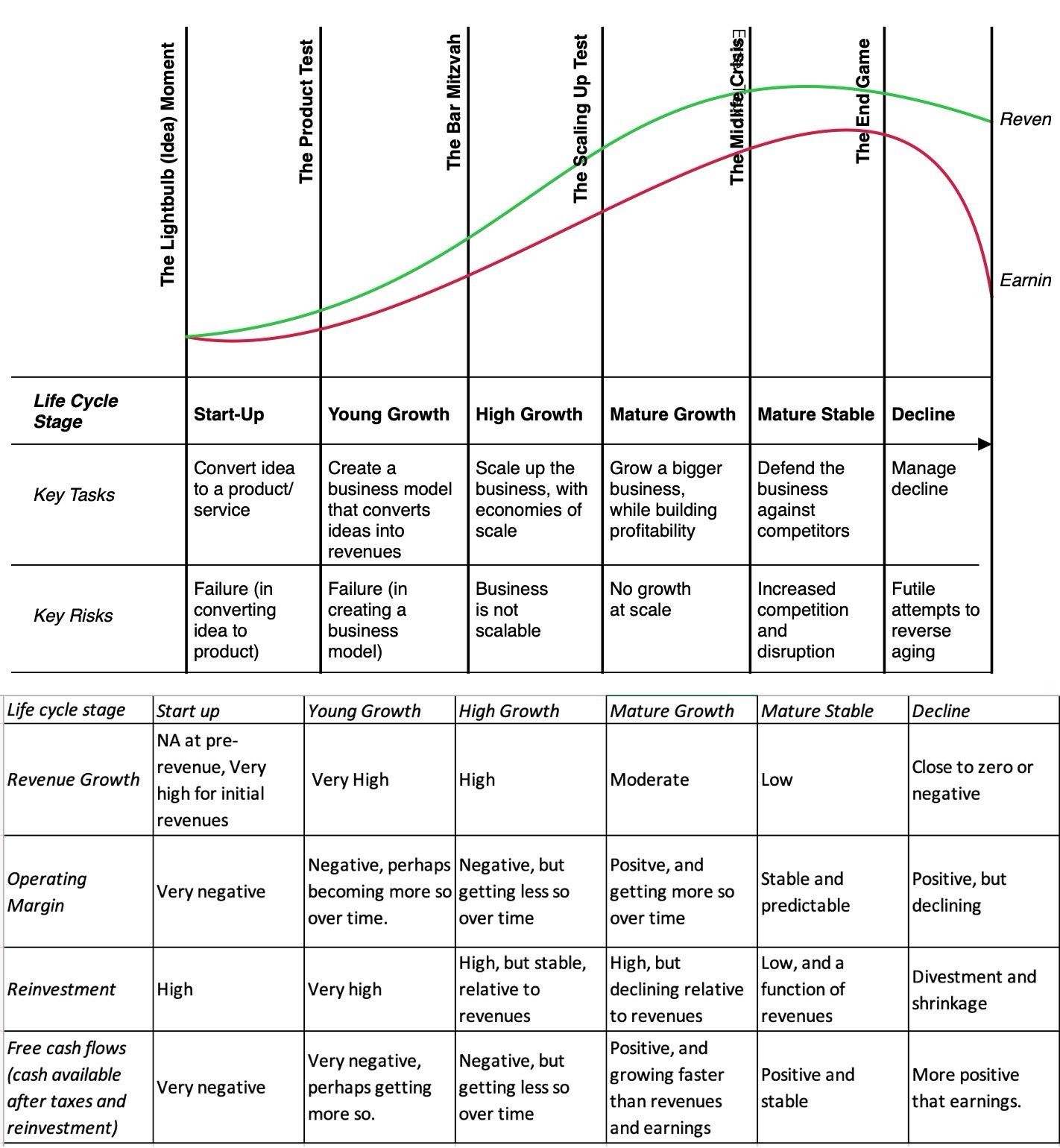
    My version of the corporate life cycle is built around six stages with the first stage being an idea business (a start-up) and the last one representing decline and demise. 


As you can see, the key tasks shift as business age, from building business models in the high growth phase to scaling up the business in high growth to defending against competition in the mature phase to managing decline int he last phase. Not surprisingly, the operating metrics change as companies age, with high revenue growth accompanied by big losses (from work-in-progress business models) and large reinvestment needs (to delivery future growth) in early-stage companies to large profits and free cash flows in the mature phase to stresses on growth and margins in decline. Consequently, in terms of cash flows, young companies burn through cash, with the burn increasing with potential, cash buildup is common as companies mature followed by cash return, as the realization kicks in that a company’s high growth days are in the past.
    As companies move through the life cycle, they will hit transition points in operations and in capital raising that have to be navigated, with high failure rates at each transition. Thus, most idea businesses never make it to the product phase, many product companies are unable to scale up, and quite a few scaled up firms are unable to defend their businesses from competitors. In short, the corporate life cycle has far higher mortality rates as businesses age than the human life cycle, making it imperative, if you are a business person, that you find the uncommon pathways to survive and grow.

Measures and Determinants

    If you buy into the notion of a corporate life cycle, it stands to reason that you would like a way to determine where a company stands in the life cycle. There are three choices, each with pluses and minuses. 

  • The first is to focus on corporate age, where you estimate how old a company is, relative its founding date; it is easy to obtain, but companies age at different rates (as well will argue in the following section), making it a blunt weapon.
  • The second is to look at the industry group or sector that a company is in, and then follow up by classifying that industry group or sector into high or low growth; for the last four decades, in US equity markets, tech has been viewed as growth and utilities as mature. Here again, the problem is that high growth industry groups begin to mature, just as companies do, and this has been true for some segments of the tech sector.
  • The third is to focus on the operating metrics of the firm, with firms that deliver high revenue growth, with low/negative profits and negative free cash flows being treated as young firms. It is more data-intensive, since making a judgment on what comprises high (revenue growth or margins) requires estimating these metrics across all firms.
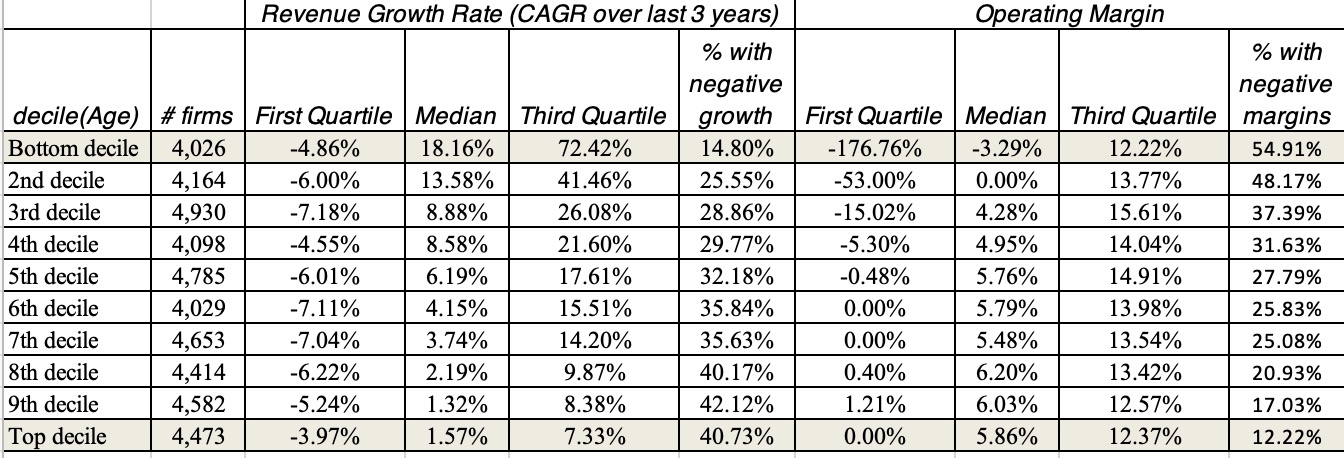
While I delve into the details of all three measures, corporate age works surprisingly well as a proxy for where a company falls in the life cycle, as can be seen in this table of all publicly traded companies listed globally, broken down by corporate age into ten deciles:


As you can see, the youngest companies have much higher revenue growth and more negative operating margins than older companies.

    Ultimately, the life cycles for companies can vary on three dimensions - length (how long a business lasts), height (how much it can scale up before it plateaus) and slope (how quickly it can scale up). Even a cursory glance at the companies that surround you should tell you that there are wide variations across companies, on these dimensions. To see why, consider the factors that determine these life cycle dimensions:

Companies in capital-light businesses, where customers are willing to switch from the status quo, can scale up much faster than companies in capital-intensive businesses, where brand names and customer inertia can make breakthroughs more difficult. It is worth noting, though, that the forces that allow a business to scale up quickly often limit how long it can stay at the top and cause decline to be quicker, a trade off that was ignored during the last decade, where scaling up was given primacy.

    The drivers of the corporate life cycle can also explain why the typical twenty-first century company faces a compressed life cycle, relative to its twentieth century counterpart. In the manufacturing-centered twentieth century, it took decades for companies like GE and Ford to scale up, but they also stayed at the top for long periods, before declining over decades. The tech-centered economy that we live in is dominated by companies that can scale up quickly, but they have brief periods at the top and scale down just as fast. Yahoo! and BlackBerry soared from start ups to being worth tens of billions of dollars in a blink of an eye, had brief reigns at the top and melted down to nothing almost as quickly. 

Tech companies age in dog years, and the consequences for how we manage, value and invest in them are profound. In fact, I would argue that the lessons that we teach in business school and the processes that we use in analysis need adaptation for compressed life cycle companies, and while I don't have all the answers, the discussion about changing practices is a healthy one.

Corporate Finance across the Life Cycle

    Corporate finance, as a discipline, lays out the first principles that govern how to run a business, and with a focus on maximizing value, all decisions that a business makes can be categorized into investing (deciding what assets/projects to invest in), financing (choosing a mix of debt and equity, as well as debt type) and dividend decisions (determining how much, if any, cash to return to owners, and in what form).


While the first principles of corporate finance do not change as a company ages, the focus and estimation processes will shift, as shown in the picture below:


With young companies, where the bulk of the value lies in future growth, and earnings and cash flows are often negative, it is the investment decision that dominates; these companies cannot afford to borrow or pay dividends. With more mature companies, as investment opportunities become scarcer, at least relative to available capital, the focus not surprisingly shifts to financing mix, with a lower hurdle rate being the pay off. With declining businesses, facing shrinking revenues and margins, it is cash return or dividend policy that moves into the front seat. 

Valuation across the Life Cycle

    I am fascinated by valuation, and the link between the value of a business and its fundamentals - cash flows, growth and risk. I am also a realist and recognize that I live in a world, where pricing dominates, with what you pay for a company or asset being determined by what others are paying for similar companies and assets:


All companies can be both valued and priced, but the absence of history and high uncertainty about the future that characterizes young companies makes it more likely that pricing will dominate valuation more decisively than it does with more mature firms. 
    All businesses, no matter where they stand in the life cycle, can be valued, but there are key differences that can be off putting to some. A well done valuation is a bridge between stories and numbers, with the interplay determining how defensible the valuation is, but the balance between stories and numbers will shift, as you move through the life cycle:

With young companies, absent historical data on growth and profitability, it is your story for the company that will drive your numbers and value. As companies age, the numbers will become more important, as the stories you tell will be constrained by what you have been able to deliver in growth and margins. If your strength as an analyst or appraiser is in bounded story telling, you will be better served valuing young companies, whereas if you are a number-cruncher (comfortable with accounting ratios and elaborate spreadsheet models), you will find valuing mature companies to be your natural habitat. 
    The draw of pricing is strong even for those who claim to be believers in value, and pricing in its simplest form requires a standardized price (a multiple like price earnings or enterprise value to EBITDA) and a peer group. While the pricing process is the same for all companies, the pricing metrics you use and the peer groups that you compare them to will shift as companies age:


For pre-revenue and very young companies, the pricing metrics will standardize the price paid (by venture capitalists and other investors) to the number of users or subscribers that a company has or to the total market that its product is aimed at. As business models develop, and revenues come into play, you are likely to see a shift to revenue multiples, albeit often to estimated revenues in a future year (forward numbers). In the mature phase, you will see earnings multiples become more widely used, with equity versions (like PE) in peer groups where leverage is similar across companies, and enterprise value versions (EV to EBITDA) in peer groups, where leverage is different across companies. In decline, multiples of book value will become more common, with book value serving as a (poor) proxy for liquidation or break up value. In short, if you want to be open to investing in companies across the life cycle, it behooves you to become comfortable with different pricing ratios, since no one pricing multiple will work on all firms.

Investing across the Life Cycle

    In my class (and book) on investment philosophies, I start by noting that every investment philosophy is rooted in a belief about markets making (and correcting) mistakes, and that there is no one best philosophy for all investors. I use the investment process, starting with asset allocation, moving to stock/asset selection and ending with execution to show the range of views that investors bring to the game:    

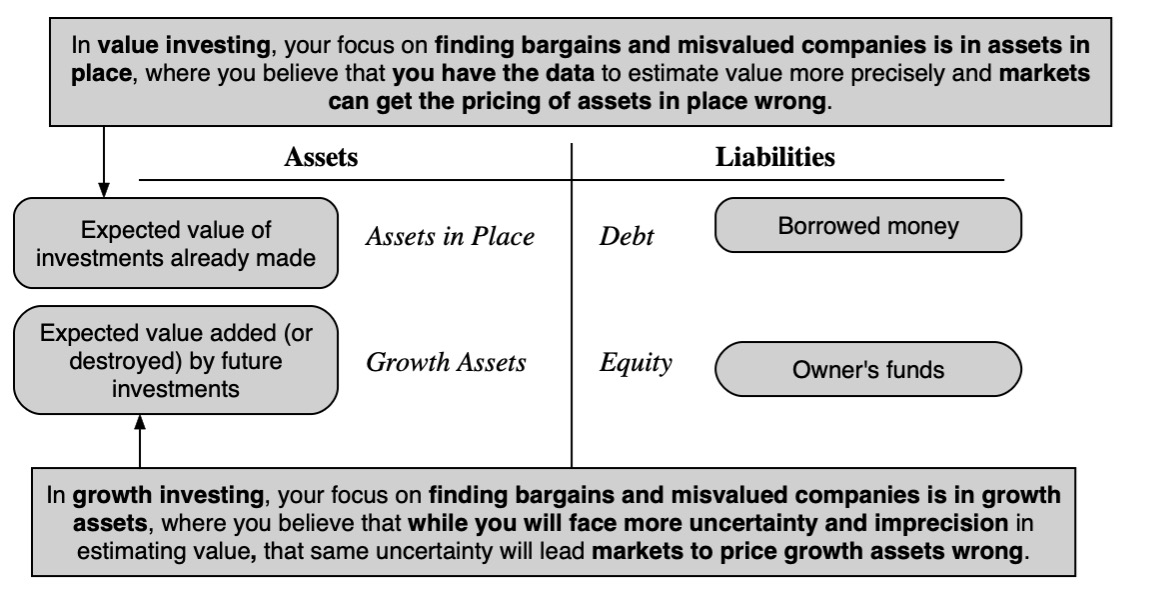
Market timing, whether it be based on charts/technical indicators or fundamentals, is primarily focused  on the asset allocation phase of investing, with cheaper (based upon your market timing measures) asset classes being over weighted and more expensive asset classes being under weighted. Within the stock selection phase, there are a whole host of investment philosophies, often holding contradictory views of market behavior. Among stock traders, for instance, there are those who believe that markets learn slowly (and go with momentum) and those who believe that markets over react (and bet on reversals). On the investing side, you have the classic divide between value and growth investors, both claiming the high ground. I view the differences between these two groups through the prism of a financial balance sheet:

Value investors believe that the best investment bargains are in mature companies, where assets in place (investments already made) are being underpriced by the market, whereas growth investors build their investment theses around the idea that it is growth assets where markets make mistakes. Finally, there are market players who try to make money from market frictions, by locking in market mispricing (with pure or near arbitrage). 

    Drawing on the earlier discussion of value versus price, you can classify market players into investors (who value companies, and try to buy them at a lower price, while hoping that the gap closes) and traders (who make them money on the pricing game, buying at a low price and selling at a higher one).  While investors and traders are part of the market in every company, you are likely to see the balance between the two groups shift as companies move through the life cycle:


Early in the life cycle, it is undeniable that traders dominate, and for investors in these companies, even if they are right in their value assessments, winning will require much longer time horizons and stronger stomachs. As companies mature, you are likely to see more investors become part of the game, with bargain hunters entering when the stock drops too much and short sellers more willing to counter when it goes up too much. In decline, as legal and restructuring challenges mount, and a company can have multiple securities (convertibles, bonds, warrants) trading on it, hedge funds and activists become bigger players.

    In sum, the investment philosophy you choose can lead you to over invest in companies in some phases of the life cycle, and while that by itself is not a problem, denying that this skew exists can become one. Thus, deep value investing, where you buy stocks that trade at low multiples of earnings and book value, will result in larger portions of the portfolio being invested in mature and declining companies. That portfolio will have the benefit of stability, but expecting it to contain ten-baggers and hundred-baggers is a reach. In contrast, a venture capital portfolio, invested almost entirely in very young companies, will have a large number of wipeouts, but it can still outperform, if it has a few large winners. Advice on concentrating your portfolio and having a margin of safety, both value investing nostrums, may work with the former but not with the latter.

Managing across the Life Cycle

    Management experts who teach at business schools and populate the premier consulting firms have much to gain by propagating the myth that there is a prototype for a great CEO. After all, it gives them a reason to charge nose-bleed prices for an MBA (to be imbued with these qualities) or for consulting advice, with the same end game. The truth is that there is no one-size-fits-all for a great CEO, since the qualities that you are looking for in top management will shift as companies age:


Early in the life cycle, you want a visionary at the top, since you have to get investors, employees and potential customers to buy into that vision. To turn the vision into products and services, though, you need a pragmatist, willing to accept compromises. As the focus shifts to business models, it is the business-building skills that make for a great CEO, allowing for scaling up and success. As a scaled-up business, the skill sets change again, with opportunism becoming the key quality, allowing the company to find new markets to grow in. In maturity, where playing defense becomes central, you want a top manager who can guard a company's competitive advantages fiercely. Finally, in decline, you want CEOs, unencumbered by ego or the desire to build empires, who are willing to preside over a shrinking business, with divestitures and cash returns high on the to-do list.
    There are very few people who have all of these skills, and it should come as no surprise that there can be a mismatch between a company and its CEO, either because they (CEO and company) age at different rates or because of hiring mistakes. Those mismatches can be catastrophic, if a headstrong CEO pushes ahead with actions that are unsuited to the company he or she is in charge off, but they can be benign, if the mismatched CEO can find a partner who can fill in for weaknesses:

While the possibilities of mismatches have always been part of business, the compression of corporate life cycles has made them both much more likely, as well as more damaging. After all, time took care of management transitions for long-lived twentieth century firms, but with firms that can scale up to become market cap giants in a decade, before scaling down and disappearing in the next one, you can very well see a founder/CEO go from being a hero in one phase to a zero in the next one. As we have allowed many of the most successful firms that have gone public in this century to skew the corporate finance game, with shares with different voting rights, we may be losing our power to change management at those firms where the need for change is greatest.

Aging gracefully? 

    The healthiest response to aging is acceptance, where a business accepts where it is in the life cycle, and behaves accordingly. Thus, a young firm that derives much of its value from future growth should not put that at risk by borrowing money or by buying back stock, just as a mature firm, where value comes from its existing assets and competitive advantages, should not risk that value by acquiring companies in new and unfamiliar businesses, in an attempt to return to its growth days. Acceptance is most difficult for declining firms, since the management and investors have to make peace with downsizing the firm. For these firms, it is worth emphasizing that acceptance does not imply passivity, a distorted and defeatist view of karma, where you do nothing in the face of decline, but requires actions that allow the firm to navigate the process with the least pain and most value to its stakeholders.

    It should come as no surprise that many firms, especially in decline, choose denial, where managers and investors come up with excuses for poor performance and lay blame on outside factors. On this path, declining firms will continue to act the way they did when they were mature or even growth companies, with large costs to everyone involved. When the promised turnaround does not ensue, desperation becomes the alternative path, with managers gambling large sums of other people’s money on long shots, with predictable results.

    The siren song that draws declining firms to make these attempts to recreate themselves, is the hope of a rebirth, and an ecosystem of bankers and consultants offers them magic potions (taking the form of proprietary acronyms that either restate the obvious or are built on foundations of made-up data) that will make them young again. They are aided and abetted by case studies of companies that found pathways to reincarnation (IBM in 1992, Apple in 2000 and Microsoft in 2013), with the added bonus that their CEOs were elevated to legendary status. While it is undeniable that companies do sometimes reincarnate, it is worth recognizing that they remain the exception rather than the rule, and while their top management deserves plaudits, luck played a key role as well.

    I am a skeptic on sustainability, at least as applied to companies, since its makes corporate survival the end game, sometimes with substantial costs for many stakeholders, as well as for society. Like the Egyptian Pharaohs who sought immortality by wrapping their bodies in bandages and being buried with their favorite possessions, companies that seek to live forever will become mummies (and sometimes zombies), sucking up resources that could be better used elsewhere.

In conclusion

    It is the dream, in every discipline, to come up with a theory or construct that explains everything in that disciple. Unlike the physical sciences, where that search is constrained by the laws of nature, the social sciences reflect more trial and error, with the unpredictability of human nature being the wild card. In finance, a discipline that started as an offshoot of economics in the 1950s, that search began with theory-based models, with portfolio theory and the CAPM, veered into data-based constructs (proxy models, factor analysis), and behavioral finance, with its marriage of finance and psychology. I am grateful for those contributions, but the corporate life cycle has offered me a low-tech, but surprisingly wide reaching, construct to explain much of what I see in business and investment behavior. 

    If you find yourself interested in the topic, you can try the book, and in the interests of making it accessible to a diverse reader base, I have tried to make it both modular and self-standing. Thus, if you are interested in how running a business changes, as it ages, you can focus on the four chapters that look at corporate finance implications, with the lead-in chapter providing you enough of a corporate finance foundation (even if you have never taken a corporate finance class) to be able to understand the investing, financing and dividend effects. If you are an appraiser or analyst, interested in valuing companies across the life cycle, it is the five chapters on valuation that may draw your interest, again with a lead-in chapter containing an introduction to valuation and pricing. As an investor, no matter what your investment philosophy, it is the four chapters on investing across the life cycle that may appeal to you the most. While I am sure that you will have no trouble finding the book, I have a list of book retailers listed below that you can use, if you choose, and the webpage supporting the book can be found here

    If you are budget-constrained or just don't like reading (and there is no shame in that), I have also created an online class, with twenty sessions of 25-35 minutes apiece, that delivers the material from the book. It includes exercises that you can use to check your understanding, and the link to the class is here

YouTube Video


Book and Class Webpages

  1. Book webpage: https://pages.stern.nyu.edu/~adamodar//New_Home_Page/CLC.htm
  2. Class webpage: https://pages.stern.nyu.edu/~adamodar//New_Home_Page/webcastCLC.htm
  3. YouTube Playlist for class: https://www.youtube.com/playlist?list=PLUkh9m2BorqlpbJBd26UEawPHk0k9y04_

Links to booksellers

  1. Amazon: https://www.amazon.com/Corporate-Lifecycle-Investment-Management-Implications/dp/0593545060
  2. Barnes & Noble: https://www.barnesandnoble.com/w/the-corporate-life-cycle-aswath-damodaran/1143170651?ean=9780593545065
  3. Bookshop.org: https://bookshop.org/p/books/the-corporate-lifecycle-business-investment-and-management-implications-aswath-damodaran/19850366?ean=9780593545065
  4. Apple: https://books.apple.com/us/audiobook/the-corporate-life-cycle-business-investment/id1680865376
There is an Indian edition that will be released in September, which should be available in bookstores there. The Indian edition can be found on Amazon India.