Showing posts with label Corporate Finance. Show all posts

Monday, August 19, 2024

The Corporate Life Cycle: Managing, Valuation and Investing Implications!

As I reveal my ignorance about TikTok trends, social media celebrities and Gen Z slang, my children are quick to point out my age, and I accept that reality, for the most part. I understand that I am too old to exercise without stretching first or eat a heaping plate of cheese fries and not suffer heartburn, but that does not stop me from trying occasionally. For the last decade or so, I have argued that businesses, like human beings, age, and struggle with aging, and that much of the dysfunction we observe in their decision making stems from refusing to act their age. In fact, the business life cycle has become an integral part of the corporate finance, valuation and investing classes that I teach, and in many of the posts that I have written on this blog. In 2022, I decided that I had hit critical mass, in terms of corporate life cycle content, and that the material could be organized as a book. While the writing for the book was largely done by November 2022, publishing does have a long lead time, and the book, published by Penguin Random House, will be available on August 20, 2024, at a book shop near you. If you are concerned that you are going to be hit with a sales pitch for that book, far from it!  Rather than try to part you from your money, I thought I would give a compressed version of the book in this post, and for most of you, that will suffice.

Setting the Stage
    The notion of a business life cycle is neither new nor original, since versions of it have floated around in management circles for decades, but its applications in finance have been spotty, with some attempts to tie where a company is in the life cycle to its corporate governance and others to accounting ratios. In fact, and this should come as no surprise to anyone who is familiar with his work, the most incisive piece tying excess returns (return on invested capital minus cost of capital) to the corporate life cycle was penned by Michael Mauboussin (with Dan Callahan) just a few months ago.
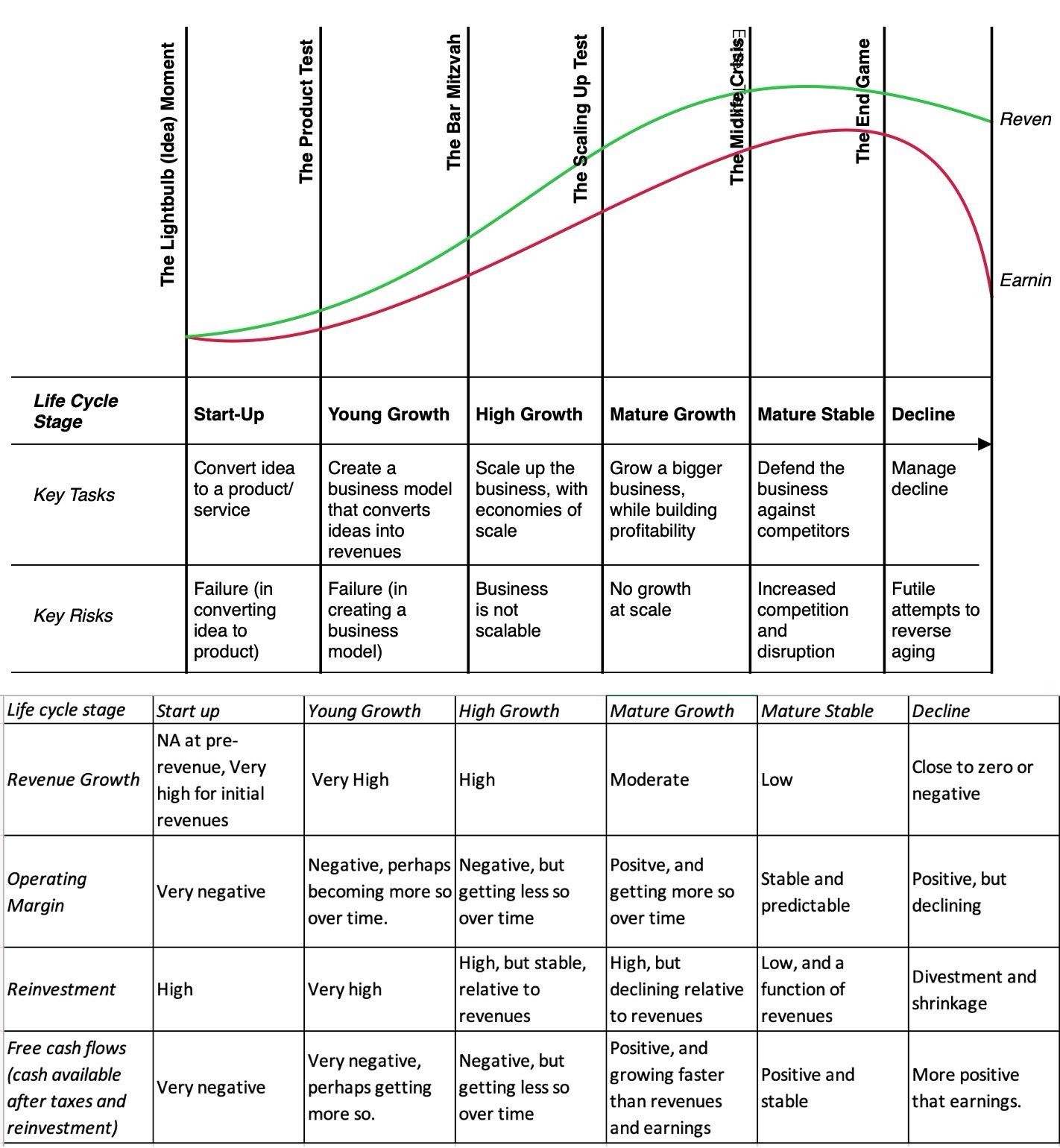
    My version of the corporate life cycle is built around six stages with the first stage being an idea business (a start-up) and the last one representing decline and demise. 


As you can see, the key tasks shift as business age, from building business models in the high growth phase to scaling up the business in high growth to defending against competition in the mature phase to managing decline int he last phase. Not surprisingly, the operating metrics change as companies age, with high revenue growth accompanied by big losses (from work-in-progress business models) and large reinvestment needs (to delivery future growth) in early-stage companies to large profits and free cash flows in the mature phase to stresses on growth and margins in decline. Consequently, in terms of cash flows, young companies burn through cash, with the burn increasing with potential, cash buildup is common as companies mature followed by cash return, as the realization kicks in that a company’s high growth days are in the past.
    As companies move through the life cycle, they will hit transition points in operations and in capital raising that have to be navigated, with high failure rates at each transition. Thus, most idea businesses never make it to the product phase, many product companies are unable to scale up, and quite a few scaled up firms are unable to defend their businesses from competitors. In short, the corporate life cycle has far higher mortality rates as businesses age than the human life cycle, making it imperative, if you are a business person, that you find the uncommon pathways to survive and grow.

Measures and Determinants

    If you buy into the notion of a corporate life cycle, it stands to reason that you would like a way to determine where a company stands in the life cycle. There are three choices, each with pluses and minuses. 

  • The first is to focus on corporate age, where you estimate how old a company is, relative its founding date; it is easy to obtain, but companies age at different rates (as well will argue in the following section), making it a blunt weapon.
  • The second is to look at the industry group or sector that a company is in, and then follow up by classifying that industry group or sector into high or low growth; for the last four decades, in US equity markets, tech has been viewed as growth and utilities as mature. Here again, the problem is that high growth industry groups begin to mature, just as companies do, and this has been true for some segments of the tech sector.
  • The third is to focus on the operating metrics of the firm, with firms that deliver high revenue growth, with low/negative profits and negative free cash flows being treated as young firms. It is more data-intensive, since making a judgment on what comprises high (revenue growth or margins) requires estimating these metrics across all firms.
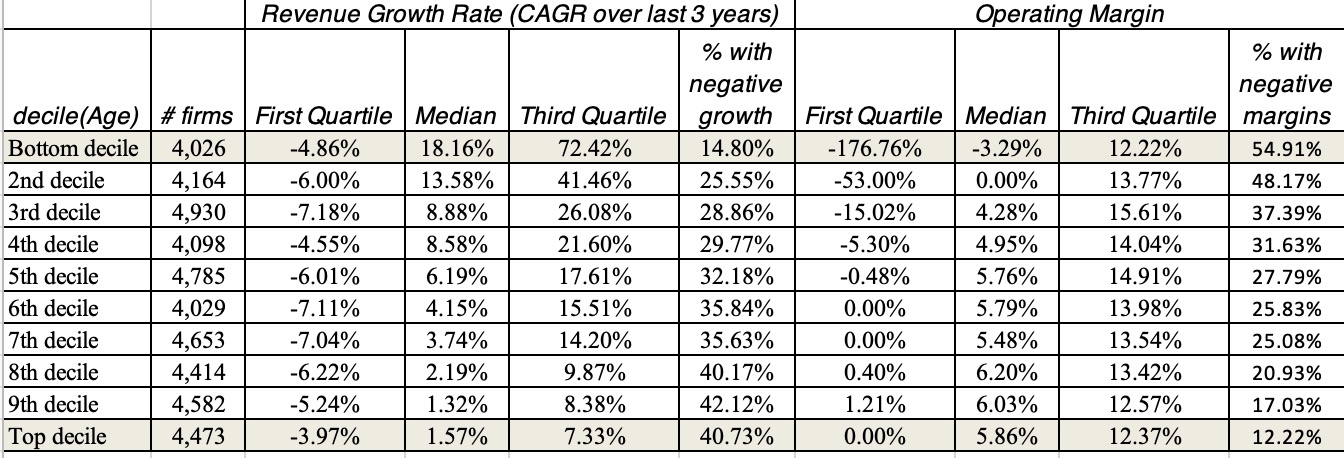
While I delve into the details of all three measures, corporate age works surprisingly well as a proxy for where a company falls in the life cycle, as can be seen in this table of all publicly traded companies listed globally, broken down by corporate age into ten deciles:


As you can see, the youngest companies have much higher revenue growth and more negative operating margins than older companies.

    Ultimately, the life cycles for companies can vary on three dimensions - length (how long a business lasts), height (how much it can scale up before it plateaus) and slope (how quickly it can scale up). Even a cursory glance at the companies that surround you should tell you that there are wide variations across companies, on these dimensions. To see why, consider the factors that determine these life cycle dimensions:

Companies in capital-light businesses, where customers are willing to switch from the status quo, can scale up much faster than companies in capital-intensive businesses, where brand names and customer inertia can make breakthroughs more difficult. It is worth noting, though, that the forces that allow a business to scale up quickly often limit how long it can stay at the top and cause decline to be quicker, a trade off that was ignored during the last decade, where scaling up was given primacy.

    The drivers of the corporate life cycle can also explain why the typical twenty-first century company faces a compressed life cycle, relative to its twentieth century counterpart. In the manufacturing-centered twentieth century, it took decades for companies like GE and Ford to scale up, but they also stayed at the top for long periods, before declining over decades. The tech-centered economy that we live in is dominated by companies that can scale up quickly, but they have brief periods at the top and scale down just as fast. Yahoo! and BlackBerry soared from start ups to being worth tens of billions of dollars in a blink of an eye, had brief reigns at the top and melted down to nothing almost as quickly. 

Tech companies age in dog years, and the consequences for how we manage, value and invest in them are profound. In fact, I would argue that the lessons that we teach in business school and the processes that we use in analysis need adaptation for compressed life cycle companies, and while I don't have all the answers, the discussion about changing practices is a healthy one.

Corporate Finance across the Life Cycle

    Corporate finance, as a discipline, lays out the first principles that govern how to run a business, and with a focus on maximizing value, all decisions that a business makes can be categorized into investing (deciding what assets/projects to invest in), financing (choosing a mix of debt and equity, as well as debt type) and dividend decisions (determining how much, if any, cash to return to owners, and in what form).


While the first principles of corporate finance do not change as a company ages, the focus and estimation processes will shift, as shown in the picture below:


With young companies, where the bulk of the value lies in future growth, and earnings and cash flows are often negative, it is the investment decision that dominates; these companies cannot afford to borrow or pay dividends. With more mature companies, as investment opportunities become scarcer, at least relative to available capital, the focus not surprisingly shifts to financing mix, with a lower hurdle rate being the pay off. With declining businesses, facing shrinking revenues and margins, it is cash return or dividend policy that moves into the front seat. 

Valuation across the Life Cycle

    I am fascinated by valuation, and the link between the value of a business and its fundamentals - cash flows, growth and risk. I am also a realist and recognize that I live in a world, where pricing dominates, with what you pay for a company or asset being determined by what others are paying for similar companies and assets:


All companies can be both valued and priced, but the absence of history and high uncertainty about the future that characterizes young companies makes it more likely that pricing will dominate valuation more decisively than it does with more mature firms. 
    All businesses, no matter where they stand in the life cycle, can be valued, but there are key differences that can be off putting to some. A well done valuation is a bridge between stories and numbers, with the interplay determining how defensible the valuation is, but the balance between stories and numbers will shift, as you move through the life cycle:

With young companies, absent historical data on growth and profitability, it is your story for the company that will drive your numbers and value. As companies age, the numbers will become more important, as the stories you tell will be constrained by what you have been able to deliver in growth and margins. If your strength as an analyst or appraiser is in bounded story telling, you will be better served valuing young companies, whereas if you are a number-cruncher (comfortable with accounting ratios and elaborate spreadsheet models), you will find valuing mature companies to be your natural habitat. 
    The draw of pricing is strong even for those who claim to be believers in value, and pricing in its simplest form requires a standardized price (a multiple like price earnings or enterprise value to EBITDA) and a peer group. While the pricing process is the same for all companies, the pricing metrics you use and the peer groups that you compare them to will shift as companies age:


For pre-revenue and very young companies, the pricing metrics will standardize the price paid (by venture capitalists and other investors) to the number of users or subscribers that a company has or to the total market that its product is aimed at. As business models develop, and revenues come into play, you are likely to see a shift to revenue multiples, albeit often to estimated revenues in a future year (forward numbers). In the mature phase, you will see earnings multiples become more widely used, with equity versions (like PE) in peer groups where leverage is similar across companies, and enterprise value versions (EV to EBITDA) in peer groups, where leverage is different across companies. In decline, multiples of book value will become more common, with book value serving as a (poor) proxy for liquidation or break up value. In short, if you want to be open to investing in companies across the life cycle, it behooves you to become comfortable with different pricing ratios, since no one pricing multiple will work on all firms.

Investing across the Life Cycle

    In my class (and book) on investment philosophies, I start by noting that every investment philosophy is rooted in a belief about markets making (and correcting) mistakes, and that there is no one best philosophy for all investors. I use the investment process, starting with asset allocation, moving to stock/asset selection and ending with execution to show the range of views that investors bring to the game:    

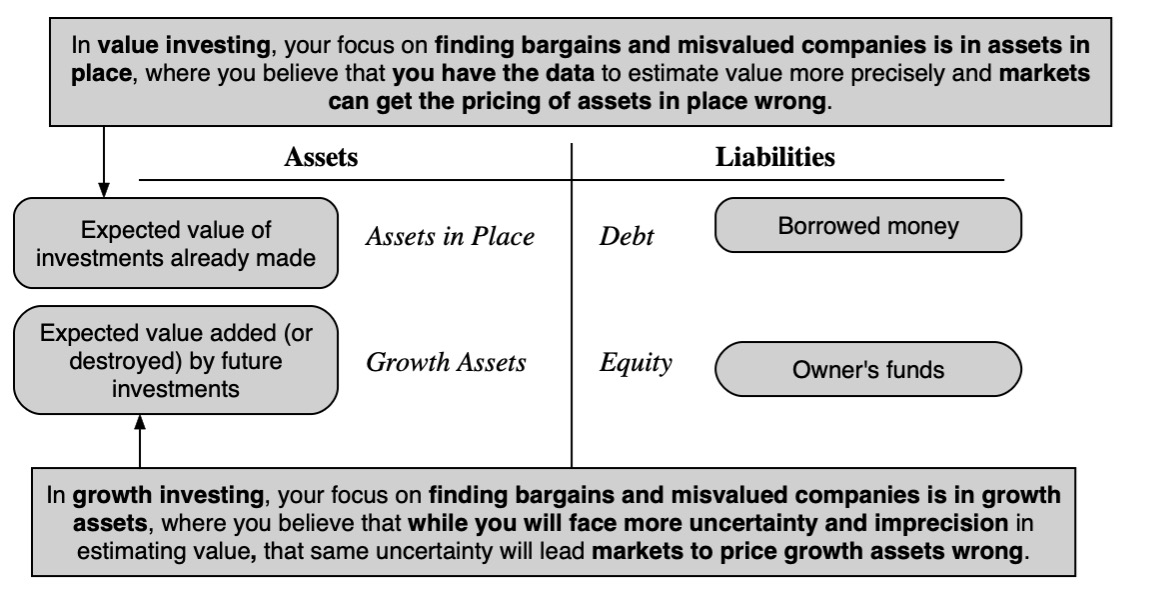
Market timing, whether it be based on charts/technical indicators or fundamentals, is primarily focused  on the asset allocation phase of investing, with cheaper (based upon your market timing measures) asset classes being over weighted and more expensive asset classes being under weighted. Within the stock selection phase, there are a whole host of investment philosophies, often holding contradictory views of market behavior. Among stock traders, for instance, there are those who believe that markets learn slowly (and go with momentum) and those who believe that markets over react (and bet on reversals). On the investing side, you have the classic divide between value and growth investors, both claiming the high ground. I view the differences between these two groups through the prism of a financial balance sheet:

Value investors believe that the best investment bargains are in mature companies, where assets in place (investments already made) are being underpriced by the market, whereas growth investors build their investment theses around the idea that it is growth assets where markets make mistakes. Finally, there are market players who try to make money from market frictions, by locking in market mispricing (with pure or near arbitrage). 

    Drawing on the earlier discussion of value versus price, you can classify market players into investors (who value companies, and try to buy them at a lower price, while hoping that the gap closes) and traders (who make them money on the pricing game, buying at a low price and selling at a higher one).  While investors and traders are part of the market in every company, you are likely to see the balance between the two groups shift as companies move through the life cycle:


Early in the life cycle, it is undeniable that traders dominate, and for investors in these companies, even if they are right in their value assessments, winning will require much longer time horizons and stronger stomachs. As companies mature, you are likely to see more investors become part of the game, with bargain hunters entering when the stock drops too much and short sellers more willing to counter when it goes up too much. In decline, as legal and restructuring challenges mount, and a company can have multiple securities (convertibles, bonds, warrants) trading on it, hedge funds and activists become bigger players.

    In sum, the investment philosophy you choose can lead you to over invest in companies in some phases of the life cycle, and while that by itself is not a problem, denying that this skew exists can become one. Thus, deep value investing, where you buy stocks that trade at low multiples of earnings and book value, will result in larger portions of the portfolio being invested in mature and declining companies. That portfolio will have the benefit of stability, but expecting it to contain ten-baggers and hundred-baggers is a reach. In contrast, a venture capital portfolio, invested almost entirely in very young companies, will have a large number of wipeouts, but it can still outperform, if it has a few large winners. Advice on concentrating your portfolio and having a margin of safety, both value investing nostrums, may work with the former but not with the latter.

Managing across the Life Cycle

    Management experts who teach at business schools and populate the premier consulting firms have much to gain by propagating the myth that there is a prototype for a great CEO. After all, it gives them a reason to charge nose-bleed prices for an MBA (to be imbued with these qualities) or for consulting advice, with the same end game. The truth is that there is no one-size-fits-all for a great CEO, since the qualities that you are looking for in top management will shift as companies age:


Early in the life cycle, you want a visionary at the top, since you have to get investors, employees and potential customers to buy into that vision. To turn the vision into products and services, though, you need a pragmatist, willing to accept compromises. As the focus shifts to business models, it is the business-building skills that make for a great CEO, allowing for scaling up and success. As a scaled-up business, the skill sets change again, with opportunism becoming the key quality, allowing the company to find new markets to grow in. In maturity, where playing defense becomes central, you want a top manager who can guard a company's competitive advantages fiercely. Finally, in decline, you want CEOs, unencumbered by ego or the desire to build empires, who are willing to preside over a shrinking business, with divestitures and cash returns high on the to-do list.
    There are very few people who have all of these skills, and it should come as no surprise that there can be a mismatch between a company and its CEO, either because they (CEO and company) age at different rates or because of hiring mistakes. Those mismatches can be catastrophic, if a headstrong CEO pushes ahead with actions that are unsuited to the company he or she is in charge off, but they can be benign, if the mismatched CEO can find a partner who can fill in for weaknesses:

While the possibilities of mismatches have always been part of business, the compression of corporate life cycles has made them both much more likely, as well as more damaging. After all, time took care of management transitions for long-lived twentieth century firms, but with firms that can scale up to become market cap giants in a decade, before scaling down and disappearing in the next one, you can very well see a founder/CEO go from being a hero in one phase to a zero in the next one. As we have allowed many of the most successful firms that have gone public in this century to skew the corporate finance game, with shares with different voting rights, we may be losing our power to change management at those firms where the need for change is greatest.

Aging gracefully? 

    The healthiest response to aging is acceptance, where a business accepts where it is in the life cycle, and behaves accordingly. Thus, a young firm that derives much of its value from future growth should not put that at risk by borrowing money or by buying back stock, just as a mature firm, where value comes from its existing assets and competitive advantages, should not risk that value by acquiring companies in new and unfamiliar businesses, in an attempt to return to its growth days. Acceptance is most difficult for declining firms, since the management and investors have to make peace with downsizing the firm. For these firms, it is worth emphasizing that acceptance does not imply passivity, a distorted and defeatist view of karma, where you do nothing in the face of decline, but requires actions that allow the firm to navigate the process with the least pain and most value to its stakeholders.

    It should come as no surprise that many firms, especially in decline, choose denial, where managers and investors come up with excuses for poor performance and lay blame on outside factors. On this path, declining firms will continue to act the way they did when they were mature or even growth companies, with large costs to everyone involved. When the promised turnaround does not ensue, desperation becomes the alternative path, with managers gambling large sums of other people’s money on long shots, with predictable results.

    The siren song that draws declining firms to make these attempts to recreate themselves, is the hope of a rebirth, and an ecosystem of bankers and consultants offers them magic potions (taking the form of proprietary acronyms that either restate the obvious or are built on foundations of made-up data) that will make them young again. They are aided and abetted by case studies of companies that found pathways to reincarnation (IBM in 1992, Apple in 2000 and Microsoft in 2013), with the added bonus that their CEOs were elevated to legendary status. While it is undeniable that companies do sometimes reincarnate, it is worth recognizing that they remain the exception rather than the rule, and while their top management deserves plaudits, luck played a key role as well.

    I am a skeptic on sustainability, at least as applied to companies, since its makes corporate survival the end game, sometimes with substantial costs for many stakeholders, as well as for society. Like the Egyptian Pharaohs who sought immortality by wrapping their bodies in bandages and being buried with their favorite possessions, companies that seek to live forever will become mummies (and sometimes zombies), sucking up resources that could be better used elsewhere.

In conclusion

    It is the dream, in every discipline, to come up with a theory or construct that explains everything in that disciple. Unlike the physical sciences, where that search is constrained by the laws of nature, the social sciences reflect more trial and error, with the unpredictability of human nature being the wild card. In finance, a discipline that started as an offshoot of economics in the 1950s, that search began with theory-based models, with portfolio theory and the CAPM, veered into data-based constructs (proxy models, factor analysis), and behavioral finance, with its marriage of finance and psychology. I am grateful for those contributions, but the corporate life cycle has offered me a low-tech, but surprisingly wide reaching, construct to explain much of what I see in business and investment behavior. 

    If you find yourself interested in the topic, you can try the book, and in the interests of making it accessible to a diverse reader base, I have tried to make it both modular and self-standing. Thus, if you are interested in how running a business changes, as it ages, you can focus on the four chapters that look at corporate finance implications, with the lead-in chapter providing you enough of a corporate finance foundation (even if you have never taken a corporate finance class) to be able to understand the investing, financing and dividend effects. If you are an appraiser or analyst, interested in valuing companies across the life cycle, it is the five chapters on valuation that may draw your interest, again with a lead-in chapter containing an introduction to valuation and pricing. As an investor, no matter what your investment philosophy, it is the four chapters on investing across the life cycle that may appeal to you the most. While I am sure that you will have no trouble finding the book, I have a list of book retailers listed below that you can use, if you choose, and the webpage supporting the book can be found here

    If you are budget-constrained or just don't like reading (and there is no shame in that), I have also created an online class, with twenty sessions of 25-35 minutes apiece, that delivers the material from the book. It includes exercises that you can use to check your understanding, and the link to the class is here

YouTube Video


Book and Class Webpages

  1. Book webpage: https://pages.stern.nyu.edu/~adamodar//New_Home_Page/CLC.htm
  2. Class webpage: https://pages.stern.nyu.edu/~adamodar//New_Home_Page/webcastCLC.htm
  3. YouTube Playlist for class: https://www.youtube.com/playlist?list=PLUkh9m2BorqlpbJBd26UEawPHk0k9y04_

Links to booksellers

  1. Amazon: https://www.amazon.com/Corporate-Lifecycle-Investment-Management-Implications/dp/0593545060
  2. Barnes & Noble: https://www.barnesandnoble.com/w/the-corporate-life-cycle-aswath-damodaran/1143170651?ean=9780593545065
  3. Bookshop.org: https://bookshop.org/p/books/the-corporate-lifecycle-business-investment-and-management-implications-aswath-damodaran/19850366?ean=9780593545065
  4. Apple: https://books.apple.com/us/audiobook/the-corporate-life-cycle-business-investment/id1680865376
There is an Indian edition that will be released in September, which should be available in bookstores there. The Indian edition can be found on Amazon India.

Thursday, December 19, 2019

A Teaching Manifesto: An Invitation to my Spring 2020 classes

If you have been reading my blog for long enough, you should have seen this post coming. Every semester that I teach, and it has only been in the spring in the last few years, I issue an invitation to anyone interested to attend my classes online. While I cannot offer you credit for taking the class or much direct personal help, you can watch my sessions online (albeit not live), review the slides that I use and access the post class material, and it is free. If you are interested in a certificate version of the class, NYU offers that option, but it does so for a fee. You can decide what works for you, and whatever your decision is, I hope that you enjoy the material and learn from it, in that order.

The Structure

I will be teaching three classes in Spring 2020 at the Stern School of Business (NYU), a corporate finance class to the MBAs and two identical valuation classes, one to the MBAs and one for undergraduates. If you decide to take one of the MBA classes, the first session will be on February 3, 2020, and there will be classes every Monday and Wednesday until May 11, 2020, with the week of March 15-22 being spring break. In total, there will be 26 sessions, each session lasting 80 minutes. The undergraduate classes start a week earlier, on January 27, and go through May 11, comprising 28 sessions of 75 minutes apiece. 
  1. The Spring 2020 Classses: With all three classes, the sessions will be recorded and converted into streams, accessible on my website and downloadable, as well as YouTube videos, with each class having its own playlist. In addition, the classes will also be carried on iTunes U, with material and slides, accessible from the site. The session videos will usually be accessible about 3-4 hours after class is done and you can either take the class in real time, watching the sessions in the week that they are taught, or in bunches, when you have the time to spend to watch the sessions; the recordings will stay online for at least a couple of years after the class ends. There will be no need for passwords, since the session videos will be unprotected on all of the platforms. 
  2. The (Free) Online Version: During the two decades that I have been offering this online option, I have noticed that many people who start the class with the intent of finishing it give up for one of two reasons. The first is that watching an 80-minute video on a TV or tablet is a lot more difficult than watching it live in class, straining both your patience and your attention. The second is that watching these full-length videos is a huge time commitment and life gets in the way. It is to counter these problems that I created 12-15 minute versions of the each session for online versions of the classes. These online classes, recorded in 2014 and 2015, is also available on my website and through YouTube, and should perhaps be more doable than the full class version.
  3. The NYU Certificate Version: For most of the last 20 years, I have been asked why I don’t offer certificates of completion for my own classes and I have had three answers. The first is that, as a solo act, I don’t have the bandwidth to grade and certify the 20,000 people who take the classes each semester. The second is that certification requires regulatory permission, a bureaucratic process in New York State that I have neither the stomach nor the inclination to go through. The third is, and it is perhaps the most critical, is that I am lazy and I really don't want to add this to my to-do list. One solution would be to offer the classes through platforms like Coursera, but those platforms work with universities, not individual faculty, and NYU has no agreements with any of these platforms. About three years ago, when NYU approached me with a request to create online certificate classes, I agreed, with one condition: that the free online versions of these classes would continue to be offered. With those terms agreed to, there are now NYU Certificate versions of each of the online classes, with much of the same content, but with four add ons. First, each participant will have to take quizzes and a final exam, multiple choice and auto-graded, that will be scored and recorded. Second, each participant will have to complete and turn in a real-world project, showing that they can apply the principles of the class on a company of their choice, to be graded by me. Third, I will have live Zoom sessions every other week for class participants, where you can join and ask questions about the material. Finally, at the end of the class, assuming that the scores on the exams and project meet thresholds, you will get a certificate, if you pass the class, or a certificate with honors, if you pass it with flying colors.
The Classes
I have absolutely no desire to waste your time and your energy by trying to get you to take classes that you either have no interest in, or feel will serve no good purpose for you. In this section, I will  provide a short description of each class, and provide links to the different options for taking each class.

I. Corporate Finance

Class description: I don’t like to play favorites, but corporate finance is my favorite class, a big picture class about the first principles of finance that govern how to run a business. I will not be egotistical enough to claim that you cannot run a business without taking this class, since there are many incredibly successful business-people who do, but I do believe that you cannot run a business without paying heed to the first principles. I teach this class as a narrative, staring with the question of what the objective of a business should be and then using that objective to determine how best to allocate and invest scarce resources (the investment decision), how to fund the business (the financing decision) and how much cash to take out and how much to leave in the business (the dividend decision). I end the class, by looking at how all of these decisions are connected to value.

Chapters: Applied Corporate Finance Book, Sessions: Class session
I am not a believer in theory, for the sake of theory, and everything that we do in this class will be applied to real companies, and I will use six companies (Disney, Vale, Tata Motors, Deutsche Bank, Baidu and a small private bookstore called Bookscape) as lab experiements that run through the entire class.

I say, only half-jokingly, that everything in business is corporate finance, from the question of whether shareholder or stakeholder interests should have top billing at companies, to why companies borrow money and whether the shift to stock buybacks that we are seeing at US companies is good or bad for the economy. Since each of these questions has a political component, and have now entered the political domain, I am sure that the upcoming presidential election in the US will create some heat, if not light, around how they are answered.

For whom?

As I admitted up front, I believe that having a solid corporate finance perspective can be helpful to everyone. I have taught this class to diverse groups, from CEOs to banking analysts, from VCs to startup founders, from high schoolers to senior citizens, and while the content does not change, what people take away from the class is different. For bankers and analysts, it may be the tools and techniques that have the most staying power, whereas for strategists and founders, it is the big picture that sticks. So, in the words of the old English calling, "Come ye, come all", take what you find useful, abandon what you don't and have fun while you do this.

Links to Offerings

1. Spring 2020 Corporate Finance MBA class (Free)
2. Online Corporate Finance Class (Free)

3. NYU Certificate Class on Corporate Finance (It will cost you...)

II. Valuation

Class description: Some time in the last decade, I was tagged as the Dean of Valuation, and I still cringe when I hear those words for two reasons. First, it suggests that valuation is a deep and complex subject that requires intense study to get good at. Second, it also suggests that I somehow have mastered the topic. If nothing else, this class that I first taught in 1987 at NYU, and have taught pretty much every year since, dispenses with both delusions. I emphasize that valuation, at its core, is simple and that practitioner, academics and analysts often choose to make it complex, sometimes to make their services seem indispensable, and sometimes because they lose the forest for the trees. Second, I describe valuation as a craft that you learn by doing, not by reading or watching other people talk about it, and that I am still working on the craft. In fact, the more I learn, the more I realize that I have more work to do.  This is a class about valuing just about anything, from an infrastructure project to a small private business to a multinational conglomerate, and it also looks at value from different perspectives, from that of a passive investor seeking to buy a stake or shares in a company to a PE or VC investor taking a larger stake to an acquirer interested in buying the whole company. 

Finally, I lay out my rationale for differentiating between value and price, and why pricing an asset can give you a very different number than valuing that asset, and why much of what passes for valuation in the real world is really pricing. 

Along the way, I emphasize how little has changed in valuation over the centuries, even as we get access to more data and more complex models, while also bringing in new tools that have enriched us, from option pricing models to value real options (young biotech companies, natural resource firms) to statistical add-ons (decision trees, Monte Carlo simulations, regressions). 

For whom?

Do you need to be able to do valuation to live a happy and fulfilling life? Of course not, but it is a skill worth having as a business owner, consultant, investor or just bystander. With that broad audience in mind, I don't teach this class to prepare people for equity research or financial analysis jobs, but to get a handle on what it is that drives value, in general, and how to detect BS, often spouted in its context. Don't get me wrong! I want you to be able to value or price just about anything by the end of this class, from Bitcoin to WeWork, but don't take yourself too seriously, as you do so.

Links to Offerings
1a. Spring 2020 Valuation MBA class (Free)
1b. Spring 2020 Valuation Undergraduate class (Free)
2. Online Valuation Class (Free)
3. NYU Certificate Class on Valuation (Paid)
III. Investment Philosophies

Class description: This is my orphan class, a class that I have had the material to teach but never taught in a regular classroom. It had its origins in an couple of observations that puzzled me. The first was that, if you look at the pantheon of successful investors over time, it is not only a short one, but a diverse grouping, including those from the old time value school (Ben Graham, Warren Buffett), growth success stories (Peter Lynch and VC), macro and market timers (George Soros), quant players (Jim Simon) and even chartists. The second was that the millions who claim to follow these legends, by reading everything ever written by or about them and listening to their advice, don’t seem to replicate their success. That led me to conclude that there could be no one ‘best’ Investment philosophy across all investors but there could be one that is best for you, given your personal makeup and characteristics, and that if you are seeking investment nirvana, the person that you most need to understand is not Buffett or Lynch, but you.  In this class, having laid the foundations for understanding risk, transactions cost and market efficiency (and inefficiency), I look at the entire spectrum of investment philosophies, from charting/technical analysis to value investing in all its forms (passive, activist, contrarian) to growth investing (from small cap to venture capital) to market timing. With each one, I look at the core drivers (beliefs and assumptions) of the philosophy, the historical evidence on what works and does not work and end by looking at what an investor needs to bring to the table, to succeed with each one.

I will try (and not always succeed) to keep my biases out of the discussion, but I will also be open about where my search for an investment philosophy has brought me. By the end of the class, it is not my intent to make you follow my path but to help you find your own.

For whom?
This is a class for investors, not portfolio managers or analysts, and since we are all investors in one way or the other, I try to make it general. That said, if your intent is to take a class that will provide easy pathways to making money, or an affirmation of the "best" investment philosophy, this is not the class for you. My objective in this class is not to provide prescriptive advice, but to instead provide a menu of choices, with enough information to help you can make the choice that is best for you. Along the way, you will see how difficult it is to beat the market, why almost every investment strategy that sounds too good to be true is built on sand, and why imitating great investors is not a great way to make money.


Links to Offerings

1. Online Investment Philosophies Class (Free)
2. NYU Certificate Class on Valuation (Paid)
  • NYU Entry Page (Coming soon)
Conclusion
I have to confess that I don't subscribe to the ancient Guru/Sishya relationship in teaching, where the Guru (teacher) is an all-knowing individual who imparts his or her fountain of wisdom to a receptive and usually subservient follower. I have always believed that every person who takes my class, no matter how much of a novice in finance, already knows everything that needs to be known about valuation, corporate finance and investments, and it is my job, as a teacher, to make him or her aware of this knowledge. Put simply, I can provide some structure for you to organize what you already know, and tools that may help you put that knowledge into practice, but I am incapable of profundity. I hope that you do give one (or more) of my classes a shot and I hope that you both enjoy the experience and get a chance to try it out on real companies in real time.

YouTube Video

Wednesday, August 15, 2018

Deja Vu In Turkey: Currency Crisis and Corporate Insanity!

This has been a year of rolling crises, some originating in developed markets and some in emerging markets, and the market has been remarkably resilient through all of them. It is now Turkey's turn to be in the limelight, though not in a way it hoped to be, as the Turkish Lira enters what seems like a death spiral, that threatens to spill over into other emerging markets. There is plenty that can be said about the macro origins of this crisis, with Turkey's leaders and central bank bearing a lion's share of the blame, but that is not going to be the focus of this post. Instead, I would like to examine how Turkish business practices, and the willful ignorance of basic financial first principles, are making the effects of this crisis worse, and perhaps even catastrophic. 

The Turkish Crisis: So far!
The Turkish problem became a full fledged crisis towards the end of last week, but this is a crisis that has been brewing for months, if not years. It has its roots in both Turkish politics and dysfunctional practices on the part of Turkish regulators, banks and businesses, and has been aided and abetted by investors who have been too willing to look the other way. The most visible symbol of this crisis has been the collapse of the Turkish Lira, which has been losing value, relative to other currencies, for a while, capped off by a drop of almost 15% last Friday (August 10):
Yahoo! Finance
While it is undoubtedly true that the weaker Lira will lead to more problems, currency collapses are symptoms of fundamental problems and for Turkey, those problems are two fold. One is a surge in inflation in the Turkish economy, which can be seen in graph below:

While it easy to blame the Turkish central bank for dereliction of duty, it has been handicapped by Turkey's political leadership, which seems intent on making its own central bank toothless. Rather than allow the central bank to use the classic counter to a currency collapse of raising central bank-set interest rates, the government has put pressure on the bank to lower rates, with predictable (and disastrous) consequences.

Corporate Finance: First Principles
I teach both corporate finance and valuation, and while both are built on the same first principles, corporate finance is both wider and deeper than valuation since it looks at businesses from the inside out. i.e., how decisions made a firm's founders/managers play out in value. In my introductory corporate finance class, I list out the three common sense principles that govern all businesses and how they drive value:
The financing principle operates at the nexus of investing and dividend principles and choices you make on financing can affect both investment and dividend policy. It is true that when most analysts look at the financing principle, they zero in on the financing mix part, looking at the right mix of debt and equity for a firm. I have posted on that question many times, including the start of this year as part of my examination of global debt ratios, and have used the tools to assess whether a company should borrow money or use equity (See my posts on Tesla and Valeant). There is another part to the financing principle, though, that is often ignored, and it is that the right debt for a company should mirror its asset characteristics. Put simply, long term projects should be funded with long term debt, convertible debt is a better choice than fixed rate debt for growth companies and assets with cash flows in dollars (euros) should be funded with dollar (euro) debt. The intuition behind matching does not require elaborate mathematical reasoning but is built on common sense. When you mismatch debt (in terms of maturity, type or currency) with assets, you increase your likelihood of default, and holding debt ratios constant, your cost of debt and capital.
In effect, your perfect debt will provide you with all of the tax benefits of debt while behaving like equity, with cash flows that adapt to your cash flows from operations.

There are two ways that you can match debt up to assets. The first is to issue debt that is reflective of your projects and assets and the second is to use derivatives and swaps to fix the mismatch. Thus, a company that gets its cash flows in rupees, but has dollar debt, can use currency futures and options to protect itself, at least partially, against currency movements. While access to derivatives and swap markets has increased over time, a company that knows its long term project characteristics should issue debt that matches that long term exposure, and then use derivatives & swaps to protect itself against short term variations in exposure.

Turkey: A Debt Mismatch Outlier?
The argument for matching debt structure (maturity, currency, convertibility) to asset characteristics is not rocket-science but corporations around the world seem to revel in mismatching debt and assets, using short term debt to fund long term assets (or vice versa) and sometimes debt in one currency to fund projects that generate cashflows in another. In numerous studies, done over the decades, looking across countries, Turkish companies rank among the very worst, when it comes to mismatching currencies on debt, using foreign currency debt (Euros and dollars primarily) to fund domestic investments. 

Lest I be accused of using foreign data services that are biased against Turkey, I decided to stick with the data provided by the Turkish Central Bank on the currency breakdown of borrowings by Turkish firms. In the chart below, I trace the foreign exchange (FX) assets and liabilities, for non-financial Turkish companies, from 2008 and 2018:
Central Bank of Turkey
The numbers are staggeringly out of sync with  Turkish non-financial service companies owing $217 billion more in foreign currency terms than they own on foreign currency assets, and this imbalance (between foreign exchange assets and liabilities) has widened over time, tripling since 2008.

I am sure that there will be some in the Turkish business establishment who will blame the mismatching on external forces, with banks in other European countries playing the role of villains, but the numbers tell a different story. Much of the FX debt has come from Turkish banks, not German or French banks, as can be seen in the chart below:
Central Bank of Turkey
In 2018, 59% of all FX liabilities at Turkish non-financial service firms came from Turkish banks and financial service firms, up from 39% in 2008. The mismatch is not just on currencies, though. Looking at the breakdown, by maturity, of FX assets and liabilities for Turkish non-financial service firms, here is what we see:
Central Bank of Turkey
In May 2018, while about 80% of FX assets are Turkish non-financial firms are short term, only 27% of the FX debt is short term, a large temporal imbalance.

It is possible that the Turkish government may be able to put pressure on domestic banks to prevent them from forcing debt payments, in the face of the collapse of the lira, but looking at when the debt owed foreign borrowers comes due (for both Turkish financial and non-financial firms), here is what we see.
Central Bank of Turkey
From a default risk perspective, though, the debt maturity schedule carries a message. About 50% of debt owed by Turkish banks and 40% of the debt owed by Turkish non-financial service companies will be coming due by 2020, and if the precipitous drop in the Lira is not reversed, there is a whole lot of pain in store for these firms.

Rationalizing the Mismatch: The Good, The Dangerous and the Deadly
Turkish firms clearly have a debt mismatch problem, and the institutions (government, bank regulators, banks) that should have been keeping the problem in check seem to have played an active role in making it worse. Worse, this is not the first time that Turkish firms and banks will be working through a debt mismatch crisis. It has happened before, in 1994, 2001 and 2008, just looking at recent decades. If insanity is doing the same thing over and over, expecting a different outcome, there is a good case to be made that Turkish institutions, from top to bottom, are insane, at least when it comes to dealing with currency in financing. So, why do Turkish companies seem willing to repeat this mistake over and over again? In fact, since this mismatching seems to occur in many emerging markets, though to a lesser scale, why do companies go for currency mismatches? Having heard the rationalizations from dozens of CFOs on every continent, I would classify the reasons on a spectrum from acceptable to absurd.

Acceptable Reasons
There are three scenarios where a company may choose to mismatch debt, borrowing in a currency other than the one in which it gets its cash flows.
  1. The mismatched debt is subsidized: If the mismatched debt is being offered to you (the borrower) at rates that are well below what you should be paying, given your default risk, you should accept that mismatched debt. That is sometimes the case when companies get funding from organizations like the IFC that offer the subsidies in the interests of meeting other objectives (such as increasing investment in under developed countries). It can also happen when lenders and bondholders become overly optimistic about an emerging market's prospects, and lend money on the assumption that high growth will continue without hiccups.
  2. Domestic debt markets are moribund: There are emerging markets where the only option for borrowing money is local banks, and during periods of uncertainty or crisis, these banks can pull back from lending. If you are a company in one of these markets and have the option of borrowing elsewhere in the world to fund what you believe are good investments, you may push forward with your borrowing, even though it is currency mismatched.
  3. Domestic debt markets are too rigid: As you can see from the debt design section, the perfect debt for your firm will often require tweaks that include not only conversion and floating rate options, but more unusual tweaks (such as commodity-linked interest rates). If domestic debt markets are unwilling or unable to offer these customized debt offerings, a company that can access bond markets overseas may do so, even if it means borrowing in a mismatched currency.
In all three cases, though, once the money has been borrowed, the company that has mismatched its debt should turn to the derivatives and swap markets to reduce or eliminate this mismatch.

Dangerous Reasons
There are two reasons that are offered by some companies that mismatch debt that may make sense, on the surface, but are inherently dangerous:

  1. Speculate on currency: Mismatching currencies, when you borrow money, can be a profitable exercise, if the currency moves in the right direction. A Turkish company that borrows in US dollars, a lower-inflation currency with lower interest rates, to fund projects that deliver cashflows in Turkish Lira, a higher-inflation currency, will book profits if the Lira strengthens against the US dollar. Since emerging market currencies can go through extended periods of deviation from purchasing power parity, i.e., the higher inflation emerging market currency strengthens (rather than weakening) against the lower inflation developed market currency, mismatching currencies can be profitable for extended periods. There will be a moment of reckoning, in the longer term, though, when exchange rates will correct, and unless the company can see this moment coming and correct its mismatch, it will not only lose all of the easy profits from prior periods, but find its survival threatened. Currency forecasting is a pointless exercise, even when practiced by professional currency traders, and I think that companies should steer away from the practice.
  2. Everyone does it: I have argued that many corporate finance practices are driven by inertia and me-tooism rather than good sense, and in many countries where currency mismatches are common, the standard defense is that everyone does it. Many of these companies argue that the government cannot let the entire corporate sector slide into default and will step in to bail them out, and true to form, governments deliver those bailouts. In effect, the taxpayers become the backstop for bad corporate behavior.
Bad Reasons
I am surprised by some of the arguments that I have heard for mismatching debt, since they suggest fundamental gaps in basic financial and economic knowledge.

  1. The mismatched debt has a lower interest rate:  I have heard CFOs of companies in emerging markets, where domestic debt carries high interest rates, argue that it is cheaper to borrow in US dollars or Euros, because interest rates are lower on loans denominated in those currencies. After all, it is cheaper to borrow at 5% than at 15%, right? Not necessarily, if the 5% rate is on a US dollar debt and the 15% debt is in Turkish Lira, and here is why. If the expected inflation rate in US dollars is 2% and in Turkish Lira is 14%, it is the Turkish Lira debt that is cheaper.
  2. Risk/Reward: There are some companies that fall back on the proposition that mismatching debt is like any other financial choice, a trade off between higher risk and higher reward. In other words, their belief is that they will earn higher profits, on average and over time, with mismatched debt than with matched debt, but with more variability in those profits. This argument stems from the misplaced belief that markets reward all risk taking, when the truth is that senseless risk taking just delivers more risk, with no reward, and mismatching debt is senseless.
The Fix
It is too late for Turkish companies to fix their debt problem for this crisis, but given that this crisis too shall pass, albeit after substantial damage has been done, there are actions that we can take to keep it from repeating, though it will require everyone involved to change their ways:
  • Governments should stop enabling debt mismatching, by not stepping in repeatedly to save corporates that have mismatched debt. That will increase the short term pain of the next crisis, but reduce the likelihood of repeating that crisis. 
  • Bank Regulators should measure how much the banks that they regulate have lent out to corporates, in mismatched debt, and require them to set aside more capital to cover the inevitable losses. That, in turn, will reduce the profitability of lending out money to companies that mismatch.
  • Banks have to incorporate whether the debt being taken by a business is mismatched in deciding how much to lend and on what terms. The interest rates on mismatched debt should be higher than on matched debt.
  • Companies and businesses have to consider what currency a loan or bond is in, when evaluating interest rates, and in their own best interests, try to match up debt to assets, either directly (in debt design) or using derivatives.
  • Investors in companies should start breaking down the profitability of firms with mismatched debt, especially in good periods, into profits from debt mismatch and profits from operations, and ignore or at least discount the former, when pricing these companies.
I don't think any of these changes will happen overnight but unless we change our behavior, we are designed to replay this crisis in other emerging markets repeatedly. 

YouTube Video


Data

  1. FX Assets & Liabilities of Turkish non-financial corporations (from Turkish Central Bank)
  2. Loans from Abroad to Turkish Private Sector

Papers

  1. Financing Innovations and Capital Structure Choices

Saturday, January 30, 2016

Corporate Finance 101: A Big Picture, Applied Class!

In my last seven posts, I played my version of Moneyball with company data from the end of 2015, looking at how companies invest their shareholders' money, how much they borrow and the determinants of how much cash they return to stockholders. That structure is the one that underlies the corporate finance class that I have taught every year since 1984, the first two years at UC Berkeley, and the last 30 years at the Stern School of Business. Each semester, for the last few years, I have also invited you, even if you are not a Stern MBA student, to follow the class online, if you so desire, in all its gory details. If you are considering this options, I thought it would make sense to take you on a mini-tour of corporate finance, as a discipline, and how I aim to tackle it in this class.

Corporate Finance: The Big Picture
There are many versions of corporate finance that are taught in class rooms. There is the accounting version of corporate finance, that uses the historical, rule-bound construct of accounting as the basis for corporate finance. Decision making is driven by accounting ratios and financial statements, rather than first principles. There is the banking version of corporate finance, where the class is structured around what bankers do for firms, with the bulk of the class being spent on areas where firms interact with financial markets (M&A, financing choices) and the focus is less on what's right for the firms, and more on how the deal making works. My version of corporate finance is built around the first principles of running a business and it covers every aspect of business from production to marketing to even strategy. In case you are skeptical about the big picture version of this class, here is what it looks like:
All of corporate finance boils down to three broad decisions, the investment decision, which looks at where you should invest your resources, the financing decision, where you decide the right mix and type of debt to use in funding your business and the dividend decision, where you determine how much to hold back in the business (as cash or for reinvestment) and how much to return to the owners of the business.

Applied, not Theory
I find theory for the sake of theory to be arid, and I build my classes around a very simple proposition: if it cannot be applied, I don't talk about it. That application focus may put you off, but my class is essentially the equivalent of a corporate finance lab, where when I introduce a model or a hypothesis,  I get to try it out on real companies in real time. I use six companies through the entire class to illustrate both the theory and how its application can vary across companies:


Thus everything I do in the class, from estimating hurdle rates to determining finance mix to assessing dividend policy, I try on Disney (a large, US, entertainment firm), Vale (a global mining company, based in Brazil, with a government interest in it), Tata Motors (an India-based auto company, part of a family group), Baidu (a Chinese search engine company, traded as a shell company on the NASDAQ), Deutsche Bank (a messy, money center bank, with regulatory constraints) and a small privately owned bookstore in New York City (owned by a third-generation owner).

The Class Structure
The class starts on February 1, with a session from 10.30 to 11.50, and continues through May 9, with sessions every Monday and Wednesday, with a break week starting March 14. The lectures are supplemented with slides and my book on applied corporate finance, with the latter being completely optional, since you can live without it.  The calendar for the class is at this link.

There will be three 30-minute quizzes in the class, each worth 10%, spread out almost evenly across the first 22 sessions, and each quiz will be non-cumulative, covering only the 6-7 sessions prior. In keeping with my view that this is not about memorizing equations and formulas, the quizzes will be open books and open notes. There is a two-hour final exam, which is cumulative and will be after the final session  in May that will account for 30% of the grade.

There will be two projects, with the first being an investment case (that I have not written yet) that will make you decide on whether to make a big investment or not (Apple in the electric car market, Google buying Twitter etc.) and the second being a semester-long exercise of trying every aspect of corporate finance on a company of your choice.

The Online Version
If you are in my class, there is little more to be said, since I will see you in class on Monday. If you are not, you can still partake in almost all of the class. The lectures will not be carried live, but will be recorded and the webcasts should be up by late in the day, Mondays and Wednesdays, through the entire semester. You can find those webcasts in one of three forums:
  1. My website: The links to the webcasts, as well as links to my other material (lecture notes, handouts, even emails to the class) can be found at this link
  2. iTunes U: If you prefer a more polished format, I will also be putting the class online on iTunes U, the app that you can download from the Apple store for any Apple device. The link to the class is here and if already have Apple iTunes U installed on your device, you can add this class with the enroll code of EPF-JFH-SHE. 
  3. YouTube Playlist: I will also be putting the classes up on a playlist on my YouTube account. With each session that I put up, I will also add links to the lecture notes used in the session and additional exercise. 
Not only can you watch the lectures and review the notes, you can also try your hand at the quizzes and final exam, when they are given. I will post the exams, after the class has taken them, online and  I will post the solution, with the grading template that I used in class. You will be your own grader and may be tempted to go easy on yourself, but that's your choice. You can even do the case and the project, but I will unfortunately not have the resources to review or grade either. The good news is that none of this should dent your pocket book, but the bad news is that you will not get class credit or a certificate.

Alternative Routes
Each semester, I know that quite a few people start with my classes, but life very quickly gets in the way. One of the problems of online classes is that without the discipline of having to get to a physical class or concern about credit/grades, it is difficult to persevere to the end. I entirely understand this problem and if, after trying one or two classes or even a few, you decide that your life is too full for more stuff to be added on. I do have a few suggestions, if you still feel that you will gain from the class:
  1. Stretch it out: The class will stay online on all three forums for at least a year or two. Thus, you can stretch out the class to match your time schedule, instead of taking it in calendar time. I had at least three or four people completing the Spring 2012 class, last year.
  2. Online Corporate Finance class: If you find the 80-minute class sessions that make up this class unendurable, I do have a compressed version of the class, where I take each session and do it in 10-15 minutes, instead of 80 minutes. In a testimonial to how much we bulk up college classes, it was not that tough to do and you can find it on my website at this link, on iTunes U at this one or on YouTube at this one.
  3. Executive Corporate Finance class: I just completed a three-day corporate finance class for executive MBAs that is only a mildly compressed version of my regular class and you can find the links to the webcasts for that class on my website.
The End Game
I know that some of you may wonder what the catch is and where I plan to hit you up for fees. While you search for my hidden agenda, I have only one request of you. If you find any of the material in these classes to be useful to you, rather than thank me for it, please pass the favor on, by helping someone else learn, understand or do something. Not only will you get far more out of this simple act of kindness than the person that you offer it to, but I hope that you will also get a sense of why teaching is its own reward.

YouTube Intro to Class


Class links (Spring 2016 MBA class)
  1. My website
  2. iTunes U
  3. YouTube Playlist
Lecture Notes for Class
  1. Syllabus and Project
  2. Lecture Note Packet 1
  3. Lecture Note Packet 2
 Book if you want it
  1. Applied Corporate Finance, 4th Edition (Warning: It is obscenely over priced but there is not much that I can do about it. Sorry!)