Showing posts with label DCF Valuation. Show all posts

Tuesday, November 19, 2019

Regime Change and Value: A Follow up Post on Aramco

In my post from a couple of days ago, I valued Aramco at about $1.65 trillion, but I qualified that valuation by noting that this was the value before adjusting for regime change concerns. That comment seems to have been lost in the reading, and it is perhaps because (a) I made it at the end of the valuation and (b) because the adjustment I made for it seemed completely arbitrary, knocking off about 10% off the value. Since this is a issue that is increasingly relevant in a world, where political disruptions seem to be the order of the day in many parts of the world, I thought that a post dedicated to just regime changes and how they affect value might be in order, and Aramco would offer an exceptionally good lab experiment.

Going Concern and Truncation Risks
Risk is part and parcel of investing. That said, risk came come from many sources and not all risk is created equal, to investors. In fact, modern finance was born from the insight that for a diversified investor, it is only risk that you cannot diversify away, i.e., macroeconomic risk exposure, that affects value. In this section, I want to examine another stratification of risk into going concern and truncation risk that is talked about much less, but could matter even more to value.

DCF Valuation: A Going Concern Judgment
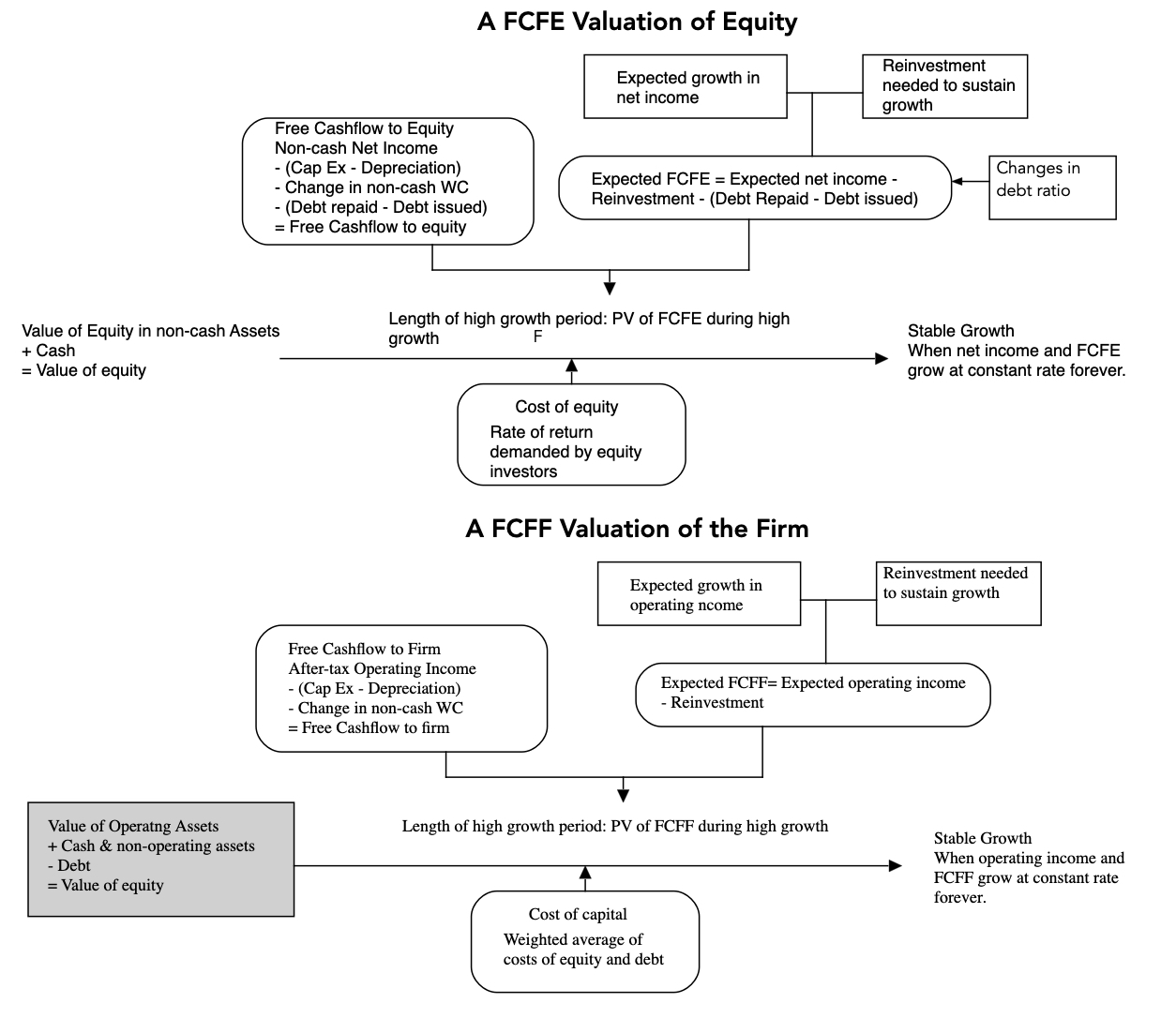
The intrinsic value of a company has always been a function of its expected cash flows, its growth and how risky the cash flows are, but in recent decades a combination of access to data and baby steps in bringing economic models into valuation has resulted in the development of discounted cashflow valuation as a tool to estimate intrinsic value. Put simply, the discounted cash flow value of an asset is:

Extended to a publicly traded company, with a potential life in perpetuity, this value can be written as:

If you are a reader of my posts, it should come as no mystery to you that I not only use DCF models to value companies, but that I believe that people under estimate how adaptable it is, usable in valuing everything from start ups to infrastructure projects.  There is, however, one significant limitation with DCF models that neither its proponents nor its critics seem be aware of, and it needs to be addressed. Specifically, a DCF is an approach for valuing going concerns, and every aspect of it is built around that presumption. Thus, you estimate expected cash flows each year for the firm, as a going concern, and your discount rate reflects the risk that you see in the company as a going concern. In fact, it is this going concern assumption that allows us to assume that cash flows continue for the long term, sometimes forever, and attach a terminal value to these cash flows.

Truncation Risks
If you accept the premise that a DCF is a going concern value, you are probably wondering what other risks there may be in investing that are being missed in a DCF valuation. The risks that I believe are either ignored or incorrectly incorporated into value are truncation risks. The simplest way of illustrating the difference between going concern and truncation risks is by picking a year in your cash flow estimation, say year 3. With going concern risk, you are worried about the actual cash flows in year 3 being different from your expectations, but with truncation risk, you are worried about whether there will be a year 3 for your company. 

So, what types of risk will fall into the truncation risk category? Looking at the corporate life cycle, you will see truncation risk become not just significant, but is perhaps the dominant risk that you worry about, age both ends of the life cycle. With start ups and young companies, it is survival risk that is front and center, given that approximately two thirds of start ups never make it to becoming viable businesses. With declining and aging companies, especially laden with debt, it is distress risk, where the company unable to meet its contractual obligations, shutters its doors and liquidates it assets. Looking at political risk, truncation risk can come in many forms, starting with nationalization risk, where a government takes over your business and pays you nothing in some cases and less than fair value in the rest, but extending to other expropriation risks, where you still are allowed to hold equity, but in a much less valuable concern.

Since truncation risk is more the rule than the exception, and it is the dominant risk in some companies, you would think that investors and analysts valuing these companies will have devised sensible ways of incorporating the risk, but you would be wrong.
  • The most common approach to dealing with truncation risk is for analysts to hike up the discount rate, using the alluring argument that if there is more risk, you would demand a higher return. The problem, though, is that this higher discount rate still goes into a DCF where expected cash flows continue in perpetuity, creating an internal contradiction, where you increase the discount rate for truncation risk but you do nothing to the cash flows. In addition, the discount rate that these analysts use are made up, higher just for the sake of being higher, with no rationale for the adjustment. With venture capitalists, this shows up as absurdly high target rates of 40%, 50% or 60%, fiction in a world where these VCs actually deliver returns closer to 15-20%. Discount rates are blunt instruments and are incapable of carrying the burden of truncation risk, and should not be made to do so.
  • Some analysts take the more sensible approach of scenario analysis, allowing for good and bad scenarios (including failure or nationalization) but never close the loop by attaching probabilities to the scenarios. Instead, they leave behind ranges for the value that are so wide as to be useless for decision making purposes. 
My suggestion is that you use a decision tree approach, where you not only allow for different scenarios, but you make these scenarios cover all possibilities and then attach a probability to each one. In the case of a start up, then, your two possible outcomes will be that the company will make it as a going concern and that it will not, and you will follow through with a DCF, with a going concern discount rate, yielding the value for the going concern outcome, and a liquidation providing your judgment for what the company will be worth, in the failure scenario:

Since you have probabilities for each outcome, you can compute an expected value. If you do this, you should expect to see discount rates for companies prone to failure (young start ups and declining firms) be drawn from the same distribution as that for healthy companies, but the adjustment for failure will be in the post-DCF adjustments. Put more simply, you should see 12-15% as costs of capital for even the riskiest start-ups, in a DCF, never 40-50%, but your post value adjustments for failure and its consequences will still take their toll.

The Aramco Valuation: Bringing in Truncation Risk 
In my last post, I valued Aramco in a DCF, using three measures of cash flows from dividends to potential dividends to free cash flows to the firm and arrived at values that were surprisingly close to each other, centered around $1.65 trillion, for the equity. Note, though, that these are going concern values, and reflect the expectation that while there may be year to year changes in cash flows, as oil prices changes, management recalibrate and the government tweaks tax and royalty rates, the company will be a going concern and that it will not suffer catastrophic damage to its core asset of low-cost oil reserves. For many investors in Aramco, the prime concern may be less on these fronts and more on whether the House of Saud, as the backer of the promises that Aramco is making its investors, will survive intact for the next few decades.

DCF Valuation: Going Concern Risk
Reviewing my discounted cash flow valuations of Aramco, you will notice that I began with a risk free rate in US dollars, because my currency choice was that currency. I then adjusted for risk, using a beta for Aramco, based upon REITs/royalty trusts for the promised dividend model and integrated oil companies for the potential dividends/free cash flow models, and an equity risk premium for Saudi Arabia of only 6.23%, with a country risk premium of 0.79% estimated for the country added to the mature market premium estimated for the US. The end result is that I had costs of equity ranging from 4.82% for promised dividends to 8.15% for cash flows.

The biggest push back I have had on my valuations is that the cost of equity seems low for a country like Saudi Arabia, and my response is that you are right, if you consider all of the risk in investing in a Saudi equity. However, much of the risk that you are contemplating in Saudi Arabia is political risk, or put more bluntly, the risk of regime change in the country, that could have dramatic effects on value. In fact, if you remove that risk from consideration and look at the remaining risk, Aramco is a remarkably safe investment, with the safety coming from its access to huge oil reserves and mind-boggling profits and cash flows. The DCF values that I have estimated, centered around $1.65 trillion, are therefore values before adjusting for the risk of regime change.

Regime Change Concerns
If you invest in Aramco, you clearly have an interests in who rules and runs the country, since every aspect of your valuation is dependent on that assumption. If the House of Saud continues to rule, I believe that the company will be the cash cow that I project it to be in my DCF and the values that I estimated hold. If the Arab spring comes to Riyadh and there is a regime change, the foundations of my value can either crack or be completely swept away, with cash flows, growth and risk all up for re-estimation. In fact, to complete my valuation, I need to bring both the probability of regime change and the consequences into my final valuation:

Consider the most extreme case. If you believe that regime change in imminent and certain, and that the change will be extreme (with equity being expropriated and Aramco being brought back entirely into the hands of the state), my expected value for equity becomes zero:

If at the other extreme, you either believe that regime change will never happen, or even if it does, the new regime will not want to hurt the goose that lays the golden eggs and leaves existing terms in place, the value effect of considering regime change will be zero. The truth lies between the extremes, though where it lies is open for debate. I believe that there remains a non-trivial chance (perhaps as high as 20%) that there will be a regime change over the long term and that if there is one, there will be changes that reduce, but not extinguish, my claim, as an equity investor, on the cash flows. 

That, in an entirely subjective nutshell, is why I think Aramco's equity value is closer to $1.5 trillion than $1.7 trillion.  As with all my other valuations, I understand that your judgments on Aramco will be different from mine, but I think that the disagreements we have are not so much on the going concern estimates of cash flows and risk but on the likelihood and consequences of regime change. 

Democracies versus Autocracies
I am not a political scientist, but I have always been fascinated by the question of how political structure and economic value are intertwined. Specifically, would you attach more value to a company or project operating in a democracy or in an autocracy? The approach that I have described in this post to deal with going concern and regime change risk allows me one way of trying too answer the question. 
  • Democracies are messy institutions, where governments change and policies morph, because voters change their minds. Put simply, a democracy generally cannot offer any business iron clad guarantees about regulations not changing or tax rates remaining stable, because the government that offers those promises first has to get them approved by legislatures, often can be checked by legal institutions and, most critically, can be voted out of office. Consequently, companies operating in democracies will always complain more about the rules constantly changing, and how those changing rules affect cash flows, growth and risk. 
  • Autocracies offer more stability, since autocrats don't have to get policies approved by legislators, often are unchecked by legal institutions and don't have to worry about how their decision poll with voters. Companies operating in autocracies can be promise rules that are fixed, regulations that don't change and tax rates that will stay constant. The catch, though, is that autocracies seldom transition smoothly, and when change comes, it is often unexpected and wrenching.
In valuation terms, democracies create more going concern risk and autocracies create more worries about regime change. The former will show up as higher discount rates in a DCF valuation and the latter as post-DCF adjustments. While I prefer democracies to autocracies, there is no way, a priori, that you can argue that democracies are always better than autocracies or vice versa, at least when it comes to value, and here is why:
  • The going concern risk that is added by being in a democracy will depend on how the democracy works. If you have a democracy, where the opposing parties tend to agree on basic economic principles and disagree on the margins, the going concern risk added will be small. In the United States, in the second half of the last century, both parties (Republicans and Democrats) agreed on the fundamentals of the economy, though one party may have been more favorable on some issues, for business, and less favorable on other issues. In contrast, if you have a democracy, where governments are unstable and the opposing parties have widely different views on the very fundamentals of how an economy should be structured, the effect on going concern risk will be much higher. 
  • The regime change risk in an autocracy will vary in how the autocracy is structured and how transitions happen. Autocracies structured around a person are inherently more unstable than autocracies built around a party or ideology, and transitions are more likely to be violent if the military is involved in regime change, in either direction. In addition, violent regime changes feed on themselves, with memories of past violent meted out to a group driving the violence that it metes out, when its turn comes.
In summary, when you are trying to decide on whether a business is worth more in a democracy than in a dictatorship, you are being asked to trade off more continuous, going concern risk in the former for the more stable environment of the latter, but with more discontinuous risk. I have deliberately stayed away from using specific country examples in this section, because this argument is more emotion than intellect, but you can fill your own contrasts of countries, and make your own judgments. 

Conclusion
I have often described valuation as a craft, where mastery is an elusive goal and the key to getting better is working at doing more valuation. I am glad that I valued Aramco, because it is an unconventional investment, a company where I have to worry more about political risks than economic ones. The techniques I develop on Aramco will serve me well, not only when I value Latin American companies, as that continent seems to be entering one of its phases of disquiet, but when I value developed market companies, as Europe and the US seem to be developing emerging market traits.

YouTube Video


Blog Posts

  1. A coming out party for an Oil Colossus: Aramco's IPO
Valuation Links

Wednesday, July 25, 2018

Share Count Confusion: Dilution, Employee Options and Multiple Share Classes!

In my last post, just about four weeks ago, I valued Tesla, and as with all of my Tesla valuations, I got feedback, much of it heated. My valuation of Tesla was $186, in what I termed my base case, and there were many who disputed that value, from both directions. There were some who felt that I was being too pessimistic in my assessments of Tesla's growth potential, but there were many more who argued that I was being too optimistic. In either case, I have no desire to convert you to my point of view, since the essence of valuation is disagreement. In the context of some of these critiques, there was discussion of how my valuation incorporated (or did not incorporate) the expected dilution from future share issuances and what share count to use in computing value per share. Since these are broader issues that recur across companies, I decided to dedicate a post entirely to these questions.

Share Count and Value Per Share
There was a time, not so long ago, when getting from the value of equity for a company to value per share was a trivial exercise, involving dividing the aggregate value by the number of shares outstanding.
Value per share = Aggregate Value of Equity/ Number of Shares outstanding
This computation can become problematic when you have one or more of the following phenomena:
  1. Expected Dilution: As young companies and start-ups get listed on public market places, investors are increasingly being called upon to value companies that will need to access capital markets in future years, to cover reinvestment and operating needs. To the extent that some or all of this new capital will come from new share issuances, the share count at these companies can be expected to climb over time. The question for analysts then becomes whether, and if yes, how, to adjust the value per share today for these additional shares.
  2. Share based compensation: When employees and managers are compensated with shares or options, there are three issues that affect valuation. The first is whether the expense associated with stock based compensation should be added back to arrive at cash flows, since it is a non-cash expense. The second is how to adjust the value per share today for the restricted shares and options that have already been granted to managers. Third, if a company is expected to continue with its policy of using stock based compensation, you have to decide how to adjust the value per share today for future grants of options or shares.
  3. Shares with different rights (voting and dividend): When companies issue shares with different voting rights or dividends, they are in effect creating shares that can have different per-share values. If a company has voting and non-voting shares, and you believe that voting shares have more value than non-voting shares, you cannot divide the aggregate value of equity by the number of shares outstanding to get to value per share.
Note that while none of these developments are new, analysts in public markets dealt with them infrequently a few decades ago, and could, in fact, get away with using short cuts or ignoring them. Today, they have become more pervasive, and the old evasions no longer will stand you in good stead.

Expected Dilution
The Change: An investor or analyst dealing with publicly traded companies in the 1980s generally valued more mature companies, since going public was considered an option only for those companies that had reached a stage in their life cycle, where profits were positive (or close) and continued access to capital markets was not a prerequisite for survival. Young companies and start-ups tended to be funded by venture capitalists, who priced these companies, rather than valued them. In the 1990s, with the dot com boom, we saw the change in the public listing paradigm, with many young companies listing themselves on public markets, based upon promise and potential, rather than profits or established business models. Even though the dot com bubble is a distant memory, that pattern of listing early has continued, and there are far more young companies listed in markets today. An investor who avoids these companies just because they do not fit old metrics or models is likely to find large segments of the market to be out of his or her reach.

The Consequence: If you are valuing a young company with growth potential, you will generally find yourself facing two realities. The first is that many young companies lose money, as they focus their attention on building businesses and acquiring clientele. The second is that growth requires reinvestment, in plant and equipment, if you are a manufacturing company, or in technology and R&D, if you are a technology company. As a consequence, in a discounted cash flow valuation, you can expect to see negative expected cash flows, at least for the first few years of your forecast period. To survive these years and make it to positive earnings and cash flows, the company will have to raise fresh capital, and given its lack of earnings, that capital will generally take the form of new equity, i.e., expected dilution, which, in turn, will affect value per share.

The Right Response: If you are doing a discounted cash flow valuation, the right response to the expected dilution is to do nothing. That may sound too good to be true, but it is true, and here is why. The aggregate value of equity that you compute today includes the present value of expected cash flows, including the negative cash flows in the up front years. The latter will reduce the present value (value of operating assets), and that reduction captures the dilution effect. You can divide the value of equity by the number of share outstanding today, and you will have already incorporated dilution. 

I know that it sounds like a reach, but let me use my base case Tesla valuation to illustrate. In the table below, I have my expected cashflows for the next 10 years, with the terminal value in year 10.

Download Tesla Valuation and Dilution Spreadsheet 
The present value of the expected cash flows across all 10 years is $41,333 million, and netting out debt and adding back cash, yields an equity value of $33,124 million; the value per share is $189.23. However, this value includes the present value of expected cash flows from years 1 through 8, which are negative in my forecast,s and have a present value of $16,157 million. If these cash flows had not been considered, the value of the operating assets would have been $57,490 million and the value of equity would have been $48,282 million, a value per share of $284.41. In effect, we have applied a 33.46% discount to value, for future dilution. 

Implicitly, I am assuming that the firm will fund 88.06% of its capital needs with equity, consistent with the debt ratio that I assumed in the DCF, and that the shares will be issued at the intrinsic value per share (estimated in the valuation), with that value per share increasing over time at the cost of equity. That may strike some as unrealistic, but it is the choice that is most consistent with an intrinsic valuation. If Tesla is able to issue shares at a higher price (than its intrinsic value), we will have under estimated the value per share, and if it has to issue shares at a price lower than its intrinsic value, we will have over estimated value. There is one final reality check. While we have implicitly assumed that Tesla will have access to capital markets and be able to raise capital, there is a chance that capital markets could shut down or become inaccessible to the firm. That risk is not in the discounted cash flow valuation and has to be brought in explicitly in the form of a chance of failure. In my base case valuation, it is one of the reasons that I attached a chance of failure (albeit a small one of 5%) to the company.

A Viable Alternative: There is an alternative approach, where you forecast the number of shares that will be issued in future years to cover the negative cashflows, and count them as shares outstanding today. If you use this approach, you should set the cash flows for the negative  cash flow years to be zero. The peril in this approach is that there is a circularity that can cause your valuations to become unstable, since you will need to forecast a price per share in future years to get an estimate of value per share today. To illustrate this process, assume that you believe that the issuance price for Tesla for the new shares will be $200, with a price appreciation of 9% a year for the next 8 years. The table below computes the new shares that will need to be issued each year, assuming that 88.06% of capital comes from equity, and the dilution that will result as a consequence:
Download dilution spreadsheet
Note that, with the assumptions about the issuance price of $200, Tesla will issue 69.35 million shares over the next eight years. Adding that to the current share count of 169.76 million shares yields total shares outstanding of 236.85 million shares. If you set the cash flows in years 1-8 to zero and compute the value of equity, you arrive at a value of equity of $48,282 million, which can be divided by the 239.11 million shares to arrive at a value per share of $201.92. This is slightly higher than the value that I obtained in the cash flow approach, but it is partly because I have assumed an issuance price that is higher than the intrinsic value.

But Never Do This: Reviewing the two approaches, you can either incorporate the present value of the negative cash flows into the value of operating assets today and use the current share count, in estimating value per share, or you can try to forecast expected future share issuances and divide the present value of only positive cash flows by the enhanced share count to get to value per share. You cannot do both, because you are then reducing value per share twice for the same phenomenon, once by discounting the negative cash flows and including them in value and then again by increasing the share count for the shares issued to cover those negative cash flows.

Share Based Compensation (SBC)
The Cause: Over history, businesses have used equity to compensate employees, either to align incentives or because they lack the cash to pay competitive wages. That said, the use of share based compensation exploded in the 1990s due to two reasons. The first was an ill-conceived attempt by the US Congress to put a cap on management compensation, while not counting options granted as part of that compensation. Not surprisingly, many firms shifted to using options in compensation packages. The second was the dot com boom, where you had hundreds of young companies that had sky high valuations but no earnings or cash flows; these companies used options to attract and keep employees. Aiding and abetting these firm, in this process were the accountants, who chose not to treat these option grants as expensed at the time they were granted, and thus allowed companies to report much higher income than they were truly earning.

The Consequence: As companies shifted to share based compensation, there were two side effects that analysts had to deal with, when valuing them. The first was the drag on per-share value created by past option and share grants to employees, with options, in particular, creating trouble, since they could create dilution, if share prices went up, but could be worthless, if share prices dropped. The second was the question of how to factor in expected option and share grants in the future, since the value of these grants would be affected by expected future share prices. As with the dilution question, analysts faced a circular reasoning problem, where to value a share today, you had to make forecasts of the value per share in future years.

The Right Response: To deal with share based compensation correctly, you have to break it down into two parts:
1. Past option and share grants: If you own shares in a company, the shares and options granted by the firm in prior years to employees represent claims on the equity, that reduces your value per share. The shares issued in the past are simple to deal with, since adding them to the share count will reduce the value per share today. The fact that employees have to vest (which requires staying with the firm for a specified time period) and that the shares have restrictions on trading can make them less valuable than unrestricted shares, but that is a relatively small problem. The options that have been granted in the past are a bigger challenge, since they represent potential dilution, but only if the share price rises above the exercise price. Option pricing models are designed to capture the probabilities of  this happening and can be used to value options, no matter how in or out of the money the options are. In an intrinsic valuation, you should value these options first (using an option pricing model) and net the value out of the estimated value of equity, before dividing by the existing share count :
  • SBC Adjusted Value per share = (DCF Value of Equity - Value of Employee Options)/ Share count today including restricted shares
Note that the shares that will be created if the options get exercised should not be included in share count, in this approach, since that would be double counting.
2. Expected future grants: To the extent that a company is expected to continue to compensate its employees with options or restricted shares in future years, the most logical way to deal with these grants is to treat them as expenses in future years, and reduce expected income and cash flows. Rather than grapple with expected future share prices, you should estimate the expenses (associated with SBC) as a percent of revenues, and use that forecast as the basis for expenses in the future. Until accounting came to its senses in 2004 and required companies to expense share based  compensation at the time of grant, this was an onerous exercise for analysts, since it required estimating the value of option and share grants in past years to get historical numbers on the value of SBC grants. With the prevalent accounting rules in both GAAP and IFRS, the earnings that you see for companies should already be adjusted for SBC expenses and reported income should therefore give you a fair basis for forecasting. (The operating and net margins that I report by sector, on my website, are margins after stock based compensation expenses). At first sight, it may seem like double counting to lower future earnings because you expect option and share grants in the future, and then again lower the value of equity that you obtain by the value of options that are already outstanding. It is not, since we are dealing with two separate issues. A company that has had a history of stock based compensation, but has decided to suspend using SBC in the future, will be affected by only the second adjustment, whereas a company that has never used share based compensation in the past but plans to use it in the future, will be affected only by the former. A company that has share based compensation in its past and expects to use it in the future will be affected by both adjustments.

Tesla uses stock based compensation, and its most recent annual and quarterly statements provide a measure of the magnitude.
Tesla 10K for 2017 and Tesla 10Q, First Quarter 2018
The compensation can take the form of restricted stock or options, and the annual filing provides the cumulative effect of this share based activity. At the end of 2017, according to Tesla's 10K, the company had 10.88 million options outstanding, with a weighted average exercise price of $105.56 and a weighted average maturity of 5.30 years and 4.69 million restricted shares. The restricted shares are already included in the share count of 169.76 million shares, but the options need to be accounted for. We value the options, using a modified version of the Black-Scholes model, to arrive at a value of $2,927 million. Netting this value out of the value of equity that we obtained from the cash flows allows us to get to a corrected value per share:
Download Tesla valuation
The value per share, after adjusting for options, is $171.99. There is an elephant in the room in the form of a gigantic grant of 20.26 million shares to Elon Musk, with the issuance contingent on meeting operating milestones (revenues and adjusted EBITDA) and market milestones (market capitalization). The complexity of the vesting schedule on this grant makes it difficult to value using option pricing models, but the effect of this looming grant is to lower value per share today and here is why. If Tesla succeeds in growing revenues and turning to profitability, these option grants will vest, creating large expenses in the year in which that occurs and putting downward pressure on margins. In making my forecasts of future margins for Tesla, I have been more conservative at least in the early years, simply for this reason.

A Sloppy Alternative: There is an alternative approach to deal with options outstanding from past grants. They value options at their exercise value, i.e., the difference between the stock price and strike price today, and ignore out of the money options. This is called the treasury stock approach and the value of equity per share in this approach can be written as follows:
Treasury Stock Value per share = (DCF value of equity + Exercise Price * # Options outstanding) / (Share Count today + Options Outstanding)
By ignoring the time premium on options, this approach will over value shares today and by ignoring out of the money options, you exacerbate the problem. In the case of Tesla, using the exercise stock approach would yield the following value per share:
Treasury Stock Value per share (Tesla) = ($32,124 + $105.56 * 10.88) / (169.76 + 10.88) = $184.19
The analysts who use this approach often justify it by arguing that option pricing models can yield noisy estimates, but even the worst option pricing model will outperform one that assumes that options trade at exercise value.

And Nonsensical Practices: There are two woefully bad practices, when it comes to stock based compensation, that should be avoided. The first is to just adjust the share count for options  outstanding and make no other changes. In this "fully diluted" approach, you are counting in the dilution that will arise from option exercise but ignoring the cash that will come into the firm from the exercise.

  • Fully Diluted Value per share =  DCF value of equity / (Share Count today + Options Outstanding)
With Tesla, for instance, this approach would yield the following:

  • Fully Diluted Value per share (Tesla) = $32,124/ (169.76 + 10.88) = $177.83
This approach will yield too low a value per share, and especially so if you count out of the money options as well in the denominator. The second and even more indefensible practice is to add back share based compensation to earnings to get to adjusted earnings. The rationale that is offered for doing so is that share based compensation is a non-cash expense, a dangerous bending of logic, since it allows companies to use in-kind payments (shares, services) to evade the cash flow test. Using this logic, Tesla would add back the $141.6 million they had in share-based compensation expenses to their income in the first quarter of 2018 and report lower losses. Carried into future forecasts, this will inflate future earnings and cash flows, pushing up estimated value. Since these two bad practices push value away from fair value in different directions, the only logic for their continued use is that, in combination, the mistakes will magically offset each other. Good luck with that!

Shares with different rights
The Cause: Founders and families who take their companies public have always wanted to have their cake and eat it too, and one way in which they have been able to do so is by creating different share classes, usually built around voting rights. The founder/family hold on to the higher voting right shares and thus maintain control of the company, while selling off large shares of equity to the public, and cashing out. In the United States, shares with different voting rights were rare for much of the last century, primarily because the New York Stock Exchange, which was the preferred listing place for companies, did not allow them. Again, the tech boom of the 1990s changed the game, by making the NASDAQ, which had no restrictions on shares with different voting rights, an alternative destination, especially for large technology companies. The floodgates on shares with different voting rights opened up with the Google listing in 2004, and the Google model, with shares with different voting rights, has become the default model for many of the tech companies that have gone public in the last decade.

The Consequence: When you have different classes of shares, with different voting rights, you have two effects on value. The first is a corporate governance effect, since changing management becomes much more difficult, and that can affect how you value and view badly managed firms. The second is a unit problem, since a voting right share and a non-voting right share represent different equity claims and cannot be treated as having the same value. Thus, you can no longer divide the aggregate value of equity by the total number of shares outstanding.

The Right Response: When valuing firms with different voting rights, you have to deal with it in two steps. When valuing the firm, you have to incorporate the fact that changing management is going to be more difficult to do in your estimates. Thus, if you firm borrows no money (even though it can lower its cost of capital by moving to an optimal or target debt ratio fo 40%), you should leave the debt ratio at zero rather than change it. This will lower the value that you estimate for the operating assets and equity in the firm. Once you have the value of equity, you will have to make a judgment on how much of a premium you would expect the voting shares to trade at, relative to non-voting shares, in one of two ways. In the first, you can look at studies of voting shares in publicly traded companies in the US and Europe, which find a premium of between 5-10% for voting shares, and use that premium as your base number. In the second, you can use an approach that uses intrinsic valuation models to estimate the premium, which I describe in my paper on valuing control. Once you have the estimate, you can use algebra to complete your estimate of value per share. 
Value per non-voting share = Aggregate Value of Equity/ (# Non-Voting Shares + (1+ Voting Share Premium) # Voting Shares)
For example, if the value of equity is $210 million, there are 50 million non-voting shares and 50 million voting shares and the voting share premium is 10%, your value per non-voting share will be:
Value per non-voting share = 210/ (50+ 1.1*50) = $2.00/share
Value per voting share = $2.00 (1.10) = $2.20/share

The Bottom Line
I know that some of you will view this post as nit-picking, but you will be surprised at how much of an effect on value you can have by not being careful about share count. Those of you who use multiples (PE, EV/EBITDA) may be secretly happy that you don't have to deal with the issues of share count, since you don't do discounted cash flow valuations. Unfortunately, that is not true. Dilution, share based compensation and shares with different rights are just as much an issue when you compare multiples across companies, and ignoring them or using short cuts (like full dilution) will only skew your comparisons and lead to mis-pricing stocks. I would suggest four general rules:
  1. Aggregate versus Per-share numbers: Given how dilution and options can play havoc with share count, it is better to use aggregate than to use per share numbers, in valuation and in pricing. Thus, to obtain PE, divide the market capitalization of the company by its total net income, rather than price per share by earnings per share.
  2. When SBC is rampant, control for differences: If the use of restricted stockand options vary widely across sector, you need to control for those differences when comparing pricing in the sector. If you do not, companies that have large option overhangs will look cheap, relative to those that do not.
  3. Don't use SBC adjusted earnings: Adjusting earnings and EBITDA, by adding back stock based compensation, is an abomination, used by desperate companies and analysts to show you that they are making money, when they are not even close. Don't fall for the sleight of hand.
  4. With forward multiples, check on and control for dilution: Analysts, when valuing young companies, often divide today’s market capitalization or enterprise value by expected revenues or EBITDA in the future. The dilution that will be needed to get to future EBITDA has to be brought into the equation.
YouTube Video


Spreadsheets
  1. Tesla Valuation (June 2018)
  2. Tesla Dilution 
Blog Posts on Tesla
  1. A Tesla  2017 Update: A Disruptive Force and a Debt Puzzle
  2. Twists and Turns in the Tesla Story: A Boring, Boneheaded Update!

Wednesday, June 28, 2017

User/Subscriber Economics: An Alternative View of Uber's Value

In the week since I posted my Uber valuation, I have received many suggestions on what I should have done differently in the valuation, with many of you arguing that I was being a over optimistic in my forecasts of total market, market share and margin improvements and some of you positing that I was too pessimistic. I don't claim to have any certitude about these numbers but the spreadsheet that I used to value Uber is an open one, and you are welcome to convert your suggestions into valuation inputs and make the valuation your own. In just the last few days, though, I have been watching an argument unfold among people that I respect. about whether the reason for my low valuation for Uber is that I am using a DCF model, with the critics making the case that valuing a company based upon its expected cash flows is an old economy framework that will not yield a reasonable estimate of value for new economy companies, driven less by infrastructure investments and returns on those investments, and more by user and subscriber economics.  I have long argued that DCF models are much more flexible than most people give them credit for, and that they can be modified to reflect other frameworks. So, rather than deflect the criticism, I will try to build a user based model to value Uber and contrast with my conventional valuation.

Aggregated versus Disaggregated Valuation
If you are doing an intrinsic valuation, the principle that the value of a business is the present value of the expected cash flows from that business, with the discount rate adjusted for risk, cannot be contested. That is true for any business, manufacturing or service, small or large, old economy or new economy. Since that is what a discounted cash flow valuation is designed to do, I have to believe that what critics find objectionable in my Uber DCF model is not with the model itself but in how I estimated the cash flows for Uber, and adjusted for risk. I followed the aggregated model for discounted cash flow valuation where I estimated the cash flows to Uber as a company, starting with its revenues and working through the consolidated expenses and total reinvestment each year and discounted these cash flows at a cost of capital that I estimated for the entire company. Along the way, I had to make assumptions about a total market that Uber would go after, the market share that I expect the company to get in that market and the operating margins in steady state. 

Disaggregated Valuation
Value is additive and you can value any company on a disaggregated basis, breaking it down into different divisions/businesses, geographical areas or by units:
  • Business Units: In a sum of the parts valuation (SOTP), you can break a multi-business company into its individual business units and value each unit separately.  I have a paper where I describe the process of doing a SOTP valuation, using United Technologies, a conglomerate, as my example. If that SOTP valuation is much higher than the value that the market attaches to the company, you may very well find an activist investor targeting the company for a break up. 
  • Geographical Groupings: When valuing a multinational, you can break the company's operations down geographically and value each geographical grouping (Asia, Latin America, North America, Europe) separately, not only using different assumptions about growth and risk in region but even different currencies for each region. 
  • Unit-based Valuation: More generally, when valuing any company, you can try to value it on a unit-basis, building up to its value by valuing each unit separately and then aggregating across units. Thus, a pharmaceutical company can be valued by taking each of the drugs that are in its portfolio, including those in the pipeline, and valuing that drug based upon its cash flows and risk and then adding up the values across the entire portfolio. A retail business can be valued by valuing individual stores and adding up the store values and a subscription-based company can be valuing by valuing a subscription and multiplying by the number of subscriptions, current and forecasted.
I may be misreading the critics of my Uber valuation but it seems to me that some of them, at least are making the argument it is better to value Uber, by valuing an individual Uber user first, and then scaling the value up to reflect not just the number of users that Uber has today (existing users) but also new users it expects to add in the future. 

Aggregated versus Disaggregated Valuations: Weighing the Trade offs
Valuation on a disaggregated basis allows you to be much more flexible in your assumptions, allowing them to vary across each grouping but there are four reasons why you seldom see them practiced (or at least practiced well) in company valuation.
  1. Law of large numbers: As companies get larger and more diverse, there is an argument to be made that you are better off estimating on an aggregated basis rather than a disaggregated one. The reason is statistical. To the extent that your estimation errors on a unit basis are uncorrelated or lightly correlated, your estimates on an aggregated level will be more precise than the unit-based estimates. For example, you will have a much better chance of estimating the aggregate revenues for Pfizer correctly than you do of estimating the revenues of each of its dozens of drugs.
  2. Information Vacuums: Information on a disaggregated basis is difficult to get for individual businesses, geographies, products or users, if you are an investor looking at a company from the outside. If you are doing your valuation from inside the company (as an owner or venture capitalist), you may be able to get this information, but as you will see with my Uber user valuation, even insiders will face limits.
  3. Missing Value Pieces: When valuing a company on a disaggregated business, it is easy to overlook some items that are consequential for value. In sum of the parts valuation, for instance, analysts are so caught up in estimating the values of individual businesses that they sometimes forget to value "corporate costs", which can be a multi-billion drag on value.  
  4. Corporate Structure: There are some items that are easier to deal with at the aggregate level, because that is where they affect the business. Thus, you can model when taxes come due and the effect of losses easier when you are valuing an aggregated business than when you are valuing it on a disaggregated level. Similarly, if you are concerned about legal penalties or corporate governance, these are better addressed at the aggregated level.
It is true that aggregation comes with costs, starting with the blurring of differences across disaggregated units (business, geographies, products, users) as well as the missing of competitive advantages that apply only to some units of the business and not to others. It is also true that using an aggregated valuation can result in a process that is disconnected from how the owners and managers at user-based companies think about their companies and thus cannot help them in managing these companies or valuing them better.

User Based Valuation
Now that we have laid out the pluses and minuses of aggregated versus disaggregated valuation, let us think about how you would construct a disaggregated valuation of a company that derives its value from users or subscribers. In general, the value of such a company can be written as the sum of three components:
Value of user-based company = Value of existing users + Value added by new users - Value drag from corporate expenses

1. Valuing Existing Users
The key step in a user-based valuation is estimating the value of a user and that value is a function of many variables: the cash flows that you are currently generating from a typical user, the length of time you expect that user to use your product or service, your expectations of how much growth you can expect in cash flows from a user over time and the uncertainty that you feel about all of these judgments:

Consider the implications that emerge from this simple framework:
  1. The value of a user increases with user stickiness and loyalty (captured in the expected lifetime of a user and the annual renewal rate).
  2. The value of a user is directly proportional to the profitability of that user (captured as the difference between the revenues from that user and the cost of servicing that user). 
  3. The value of a user is directly proportional to the growth that you can generate in profits over time, by either getting the user to use more of your product or service or coming up with other products or services that you can sell that user. 
  4. The value of a user decreases as you become more uncertain about future cash flows from that user, with that uncertainty being a function of the revenue model that you use and the discretionary nature of the product or service. A subscription-based model, where users agree to pay a fixed amount every period, will generally be less risky and more valuable than a transaction-based model or an advertising-based model, that delivers the same cash flows. A product or service that delivers a necessity (transportation) is less risky than one that meets a more discretionary need (travel). 
If you can value a user, you can then estimate the value of an existing user base, by multiplying the value/user by the number of existing users. If you have multiple types of users, with perhaps different revenue models for each, as is the case with LinkedIn's premium and regular members, you can value each user group separately. 

Value Added by New Users
The second segment of value is the value added by new users that you expect to see added in the future. To estimate this value, you can start with the value per user from the last section but you have to net out the cost of acquiring a new user, which can take the form of advertising, introductory discounts and/or infrastructure investments to enter new markets. That net value added by a new user  (value per user minus cost of acquiring a user) then has to be multiplied by the number of new users that you expect to add each period and brought back to the present, adjusting for both the risk in the cash flows and the time value of money.

Again, I will agree that this is simplistic but consider the common sense implications:
  1. The value added by a new user increases with the value of a user, estimated in the last section. A strategy of going for fewer and more intense users may create more value than one with more and less engaged users, a warning that pursuing user growth at any cost can be dangerous for value.
  2. The value added by a new user decreases as the cost of adding users increases. That cost will be a function of the competitiveness of the business (increasing as competition increases) but also of networking effects. If you have strong networking effects, the cost of adding new users will decrease as you accumulate new users, thus creating a value accelerator for your business.
  3. The value added by a new user decreases as you become more uncertain about user growth. That uncertainty will be a function of competition and whether the technology that you have built your product or service on is sustainable.
Corporate Expenses and Value
To get from user value to the value of the business, you have to bring in the rest of the company into your analysis. To the extent that you have expenses that are unrelated to servicing existing users or adding new ones, i.e., corporate expenses, for lack of a better term, you have to compute the value of these expenses over time and reduce your value as a company by this amount:

While at first sight, this item may look like wasteful that should be eliminated, it represents both a danger and an opportunity for young companies. It is a danger to the extent that bloated corporate expenses can drag a company's value down, but it can be an opportunity insofar as it is at the basis of economies of scale. If corporate expenses represent necessary expenses to keep a business going, and they grow at a rate much lower than the growth rate in users and revenues, you will see margins improve quickly as a company scales up.

Valuing Uber: A User based Model
Can Uber be valued using a user-based model? Yes, but it will require assumptions about users that are, at best, tentative and at worst, based upon little information. While I will attempt with the limited information that I have on Uber to do a user-based valuation, I will leave it to someone who has access to more information than I do (a VC invested in Uber or an Uber manager) to tweak the numbers to get better estimates of value.

Deconstructing the Financials
The numbers that we have on Uber's operations are minimalist, reflecting both its standing as a private company and its general secretiveness. In 2016, according to the financials that Uber provided to a Bloomberg reported, Uber reported $20 billion in gross billings, $6.5 billion in net revenues (counting all revenues from UberPool) and a loss of $2.8 billion (not counting the $1 billion loss on the China operations). According to other reports, Uber had about 40 million users at the end of 2016, up from 24 million users at the end of 2015. Finally, other (dated) reports suggest Uber's contribution margins (revenues minus variable costs) in its most profitable cities ranges from 3-11% of gross billings and its contribution margin in San Francisco, its longest standing and most mature market, is 10.1%. Bringing in these noisy and diverse estimates together, here are my estimates of user statistics:

These numbers are stitched together from diverse sources and vary in reliability, but based upon my judgments, I break down Uber's operating expenses in 2016 into three categories: to service existing users (48.17%), to get new users (41.08%) and corporate expenses (10.75%); the last estimate is a shot in the dark, since there is no information available on the value. The annual profit from an existing user, based on 2016 numbers, is about $50.50 (Net Revenues - Expense/user) and the  cost of adding a new user is about $238/75, and both will be key inputs in my valuation.

Valuing Existing Users
To value Uber's existing users, I use the framework developed in the last section, in conjunction with the estimates that I obtained from the limited financial information provided by Uber. I valued existing users, assuming four additional parameters: a lifetime of 15 years for users, an annual renewal likelihood of 95%, a compounded growth rate of 12% in annual revenues from users expanding their user of Uber services and a growth rate of 9.9% a year in annual user servicing expenses (on the assumption that 80% of the servicing cost is variable). Assuming a cost of capital of 10% (in the 75th percentile of US firms), the resulting value per user and the overall value of existing users is shown below:
Download spreadsheet
The value per existing user is about $410 and the overall value of Uber's 40 million existing users is $16,412 million. Not surprisingly, this value is sensitive to user stickiness (as measured by user lifetime) and user growth potential (as measured by the growth rate in annual revenues):

In a market where investors swoon at user numbers, this table makes an obvious point. Not all users are created equal, with more intense, sticky users being worth a great deal more than transient, switching users.

Value Added by New Users
To estimate the value added by new users, I start with the value per user (estimated in the last section to be $410), which I grow at the inflation rate to get expected value per user over time, and use the cost of acquiring a new user from 2016 (about $240/user). Assuming a growth rate of 25% a year for the next five years, 10% between years six and ten and overall economic growth after year ten, I estimate the value added by new users over time. (With those growth rates, I more than quadruple the number of users over the next ten years to 164 million.) In coming up with value, I assume that new user growth is more uncertain than the value created by existing users, and use a 12% cost of capital (at the 90th percentile of US firms) to get today's value.
Download spreadsheet
The value added by new users, based upon my estimates, is $20,191 million. That value is sensitive to the net value created by each new user (value of a new user minus the cost of adding a new user) and the growth rate in the number of users:
This table illustrates the point made earlier about how some companies will be better off trading off higher value added per user for lower user growth, since there are clearly lower growth/ higher value added scenarios that dominate higher growth/lower value added scenarios in terms of value creation.  

Corporate Expenses and overall Value
The final loose end is the corporate expense component, a number that I estimated (arbitrarily) to be $1 billion in 2016. Allowing for the tax savings that these expenses will generate and assuming a 4% compounded growth rate, well below the 15.16% compounded growth rate in total users, I estimate a value for these corporate expenses (using the 10% cost of capital that I used for existing users):
Download spreadsheet
The value drag created by corporate expenses is about $10,369 million. Bringing together all three components, we get a value for Uber's operations of $26.2 billion
Value of Uber's Operating Assets:
= Value of Existing Users+  Value added by New Users - Value drag from corporate expenses
= $16.4 billion + $20.2 billion + $10.4 billion = $26.2 billion
Adding the cash balance ($5 billion) and the holding in Didi Chuxing (estimate value of $6 billion) results in an overall value of equity of $37.2 billion for the company (and its equity, since it has no debt):
Value of Uber Equity = Value of Operating Assets + Cash - Debt = $26.2 + $5.0 + $6.0 = $37.2 billion
This is close to the value that I obtained for Uber on an aggregated basis, but that is a reflection of my understanding of the company's economics.

Pricing versus Valuing Users
As you can see, valuing users requires assumptions about users that can be difficult to make. So, how do venture capitalists and other early stage investors come up with per user or per subscriber numbers? The answer is that they do not. Drawing on an earlier post that I had on how venture capitalists play the pricing game, venture capitalists price users, rather than value them. What does that involve? Very simply put, the price per user at Uber, given its most recent pricing of $69 billion and the estimated 40 million users is $1,725/user ($69,000/40).  To make a judgment on whether that number is a high or a low number, you would compare that price to what you the market is pricing a user at Lyft or Didi Chuxing and if naive, argue that the lower the price per user, the cheaper the company. Using the most recent estimates of pricing and users for the five big ride sharing companies, here is what we get:

CompanyMost Recent Pricing (in $ millions)# Users (in millions)Price/User
Uber$69,00040.00$1,725.00
Lyft$7,5005.00$1,500.00
Didi Chuxing$50,000250.00$200.00
Ola$3,00010.00$300.00
GrabTaxi$4,2003.80$1,105.26
If you follow the user valuation in the last section, you can see why this pricing comparison can be dangerous. The aggregate pricing that you get for individual companies reflects not only existing users but also new users, and dividing by the existing users will give you much higher numbers for companies that expect to grow their user base more. Even if every company is correctly priced, you should expect to see users at companies with less cash flows per user, lower user growth, less intense and loyal users and more uncertainty about future cash flows to be priced much lower than at companies with intense and sticky users, with more growth potential.

The Bottom Line
If your argument against using discounted cash flow valuation (at least in the aggregated form that it is usually done) is that you have to make a lot of assumptions, I hope that this process of valuing users brings home the reality that you cannot escape having to make those assumptions. In fact,  the assumptions that you need to make to value a company on a disaggregated basis (based on users or subscribers) are often more involved and complex than the ones that you have to make in an aggregated valuation. That said, I do agree that looking at value on a disaggregated basis can not only give you insights about value drivers but also about questions that you would want to ask (and get answered) if you are thinking about investing in or building a young company whose value is coming from its user or subscriber base. 

YouTube Video

Attachments
  1. Uber User-based Valuation
  2. Uber aggregated DCF
Previous Posts on Uber

Wednesday, November 30, 2016

Myth 5.5: The Terminal Value ate my DCF!

When you complete a discounted cash flow valuation of a company with a growth window and a terminal value at the end, it is natural to consider how much of your value today comes from your terminal value but it is easy to interpret this number incorrectly. First, there is a perception that if the terminal value is a high proportion of your value today, the DCF is inherently unreliable, perhaps a reflection of old value investing roots. Second, following up on the realization that a high percentage of your current value comes from your terminal value, you may start believing that the assumptions that you make about high growth therefore don't matter as much as the assumptions you make in your terminal valuation. Neither presumption is correct but they are deeply held!

If the terminal value is a high percent of value, your DCF is flawed!
To understand why the terminal value is such a high proportion of the current value, it is perhaps best to deconstruct a discounted cash flow valuation in the form of the return that you make from investing in the equity of a business. For simplicity, let’s assume that you are discounting cash flows to equity (dividends of free cash flow to equity) to arrive at a value of equity today:

Note that if you were to invest at the current value and hold through the end of your growth period, your returns will take the form of annual cash flows (yield) for the first five years and an expected price appreciation, captured as the difference between the terminal value and the value today. So what? Consider how investors have historically made money on stocks, decomposing US stock returns from 1928 through 2015 in the graph below:

1-Year Horizon5-Year Horizon10-year Horizon
1928-2015
67.09%
67.57%
70.09%
1966-2015
72.43%
73.42%
75.10%
1996-2015
81.51%
84.11%
85.28%
Note that no matter what time period you use in your assessment, the bulk of your return has taken the form of price appreciation and not dividends. Consequently, you should not be surprised to see the bulk of your value in a DCF come from your terminal value. In fact, it is when it does not account for the bulk of the value that you should be wary of a DCF!

Determinants of Terminal Value Proportion
While the terminal value will be a high proportion of the current value for all companies, the proportion of value that is explained by the terminal value will vary across companies. When you buy a mature company, you will get larger and more positive cash flows up front, and not surprisingly, if you put a 5-year or a 10-year growth window, you will get a smaller percentage of your value today from the terminal value than for a growth company, which is likely to have low (or even negative0 cash flows in the early years (because of reinvestment needs) before you can collect your terminal value. This can be seen numerically in the table below, where I estimate the percentage of current equity value that is explained by the terminal equity value for a firm with a high growth period of 5 years, varying the expected growth over the next 5 years and the efficiency with which that growth is delivered (through the return on equity):

Excess Growth Rate (next 5 years)ROE = COE -2%ROE = COEROE = COE +2%
0%
75.14%
75.14%
75.14%
2%
86.30%
82.53%
80.86%
4%
100.00%
90.76%
86.75%
6%
117.24%
100.00%
93.15%
8%
139.59%
110.44%
100.00%
10%
169.71%
122.33%
107.35%
In fact, if the reinvestment needs are large enough or the company is not quite ready to make profits, you can get more than 100% of your value today  from the terminal value. While that sounds patently absurd, it reflects the reality that when your cash flows are negative in the early years (as a result of high growth and reinvestment), your equity holding may get diluted in those years as the company raises new equity (by issuing shares). Note that to the extent that the cash flows come in as anticipated, with high growth and low/negative cash flows, you will not have to wait until the terminal year to cash out, since the price adjustment will lead the cash flows turning positive. (You can download the spreadsheet and try your own numbers)

If your terminal value accounts for most of your value, your growth assumptions don’t matter
If you accept the premise that the terminal value, in any well-done DCF, will account for a big proportion of the current value of the firm and that proportion will get higher, as growth increases, it seems logical to conclude that you should spend most of your time in a DCF finessing your assumptions about terminal value and very little on the assumptions that you make during the high growth period. Not only is this a dangerous leap of logic, but it is also not true. To see why, let me take the simple example of a firm with after-tax operating income of $100 million in the most recent year, a five-year high growth period , after which earnings will grow at 2% a year forever, with a 8% cost of equity. Holding the terminal growth rate fixed, I varied the growth rate in the high growth period and the return on equity. The resulting terminal values are reported in the table below:

Excess Growth Rate (next 5 years)ROE = COE -2%ROE = COEROE = COE +2%
0%
$1,227.00
$1,380.00
$1,472.00
2%
$1,326.00
$1,491.00
$1,591.00
4%
$1,431.00
$1,610.00
$1,717.00
6%
$1,542.00
$1,734.00
$1,850.00
8%
$1,659.00
$1,864.00
$1,991.00
10%
$1,783.00
$2,006.00
$2,140.00
Note that assuming a much higher growth rate and return on equity in the first five years has a large impact on my terminal value, even though the terminal growth rate remains unchanged. This effect will get larger for high growth firms and for longer growth periods. The conclusion that I would draw is ironic: as the terminal value accounts for a larger and larger percent of my current value, I should be paying more attention to the assumptions I make about my high growth period, not less!

Conclusion
If you are valuing equity in a going concern with a long life, you should not be surprised to see the terminal value in your DCF account for a high percentage of value. Contrary to what some may tell you, this is not a flaw in your valuation but a reflection of how investors make money from equity investments, i.e., predominantly from capital gains or price appreciation. You should also be aware of the fact that even though the terminal value will be a high proportion of current value, you should still pay attention to your assumptions about cash flows and growth during your high growth period, since your terminal value will be determined largely by these assumptions.

YouTube Video


Attachments
  1. Returns on US Stocks: Dividends and Capital Gains
  2. Spreadsheet to compute effect of growth assumptions on terminal value
DCF Myth Posts
  1. If you have a D(discount rate) and a CF (cash flow), you have a DCF.  
  2. A DCF is an exercise in modeling & number crunching. 
  3. You cannot do a DCF when there is too much uncertainty.
  4. It's all about D in the DCF (Myths 4.14.24.34.4 & 4.5)
  5. The Terminal Value: Elephant in the Room! (Myths 5.15.25.35.4 & 5.5)
  6. A DCF requires too many assumptions and can be manipulated to yield any value you want.
  7. A DCF cannot value brand name or other intangibles. 
  8. A DCF yields a conservative estimate of value. 
  9. If your DCF value changes significantly over time, there is something wrong with your valuation.
  10. A DCF is an academic exercise.