Showing posts with label Tesla. Show all posts

Wednesday, November 1, 2023

Tesla in November 2023 : Story twists and turns, with value consequences!

I was planning to start this post by telling you that Tesla was back in the news, but that would be misleading, since Tesla never leaves the news. Some of that attention comes from the company's products and innovations, but much of it comes from having Elon Musk as a CEO, a man who makes himself the center of every news cycle. That attention has worked in the company's favor over much of its lifetime, as it has gone from a start-up to one of the largest market cap companies in the world, disrupting multiple businesses in the process. At regular intervals, though, the company steps on its own story line, creating confusion and distractions, and during these periods, its stock price is quick to give up gains, and that has been the case for the last few weeks. As the price dropped below $200 today (October 30,2023), I decided that it was time for me to revisit and revalue the company, taking into account the news, financial and other, that has come out since my last valuation in January 2023, and to understand the dueling stories that are emerging about the company.

My Tesla History

    When I write and teach valuation, I describe it as a craft, and there are very few companies that I enjoy practicing that craft more than I do with Tesla. Along the way, I have been wrong often on the company, and if you are one of those who only reads valuations by people who get it right all the time, you should skip the rest of this post, because I will cheerfully admit that I will be wrong again, though I don't know in which direction. My first valuation of Tesla was in 2013, when it was a nascent automobile firm, selling less than 25,000 cars a year, and viewed by the rest of the automobile sector with a mix of disdain and curiosity. I valued it as a luxury automobile firm that would succeed in that mission, giving it Audi-level revenues in 2023 of about $65 billion, and operating margins of 12.50% that year (reflecting luxury auto margins). To deliver this growth, I did assume that Tesla would have to invest large amounts of capital in capacity, and that this would create a significant drag on value, resulting in a equity value of just under $10 billion.

    In subsequent valuations, I modified and adapted this story to reflect lessons that I learned about Tesla, along the way. First, I learned that the company was capable of generating growth much more efficiently, and more flexibly, than other auto companies, reducing the capital investment needed for growth. Second, I noticed that Tesla customers were almost fanatically attached to the company's products, and were willing to evangelize about it, yielding a brand loyalty that legacy auto companies could only dream about. Third, in a world where many companies are run by CEO who are, at best, operating automatons, and at worst, evidence of the Peter Principle at play, where incompetence rises to the top, Tesla had a CEO whose primary problem was too much vision, rather than too little. In valuation terms, that results in a company whose value shifts with narrative changes, creating not only wide swings in value, but vast divergences in opinion on value. In 2016, I looked at how Tesla's story would vary depending upon the narrative you had for the company and listed some of the possible choices in a picture:

I translated these stories into inputs on revenue growth, profit margins and reinvestment, to arrive at a template of values:
Note that is multiple stock splits ago, and the prices per share here are not comparable to the share price today, but the overall lessons contained in this table still apply. First, when you see significant disagreements about what Tesla is worth, those differences come from divergent stories, not disagreements about numbers. Second, every news story or financial disclosure about Tesla has to be used to evaluate how the company's narrative is changing, creating multiplier effects that create disproportionate value changes.
    Along the way, Tesla (or more precisely, Elon Musk) has made choices that could be, at best, described as puzzling, and, at worst, as perilous for the company's long term health, from borrowing money in 2017, when equity would have been a much better choice, to setting arbitrary targets on production (remember the 5000 cars a week for the company in 2018) and cash flows (positive cash flows in 2018) that pushed the company into a corner. If you add to that the self-inflicted wounds including Musk tweeting out that he had a deal to sell the company at $420 a share, funding secured, in 2018, it is not surprising that the stock has had periods of trauma. It was after one of these downturns in 2019, when the stock hit $180 (with a market cap of $32 billion), that I bought Tesla for the first time, albeit labeling it as my corporate teenager, an investment that would frustrate me because it would get in the way of its own potential. 
    I profited mightily on that investment, but I sold too soon, when Tesla's market capitalization hit $150 billion, and just before COVID put the company on a new price orbit. In fact, I revisited the company's value in November 2021, when its market capitalization hit a trillion, marveling at its rise, but also noting that it was priced to deliver such wondrous results ($600-$800 billion in revenues, with 20%+ margins) that I was uncomfortable going along:

In 2022, the stock came back to earth with a vengeance, losing more than 65% of its equity value, leaving the stock (on a post-split basis) trading at close to $100 a share at the end of the year. Three weeks later, i.e., at the start of 2023, I revalued the stock, allowing for uncertainties in my estimate of revenues and margins to deliver a median value per share of $153, with significant variation in potential outcomes:


I was about a week late on my valuation, since the stock price had already broken through this value by the time I finished it, leaving my portfolio Tesla-free, in 2023.

Tesla Update

    My last Tesla valuation is less than ten months old, and while that is not long in calendar time, with Tesla, it feels like an eternity, with this stock. As a lead in to updating the company’s valuation, it makes sense to start with the stock price, the market’s barometer for the company's health. The stock, which  started the year in a swoon, recovered quickly in the first half of the year, peaking around mid-year at close to $300 a share. 

The last four months have tested the stock, and it has given back a significant portion of its gains this year, with the stock dropping below $200 on October 30, 2023. Since earnings reports are often viewed as the catalysts for momentum shifts, I have highlighted the four earnings reports during the course of 2023, with a comparison of earnings per share reported, relative to expectations. The first earnings report, in January 2023, has been the only one where the company beat expectations, and it matched expectations in the April report, and fallen behind in the July and October reports. 

    The earnings per share focus misses much of Tesla’s story, and it is instructive to dig deeper into the income statement and examine how the company has performed on broader operating metrics:

In the twelve months, ending September 2023, Tesla reported operating income of $10.7 billion on revenues of $95.9 billion; that puts their revenues well ahead of my 2013 projection of $65 billion, albeit with an operating margin of 11.18%, lagging my estimate of 12.5%.  That makes Tesla the eleventh largest automobile company in the world, in revenue terms, and the seventh most profitable on the list, making it more and more difficult for naysayers to argue that it is a fad that will pass. Breaking down the news in the financials by business grouping, here is what the reports reveal:

  • Auto business: Tesla's auto business saw revenue growth slow down from the torrid pace that it posted between 2020 and 2022, with third quarter year-on-year revenue growth dropping to single digits, but given the flat sales in the auto sector and a sluggish electric car market, it remains a stand-out. The more disappointing number, at least for those who were expecting pathways to software-company like margins for the company, was the decline in profit margins on automobiles from 2022 levels, though  the 17.42% gross margin in the third quarter, while disappointing for Tesla, would have been cause for celebration at almost any of its competitors.
  • Energy business: Tesla's energy business, which was grounded by its acquisition of Solar City in 2016, has had a strong year, rising from 4.8% of the company's revenues in 2022 to 6.2% in the twelve months ending September 2023. In conjunction, the profitability of the business also surged in the last twelve months, and while some of this increase will average out, some of it can be attributed to a shift in emphasis to storage solutions (battery packs and other) from energy generation.
In short, Tesla's financial reports, are an illustration of how much expectations can play a role in how markets react to the news in them. The post-COVID surge in Tesla's revenues and profitability led to unrealistically high expectations of what the company can do in this decade, and the numbers, especially in the last two quarters, have acted as a reality check.
    As a story stock, Tesla is affected as much by news stories about the company and its CEO, as it is by financials, and there are three big story lines about the company that bear on its value today:
  1. Price Cuts: During the course of 2023, Tesla has repeatedly cut prices on its offerings, with the most recent ones coming earlier this month, The $1,250 reduction in the Model 3 should see its price drop to about $39,000, making it competitive, even on a purely price basis, in the mass auto market in the United States. Some of this price cutting is tactical and in response to competition, current or forecast, but some of it may reflect a shift in the company's business model.
  2. Full Self Driving (FSD): Tesla, as a company, has pushed its work on full self driving to the forefront of its story, though there remains a divide in how far ahead Tesla is of its competition, and the long term prospects for automated driving. Its novelty and news value has made it a central theme of debate, with Tesla fans and critics using its successes and failures as grist for their social media postings. While an autopilot feature is packaged as a standard feature with Teslas,  it offers  FSD software, which is still in beta version, offers an enhanced autopilot model, albeit at a price of $12,000. The FSD news stories have also reignited talk of a robotaxi business for Tesla, with leaks from the company of a $25,000 vehicle specifically aimed at that business.
  3. Cybertruck: After years of waiting, the Tesla Cybertruck is here, and it too has garnered outsized attention, partly because of its unique design and partly because it is Tesla's entree into a market, where traditional auto companies still dominate. While there is still debate about whether this product will be a niche offering or one that changes the trucking market, it has undoubtedly drawn attention to the company. In fact, the company's reservation tracker records more than two millions reservations (with deposits), though if history is a guide, the actual sales will fall well short of these numbers.
This being Tesla, there are dozens of other stories about the company, but that is par for the course. We will focus on these three stories because they have the potential to upend or alter the Tesla narrative, and by extension, its value.

Story and Valuation: Revisit and Revaluation

    In my Tesla valuations through the start of 2023, I have valued Tesla as an automobile company, with the other businesses captured in top line numbers, rather than broken out individually. That does not mean that they are adding significantly to value, but that the value addition is buried in an input to value, rather than estimated standing alone. In my early 2023 valuation, I estimated an operating margin of 16% for Tesla, well above auto industry averages, because I believed that software and or the robotaxi businesses, in addition to delivering additional revenues, would augment operating margins, since they are high-margin businesses.     

    The news stories about Tesla this year have made me reassess that point of view, since they feed into the narrative that Tesla not only believes that the software and robotaxi businesses have significant value potential as stand-alone businesses, but it is acting accordingly. To see why, let me take each of the three news story lines and work them into my Tesla narrative:

  1. Cybertrucks: The easiest news items to weave into the Tesla narrative is the Cybertruck effect. If the advance orders are an indication of pent-up demand and the Cybertruck represents an extension into a hitherto untapped market, it does increase Tesla's revenue growth potential. There are two potential negatives to consider, and Musk referenced them during the course of the most recent earnings call. The first is that, even with clever design choices, at their rumored pricing, the margins on these trucks will be lower than on higher-end offerings. The other is that the Cybertruck may very well require dedicated production facilities,  pushing up reinvestment needs. If Cybertruck sales are brisk, and the demand is strong, the positives will outweigh the negatives, but if the buzz fades, and it becomes a niche product, it may very well prove a distraction that reduces value. The value added by Cybertrucks will also depend, in part, on who buys them, with Tesla gaining more if the sales comes from truck buyers, coming from other companies, than it will if the sales comes from Tesla car buyers, which will cannibalize their own sales.
  2. FSD: As I look at the competing arguments about Tesla's FSD research, it seems clear to me that both sides have a point. On the plus side, Tesla is clearly further along this road than any other company, not only from a technological standpoint, but also from business model and marketing standpoints. While I do not believe that charging $12,000 for FSD as an add-on will create a big market, lowering that price will open the door not only to software sales to Tesla drivers, but perhaps even to other carmakers. In addition, it seems clear to me that the Tesla robotaxi business has now moved from possible to plausible on my scale, and thus merits being taken seriously. On the minus side, I do agree that the world is not quite ready for driverless cars, on scale, and that rushing the product to market can be catastrophic. 
  3. Price cuts: The Tesla price cuts have led to a divide among Tesla bulls, with some pointing to it as the reason for Tesla's recent pricing travails and others viewing it as a masterstroke advancing it on its mission of global domination. To decide which side has the more realistic perspective, I decided to take a look at how price cuts play out in value for a generic company. The first order effect of a price cut is negative, since lowering prices will lower margins and profits, and it is easy to compute. It is the second order effects that are tricky, and I list the possibilities in the figure below, with value consequences:

    In short, price cuts can, and often will, change the number of units sold, perhaps offsetting some of the downside to price cut (tactical), make it more difficult for competitors to keep up or enter your business (strategic) and expand the potential for side or supplemental businesses to thrive (synergistic). This figure explains the divide on the Tesla price cuts, with the pessimists arguing that electric car demand is too inelastic for volume increases that will compensate for the lower margins, and the optimists arguing that the value losses from lower margins will be more than offset by a long-term increase in Tesla's market share, and increase the value from their software and robotaxi businesses.

To bring these stories into play, I break Tesla down into four businesses - the auto business, the energy business, the software business and the robotaxi business. I do know that there will be Tesla optimists who will argue that there are other businesses that Tesla can enter, including insurance and robots, but for the moment, I think that the company has its hands full. I look out the landscape for these businesses in the picture below, looking at the potential size and profitability of the market for each of these businesses, as well as Tesla's standing in each.

Note that the auto business is, by far, the largest in terms of revenue potential, but it lags the other business in profitability, especially the software and robotaxi businesses, where unit economics are favorable and margins much higher. Note also that estimates for the future in the robotaxi and auto software businesses are squishy, insofar as they are till nascent, and there is much that we do not know.My Tesla story for each of these businesses is below, with revenue and profitability assumption, broken down  by business:


With these stories in place, I estimate revenues, earnings and cash flows for the businesses, and in sum, for the company, and use these cash flows to estimate a value per share for the company:

Download spreadsheet

In sum, the value per share that I get with Tesla's businesses broken down and allowing for divergent growth and profitability across businesses, is about $180 a share. That is higher than my estimate at the start of the year, with part of that increase coming from the higher profit potential in the side businesses, and expectations of a much larger end game in each one. 
    Given that this value comes from four businesses, you can break down the value into each of those businesses, and I do so below:
Just as a note of caution, these businesses are all linked together, since the battery technology that drives the auto and energy businesses are shared, and FSD software sales will be tied to car sales. Consequently, you would not be able to spin off or sell these businesses, at least as these estimated values, but it does provide a sense of investors should watch for in this company. Thus, with a chunk of value tied to FSD, from software and robotaxis, any signs of progress (failure) on the FSD front will have consequences for value.

An Action Plan
    As you review my story and numbers, you will undoubtedly have very different views about Tesla going forward, and rather than tell me that you disagree with my views, which serves neither of us, please download the spreadsheet and make your own projections, by business. So, if you believe that I am massively underestimating the size of the robotaxi business, please do make your own judgment on how big it can get, with the caveat that making that business bigger will make your auto and software businesses smaller. After all, if everyone is taking robotaxis, the number of cars sold should drop off and existing car owners may be less likely to pay extra for a FSD package. 
    At $197 a share, Tesla remains over valued, at least based on my story, but a stock that has dropped $54 in price in the last few weeks could very well drop another $20 in the next few. To capture that possibility, I have a limit buy at my estimated value of $180, with the acceptance that it may never hit that price in this iteration. For those of you who wonder why I don't have a margin of safety (MOS), I have argued that the MOS is a blunt instrument that is most useful when you are valuing mature companies where you face a luxury of riches (lots of under valued companies). Furthermore, as my January 2023 simulation of Tesla value reveals, this is a company with more upside than downside, and that make a fair-value investment one that I can live with.  Put simply, the possibility of other businesses  that Tesla can enter into adds optionality that I have not incorporated into my value, and that acts as icing on the cake.
    Obviously, and this will sound like the postscript from an email that you get from your investment banking friends, I am not offering this as investment advice. Unlike those investment banking email postscripts, I mean that from the heart and am not required by either regulators or lawyer to say it. I believe that investors have to take ownership of their investment decisions, and I would suggest that the only way for you to make your own judgment on Tesla is to frame your story, and value it based on that story. Of course, you are welcome to use, adapt or just ignore my spreadsheet in that process.

YouTube Video


Data and Spreadsheets

Thursday, January 26, 2023

Tesla in 2023: A Return to Reality, The Start of the End or Time to Buy?

I am not much of a car person and view cars primarily as a mode of transportation. I drive a 2010 Honda Civic, a perfectly serviceable vehicle that is never going to get oohs and ahas from onlookers, but I feel no urge to value Honda. I don't own a Tesla, and have only driven someone else's Tesla, but as readers of this blog know, I valued Tesla for the first time in 2014, and I keep returning to the scene of the crime.  One reason is that no matter what you think of Elon Musk and Tesla, they are never boring,  and interesting companies are much more fun to value than boring ones. Another is that when valuing companies, I am, in addition to valuing a company to see if it is fairly priced,  interested into the broader insights about business and valuation that emerge from the company. Thus, almost everything I know and practice, when valuing young and start-up companies, I learned in the process of valuing Amazon in the 1990s. In the same vein, I have learned a great about the power of disruption and the capacity of a young company (and its founder) to change the way a large, inertia-bound business is run, in the process of valuing Tesla. As I will note in more detail in the post, I have been wrong, and sometimes hopelessly so, in some of my earlier valuations of Tesla, but that does not stop me from trying anew. It is also true that Tesla is a company that attracts strong and very divergent views, and consequently, I get more pushback on my valuations of Tesla than on any other company, but as in last few attempts with this company, I have structured my valuation to allow you to incorporate your disagreement. My last valuation of Tesla was in November 2021, towards its market peak, and given its steep fall from grace, in conjunction with Elon Musk's Twitter experiment, it is time for a revisit.

Tesla: A Revolution Unfolds

    In evaluating Tesla's climb to domination, at least in market value terms, of the automobile business, it is worth remembering how impervious this business was to disruption in the decades leading up to Tesla's arrival. In the United States and Europe, domestic competitors to the established players did not get far, largely brought down by requirements of large capital investments and a distribution system built to favor established players. When Tesla was founded in 2006, with a stated intent of building electric cars, the traditional auto companies were quick to dismiss it as a potential competitor. Tesla's rise is summarized in the graph below, where we look at the company's revenues and earnings over time, with earnings measured in gross and operating terms, and EBITDA capturing operating cash flows:

2022 numbers updated to reflect 4th quarter earnings call on 1/25/23

Between 2010 and 2020, Tesla grew revenues from $117 million to $31.5 billion, a remarkable achievement by itself, but COVID gave the company a boost, as revenue have increased about 250% in the 2020-22 time-period. Just as impressively, the company finally started delivering on its promise of  profitability, going from barely making money in 2019 to an operating margin of 16.57% in 2022. While the company still has skeptics, it is no longer a niche player in a big market, and has moved the sector closer to its vision than the other way around.

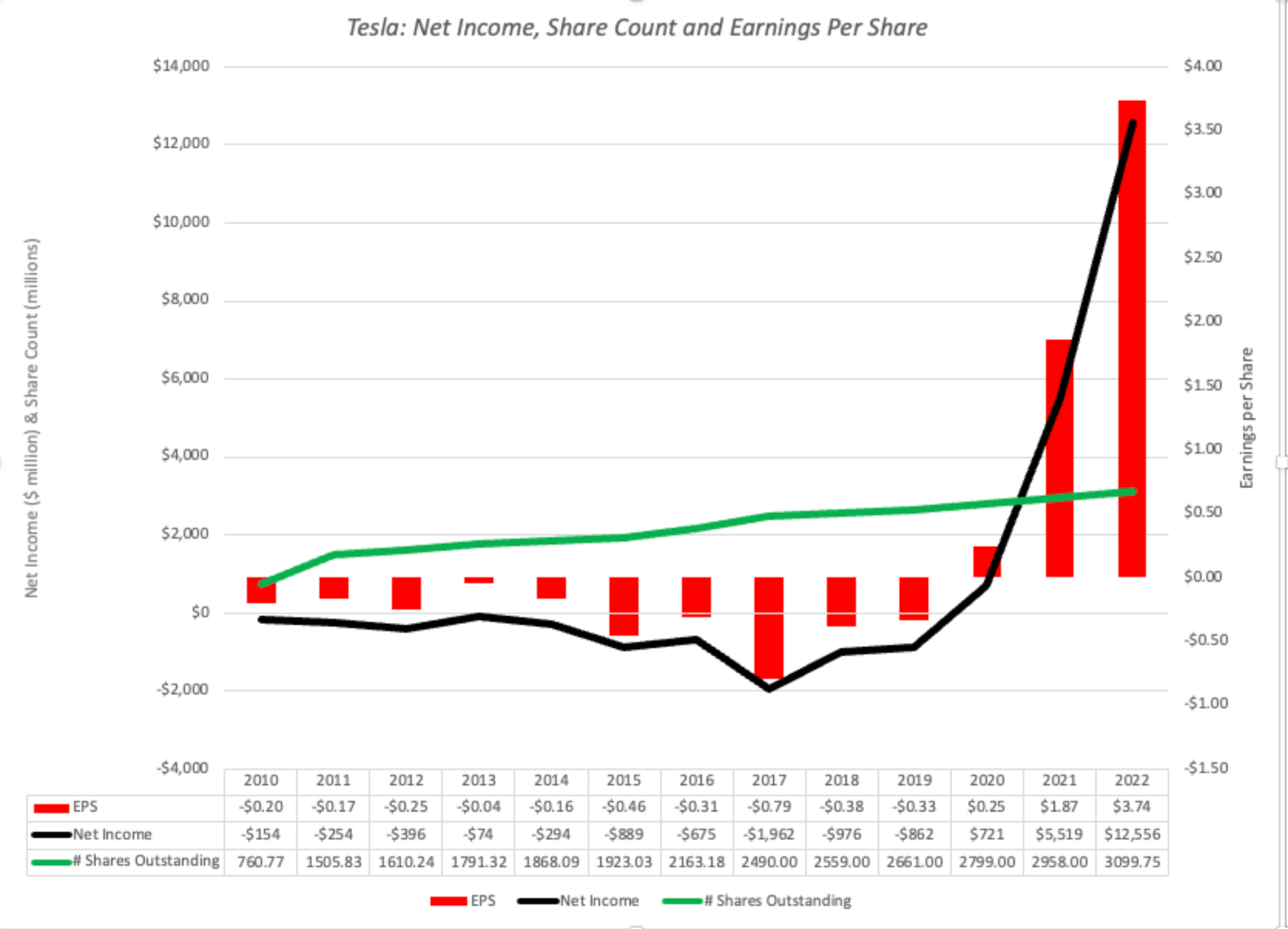
    In its early years, Tesla was dependent on equity issuances for funding growth investments, and its liberal use of options to reward management (and especially Elon Musk) opened it up to criticism. Since both  affect share count, I look at the company's net income and earnings per share over its public life:

2022 numbers updated to reflect 4th quarter earnings call on 1/25/23

It is true that the number of shares outstanding has quadrupled over the company's lifetime, but the good news is that the net income increases in recent years have outstripped the share count increase, with earnings per share increasing from 25 cents per share in 2020 to $3.74 per share in 2022.

My Tesla History

    I have valued Tesla multiple times over the last decade, and while I have been wrong at each turn, I have tried to learn from my mistakes. In this section, I will begin by looking at the evolution of my Tesla value from 2013 to 2021, and then present my updated valuation of the company.

My Tesla Valuations over Time

    My first valuation of Tesla was in 2013, and I found the company significantly overvalued then, and in hindsight, there were three errors that I made in that valuation that I systematically found myself repeating in my early valuations. 

  • Growth potential: I underestimated the company's capacity to grow, by limiting its product reach. In my 2013 valuation, I estimated the potential revenues by assuming that Tesla was more luxury than mass-market automobile, giving it revenues of $64 billion in steady state. (It is worth noting that year 10 in that valuation would be 2023, and Tesla's revenues in 2022 were not that far off at $73 billion, albeit with more potential for growth.) Since that valuation, it is clear that the company's products reach a much broader market than I originally anticipated, and my estimates of Tesla's revenues in steady state have increased over time. In fact, in my most recent valuations, I have assumed that Tesla will not only become a mass-market automobile company over time, but that it will have a dominant market share of the electric car portion of that business.
  • Product characteristics: In my early valuations, I viewed Tesla cars as automobiles first and foremost, leading me towards operating margins more suited for a manufacturing company, i.e., single digit values or, at best, just barely double digits. While the experiment is ongoing, it is clear to me that an electric car is both an automobile and an electronic product, with software forming an integral part of a Tesla automobile. That recognition has led me to push margins higher, and that push has been vindicated, at least partly, by the margins the company has been able to deliver in 2021 and 2022.
  • Reinvestment needs: The automobile business has always been capital intensive, with companies needing to invest large amounts in new factories to be able to deliver on growth. In my early valuations of Tesla, I assumed that Tesla would have to follow the same path, and that reinvestment translated into large negative cashflows, with a concurrent need to raise new capital, in the growth years. Having watched Tesla reinvest and grow over the last few years, it is clear to me that the company's been able to generate its growth with far less money invested in plant and more in technology and R&D than a typical auto company. That recognition has led me to reduce my estimates of reinvestment at the company, using a higher sales to capital ratio as my vehicle to reflect that reduced investment need. 
It was this combination of changes that led me to find Tesla to be under valued in June 2019, in the aftermath of Musk's "funding secured" fiasco and stories of cars being built in tents since the company ran out of capacity in its plants. I did buy the stock at the time of that post, and luck was my ally since I caught it at its bottom ($180 per share in 2019 or $12 per share in today terms), though I did sell the shares in January 2020, after the price quadrupled. 
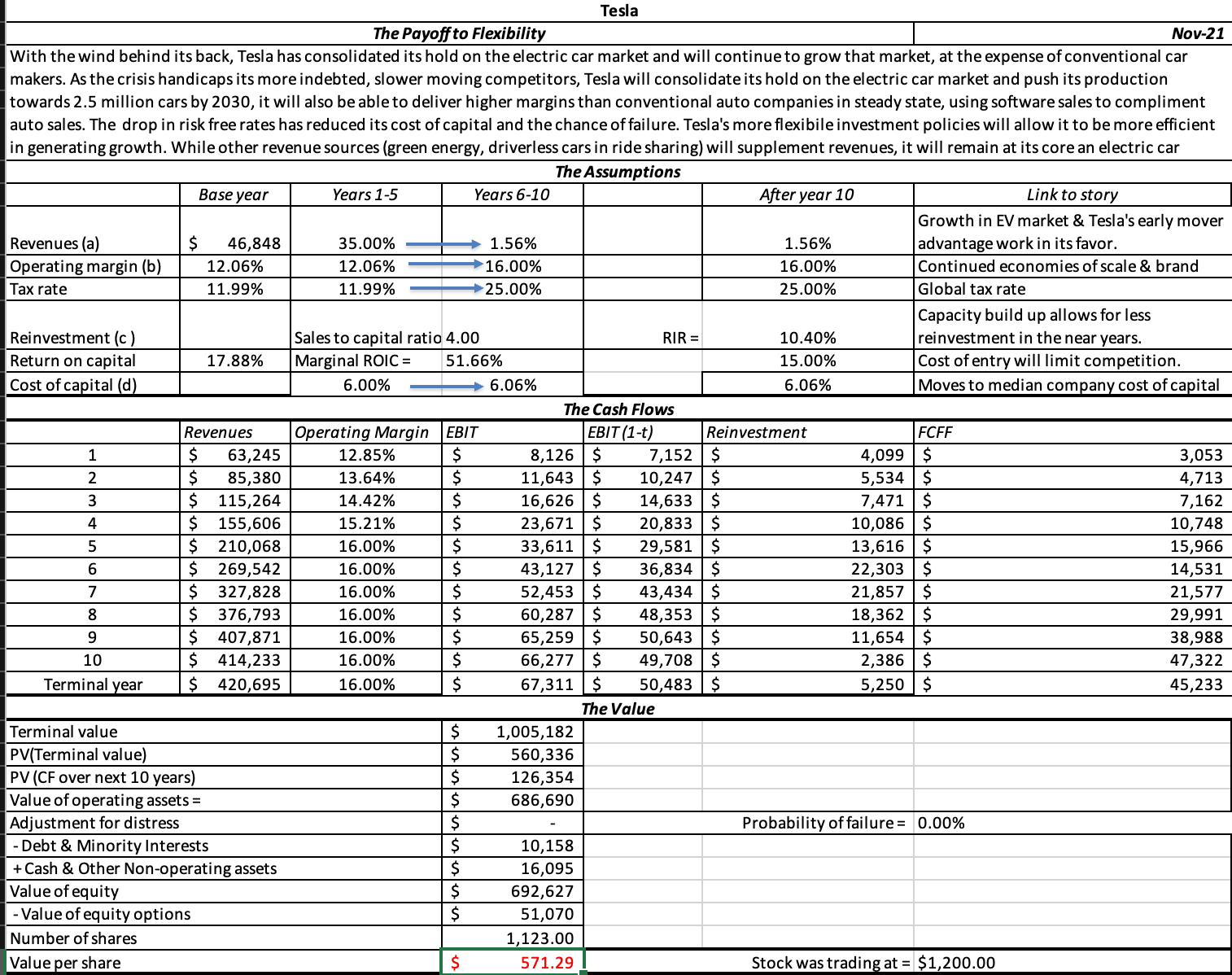
   With the benefit of hindsight, I clearly timed my sale wrong, because right after my sale, COVID hit and the company used its adaptability to take advantage of tumultuous times. The company's stock price soared (reaching $1200/share  in November 2021 ($410 in today's terms), and when its market cap breached a trillion, I revisited my Tesla valuation then, using a do-it-yourself (DIY) structure to allow readers to disagree. Pushing every one of my assumptions to its limits, the best I could do was arrive at a value ($571) roughly half of what it was trading at then ($1200+), about $190/share in current share units. My November 2021 best-case valuation is shown below:
Download spreadsheet
I argued that I could see almost no plausible pathway to get to Tesla's market cap then and that I believed that the company was over valued.

A Valuation Update

       It is a year and two months since my last valuation of Tesla, and it has been an eventful period for the company, Elon Musk, its founder/CEO and the overall market:

  1. The Company: At the company level, even as earnings reports delivered progress towards scaling up and becoming more profitable, there have been questions about whether the pathway is becoming more rocky. In its report on the first quarter of 2022, Tesla beat analyst estimates for both revenue growth and profit margins, but acknowledged COVID-related production problems in its Shanghai plant. In its earnings report from the second quarter of 2022, Tesla reported a slowing of revenue growth to 25% (from the heated pace of 2021) and a decline in margins that it attributed to inflation and competition for EV components. The 2022 third quarter report included news that revenues would come in below analyst estimates, both in dollar value and number of cares. The fourth quarter earnings report, delivered yesterday (January 25) confirmed earlier reports of slowing growth and a decrease in profitability (gross and operating), due to supply chain problems, with the company providing guidance that its pricing cuts will put pressure on future margins.
  2. The Founder Effect: In all of my valuations of Tesla, I have emphasized that it is a personality-driven company, with Elon Musk representing the company's vision and driving or perceived to be driving its decisions. In fact, in my November 2021 post on Tesla, I explicitly noted that it is almost impossible to value Tesla without bringing in your view of Musk into the valuation:
    Until recently, even Tesla critics would have conceded that Musk, in spite of his numerous faults, was a net positive to the company. In the last year, even Tesla advocates have starting questioning that belief, partly because Musk's Twitter adventures seem to be taking up much of his time, leaving a perceived vacuum at the helm of the company. That may be an overreaction, and I am not quite ready to come to the conclusion that he is net negative for the company, but it is undeniable that the net Musk effect being negative is not being dismissed. There is also the question of whether Musk will come under pressure to sell Tesla shares to meet demands from Twitter lenders, and how that will play out in markets.
  3. The Market: The US equity market in January 2023 looks very different from the market at the start of 2022. As I noted in my last post, rising risk free rates and equity risk premiums have pushed up the costs of equity for all companies, and Tesla is not only no exception but is perhaps even more exposed as an above-average risk company. In short, the cost of capital of 6% that I used in November 2021, higher than the median cost of capital of 5.6% for US companies then, no longer is defensible, as the median cost of capital has climbed toward 9.6%.
With these changes in mind, I revisited my valuation of Tesla from November 2021 and made the following changes: 
  • First, I left my end revenues for Tesla back to $400 billion, still a reflection of my view that electric cars will become the dominant part of the auto market, and that Tesla still has not only a lead in that market, but will have a significant market share. In fact, Tesla's revenues of $81 billion in 2022 makes this assumption more plausible, not less so Note that this will still give Tesla more revenues than the largest automobile companies in the world, and will require that they make a transition, at least on core models, to a mass market product (with prices to match). I know that Tesla does and can sell more than just cars (energy solutions and software), but these are businesses that, at best, can add tens of billions of dollars to the mix, not hundreds.
  • In my November 2021 valuation, I had chosen a target operating margin of 16%, higher than the then-prevailing margin of 12.06%. In 2022, Tesla delivered an operating margin of 16.76% before correcting for R&D, and 18.41% after the correction, though its performance varied widely across the four quarters:

    While Tesla's profitability in 2022 has been a pleasant surprise, I have left the target margin at 16% because the forces that pushed the operating margin back down to 16% in the last quarter of 2022, which include price cuts and increasing production costs at their plants, will only intensify as Tesla seeks out market share. There is a niche market story that can be used to justify higher operating margins at Tesla, but that story would be incompatible with it having revenues of $400 billion.
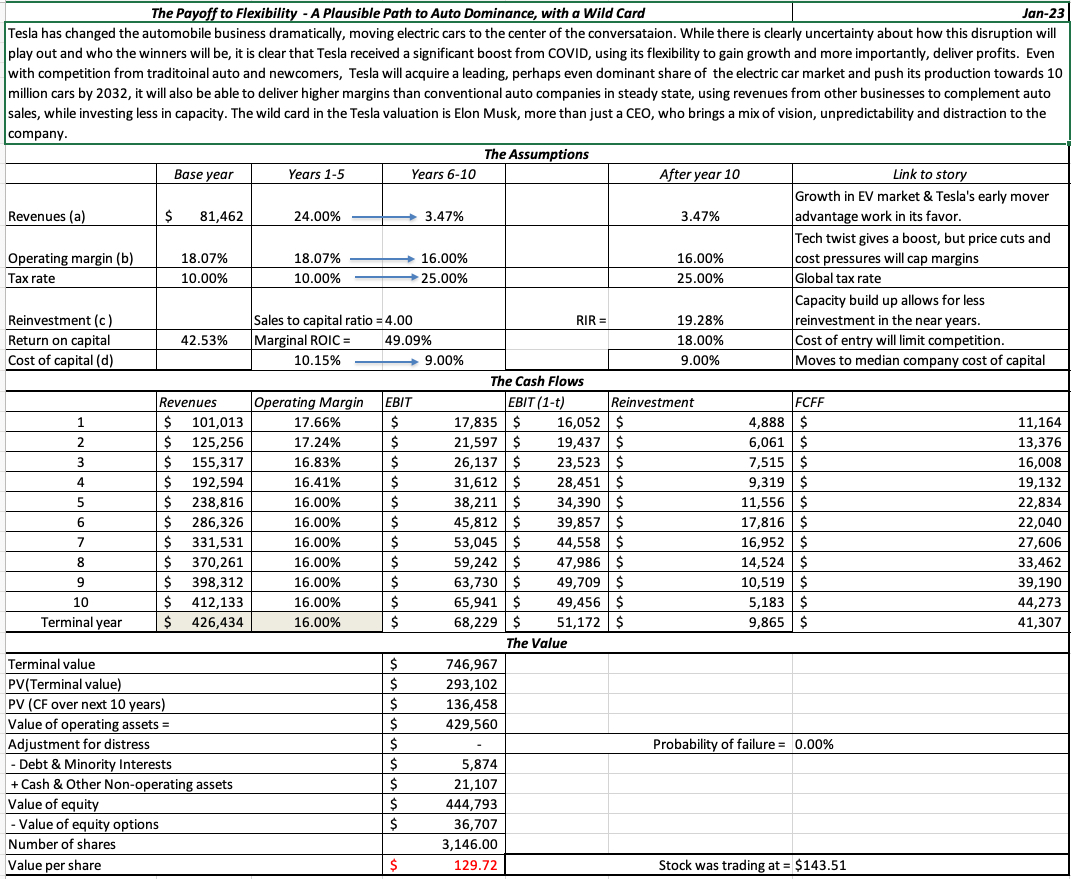
  • Third, my cost of capital for Tesla has jumped to 10.15%, reflecting a world of higher interest rates and risk premiums:

Download spreadsheet

This is still an upbeat story, but the value per share that I get with these updated inputs is about $130, a mark down from my November 2021 valuation, and about 10% below the stock price ($143 on January 25, 2023)

As with my previous valuations of Tesla, I am open about the fact that my Tesla story and inputs come with uncertainties, significant and potentially value-changing. Rather than wring my hands about these mistakes or be defensive about them, I chose to run a simulation, replacing my point estimates for revenue growth, operating margins and cost of capital, with distributions to arrive at the following value distribution

Note that my median value is slightly lower than my base case value, mostly because there are more potential upside values than downside value. The bottom line, though, is that the median value, at $120, confirms that the stock is overvalued, at least based on my estimates, at least at its stock price of  $143. However, unlike November 2021 or at other points in Tesla's life, the stock is very much in play, and anyone who bought the stock on 12/27/22, when the price hit $109, would have got a reasonable bargain. I am writing this post, in the aftermath of Tesla's earnings report, and the stock is up in the after market, perhaps in reaction to the fact that the company beat its earnings per share forecast, the least meaningful part of any earnings report. To be honest, there is nothing that I see in that report, which is still barebones, that would lead to fundamentally reassess Tesla's value, but clearly the earnings per share beat and the "news is not as bad as it could have been" effect is clearly playing out in Tesla's pricing.

Lessons for Investing

    When valuing companies, it is important that you focus on the task at hand, which is to value a company and make an investment judgment on whether you should buy or sell the company, but it is also productive to look for general lessons that you can use in valuing other companies in the future. The Tesla valuation offers me a chance to examine bigger questions including how much a personality (Musk in the case of Tesla) can affect value, when the laws of business catch up with even the most successful disruptors and finally, and most depressingly, how politics has entered investing and business decisions in ways that we will come to regret.

1. Personality-driven Companies

In entertainment, sports, politics and business, we live in a personality-driven world, where individuals are given more attention than institutions. This is not a new phenomenon, but social media has furthered this trend, by giving influential people platforms and megaphones to reach tens of millions of followers. Some of the highest profile corporations in the last decade have tied their business stories to their founders, making it difficult to separate one from the other. In many cases, this has helped, not hurt, these companies, as Jack Ma drew investors and customers to Alibaba with his enthusiasm and energy, and no one sold Tesla to customers and investors better than Elon Musk. In both cases, though, we are discovering that there is a downside to personality-driven companies, since as human beings, these personalities come with good and bad qualities. There is no doubt in my mind that Elon Musk has enough vision to power a dozen companies, but he is also easily distracted and sometimes eccentric, but that is the package that drew people to the company a dozen years ago, when the company was started, that engineered its ascent to trillion-dollar market cap status, just a couple of years ago, and is now, at least in the eyes of some, weighing down the company. 

Good founders find ways to build businesses that outlast them, as Bill Gates did at Microsoft and Jeff Bezos at Amazon, but that required them to set aside egos and to overcome their desire for control. With Tesla, I still believe that Musk's vision is critical,  but it is essential for Tesla's long term success that he takes two actions. The first is to stop being the spokesperson for the company on all things small and large, and allow others in the company to find their voices. The second is to either build a management team that can run the company without him, if that team does not exist, or if it does, to give more visibility and front-stage status to the members of that team. I will wager that many investors in Tesla would be hard pressed to name its CFO or others in its top ranks, and that is an indication of how completely Musk has dominated the Tesla conversation.

2. The Universal Laws of Business and Economics

    When looking at businesses, it is worth remembering the business rules that have always governed success and failure, and recognize that while there are some companies that can deviate from these rules for a period of time, they eventually find themselves subject to them. I capture these business rules in what I call my valuation triangle, shown below:

Put simply, most businesses that want to grow faster have to accept that this higher growth will come with more risk (because it will require entering riskier geographies or marks segments), will need more investment in capacity (to be able to deliver on that growth) and often require accepting lower operating margins (because you may have to cut prices to sell more). For most of the last decade, Tesla has seemed to be impervious to these rules, showing a capacity to deliver revenue growth with rapidly rising margins in a competitive electric car business, and doing so with far less reinvestment than other automobile companies. 

That said, though, there are indications that the company, while still delivered wondrous results, is finding itself coming back to earth. The recent report that the company plans to cut prices for its cars in the United States may be a transitory change in policy, but it is more likely a reflection of the reality that customers, for whatever reasons, are now willing to at least look at other carmaker's offerings, if the price is right. In the same vein, the challenges that Tesla is facing in its manufacturing plants and with supply chains are familiar problems that all manufacturing companies face, and reflect the fact that it it Tesla no longer a niche company with absolute pricing power, selling to a fanatically loyal customer base. My guess is that the stories, while more negative than positive, will even out over time, and that Tesla will be able to stay ahead of its competitors, but for those investors and analysts who are used to Tesla posting super normal performance, it may take time to stop treating  normal performance as a negative surprise. 

3. Everything is political

In a world where where you shop, to where you eat and even which sports teams you cheer on depend on which side of the political divide you fall on, is it any surprise that politics is now affecting business and investing choices as well? It is one reason why I have argued against bringing ESG into companies and investing, because there is almost no social issue that an ESG-measuring service can defensibly bring into a score, without a backlash.  In the case of Tesla, the politics of the moment are undeniably an issue, and I would argue that where your political views will have more of an effect on whether you think Tesla is under or over valued than any of its operating numbers.  It is amusing to see Tesla advocates become adversaries overnight, mostly because their politics have diverged from Musk's, and Tesla opponents become its defenders, because they are in political agreement with Musk. As should be clear from my many posts on Tesla, I fall in the muddled middle when it comes to Musk. I believe that he is a visionary, not so much because Tesla is at the cutting edge of technology, but because he has changed the automobile business and our driving choices fundamentally. There are qualities that I admire in him, and qualities that I do not, but I think that as a society, we are better off with him than without him. That said, I would like to think that my decisions on whether to buy or sell Tesla will be unaffected by my personal views on Musk, but that may be just my delusion speaking. 

YouTube Video

Spreadsheet links

  1. Valuation (DIY) of Tesla in November 2021
  2. Valuation (DIY) of Tesla in January 2023


Tuesday, November 9, 2021

Tesla's Trillion Dollar Moment: A Valuation Revisit!

I have been writing about, and valuing, Tesla for most of its lifetime in public markets, and while it remains a company that draws strong reactions, it is also one that I truly enjoy valuing. It has been a while since my last valuation of the company, which occurred in January 2020, and given how much the landscape has changed since, partly as a result of the company's own actions and partly because of how COVID has upended its competitors in the automobile business, it is time to revisit the company and reassess its value, especially as the company’s market capitalization crosses a trillion dollars.

Tesla: The Back Story

I first valued Tesla in 2013, as a "luxury automobile company" and  I have valued almost every year since. If you are interested, you can see my valuations from 2014,  2016 and 2017. If you review those valuations, you will notice that in each valuation, my story for the company expanded, and my valuations increased, but the market price for the company jumped even more, leading me to conclude in each of them that it was not a company that I would invest in. While these valuations led me to different assessments of value, there were common themes across time:

  1. At its core, Tesla has been an automobile company: In my 2016 post on Tesla, I described it as the ultimate story stock, driven less by news about its most recent financial performance, and more by news that alters its story trajectory. I would be lying if I said that I have had clarity about Tesla's story over the last decade, because it has so many tangents, distractions and shifts along the way, flirting with narratives about being a battery company, an energy company and a technology company. In 2021, looking at the company, I feel more convinced than I was a few years that it is, at its core, an automobile company, and while it will continue to derive revenues from batteries and perhaps even software, its pathway to becoming a trillion dollar market cap company still runs through the "car company" story.
  2. Tesla has disrupted and reinvented the automobile business: Putting any company into the automobile business handicaps it, when it comes to value, for a simple reason. The automobile business has been in trouble for quite a while, struggling with anemic revenue growth in the aggregate, and abysmal profit margins, with even the very best in the group struggling to earn returns that match, let alone beat, their costs of capital. As I have valued Tesla over the years, I have come to the realization that it is the most 'uncar-like" automobile company in the world, and its uniqueness shows up on two dimensions. The first is on profitability, where its operating cost structure, unconventional distribution model (which bypasses dealerships), and capacity to augment revenues with related products and services, has given it an opening to deliver much higher margins than any automobile company in history. The second is on investment and capital intensity, where it has managed to take what critics pointed to as weaknesses (unwillingness to build large and expensive assembly plants ahead of time, to meet future demand) and made them into strengths. Put simply, the company has been able to scale up more quickly, while reinvesting less in capacity, than any other automobile company.
  3. Tesla positioned itself well for structural shifts in the economy: Tesla's success over the last few years has also been fed by three other external forces. The first is in the government and business response to climate change, and the resulting policies favoring electric cars over gas-powered, cars. It is undeniable that Tesla, especially in its early years, was a beneficiary of tax credits and other benefits meted out to electric car makers and buyers. The second is the rise of ride sharing, with a host of companies around the world upending the status quo in car service. While Tesla has not directly benefited yet from this trend, it has opened up possibilities for the future, built around self-driving cars, that have added to the company's allure. The third is the rise of ESG as an investing force, and the resulting shift away by investors from all things fossil-fuel related, has benefited Tesla, at the expense of the legacy automobile companies.
  4. Tesla is built around an outsized personality: When valuing publicly traded companies, I seldom talk about its top management explicitly, since the numbers reflect what they bring to the firm. That rule does not work with Tesla, since its founder and CEO, Elon Musk, has many qualities, but being self effacing is not one of them. Tesla and Musk are locked at the hip, and it is almost impossible to have a view on one, without having a similar view on the other. Put simply, I am still to meet an investor who loves (dislikes) Tesla as a company, and dislikes (loves) Musk. On the plus side, Musk is a visionary and out-of-the-box thinker, and an evangelist for his visions, who draws true believers to his cause. On the other side of the ledger, he is unpredictable and prone to distractions that draw attention away from the company, and his impulses have created costs for the company and its investors. While his net effect has clearly been a net positive for investors in Tesla, over the last decade, it is worth remembering that you are getting a package deal, when you invest in the company.
  5. Tesla draws extreme reactions: I have never valued a company, where there is as much divergence in views about the future, cross market players, that I have seen with Tesla and Musk. There are some who see Elon as the ultimate con man, and Tesla as a shell game, and many in this group have spent the last decade making Tesla one of the most shorted stocks in history. There are others who view him a savior, and map out pathways for Tesla to become the most successful company of all time, and many of them have bought shares in the company, and held through good and bad times. 

My two most recent valuations were in June 2019 and January 2020, and I am going to go back to them, not just because they are recent, but because they led to investment decisions on my part. 

  • In June 2019, Tesla had hit a rough spot, partly due to concerns about production bottlenecks and debt, and partly due to self inflicted wounds. Musk's tweets about going private, with funding secured, contributing to a sell off, driving the stock down to $180 ($36 in today's split adjusted terms). I valued the company, with conservative assumptions about growth and margins, and incorporating my concerns about managerial missteps, at about $190: While the buffer (between value and price) was small, I did buy shares in the company.
  • Between June 2019 and January 2020, the stock went on a tear, as the stock price more than tripled, and I revisited my Tesla valuation. With a more expansive view of future growth and profitability, I revalued Tesla in January 2020 and more than doubled my valuation, though that still left me well below the market price. I sold my shares then, and I know that many of you have pointed out how much money I have lost as a consequence of that sale, as the stock price has increased almost ten-fold since then, and I will come back and talk about my regrets, or absence thereof, towards the end of this post.

Tesla: The Numbers

    It has been roughly 22 months since my last valuation of Tesla, and it is astonishing how much change there has been, not just in the company, but also in the macro environment that it operates. In this section, I will start by chronicling the astonishing rise of Tesla in public markets in the last decade, follow by looking at the company's operating details and close by examining how the company has found a way to turn the COVID crisis into an opportunity.

Stock Prices and Market Cap

    To put Tesla's explosive performance in the last two years in perspective, I will look at its market performance since its entry into public markets. The graph below contains Tesla's stock price, adjusted for stock splits, going back to 2010, and ending in November 2021:

While the graph illustrates the surge in the stock price, the table embedded in the graph conveys the rise  more vividly, by listing Tesla's market capitalization in millions of dollars. In sum, the company's market cap has risen from $2.8 billion in August 2010 to more than a trillion dollars in November 2021, and along the way, it has not only made Elon Musk into the wealthiest man in the world, but also enriched those who bought into his vision early, and stayed invested in the company. 

Revenues and Earnings

    While the initial rise in Tesla's market capital was driven by the promise of the company, and detractors were quick to note Tesla's paltry revenues and big losses, the company's more recent financials reflect how it has acquired substance over time. In the graph below, I report on Tesla's quarterly revenues, gross profits and operating profits going back to 2013:


Tesla's quarterly revenues have risen from negligibly small values at the start of the last decade to almost $14 billion in the third quarter of 2021, making it the 20th largest automobile company in the world in 2020 (in revenue terms). The company spent much of the last decade losing large amounts each year, but it now not only generates an operating profit, but a healthy one at that, with a pre-tax operating margin of close to 15% in the third quarter of 2021.

The COVID Effect

    While Tesla's resurgence has been building for a while, its growth has clearly exploded in the last year and a half, a period where our personal and business lives have been upended by COVID. During this most trying of times for all businesses, and especially for those in manufacturing, Tesla has not just survived, but thrived, gaining market at the expense of its rivals and accelerating towards profitability. To understand why, I would point you to a series of posts that I did during 2020 about how COVID was playing out in markets, and the winners and losers. In particular, I noted to the following aspects that made the COVID crisis different, from prior crises:

  • Risk capital stayed in the game: The most striking feature of last year's crisis was how quickly markets came back from the savage sell off between February 14 and March 23 of 2020, and I argued that the biggest reason for that come back was the resilience of private risk capital. Instead of withdrawing from markets, as in prior crises, venture capital investing, initial public offerings and investment in the riskiest segments of both stock and bond markets continued, and actually increased, through 2020, and those trends have continued this year. 
  • Flexibility over Rigidity: While the overall market quickly recovered, the recovery was uneven, and the crisis left behind winners and losers. In this post, I argued that one of the key dividing lines between the two groups was flexibility, with companies with more flexible investing, financing and dividend policies winning out over companies with more rigidity on those dimensions. To be specific, service/technology companies gained at the expense of manufacturing & natural resource firms, debt-light firms won at the expense of those with much bigger debt burdens and firms that paid large dividends lost value, relative to firms that did not.
  • Young beat old: Another factor differentiating winners and losers during 2020 was that, unlike prior crises, young companies (early in their life cycles) benefited at the expense of mature and aging companies (with far more of their value coming from investments in place).
I summarized the transfer of wealth in a table in my final update:

As you can see young, high growth companies, with little debt and no dividends, benefited at the expense of older companies, with more debt and dividend commitments.  You could argue that if central casting were creating the perfect COVID winner, it would look a lot like Tesla, a young, adaptable company in a sector filled with companies with expensive manufacturing facilities, large debt burdens and legacy dividend policies. In fact, many of what many (including me) considered to be Tesla's weaknesses (make-shift manufacturing, seat-of-the-pants financing) in the pre-COVID age became strengths during COVID. While conventional automobile companies shuttered and scaled down manufacturing, Tesla continued to make and sell cars through the pandemic, and it is inarguable that it has come out of this crisis, far stronger than it was going into it. The table below breaks down the Tesla's performance from the last quarter of 2019 to the third quarter of 2021:

Tesla: The COVID Quarters
Focusing on the key financials of the company and looking at Tesla's performance through the COVID quarters, there are trends that stand out. 
  • The first is that the company stumbled briefly on revenues in the second quarter of 2020, as COVID restrictions kicked in, but saw a surge in growth in the quarters since, with growth rates significantly higher than in the pre-COVID years. 
  • The second, and more significant, is that the company seems to have turned the corner on profitability, with margins not just improving, but dramatically so, with gross margins moving towards 30% and operating margins exceeding 14% in the most recent quarter.
In brief, if there Tesla's growth was lagging, leading into 2020, and there were worries about its capacity to be profitable, the COVID quarters seem to have removed both concerns.

Tesla: Updated Story and Valuation

    I have long argued that the three most freeing words in investing and valuation are "I was wrong", and with Tesla, I have had to say those words repeatedly over the last decade. Through its lifetime, I have under estimated Tesla's value, and while COVID may have given the company an assist, my updated valuation will reflect what I have learned, since January 2020, about the company.

Story Components - Revisiting the Past

   Over the years, I have tried, not always successfully, to navigate between the extremes on Tesla, and tell a story that reflects the company's strengths and weaknesses. Not surprisingly, that story has changed over time, as the company, the business and the world have all changed. In the table below, I list the stories that I have told, with end-year revenues, operating margins and valuations for equity, for each one, in 2013, 2017, 2019 and 2020:

Over time, as you can see my story for Tesla has become bigger (in what I see both as its potential market and the revenues from it) and I have adapted my story to reflect the company's capacity to reinvest far more efficiently than the typical automobile company that I used in my very first valuation. 

    To see how much I was off the mark with my September 2013 valuation, I decided to compare my predicted revenues and operating income with the actual revenues and operating income from 2013-14 to 2020-21:

This may surprise you, since my 2013 valuation seems, at least in hindsight, to be hopelessly pessimistic, but I actually over estimated Tesla's revenues and profitability in the years since; the actual revenues in 2020-21 came in almost 24% below my prediction and my predicted margin of 8.52% was 0.75% higher than the actual margin posted by the company in that year. That said, I assumed in the 2013 valuation that, by 2021, Tesla's growth would be plateauing, and the company would be moving towards being a profitable, luxury car company. Instead, the company seems to be just getting started, redefining itself as a mass market company, with much bigger ambitions. I know that for some, my shifting stories and valuations are a sign of weakness, both in my analytical capabilities and in the very idea of intrinsic valuation. For me, and this may be just my delusions talking, an unwillingness to change your valuation stories and inputs, especially in a company that delivers as many twists and turns as Tesla, is a far greater sin.

Updated Story and Valuation
    Whatever your priors were on Tesla coming into COVID, it is difficult to argue with the fact that the company has benefited from the economic changes it has wrought, and that its story has become bigger. The question of how big is what will determine value, but rather than give you my assessment at the start, I want to try an experiment. Ultimately, whatever story you tell about Tesla has to show up in five inputs that drive its value: (a) Revenue growth, or what you see as end revenues for the company in steady state, (b) Business profitability, reflecting what you see as unit economics, and captured in the pre-tax operating margin, (c) Investment efficiency, measuring how much investment will be needed to get to your estimated end revenues, (d) Operating risk, incorporated into a cost of capital for the company and (e) the chance that the company will not make it, gauged with a probability of failure. If you are willing to go along, with each input, I will lay out the choices (as objectively as I can) and I would like you to take your pick, given what you believe about the company. As you make these choices, though, please do not open the spreadsheet that I will provide at the end, to convert your choices into value, since that will create a feedback loop that can feed your biases.
  1. Revenues: I do believe that Tesla has come out COVID with the potential for far more revenues than it did, going in. In particular, as the automobile market increasingly shifts to electric cars, Tesla will hold a strong competitive advantage in that portion of the market, and have the chance to be a market leader. To get a sense of what this will mean in terms of revenues by 2032, consider the following choices:

    Note that if your story draws primarily on Tesla remaining an auto company, revenues of $400 billion will translate into about ten million cars sold in that year, more than ten times the number of cars the company sold in 2020-21. If you believe that there are other businesses that Tesla will enter, you can augment your revenues with the added sales in those other businesses, keeping in mind that most of these businesses have far less revenue potential than the car business.
  2. Profitability: The biggest eye opener for me, during COVID, has been the surge in profitability at Tesla, with the operating margin nearing 15% in the third quarter of 2021. While that number is volatile and there will be ups and downs, it looks like the electric car business has far better unit economics than the conventional automobile business. Notwithstanding Tesla's first mover advantage, this margin will come under pressure not only from increased competition from electric car offerings from existing automakers and new entrants (Neo, Rivian etc.), but also from having to cut prices to increase market share in Asia, where car prices tend to be lower than in the US and Europe. Laying out the choices in terms of profitability:

    As you make this choice, recognize that Tesla is already approaching peak level gross margins for a manufacturing company, with its 30% gross margin in the last twelve months.
  3. Reinvestment:When I first valued Tesla in 2013, it had one plant in Fremont that produced all of the cars that it sold. At the time, one of my concerns was that the company would need massive reinvestment in assembly plants to ramp up even to luxury car revenue levels, and that this reinvestment would create significant cash burn. In the years since, Tesla has not only added capacity in lumps with assembly plants/giga factories in Storey County (Nevada), Buffalo (New York), Shanghai (China), Berlin (Germany) and Austin (Texas), but has spent far less than I originally estimated that they would have to invest. That said, if you are projecting that Tesla will sell 8, 10 or 12 million cars a year, a decade from now, it will need to reinvest in additional capacity. I use the sales to capital ratio as my proxy for investment efficiency (with higher values implying more efficiency investing), and the choices are below:
    To the extent that the company has the excess capacity to cover growth for the next few years, I will allow for a a higher sales to capital ratio in the early years, but move it towards a more sustainable number thereafter. 
  4. Risk: When I valued Tesla last in early 2020, I used a cost of capital of 7%, reflecting a risk free rate of 1.75% and an equity risk premium of 5.2% for mature markets. In November 2021, the risk free rate is down to 1.56% and equity risk premiums have drifted to 4.62%, and the cost of capital for the median firm had drifted down to about 5.90%. The choices you have on cost of capital are structured around those market realities:
    The other risk measure that will affect value is the likelihood of failure, a number that has varied over Tesla's history, partly because it used to lose money and partly because of a choice it made to borrow money in 2016. In making this assessment now, recognize that Tesla now has a cash balance that exceeds its debt due and is making money, at least for the moment.
  5. Management: Taking to heart how closely Tesla and Elon Musk are connected, one of the concerns with Tesla has always been the sheer unpredictability of Mr. Musk. The Musk effect on value can be positive, neutral or negative, depending on your priors:

    While Musk has been better behaved and more focused for the year and a half, with the exception of indulging in tweeting about cryptos, he seems to have reverted to bad habits in the last two weeks, seeking guidance from his Twitter followers on whether to sell a significant portion of his Tesla shares and indulging in a back-and-forth with senators about the billionaire tax.

I made the choices just as you did, and in the most upbeat of my forecasts, I aimed for revenues of roughly $400 billion (about ten million cars, augmented by revenues from ancillary businesses) in 2032, operating margins of 16% and a sales to capital ratio of 4.00 for the next five years (making Tesla far more profitable and investment efficient than any large manufacturing company in the world). With a cost of capital of 6% (close to the median company) and no chance of failure, it should come as no surprise that my estimated value of equity for the company has increased more than six-fold since my last valuation, to about $692 billion for equity in the aggregate, and $640 billion for equity in common stock.

Download spreadsheet

There are very few companies in the world that I would value at more than half a trillion dollars, and with Tesla, I get there almost entirely based upon its potential for growth and profitability. That said, though, the value per share that I get of $571, even in this most upbeat of scenarios, is less than half the current stock price, leaving me with the conclusion that the stock is over valued. Rather than take issue with my valuation, put your inputs into the attached spreadsheet and estimate your value of equity for the firm.

What’s your story?

    Given my choice to sell shares in Tesla at precisely the wrong time (in January 2020) and my history of undershooting on value for the company, I am the last person you should be relying on for your Tesla investment judgments. There are multiple caveats that go with my valuation, and it is possible that you are able to find a story that yields a valuation not just higher than mine, but also higher than the stock price. Alternatively, you might be one of those who believes that much of what we have seen as improvements in the last two years at Tesla are a mirage, and that I am being delusional in my assumptions. While I welcome debate and disagreement, I have found that, with Tesla, it is easy to get off on tangents and argue about what ultimately become distractions, and I would posit that almost any disagreement that we have about Tesla ultimately becomes one about how much revenues the company can generate from the businesses you see it operating in, and how profitable it will be as a company. 

  1. Revenues: In making my revenue estimates, I have assumed that Tesla will get a predominant portion of its revenues from selling cars, partly because of its history and partly because its alternative revenue sources (batteries, software etc.) are not big revenue items. It is possible, though, that there are new businesses with ample revenues that Tesla can enter, that can create new and substantial revenue streams. It is also possible that the electric car business will resemble technology businesses in their winner-take-all characteristics, and that Tesla will have a dominant market share of that business. In either case, you will have to find ways to get to revenues far greater than my already-daunting number of $414 billion in 2032. (Just for perspective, the total revenues of all publicly traded automobile companies, globally, in 2020-21 was $2.33 trillion and this would give Tesla roughly one sixth of the overall market.)
  2. Profitability: The other key driver of Tesla's value is its operating margin. While I think that my estimate of 16% is already at the upper end of what a manufacturing company can generate, there are a couple of ways in which Tesla might be able to get even higher margins. One is to enter a side business, perhaps software or ride sharing (with automated driving cars), that has much higher margins than the auto business. The other is to benefit from technological advantages to reap the benefits of economies of scale in production; this would require gross margins to continue to climb from less than 30% to much higher levels. 

You can check this for yourself, but the other assumptions about reinvestment and risk don't have as big an impact on value, and I have computed Tesla's equity value (in common stock) as a function of targeted revenues and operating margins.

As you can see, there are pathways that exist to get to the current stock price and above, but they require that you enter rarefied territory with Tesla, assuming that it will have more revenues than any company (not just automobile) in history, while delivering operating margins similar to those delivered by the largest and most successful technology stocks, none of which have the drag of substantial manufacturing costs. 

Tesla: The Pricing Game

     If you are holding or buying Tesla, finding a story to justify its current market capitalization will require a real stretch, a story that will require the company to not just be successful but a one-of-a-kind company. That said, I believe that Tesla is a "trade", not an "investment", and  that perspective provides answers to four questions that you may have about the stock.

  1. How do you explain the current stock price? For much of the last decade, Tesla skeptics have struggled with explaining why the stock is priced at the levels that it is, by the market. Put simply, they have wondered how a company with little revenue and big losses acquires a market capitalization of hundreds of billions of dollars. I have never tried to explain what other people pay for a stock, but the answer may lie in the fact that those trading Tesla are pricing it, based on pricing variables (mood, momentum), rather than on fundamentals (earnings and cash flows).  
  2. Why does the price change so much on news stories? Tesla has always been a company, where small and sometime trivial news stories cause big price changes. Take the news story a couple of weeks that Hertz was considering ordering 100,000 cars from Tesla. Given that the current market cap of Tesla reflects an expectation that the company will sell 10 million cars or more in a few years, the Hertz order, by itself, will have a tiny impact on value, and certainly far less than the hundred billion dollar jump in Tesla's market capitalization, after the news. However, if you view Tesla as a "story stock", the Hertz news story can be viewed as a sign that the company has made the transition from being a second car for the wealthy to a much wider market, potentially leading to a higher pricing.
  3. Does price affect value? Much as I would like to argue that intrinsic valuations are about cash flows, growth and risk, and are therefore insulated from market dynamics, the truth is more nuanced. The ten-fold surge in the stock price since last January did have an effect on my valuation, pushing me towards more upbeat and bigger stories, even though I still found the company to be over valued. If stock prices drop by 50% in the next few weeks, my assessment of value may be lower, as a consequence. In sum, it is almost impossible to value companies in a vacuum, where what the market is doing can be ignored.
  4. If I think the stock is over priced, why not sell short? To the question of why, if I believe in intrinsic value, I am not selling short on Tesla, it is because I believe that, at least in the short term, momentum beats fundamentals, and I have no desire to be caught in the whiplash effect. 
If you are a Tesla trader, I wish you the best, but I do hope that you don't delude yourself, if successful, with tales of fundamentals. You were on the right side of momentum, and whether this was a function of luck or skill, I will leave it for you to decide.

Conclusion

    In the last year and a half, I have heard from many of you about my decision to sell Tesla, and while I am thankful for your concern about my investment performance, there are a few of you who have asked me whether I was sorry that I had sold Tesla, just ahead of its  run-up in the last year and a half. I would be lying if I said that I did not think about the money I could have made, by holding on, when the stock crossed a trillion-dollar market cap, but those second thoughts have been fleeting and I have no regret. Like everyone else, I would rather make money on my investments, than lose money, but I would also rather leave money on the table and have an investment philosophy, flawed though it may be, than make money, and end up without a core set of beliefs about markets. I can say with certainty that I will be back valuing Tesla some time in the future, either because it has crossed a new threshold or because it is in the news. This company is far too interesting to ignore!

YouTube Video

Spreadsheets

  1. Automobile Sector in November 2021
  2. Tesla: November 2021 Valuation