Showing posts with label Pricing. Show all posts

Tuesday, October 25, 2022

Earnings and Cash Flows: A Primer on Free Cash Flow

It is never pleasant to be in the midst of a market correction, but a market correction does operate as a cleanser for excesses that enter into even the most disciplined investors' playbooks in the good times. This correction has been no exception, as the threat of losing investment capital has focused the minds of investors, and led many to reexamine practices adopted during the last decade. In particular, there has been more talk of earnings than of revenue or user growth this year, and the notion of cashflows driving value seems to be back in vogue. As someone who believes that intrinsic value comes from expected cash flows, I find that development welcome, but I do find myself doing double takes when I see concoctions of free cash flow that violate first financial principles. While I understand that there is no one overriding definition of cash flow that trumps others, it is essential that we define what we mean when we talk about free cash flows, and get perspective on what companies look like, on these cash flow measures.

Free Cash Flows: The What and The Why!

    Free cash flow is one of the most dangerous terms in finance, and I am astonished by how it can be bent to mean whatever investors or managers want it to, and used to advance their sales pitches. I have seen analysts and managers argue that adding back depreciation to earnings gives you free cash flow, an intermediate stop, at best, if you truly are intent on computing free cash flow. In the last two decades, I have seen free cash flow measures stretched to cover adjusted EBITDA, where stock-based compensation is added back to EBITDA, and with WeWork, to community-adjusted EBITDA, where almost all expenses get added back to get to the adjusted value.  I will use this section to clarify what free cash flows are trying to measure, how they get used in investing and valuation, and the measurement questions that can cause measurement divergences.

What is Free cash flow (FCF)?

    I believe that any measurement of free cash flow has to begin with a definition of to whom those cash flows accrue. Since a business can raise capital from owners (equity) and lenders (debt), the free cash flows that you compute can be to just the equity investors in the business, in which case it is free cash flow to equity, or to all capital providers in the business, as free cash flow to the firm.    

In short, the free cash flow to equity is the cash flow that a business generates after taxes, reinvestment and debt payments (interest and principal). The free cash flow to the firm is a pre-debt cash flow, before interest payments and debt repayments or issuances, but still after taxes and reinvestment. An alternate way of describing free cash flow to the firm is that it measures the cash flows that would have been available for equity investors, if there were no debt in the firm, and it is for this reason that some call it an unlevered cash flow.

To measure free cash flows for equity, you have to define reinvestment and debt cash flows, and we do that below on the left.  Note that we start with net income, earnings that is already after interest expenses and taxes, and that we consider reinvestment in both short term assets (change in non-cash working capital) as well in long term assets (as the difference between capital expenditures and depreciation). To complete the calculation, we incorporate the cash inflows that equity investors receive when they issue new debt and the cash outflows from repaying debt

Since FCFF is a pre-debt cashflow, starting with net income which is after interest expenses would be inconsistent. Thus, we start with operating income or earnings before interest and taxes (EBIT) replacing net income. (I know that you can start with net income and add back after-tax interest expenses, but it leaves embedded other items that can create distortions in FCFF). The taxes that are netted out from operating income are not actual taxes paid (accrued or cash) but hypothetical taxes, on the assumption that all of operating income would be taxed, in the absence of interest expenses (since you are working as if you have no debt), but the reinvestment in long term and short term assets is identical to the calculation used for FCFE. 

Estimation of FCFE

    If you have to compute the FCFE for a firm, you can see that every item that you need for the calculation should be accessible in its statement of cash flows, and there seems to be little room for disagreement. However, you will wrestle with what items to include and which ones to exclude, when computing the FCFE for a firm. To illustrate, we have used the statement of cash flows for Microsoft for the 2021 fiscal year (from July 2020- June 2021) as the basis for computing its FCFE in the figure below:

Source: Microsoft Annual Report for FY 2021 (Year ended June 2021)

To estimate the FCFE, I start with net income and add back depreciation & amortization and non-cash gains reported during the year. I do not add back stock-based compensation, and will provide a rationale for why in the next section, but I do subtract out the changes in non-cash working capital (provided in broken down form in the cash flow statement, but consolidated in my FCFE calculation). I net out capital expenditures and cash acquisitions, as reported, to get to FCFE prior to debt of $41,901 million. Since Microsoft did not raise any new debt, while repaying $5,504 million in existing debt, the FCFE after debt cash flows is $36,397 million. Another way of presenting this FCFE is to consolidate the working capital, capital expenditure and depreciation items into a reinvestment number ($19,370 million) and net this reinvestment out of net income to estimate FCFE. Estimating the free cash flow to the firm will require leaving the confines of the statement of cash flows and obtaining two numbers from the income statement - the operating income for the company and its effective tax rate, computed as taxes paid divided by taxable income. For Microsoft, this would yield values of $69,916 million for operating income and an effective tax rate of 13.83% in 2021, resulting in a FCFF of $40,879 million in 2021.
As you can see, the FCFE and FCFF share a common foundation, insofar that they are both after taxes and reinvestment, but FCFE adds a layer of cash flows to and from debt that can sometimes make it higher than FCFF and sometimes lower.

Using Free Cash Flows

   While there are facile reasons that you can give for computing free cash flows, including the usual “we don’t trust accounting earnings” and  “cash is king”, calculating it does involve added computations and there are three contexts where free cash flows get used. The first is that is that computing free cash flows for a past period helps in explaining what happened at a business during that period, in operating, investing and financing terms. The second is that it is that the free cash flows that you compute for a past period can be used as the basis for forecasting expected free cash flows in the future, a key ingredient if you are doing intrinsic valuation. The third is to compute the free cash flow as a base to be used to compare pricing across companies, where the market price is scaled to free cash flow, rather than to earnings. Since each of these missions has a different end game, there can be consequences for how we estimate free cash flows in each one; put simply, the free cash flow you compute, if you just want to explain what a firm did last year, can be different from the free cash flow you compute as the base year number for intrinsic valuation, which, in turn, can be different from the free cash flow that you estimate, if you are computing a pricing multiple.

1. Explain the past

    It is true that when investing in a company, it is what happens in the future that will determine whether you make money, but it is also true that to make these future assessments, a good place to start is by understanding what that company has done in the past. Notwithstanding the mission bloat that has bedeviled accounting in the last few decades, where the notion of fair value has distracted accountants, explaining what a company has done in the past, and where it stands now remains the core mission that should animate financial statements. As a believer in cash flows, I have always gravitated to the statement of cash flows as the accounting disclosure that is least contaminated by accounting overreach and the one that best reflects the true operations of a business. 

Note that the statement of cash flows looks at cash flows through the eyes of equity investors, starting as it does with net income and working its way down through investing and financing cash flows, before concluding with an explanation of the change in the company’s cash balance. As you can see in my earlier computation of FCFE for Microsoft, every item that you need for the calculation is in the FCFE, with your key decisions becoming which items not to count (any cash flows to equity, investments in securities etc.) and which ones to include (cash acquisitions, foreign exchange gains or losses etc.)

An intuitive reading of the FCFE is that it is cash available to be returned to equity investors, either in the form of dividends or as cash buybacks. It is the rare firm that follows a residual cash policy, returning its FCFE every year as dividends and/or buybacks. Some firms hold back and return less than they can, for good reasons (buffer against future bad years, set aside to cover investment opportunities) as well as bad ones (managers/insiders control the cash, over priced acquisitions); when they do hold back, the difference adds to their cash balances. Others choose to return more cash than they should be, and funding the difference from cash balances accumulated in the past and in some cases, fresh equity issuances, again for good reasons (a cyclical or commodity company riding out a down phase of a cycle) and for bad ones (inertia, an unwillingness to cut dividends, me-tooism on dividend policy or buybacks).

Companies with negative FCFE start in a hole, and even if they do not return any cash, they will find themselves with declining cash balances and/or new equity issuances, and if they do choose to pay dividends or buy back stock, they will make the cash deficits bigger. This approach of computing FCFE and comparing it actual cash return can be a device that can explain how some companies end up with huge cash balances and why other companies, especially young and money losing, will be dependent on equity infusions to stay alive. 

One of the limitations of focusing of free cash flows to equity is that you can get tunnel vision, since borrowing money operates as a cash inflow, inflating free cash flow to equity. That can explain why a firm with moderate or even below-average profitability can use debt to fund large dividends and buybacks, and to the extent that the firm is borrowing too much, it can dig a hole for itself. Estimating free cash flows to the firm can alert you to this occurrence, since it is a pre-debt cash flow and new debt issuances or repayments cannot alter it. In fact, the free cash flows to the firm, while less intuitive, are the source of cash flows to all claim holders (lenders as well as equity investors):

Mapping out these cash flows can provide a big picture perspective on where a firm’s cash flows are coming from and going, as well as a better assessment of the operating health of its business. It can also provide advance warning of the company’s exposure to downside risk, since the cash flows to lenders (interest and debt payments) are contractually set.

2. Intrinsic Valuation

    In intrinsic value, the value of an asset, business or equity stake in a business is the present value of the expected cash flows on it. Thus, in intrinsic valuation, the free cash flows (to equity or the firm) that you compute for the most recent year or time period is never part of value, but is useful only because it provides a base for forecasting the future. The question of whether you should be estimating free cash flows to equity or to the firm cannot be answered until you decide whether you are valuing just the equity in a business or the entire operating assets of the business.

  • If you are valuing just the equity, you’ll be estimate the free cash flows to equity in future years, and discounting back at the cost of equity, i.e., the rate of return that equity investors can make on other investments in the public market, of equivalent risk.
  • If you are valuing all operating assets in a business, you will estimate free flows the entire firm or business, and discount these cash flows back to today at a weighted average of the costs of equity and debt, with the weights reflecting the proportions of each funding type.
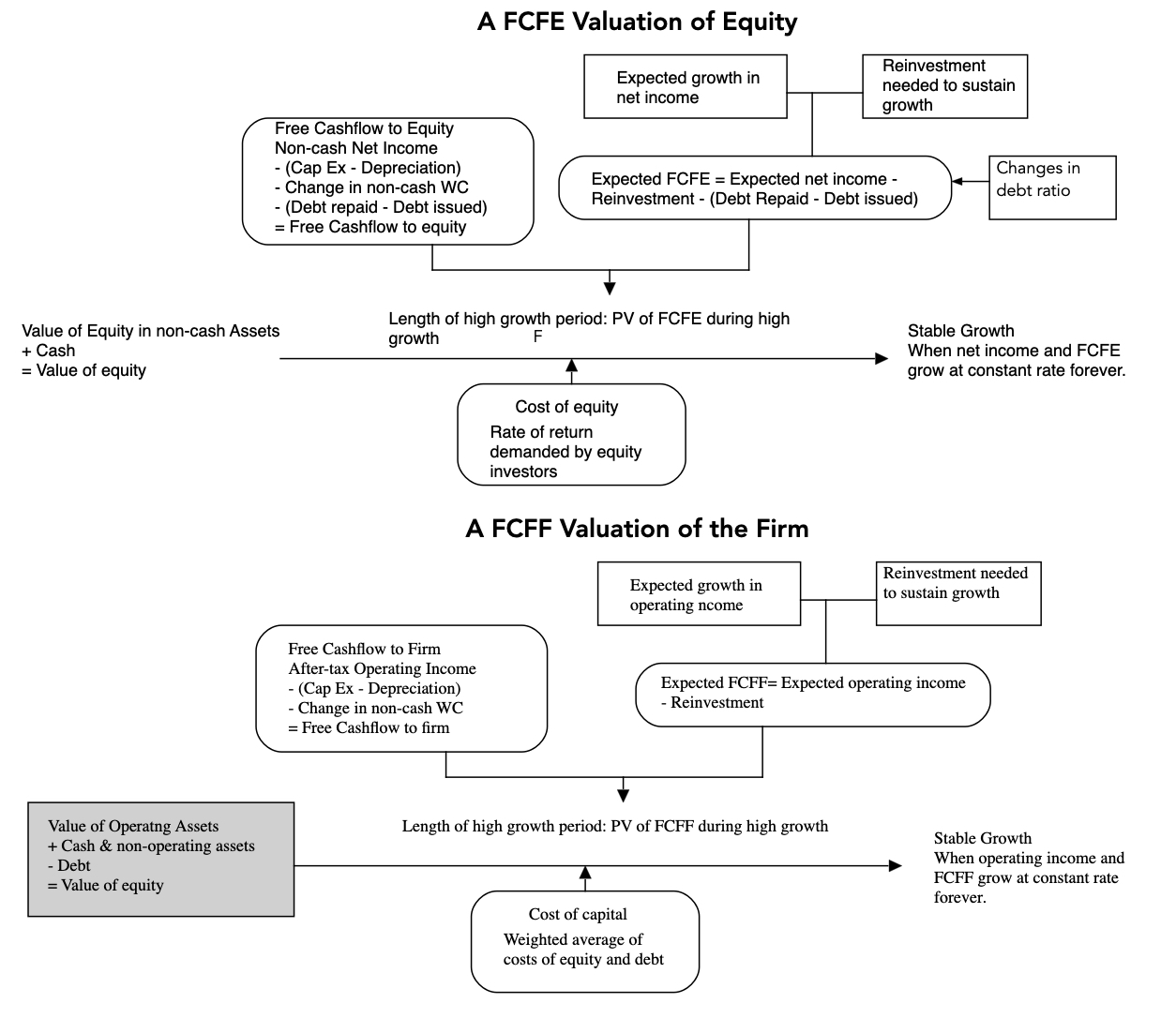
The picture below provides the contrasting uses of FCFE and FCFF in valuation:


With either estimate of free cash flow, the end game is estimating the free cash flows in the future, and the way we compute free cash flows  can be different from when we computed free cash flow for explaining the past. Here are a few reasons why:
  1. Unusual or Extraordinary items: When explaining last year’s cash flows, you should consider all items, even if they are one-time or extraordinary, since they are cash flows. However, if you are computing cash flows as a base for forecasting the future, you should eliminate any items that you don’t expect to recur in the future. Thus, a cash inflow from a one-time divestiture of a division or a cash outflow due to a loss in a lawsuit, though part of free cash flows last year, will be excluded, if you are computing a base-year free cash flow for estimating future cash flows.
  2. Normalized vs Actual numbers: For items that are recurring, but volatile, there is a good case to be made that while you will use the actual values, if computing free cash flows for the most recent year, you should be normalizing them, though the methods you use for normalization can vary across items. With the change in non-cash working capital, a notoriously volatile item on a year-to-year basis, I have found that looking at non-cash working capital as a percent of revenues, and using that statistic to reestimate the change in non-cash working capital in the most recent year provides a better base year foundation. In the Microsoft FCFE calculation, shown in the earlier section, using the historical average of non-cash working as percent of revenues of -10.18% (average from 2012-21), would have yielded a change in non-cash working capital of -$2,552 million in the base year, making it a cash inflow, rather than the outflow of $1,086 million that we attributed to working capital that year. With cash acquisitions, where a company may do only one big acquisition every three or four years, taking a long time series and averaging acquistions over that period will yield a better recurring value.
  3. Stock-based Compensation and Acquisitions: The most hotly discussed item in cash flow estimation is stock-based compensation, in the form of restricted stock or options. A simplistic reading is to argue that is non-cash and add it back, just as you depreciation and amortization, but stock-based compensation is not comparable. While depreciation and amortization are truly non-cash, stock-based compensation is more of an in-kind expense, where you give away shares of equity in the company instead of paying cash. If you are estimate free cash flows (to the firm or to equity), with the intent of valuing that firm, adding back stock-based compensation is equivalent to arguing that you can either stop paying employees in the future (and still hold on to them) or that you can keep giving away equity stakes in your company with no consequences for value per share. In short, there is no justification for adding back stock-based compensation to get to cash flows, and none of the numerous variants of adjusted EBITDA that you see populating annual reports or prospectuses holds up to scrutiny. Using the logic that paying for something with shares, instead of cash, still has an effect on free cash flows, we would argue that a company that plans to grow through acquisitions, using its own stock as currency, is reinvesting, and that this reinvestment should reduce expected free cash flows to equity, to existing shareholders. During the 2021 fiscal year, Microsoft bought Nuance Communications for $19.76 billion in all stock transaction, and that amount should be treated as reinvestment for the year, even though it is technically non-cash.
  4. Taxes: With free cash flows to equity, you start with net income but that net income can be skewed up if the company had a low effective tax rate that year, either because of write offs or losses carried forward into that year, or down, if it faced an unusually high tax rate that year. With free cash flows to the firm, the effective tax rate plays an even more direct role in determining cash flows, when you use it compute your after-tax operating income. In both cases, it makes sense to leave the effective tax rate at its actual level, when computing free cash flows for the past, but to rethink that when your objective is to forecast future free cash flows. I would suggest looking at an average effective tax rate over a longer period, in computing the base year free cash flow, and then also targeting the marginal tax rate, as you forecast taxes for the future. In the Microsoft FCFF calculation, this would imply replacing the effective tax rate of 13.83% with an average effective tax rate of 22%, using the 2017-2021 time period, which would lower free cash flows to the firm.
  5. Accounting Inconsistencies: I have written about the inconsistency in how accountants calculate capital expenditure at firms with significant investments in intangible assets and R&D, and that inconsistency can play out in your FCFE computation. While R&D remains a cash outflow, whether you treat it as an operating or a capital expenditure, moving it from operating to capital expenditures can alter your perception of a company's operations. In the case of Microsoft, for instance, capitalizing the $20,716 million that the company spent on R&D in 2021, will increase the net income for the company, while also raising the reinvestment by an equivalent amount. Put simply, Microsoft is much more profitable than the accounting statements lead you to believe, while reinvesting more than you thought it was, and both of those conclusions will have implications for valuation
In short, in intrinsic valuation, where your objective is get the best estimates that you can for the future, you have a great deal more flexibility and discretion in which items you include (and exclude) in computing free cash flows, and how you estimate values for those items. If you are wondering whether it makes enough of a difference to bother, consider what Microsoft's FCFE look like with all five adjustments made to them below:
The capitalization of R&D adds about $3.7 billion to net income, about $17 billion to depreciation and amortization and about $20.7 billion to cap ex, netting out to no effect on FCFE but with significant changes to profits and reinvestment. Incorporating the stock-based acquisition pushed up total reinvestment substantially, though the question of whether this should be built in as a recurrent component will depend on the story you tell about Microsoft.

Pricing
    The final arena where free cash flows can be used is in pricing, and more specifically, in scaling market price. Again, the question of which variants (FCFE or FCFF) can be used depends on whether you are using an equity pricing multiple (where the market cap or share price is in the numerator) or an enterprise value multiple (where it is the market value of operating assets in the numerator):
  • With equity multiples, you can scale the market value of equity (or market capitalization) of a company to its free cash flow to equity, to estimate a Price to FCFE multiple, and offer it as an alternative to the much more widely used PE ratio, where market capitalization is scaled to net income. 
  • With enterprise value multiples, you can scale enterprise value to FCFF, instead of using EBITDA or revenues as your scalar. Again, you could argue for the benefits of a more complete measure of cash flow, but as with FCFE, FCFF will be more volatile than revenues or EBITDA, making it difficult to pass pricing judgment. 
The logic that analysts use for the use of free cash flows is simple and seems compelling. If the value of a business is the present value of its expected cash flows, as we argue in intrinsic valuation, it seems reasonable to also argue that the free cash flow that a business generates is a better measure of its value than the accounting earnings. 
In sum, there is nothing inherently better about using free cash flows instead of earnings in a pricing setting, and you can argue that the additional volatility and loss of perspective that comes with free cash flow numbers yields worse pricing. I agree, with one caveat. Even if you choose to stay with PE ratios, as your pricing multiple, knowing how much of earnings gets reinvested back into the firm is a useful input in making your pricing judgments.

Free Cash Flows: Perspective

    With that long lead in on free cash flows, let us talk about why free cash flows vary across companies and across time. To make the connection, I am going to fall back on a structure that I have used before, the corporate life cycle, to look at the evolution of FCFE, as companies age, and use that structure to also examine how these FCFE play out as cash returned to shareholders, over time.

The Life Cycle Effect

    In a corporate life cycle structure, you trace a business from start-up (birth) to the toddler years (very young businesses) through their teenage years into middle and old age. I have found it useful in explaining why the focus of a business changes from finding investment opportunities, when young, to finessing capital structure, as middle age companies, to deciding how best to return cash to investors, in old age, as well as why the challenges you face in valuation are different for young companies than more mature businesses. The corporate life cycle also provides a framework for explaining how free cash flows evolve, as companies move through the life cycle:

Focusing on free cash flows to equity, you should expect to see negative values, early in the life cycle, as businesses struggle to make money and have to reinvest to deliver on their growth potential at the same time, and a resultant dependence on raising fresh equity capital (from VCs and public market investors) to keep going. As their business models take form, and they turn the corner on profitability, you should continue to see negative cash flows because of the need to reinvest to grow; in general, you should expect to see positive cash flows lag positive earnings. At mature businesses, you should expect to see free cash flows to equity to not only stay positive, but also to grow faster than earnings, and in decline, while earnings will follow revenues on their path down, divestitures and asset sales can allow FCFE to be higher than earnings. To see how net income and FCFE evolve, as a company ages, I computed the net income and FCFE for Tesla every year from 2006 to 2021:

Source: Capital IQ

For much of its existence, Tesla has been a money-losing company, reflecting its young, high growth status. It turned the profitability corner in 2020, though FCFE stayed mildly negative that year, and in 2021, the FCFE also turned positive. In corporate life cycle terms, Tesla is growing up, which is good news in terms of profitability and cash flows but bad news, if growth is what rings your bell.

To see if the corporate life cycle has relevance in explaining differences in free cash flows to equity across companies, I looked at US companies, broken down by age, into ten deciles, from youngest to oldest, and computed each component of the FCFE, by decile:

As you can see in the table, among the youngest companies (in the lowest decile), more than 73% are money-losing and more than three quarters of these companies have negative free cash flows to equity. As companies age, the proportion of companies that are money making increasing, as does the percent that has positive FCFE. In relative terms, the companies in the middle of the corporate life cycle, deliver the highest FCFE as a percent of market capitalization

Dividends and Buybacks
    You can critique FCFE as an abstraction, since shareholders cannot lay claim on them, and argue that it is only cash flows that are paid out to equity investors that count. You could focus just on dividends, but by doing so, you are missing a large proportion of cash returned by companies; in 2021, more than two thirds of all cash flows returned to shareholders were in the form of buybacks. Staying with the corporate life cycle construct, we looked at dividends and stock buybacks by companies in each age decile: 

Consistent with what we unearthed in the FCFE table, where younger companies are more likely to be money losing and have negative FCFE, we see that the a much higher percent of older companies pay dividends and buy back stock than younger companies. In the aggregate, this table suggests that it is the presence or absence of FCFE that drives dividend policy, with most firms that have negative FCFE choosing not to return cash and many that have positive FCFE deciding to return cash. 

Pricing
    Earlier, we noted that there are some analysts who use free cash flows, as a basis for pricing, than for intrinsic valuation, with price to FCFE replacing price earnings ratios in equity pricing, and EV to FCFF taking the place of EV to EBITDA multiples, in enterprise valuation. While there are some cash flow purists who prefer cash flow multiples to earnings multiples, they will never be widely used for two reasons. First, the reason that investors like to price companies, using multiples, is because they have frames of reference on these multiples, i.e., a sense of what a typical number should like like in a sector. With PE ratios, their long history of usage has left investors with frames of reference that they can use, rightfully or wrongfully, in pricing stocks, but with Price to FCFE ratios, there is no such reference frame. Second, as you can see from how FCFE is computed, with the netting out of reinvestment and incorporating debt cash flows, it will always be a more volatile number than earnings, with much of the additional volatility telling you little about current earnings power.
   If one problem with using a price to FCFE ratio to judge whether a stock is cheap and expensive is a lack of perspective on what comprises a high, low or typical value, we can counter this problem by estimating the price to FCFE ratio for every publicly traded company globally and compare the distribution of the ratio to distribution for PE ratios.

Source: S&P Capital IQ

The good news is that the distribution for price to FCFE resembles the distribution for PE ratios, but the bad news is that you are replacing a multiple where you lose almost half the firms in your sample, with PE ratios, with an even more flawed multiple in Price to FCFE, which cannot be calculated in more than 63% of publicly traded companies. Put simply, if you start with a peer group of 25 firms, you may end up with a final sample of 10 firms or less, if you are pricing with a price to FCFE multiple. Moreover, price to FCFE ratios show more divergence than PE ratios, as can be seen in the spread between the first and third quartiles of each one.
    I did the same assessment for EV to FCFF, with the contrast drawn to EV to EBITDA, both to see contrasts and get perspective:
Source: S&P Capital IQ
Not surprisingly, the multiple of EBITDA, a pre-tax and pre-reinvestment cash flows, is lower than the multiple of FCFF, which is post-tax and after reinvestment. While you lose about 42% of firms with EV to EBITDA multiples, where EBITDA is negative, you lose close to 55% of global firms, because of negative FCFF. 
    As a cash flow advocate, it pains me to say this, but if your game is pricing stocks, I see little benefit from replacing traditional multiples (like PE and EV to EBITDA) with free cash flow scaled pricing measures. That is because a single year’s free cash flow (to equity or the firm) actually has more noise in it, and is less informative about a company’s operating health, than a single year’s earnings (net income or EBITDA). 


YouTube Video


Sunday, December 29, 2019

The Market is Huge! Revisiting the Big Market Delusion

For the high-profile IPOs that have reached the market in 2019, with apologies to Charles Dickens for stealing and mangling his words, it has been the best and the worst of years. On the one hand, you have seen companies like Uber and Slack, each less than a decade old, trading at market capitalizations in the tens of billions of dollars, while working on unformed business models and reporting losses. On the other, many of these new listings have not only had disappointing openings, but have seen their market prices drop in the months after. In September 2019, we did see an implosion in the value of WeWork, another company that started the listing process with lots of promise and a pricing to match, but melted down from a combination of self-inflicted wounds and public market scrutiny. While these companies were very different in their business models (or lack of them), they shared one thing in common. When asked to justify their high pricing, they all pointed to how big the potential markets for their products/services were, captured in their assessments of market size. Uber estimated its total accessible market (TAM) to be in excess of $ 6 trillion, Slack’s judgment was that it had 5 million plus prospective clients across the world and WeWork’s argument was that the commercial real estate market was massive. In short, they were telling big market stories, just as PC makers were in the 1980s, dot com firms in the 1990s and social media companies a decade later. In this post, we will start by conceding the allure of big markets, but argue that the allure can lead to delusional pricing. (This post is a not-so short summary of a paper that Brad Cornell and I have written on this topic. You can find it by clicking here.)

The Ingredients
There is nothing more exciting for a nascent business than the perceived presence of a big market for its products and services, and the attraction is easy to understand. In the minds of entrepreneurs in these markets, big markets offer the promise of easily scalable revenues, which if coupled with profitability, can translate into large profits and high valuations. While this expectation is not unreasonable, overconfidence on the part of business founders and their capital providers can lead to unrealistic judgments of future profits, and overly high estimates for what they think their companies are worth, in what I will term the “big market delusion”. That initial overpricing is a common feature of these markets, but results in an inevitable correction that brings the pricing back to earth. In fact, there are three pieces to this puzzle, and it is when they all come together that you see the most egregious manifestations of the delusion.
  1. Big Market: It is the promise of a big market that starts the process rolling, whether it be eCommerce in the 1990s, online advertising between 2010 and 2015, cannabis in 2018 or artificial intelligence today. In each case, the logic of impending change was impeccable, but the extrapolation that the change would lead create huge and profitable markets was made casually. That extrapolation was then used to justify high pricing for every company in the space, with little effort put into separating winners from losers and good from bad business models. 
  2. Overconfidence: Daniel Kahneman, whose pioneering work with Amos Tversky, gave rise to behavioral finance as a disciple described overconfidence as the mother of all behavioral biases, for three reasons. First, it is ubiquitous, since it seems to be present in an overwhelming proportion of human beings. Second, overconfidence gives teeth to, and augments, all other biases, such as anchoring and framing. Finally, there is reason believe that overconfidence is rooted in evolutionary biology and thus cannot be easily countered. The problem gets worse with big markets, because of a selection bias, since these markets attract entrepreneurs and venture capitalists, who tend to be among the most over confident amongst us. Big markets attract entrepreneurs, over confident that their offerings will be winners in these markets, and venture capitalists, over confident in their capacity to pick the winners. 
  3. Pricing Game: We will not bore you with another extended discourse on the difference between value and price, but suffice to say that young companies tend to be priced, not valued, and often on raw metrics (users, subscribers, revenues). As a consequence, there is no attempt made to flesh out the "huge market" argument, effectively removing any possibility that entrepreneurs or the venture capitalists funding them will be confronted with the implausibility of their assumptions.
The end result is that young companies in big markets will operate in bubbles of overconfidence, leading them to over estimate their chances of succeeding, the revenues they will generate if they do and how much profit they can generate on these revenues:

This does not mean that every company in the big market space will be over priced, since a few will succeed and exploit the big market to full effect, but it does mean that the companies will be collectively over priced. As is always the case with markets, there will be a time of reckoning, where investors and managers will wake up to the reality that the big market is not big enough to accommodate all their growth dreams and there will be a correction. In the aftermath, there will be finger-wagging and talk of "never again", but the process will be repeated, albeit in a different form, with the next big market.

Case Studies
We will not claim originality here, since the big market delusion has always been part of market landscapes, and big markets have always attracted overconfident start ups and investors, creating cycles of bubble and bust. In this section, we will highlight three high profile examples:

1. Internet Retail in 1999
The Big Market: As the internet developed and became accessible to the public in the 1990s, the promise of eCommerce attracted a wave of innovators, from Amazon in online retail in 1994 to Ebay in auctions in 1995, and that innovation was aided by the arrival of Netscape Navigator's browser, opening up the internet to retail consumers and PayPal, facilitating online payments. New businesses were started to take advantage of this growing market with the entrepreneurs using the promise of big market potential to raise money from venture capitalists, who then attached sky-high prices to these companies. By the end of 1999, not only was venture capital flowing in record amounts to young ventures, but 39% of all venture capital was going into internet companies.
The Pricing Delusion: The enthusiasm that entrepreneurs and venture capitalists were bringing to online retail companies seeped into public markets, and as public market interest climbed, many young companies found that they could bypass the traditional venture capital route to success and jump directly to public listings. Many of the online retail companies that were listed on public markets in the late 1990s had the characteristics of nascent businesses, with small revenues, unformed business models and large losses, but all of these shortcomings were overwhelmed by the perception of the size of the eCommerce market. In 1999 alone, there were 295 initial public offerings of internet stocks, representing more than 60% of all initial public offerings that year. One measure of the success of these dot.com stocks is that data services created indices to track them. The Bloomberg Internet index was initiated on December 31, 1998, with a hundred young internet companies in it, and it rose 250% in the following year, reaching a peak market capitalization of $2.9 trillion in early 2000. Because the collective revenues of these companies were a fraction of that value, and most of them were losing money, the only way you could justify these market capitalizations was with a combination of very high anticipated revenue growth accompanied by healthy profit margins in steady state, premised on successful entry into a big market. 
The Correction: The rise of internet stocks was dizzying, in terms of the speed of ascent, but its descent was even more precipitous. The date the bubble burst can be debated, but the NASDAQ, dominated in 2000 by young internet companies, peaked on March 10, 2000, and in the months after, the pricing unraveled as shown in the collapse of the Bloomberg Internet Index:
The Bloomberg Internet Index
Of the dozens of publicly traded retail companies in existence in March 2000, more than two-thirds failed, as they ran out of cash (and capital access) and their business models imploded. Even those that survived, like Amazon, faced carnage, losing 90% of their value, and flirting with the possibility of shutting down. 

2. Online Advertising in 2015 & 2019
The Big Market: The same internet that gave birth to the dot com boom in the nineties also opened the door to digital advertising and while it was slow to find its footing, the arrival of search engines like Yahoo! and Google fueled its growth.  The advent of social media altered the game even more, as businesses realized that not only were they more likely to reach customers on social media sites, but that social media companies also brought in data about their users that would allow for more focused and effective advertising. The net result of all these innovations was that digital advertising grew in the decade from 2005 to 2015, both in absolute numbers and as a percent of total advertising:

As digital advertising grew, firms that sought a piece of this space also entered the market and were generally rewarded with infusions of capital from both private and public market investors.
The Pricing Delusion: In a post in 2015, I looked at how the size of the online advertising market skewed the companies of companies in this market, by looking at publicly traded companies in the space and backing out from the market capitalizations what revenues would have to be in 2025, for investors to break even. To do this, I made assumptions about the rest of the variables required to conduct a DCF valuation (the cost of capital, target operating margin and sales to capital ratio) and held them fixed, while Ie varied the revenue growth rate until I arrived at the current market capitalization. With Facebook in August 2015, for instance, here is what I estimated:

Put simply, for Facebook's market capitalization in 2015 to be justified, its revenues would have to rise to $129,318 million in 2025, with 93% of those revenues coming form online advertising. Repeating this process for all publicly traded online ad companies in August 2015:
Imputed Revenues in 2025 in millions of US $
The total future revenues for all the companies on the list totals $523 billion. Note that this list is not comprehensive, because it excludes some smaller companies that also generate revenues from online advertising and the not-inconsiderable secondary revenues from online advertising, generated by firms in other businesses (such as Apple). It also does not include the online adverting revenues being impounded into the valuations of private businesses like Snapchat, that were waiting in the wings in 2015. Consequently, we are understating the imputed online advertising revenue that was being priced into the market at that time. In 2014, the total advertising market globally was about $545 billion, with $138 billion from digital (online) advertising. Even with optimistic assumptions about the growth in total advertising and the online advertising portion of it climbing to 50% of revenues, the total online advertising market in 2025 comes to $466 billion. The imputed revenues from the publicly traded companies in August 2015 alone exceeds that number, implying that the companies in were being overpriced relative to the market (online advertising) from which their revenues were derived.
The Correction? The online ad market has not had a precipitous fall from the heights of 2015, but it has matured. By 2019, not only had investors learned more about the publicly traded companies in the online advertising business, but online advertising matured. Using the same process that we used in 2015, we imputed revenues for 2029 using data up through November 2019. Those calculations are presented in the table below:

Imputed Revenues in 2029 in millions of US $
There are signs that the market has moderated since 2015. First, the number of companies shrank, as some were acquired, some failed, and a few consolidated. Second, the market capitalizations had been recalibrated and starting revenues in 2019 are much greater than they were in 2015. As a result, the breakeven revenue in 2029 is $573 billion, only slightly higher than the imputed revenues from the 2015 calculation, despite being four years further into the future. This suggests that the market is starting to take account of the limits imposed by the size of the underlying market. Third, more of the companies on the list have had moments of reckoning with the market, where they have been asked to show pathways to profitability and not just growth numbers. Two examples are Snap and Twitter. For both companies the market capitalizations have languished because of the perception that their pathways to profitability are rocky. In short, if there is a correction occurring in this market, it seems to be happening in slow motion.

3. Cannabis in October 2018
The Big MarketUntil recently, cannabis, in any of its forms, was illegal in every state in the United States in most of the world, but that is changing rapidly. By October 2018, smoking marijuana recreationally and medical marijuana were both legal in nine states, and medical marijuana alone in another 20 states. Outside the United States, much of Europe has always taken a more sanguine view of cannabis, and on October 17, 2018, Canada became the second country (after Uruguay) to legalize the recreational use of the product. In conjunction with this development, new companies were entering the market, hoping to take advantage of what they saw as a “big” market, and excited investors were rewarding them with large market capitalizations.  The widespread view as of October 2018 was that the cannabis market would be a big one, in terms of users and revenues. There were concerns that many recreational cannabis users would continue to use the cheaper, illegal version over the regulated but more expensive one, and that US federal law would be slow to change its view on legality. In spite of these caveats, there remained optimism about growth in this market, with the more conservative forecasters predicting that global revenues from marijuana sales will increase to $70 billion in 2024, triple the estimated sales in 2018, and the more daring ones predicting close to $150 billion in sales.
The Pricing DelusionIn October 2018, the cannabis market was young and evolving, with Canadian legalization drawing more firms into the business. While many of these firms were small, with little revenue and big operating losses, and most were privately owned, a few of these companies had public listings, primarily on the Canadian market. The table below lists the top ten cannabis companies as of October 14, 2018, with the market capitalizations of each one, in conjunction with each company’s operating numbers (revenues and operating income/losses, in millions of US $).
Cannabis Stocks on Oct 14, 2018 ($ values in millions of US$)
Note that the most valuable company on the list was Tilray with a market cap of over $13 billion. Tilray had gone public a few months prior, with revenues that barely register ($28 million) and nearly equal operating losses, but had made the news right after its IPO, with its stock price increasing ten-fold in the following weeks, before subsequently losing almost half of its value in the following weeks. Canopy Growth, the largest and most established company on the list, had the highest revenues at $68 million. More generally, all of them trade at astronomical multiples of book value, with a collective market cap in excess of $48 billion, more than 20 times collective revenues and 10 times book value. For each company, the high market capitalization relative to any measure of fundamental value was justified using the same rationale, namely that the cannabis market was big, allowing for huge potential growth. 
The Correction: In the of the cannabis market, the overreach on the part of both businesses and their investors caught up with them. By October 2019, the assumptions regarding growth and profitability were being universally scaled back, business models were being questioned, and investors were reassessing the pricing of these companies. The best way to see the adjustment is to look the performance of the major cannabis exchange-traded fund, ETFMG, over the period depicted in the figure below:
Note that within a period of approximately one year, cannabis stocks lost more than 50% of their aggregate value. The damage cut across the board. Tilray and Canopy Growth, the two largest market capitalization companies in the October 2019 saw their market capitalizations decline by 80.7% and 38.6% respectively. Given that there was no significant shift in fundamentals, the apparent explanation is that investors came to realize that the “big market” was not going to deliver the previously expected growth rates or the profitability for the expanding group of individual companies.

Common Elements
The three examples that we listed are in very different businesses and have different market settings. That said, there are some common elements that you see in all three, and will in any big market setting:
  1. Big Market stories: In every big market delusion, there is one shared feature. When asked to justify the pricing of a company in the market, especially young companies with little to show in terms of fundamentals, entrepreneurs, managers and investors almost always point to macro potential, i.e., that the retail or advertising or cannabis markets were huge. The interesting aspect is that they rarely express the need to go beyond that justification, by explaining why the specific company they were recommending was positioned to take advantage of that growth. In recent years, the big markets have gone from just words to numbers, as young companies point to big total accessible markets (TAM), when seeking higher pricing, often adopting nonsensical notions of what accessible means to get to large numbers. 
  2. Blindness to competition: When the big market delusion is in force, entrepreneurs, managers and investors generally downplay existing competition, thus failing to factor in the reality that growth will have to be shared with both existing and potential new entrants. With cannabis stocks in late 2018, much of the pricing optimism was driven by the size of the potential market in the United States, assuming legalization, but very few entrepreneurs, managers and investors seemed to consider the likelihood that legalization would attract new players into the market and that illegal sources of supply would maintain their hold on the market.
  3. All about growth: When enthusiasm about growth is at its peak, companies focus on growth, often putting business models to the side or even ignoring them completely. That was true in all three of our case studies. With internet stocks, companies typically based their entire pricing pitch on how quickly they were growing. With social media companies, it took an even rawer form, with growth in users and subscribers being the calling cards for higher pricing. Investors, both private and public, not only went along with the pitch but often actively encouraged companies to emphasize growth at the expense of profits.
  4. Disconnect from fundamentals: If you combine a focus on growth as the basis for pricing with an absence of concern at these companies about business models, you get pricing that is disconnected from the fundamentals. In all three case studies presented in this paper, at the peak of the pricing run up, most of the stocks in each group had negative earnings (making earnings multiples not meaningful), little to show in assets (making book value multiples difficult to work with) and traded at huge multiples of revenues. Put simply, the pricing losing its moorings in value, but investors who look at only multiples miss the disconnect.
The one area where the three case studies diverge is in how the pricing delusion corrects itself. For instance, the dot com bubble hit a wall in March 2000 and burst in a few months, as public markets corrected first, followed by private markets, but the question of why it happened at the time that it did remains a mystery. The online advertising run-up has moderated much more gradually over a few years, and if that trend continues, the correction in this market may be smooth enough that investors will not call it a correction. With cannabis stocks, the rise and fall were both precipitous, with the stocks tripling over a few months and losing that rise in the next few months.
-->

Implications
If the big market delusion is a feature of big markets, destined to repeat over time, it behooves us as entrepreneurs, managers, investors and regulators to recognize that reality and modify our behavior.
1. Entrepreneurs and Venture Capitalists
The obvious advice that can be offered to entrepreneurs and venture capitalists, to counter the big market delusion, is to be less over confident, but given that it is not only part of their make up but the driver for exploiting the big market, it will have little effect. Our suggestions are more modest. First, testing out the plausibility of your market size assumptions and the viability of the business model you plan to use to exploit the market on people, whose opinion you value but don't operate in your bubble, is a sensible first step. Second, when you get results from your initial business forays that run counter to what you expected to see, don't be quick to rationalize them away as aberrations. By keeping the feedback loop open, you may be able to improve your business model and adjust your expectations sooner, to reflect reality. Third, build in safety buffers into your model, allowing you to keep operating even if capital dries up (as it inevitably will when the correction arrives), by accumulating cash and avoiding cost commitments that lock you in, like debt and long term cost contracts. Finally, while you may be intent on delivering the metrics that are priced highly, such as users or subscribers, pay attention to building a business model that will work at delivering profits, and if forced to pick between the two objectives, pick the latter.

2.Public Market Investors
The big market delusion almost never stays confined to private markets and sooner or later, the companies in the space list on public markets and are often priced in these markets, at least initially, like they were in private markets. While a risk averse investor may feel it prudent to entirely avoid these stocks, there are opportunities that can be exploited:
  • Momentum investors/traders: The big market delusion is one explanation for the momentum of young, growth stocks. When fascination with a big market like “transportation” takes hold, it can produce momentum in the prices of innovative companies in that space such as Uber and Lyft, and significant profits along the way. The risk, of course, is that the big market delusion fades and the market corrects as has happened in the case of both Uber and Lyft. As we have emphasized, however, there appears to be no way to time such corrections. 
  • Value investors:  The  obvious advice is to avoid young, growth stocks whose value is based on big market stories. But that carries its own risk. In the twelve year stretch beginning in 2007, growth stocks have dramatically outperformed value stocks. As one example, during this period the Russell 1000 growth index outperformed the Russell 1000 value index by an astonishing 4.3% per year. That outperformance was driven in part by stories regarding how technology companies were going to disrupt or invent big markets from housing to entertainment to automobiles. There is a riskier, higher payoff, strategy. Since the big market delusion leads to a collective over pricing, value investors can bet against a basket of stocks (sell short on an ETF like the ETFMG) and hope that the correction occurs soon enough to reap rewards.
In sum, though, young companies make markets interesting and by making them interesting, they increase liquidity and trading.
3. Governments and Market Regulators 
In the aftermath of every correction, there are many who look back at the bubble as an example of irrational exuberance. A few have gone further and argued that such episodes are bad for markets, and suggested fixes, some disclosure-related and some putting restrictions on investors and companies. In fact, in the aftermath of every bursting bubble, you hear talk of how more disclosure and regulations will prevent the next bubble. After three centuries of futility, where the regulations passed in response to one bubble often are at the heart of the next one, you would think that we would learn, but we don't. In fact, over confidence will overwhelm almost every regulatory and disclosure barrier that you can throw up. We also believe that these critics are missing the point. Not only are bubbles part and parcel of markets, they are not necessarily a negative. The dot com bubble changed the way we live, altering not only how we shop but how we travel, plan and communicate with each other. What is more, some of the best performing companies of the last two decades emerged from the debris. Amazon.com, a poster child for dot com excess, survived the collapse and has become a company with a trillion-dollar market capitalization.  Our policy advice to politicians, regulators and investors then is to stop trying to make bubbles go away. In our view, requiring more disclosure, regulating trading and legislating moderation are never going to stop human beings from overreaching. The enthusiasm for big markets may lead to added price volatility, but it is also a spur for innovation, and the benefits of that innovation, in our view, outweigh the costs of the volatility. We would choose the chaos of bubbles, and the change that they create, over a world run by actuaries, where we would still be living in caves, weighing the probabilities of whether fire is a good invention or not.

Conclusion
Overconfident in their own abilities, entrepreneurs and venture capitalists are naturally drawn to big markets which offer companies the possibility of huge valuations if they can effectively exploit them. And there are always examples of a few immense successes, like Amazon, to fuel the fire. This leads to a big market delusion, resulting in too many new companies being founded to take advantage of big markets, each company being overpriced by its cluster of founders and venture capitalists. This overconfidence then feeds into public markets, where investors get their cues on price and relevant metrics from private market investors, leading to inflated values in those markets. This results in eventual corrections as the evidence accumulates that growth has to be shared and profitability may be difficult to achieve in a competitive environment. This post is a long one, but if you find it interesting, Brad Cornell and I have a paper expounding a more complete picture here. As always, your feedback is appreciated!

Paper on the big market delusion
Previous posts relating to the big market delusion