Showing posts with label Apple. Show all posts

Thursday, August 20, 2020

A Viral Market Update XIII: The Strong (FANGAM) get stronger!

When I started these updates on February 26, 2020, about two weeks after the markets went into free fall, my first six posts were titled "Viral Market Meltdowns", reflecting the sell off across the globe. About half way through this series, I changed the title, replacing the word "meltdown" with "update", as markets turned around. In fact, by August 14, the date of this update, US equities had recouped all of their crisis losses, and were trading higher than they were on February 14, the start of the crisis. In that six-month period, though, there has been a reallocation of value, from old to young, value to growth and manufacturing to technology companies, and I have tried to both chronicle and explain these shifts in earlier posts. In this one, I plan to focus on a subset of these companies, the FANG (Facebook, Amazon, Netflix and Google) stocks, younger companies  that have soared in value over the last decade, and two other tech companies of longer standing, Apple and Microsoft. These FANGAM stocks, which have dominated the market for the last decade, have become even more dominant during the crisis, and explaining (or trying to explain) that phenomenon is key to understanding both the market comeback and to assessing whether it is sustainable.

Market Outlook

My crisis clock started on February 14, 2020, and it is now six months since its start, and as with my previous updates, I will begin with a quick overview of financial market action over this period. I start by looking at selected equity indices, spread geographically, and how they have performed over the period:

Download data

On August 14, the S&P 500 was almost back to where it was on February 14, which was an all-time high, and the NASDAQ was 13.46% higher than its February-levels, hitting new highs. In local currency terms, the Latin American indices were still showing double-digit declines, as of August 14, but the Asian indices have recouped much of their early losses. As equities have gone on a roller-coaster ride, US treasuries have settled into a holding pattern, with rates across maturities at much lower levels than prior to it:

Download data

Almost all of the drop in rates occurred in the first few weeks of the crisis, but rates are now close to zero at the short end of the maturity spectrum, less than 1% for the 10-year treasuries and approaching 1.5% for the 30-year treasuries. The Fed's two big action announcements, the one of March 15 on expanding quantitative easing and the other on March 23, on operating as a backstop in lending markets, have had only a muted effect on treasury rates, but they do seem to have caused a shift in corporate bond markets, as can be seen in the graph below, showing corporate default spreads for bonds in different ratings classes:

Download data

Corporate bond spreads, which surged in the first five weeks of the crisis, have dropped back almost to pre-crisis levels for the highest rated bonds. For the lowest rated bonds, spreads have followed the same pattern, but they remain at elevated levels, relative to pre-crisis values. The ebbs and flows in equity and bond markets have also played out in commodities, where I track oil and copper on a daily basis in the graph below:

Download data

Copper, after dropping 15.36% between February 14 and March 20, has more than recovered its losses and was trading 10.57% higher on August 14, than on February 14. Oil had a much steeper fall in the early weeks, down more than 50% in the first five weeks of the crisis, and while it too has recovered, it was trading about 20% below where it was on February 14. Finally, I look at gold and bitcoin during the crisis period:

Download data

Comparing Bitcoin to gold, the cumulative return over the six-month period is not dissimilar, with gold up about 23% from its February 14 level, while Bitcoin is up 14%, but the performance over the six month period is telling. Gold has held its value through the crisis, reinforcing its crisis investment status, but bitcoin has been on a wild ride, falling about 40% in the first five weeks, when stocks were down, and rallying almost 89% in the weeks since, as stocks have risen, behaving more like very risky equity than a crisis investment.

Equities Breakdown

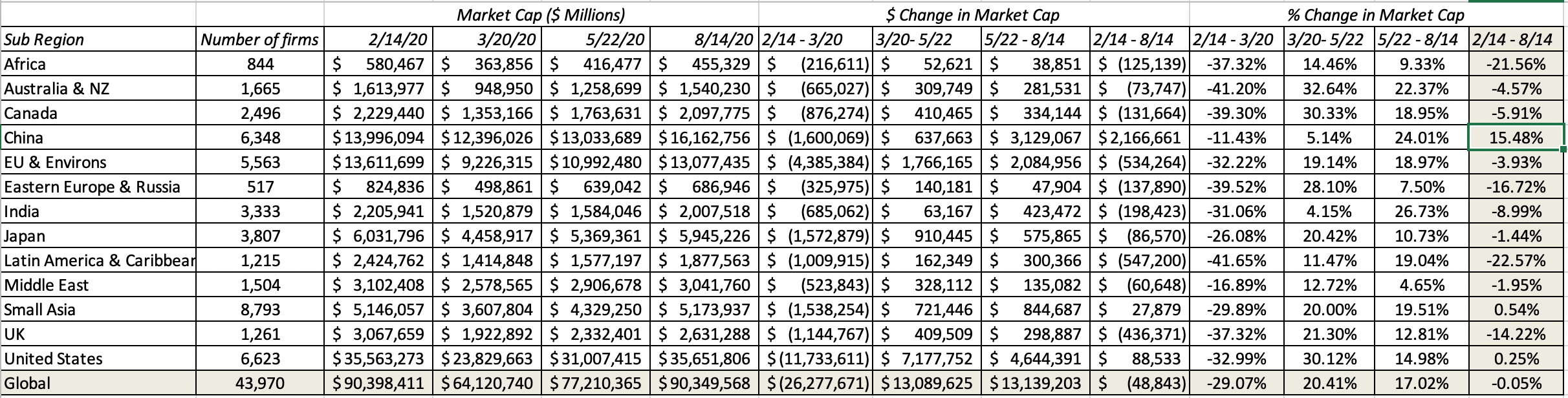
While looking at equity indices can provide a big-picture perspective on how stocks are doing, looking at individual companies can yield much richer insights. As in prior weeks, I updated my company-level data on market capitalizations to include the four weeks since my last update, and I report the changes in market capitalization, by region, in the table below:
Download data

All of these returns are computed in US dollar terms, for comparability, and they are based upon the aggregate market capitalization of all companies traded in each of these markets. As you can see,  a subset of emerging markets (Africa, Eastern Europe, Latin America), are showing the most damage, with weakening local currencies exacerbating market damage. Collectively, global equities on August 14 are back to where they were on February 14, reflecting the comeback story that the indices were telling. Breaking down global stocks by sector, here is what I see:

Download data

Of the eleven sectors that S&P uses to classify stocks, six now have positive returns over the crisis period, and technology has now overtaken health care as the best performing sector. The worst performing sectors are energy, real estate and utilities, all businesses that are capital intensive and debt laden, and default worries about that debt burden may explain why financials remain the worst performing sector. Breaking sectors down into finer detail in industry groups, I list the ten worst performing and best performing industries, over the six-month period:

Download data

The message in this table reinforces what you saw in the sector returns, with infrastructure, commodity and financial service industries making up the bulk of the loser list, and technology, health care and retail dominating the winner list.

The FANGAM Phenomenon

In my earlier posts, I argued that the market effects of this crisis have been disparate, with capital-intensive, debt-laden and rigid firms being worse affected than firms that are capital-light and flexible. You see this play out in the returns you see across sectors, industries and regions. In fact, with returns updated through August 14, 2020, technology companies are now showing healthy gains from where they were at the start of this crisis, up 11.82% since February 14, 2020. There is an inside story to this success, and it revolves around six companies - the original FANG stocks and Apple and Microsoft. They have been responsible not just for the bulk of the returns among technology companies, but  have also provided the thrust for the overall market's recovery.

FANGAM - Tale of the Tape

To understand the FANGAM story, let's retrace our steps to when there were only four young companies in this group, Facebook, Amazon, Netflix and Google (FANG) and look at how two of their senior counterparts, Apple and Microsoft, entered this group. In the table below, I list out the founding date for each of these companies, together with the date of their public offerings, the market capitalization at the time of the offering and the years in which each company hit market cap milestones ($100 billion, $500 billion and $1 trillion):


Looking at the six companies, they vary in age, with Microsoft being the oldest and Facebook the youngest, but they have also had extraordinary revenue growth in the last two decades, albeit from different bases. Coming into 2020, Apple, Amazon and Microsoft had already hit trillion-dollar market caps, and they were joined by Alphabet in 2020, and Apple crossed the $2 trillion threshold just two days prior to this post. I find the construct of a corporate life cycle useful in explaining the evolution of companies over time, in both corporate finance and valuations. 

For most companies, aging is accompanied by three phenomena. The first is that revenue growth decreases as companies scale up, with the speed of deceleration in growth a function of competition in the business. The second is that profit margins, which are negative or very low when companies are young, improve as companies grow, with the magnitude of improvement depending upon the economies of scale in the business, but plateau as new competitors emerge. The third is that even the very best companies reach mature growth, where they remain profitable, but struggle to grow and create value at the same time. The FANGAM stocks stand out from the rest of the market, since they have, at least so far, found the antidote to aging, continuing to grow even as they get larger, while sustaining or even improving profit margins. Breaking down how each of these companies deviate from the norm, here is what I conclude:

  • Amazon, the Original: In an era, where every company claims to be the "next Amazon", it is worth remembering that the original company's rise to global dominance came with hiccups and interruptions. After its stint as the poster child for the dot com boom, Amazon's online retail business flirted with failure in 2001, but survived and prospered in the next decade. By the end of the decade, though, it seemed like Amazon's story had run its course, but just as investors were readying for the company becoming a mature retailer, the company reinvented itself as a disruption platform, ready to go after any business it chose to, with an army (Amazon Prime) backing it up.
  • Apple and Microsoft, the Reincarnation Duo: By tech company standards, Apple and Microsoft are old companies that should be struggling to hold on to their customers and fighting off competition. Both companies though seem to have found a way to move the clock back, and retain their status as growth companies. Apple, given up for dead in the late 1990s, found its answer in streamed music, smartphones and tablets in the following decade. Office and Windows were the cash cows that kept Microsoft going for much of its corporate life, but after seeing growth flatline in the software business, the company found new growth in a subscription model (Office 365) and the cloud business.
  • Alphabet and Facebook, the Advertising Juggernauts: Google and Facebook have had almost uninterrupted growth, since their founding, as they have not only taken advantage of the shift to online advertising, but also dominated that shift, while also delivering profit margins in the stratosphere. Along the way, they have accumulated huge user bases, giving them the power to influence not only where people shop, but also what they think, and perhaps even how they vote.
  • Netflix, the Shape Shifter: Of the six stocks, the one that has had to make the most mid-course corrections, changing its business model to reflect a changing world, is Netflix. It started life as a video rental service, mailing DVDs to its customers, and undercutting Blockbuster, the dominant player in the business then. It pivoted quickly to become the leading streaming player, renting its content from movie and TV producers, and offering them to subscribers. As content producers squeezed the company, it shifted its business model again to make its own shows and movies, becoming the largest spender on content in the business. Along the way, it has gone global, and its business machine not only has a huge base of subscribers, but finds ways to keep adding to that base.

Every investing generation has its share of legendary companies, but I do not believe that there has been another grouping of companies that has dominated the market as completely as these six have done over the recent past.

A Decade of Domination

To understand how the FANGAM stocks made the last decade their own, you need to go back to the start of 2010, and see how the market viewed each one then:

  • The Lagging Giant: At the start of 2010, Microsoft had a market capitalization in excess of $270 billion, and was second only to Exxon Mobil, with a market cap of $320 billion, among US companies, but that represented a come down from its status as the largest market cap company at the start of 2000, with a market cap exceeding $500 billion.
  • The Rising Star: At the start of 2010, Apple's market cap was approaching $200 billion, making it the fifth largest US company in terms of market cap, but that was a quantum leap from its market cap of $16 billion, ten years earlier.
  • The Field of Dreams Company: By early 2010, Amazon had cemented its status as online retailer, capable of growing its revenues at the expense of its brick and mortar competitors, but without a clear pathway to profitability. The market seemed to be willing to overlook this limitation, giving the company a market cap of more than $50 billion, a significant comeback from the dot-com bust days of 2001, when it was valued at less than $4 billion. 
  • The New Tech Prototype: In January 2010, Google was already the prototype for the new tech company model, having reached a hundred-billion dollar market cap threshold faster (a little more than a year after going public) than any other company in history, and with its market capitalization of more than $160 billion in early 2010, the company was already on the top ten list among US companies.
  • On the cusp: In early 2010, it is unlikely that anyone would have put Netflix on the list of big-time winners, since its market capitalization was less than $4 billion and its business model of renting content and signing up subscribers was seen as successful, but not scalable.
  • The glimmer in the market's eye: At the start of 2010, Facebook was still a private business, though venture capitalists were clearly excited about its prospects, pricing it at roughly $14 billion in January 2010, based primarily on its user numbers. 
Looking at the FANG or FANGAM grouping, there is an element of revisionist history at play, since the stocks that are part of this group are there primarily because they have done so well in the last decade. In short, no one was talking about FANG stocks in early 2010, and Microsoft would never have made this list even as late as 2012, when it was viewed as a stodgy and fading company.  Notwithstanding this hindsight bias, the FANGAM stocks collectively saw their market capitalizations increase from $719 billion (albeit without Facebook) to a staggering $5 trillion between January 1, 2010 and January 1, 2020. In the graph below, I show that collective market cap figure as well as the market capitalizations of all other US equities, each year from the start of 2010 to the start of 2020.

Download data

It is true that US equities did well over the decade, but the FANGAM stocks rose much more, rising from 6.5% of the overall market capitalization of all US equities, in January 2010, to close to 15% in January 2020. To provide perspective on how much the FANGAM stocks contributed to the overall equity market's rise, I compute the change in market capitalization each year at the FANGAM stocks and all other US equities, each year from 2010 to 2019:

Download data

The $4.35 trillion in market cap added by the FANGAM stocks accounted for 19% of the overall increase in equity value across all US equities (>7000 stocks). 

The COVID Rally

At the start of 2020, there was no denying the dominance of the FANGAM stocks in US equity markets, but there was a debate about whether they were over priced, at least collectively. For many old-time value investors, the FANGAM stocks had became a symbol of growth and momentum run amok,  though a legendary member of this group (Warren Buffet) had invested in one of the companies (Apple). Between January 1, 2020 and February 14, 2020, the FANGAM stocks continued to rise more than the rest of the market and they collectively accounted for 16.08% of the market cap of all US equities on February 14, up from the 14.94% at the start of the year. When the crisis hit, there were some value investors who felt that the market correction would be felt disproportionately by this group, given their run-up in the years before. In the graph below, I look at the market capitalization of the FANGAM stocks and the rest of US equities, on a week-to-week basis from February 14, 2020 to August 14, 2020:

Download data

During the first five weeks of the crisis (2/14- 3/20), the FANGAM stocks lost about $1.44 trillion in value, providing partial vindication to value investors, but in spite of that loss, saw their share of the market rise to 17.94% of US equities. Between March 20 and August 14, the FANGAM stocks more than recouped the early losses, and were up $1.39 trillion from their February 14 levels, on August 14, while the rest of US equities have collectively lost $1.29 trillion in market capitalization. On August 14, 2020, the FANGAM stocks accounted for 19.94% of the market capitalization of all US equities. While much has been made about how technology has led the comeback on stocks, it is worth noting that US technology companies collectively are up only $973 billion in the last six months, implying that without the FANGAM stocks, there would be no tech comeback. 

From Strength to Strength

We may lump the FANGAM stocks as a group, but these are different companies in different businesses. In fact, lumping them together as technology companies misses the fact that Netflix is closer to Disney in its business than it is to Microsoft's software offerings, and Google and Facebook are advertising companies built on very different technology platforms. There are three elements that they do share in common:

  1. Cash Machines: Each of these companies has a business or segment that is a cash machine, generating large profits and huge amounts of cash for the company. With Apple, it is the iPhone business that allows it to generate tens of billions in cash flows each year, and with Microsoft, it is a combination of its legacy products (Office & Windows) and cloud services that plays this role. With Facebook and Google, their core online advertising businesses not only generate sky high margins, but require very little capital investment to grow. Amazon, until a few years ago, had no segment of equivalent profitability, but AWS (Amazon’s cloud business) is now delivering those cash flows. Netflix remains the weakest of the six companies on this dimension, but even it can count on the subscription revenues from its "sticky" subscriber base for its cash needs. 
  2. Platform of users/subscribers: The FANGAM stocks also share user bases that are immense, with Facebook leading that numbers game with close to 2.7 billion users, many of whom spend large portions of each day in its ecosystem. Microsoft, Google and Apple all also have more than a billion users apiece, with multiple ways to entangle them. Amazon and Netflix may not be able to match the other four companies on sheer numbers, but each has hundreds of millions of users.
  3. Proprietary and Actionable Data: I know that big data is the buzzword of business today, and in the hands of most companies, that big data is of little use, since it is neither exclusive to them, nor the basis for action. What sets the FANMAG companies apart is that they use big data to create value, partly because the data that they collect is proprietary (Facebook from your posts, Amazon/Alexa from your shopping/interactions, Netflix from your watching habits, Google from your search history and Apple from your device usage). Even Microsoft, a late entrant into big data, has stepped up its game. On top of the data is actionable, since these companies clearly use the data to advance their business models, 
Each of these strengths has contributed to helping these companies not just ride out the COVID storm, but to also emerge stronger from it. The cash machines embedded in each company, combined with light debt loads (relative to their earnings and valuations), have left them unscathed, while their debt-laden competitors are hamstrung by default and distress concerns. The economic shut down has left people home-bound and more dependent than ever before on the FANGAM companies to get through the day, increasing the power of the user platforms and the data collected on them by these companies.

In fact, it is the fact that these companies are doing so well that is giving rise to the biggest threat to their continued success, which is regulatory and legal pushback. With Facebook and Google, this is already a reality, especially in the aftermath of the privacy debates and worries about their platforms being used for political influence, with the EU being the forefront of writing restrictions on their data collection and usage. Amazon's disruption of retail, and the devastation it has wrought on its brick and mortar competitors has long been a source of concern for critics, but voices pushing for the use of legal restraints and anti-trust laws on the company are growing louder. Apple has been able to operate under the radar of political and legal scrutiny for a long time, but  recent attempts to force app sellers to sell only through its App Store, leaving it with a hefty slice of revenues, has drawn calls for government action. While Microsoft is now viewed as the most virtuous of the six, and is in fact the most widely held stock in ESG portfolios, I am old enough to remember when Microsoft was viewed as the Darth Vader of technology and targeted by the Justice department for breakup, because of its monopoly power.

Value and Pricing

I know that this has been a long lead in, but interesting though it might be to explain why the FANMAG stocks are where they are, the question of the moment in investing is whether you should buy, sell or just watch these stocks. Having valued all these stocks in the past, and acted on those valuations, with mixed results, I will draw on my past history with each company, to craft my stories and valuations of the companies. 

Download valuations: FacebookAmazonNetflixGoogleApple and Microsoft
Simulation resultsFacebookAmazonNetflixGoogleApple and Microsoft

With each company, I report an estimated median (or most likely) value, as well as the range (1st decile, 1st Quartile, 3rd Quartile and ninth decile) of values that I estimated from running simulations. Given how much these stocks have gone up over the last six months, it should come as no surprise that I find only one (Facebook) to be under valued. Among the remaining, Apple looks the most overvalued (>30%), to me, followed by Amazon and Microsoft (10%-20%) and Netflix and Alphabet (<10%). I have also computed the internal rates of return for these stock, based upon the current market capitalization, and my estimates of expected cash flows. I would expect to earn an IRR of 7.16% on Facebook, for instance, if I bought at its current market capitalization, and it generates the cash flows I expect it to. That may not sound like much to you, but in a world of low interest rates and equity risk premiums, it is high enough for the stock to be undervalued. Even Apple, the most overvalued stock in this group can be expected to generate a 5.30% IRR, at its current market capitalization, lower than what I would need it to make, given its risk, but not bad given the alternatives.  That said, I expect you to disagree with me, perhaps even strongly, on my stories and assumptions, which is one reason the spreadsheets are yours to download and change to reflect your views.

In Closing

In the interests of full disclosure, at the time that I started on this post, I owned three of these six stocks, Apple, Facebook and Microsoft, with each having spent significant time in my portfolio; my posts detailing their acquisitions are here, here and here. As you look back at the valuations that I used to justify those investments, they seem laughably low, and I will not claim any semblance of clairvoyance. In fact, I bought Microsoft in 2013, even though I perceived it to be an aging company with little left in the tank in 2013, Apple in 2016, notwithstanding my expectations of low growth in the future, and Facebook in 2018, in the aftermath of the Cambridge Analytica scandal, because I found the companies cheap, even with my stilted narratives. 

I did sell my Apple holdings today (August 19, 2020) as the company crested the $2 trillion mark, will continue to hold Microsoft, even though I believe that it is moderately overvalued, and Facebook, hoping for more upside.  In case you are tempted to follow my lead, let me hasten to add that I also sold my Tesla holdings in January 2020 at $640, and the stock is now trading at close to $2000. Google and Netflix will remain on my watch list, and I plan to add either stock, on weakness. I will not tempt fate, and sell short on Amazon, partly because I have seen what the market does to Amazon short sellers and partly because I struggle to think of a catalyst that will cause the price to adjust. If history is any guide, these companies, unstoppable though they seem now, will hand the baton, for carrying the market forward in this decade, to other companies. 

YouTube Video

<

Data

  1. Market data (August 14, 2020)
  2. Regional breakdown - Market Changes and Pricing (August 14, 2020)
  3. Sector breakdown - Market Changes and Pricing (August 14 2020)
  4. Industry breakdown - Market Changes and Pricing (August 14, 2020)

FANMAG: Valuations and Simulation Results

  1. Facebook: Valuation and Simulation Results
  2. Amazon: Valuation and Simulation Results
  3. Netflix: Valuation and Simulation Results
  4. Google/Alphabet: Valuation and Simulation Results
  5. Apple: Valuation and Simulation Results
  6. Microsoft: Valuation and Simulation Results

Viral Market Update Posts

Monday, December 3, 2018

Investing Whiplash: Looking for Closure with Apple and Amazon!

In September, I took a look, in a series of posts, at two companies that had crested the trillion dollar market cap mark, Apple and Amazon, and concluded that series with a post where I argued that both companies were over valued. I also mentioned that I was selling short on both stocks, Amazon for the first time in 22 years of tracking the company, and Apple at a limit price of $230. Two months later, both stocks have taken serious hits in the market, down almost 25% apiece, and one of my short sales has been covered and the other is still looking profitable. It is always nice to have happy endings to my investment stories, but rather than use this as vindication of my valuation or timing skills, I will argue that I just got lucky in terms of timing. That said, given how much these stocks have dropped over the last two months, it is an opportunity to not just revisit my valuations and investment judgments, but also to draw some general lessons about intrinsic valuation and pricing.

My September Valuations: A Look Back
In September, I valued Apple and Amazon and arrived at a value per share of roughly $200 for Apple and $1255 for Amazon, well below their prevailing stock prices of $220 (Apple) and $1950 (Amazon). I was also open about the fact that my valuations reflected my stories for the companies, and that my assumptions were open for debate. In fact, I estimated value distributions for both companies and noted that not only did I face more uncertainty in my Amazon valuation, but also that there was a significant probability in both companies that my assessment (that the stocks were over valued) was wrong. I summarized my results in a table that I reproduce below:
Apple Valuation & Amazon Valuation in September 2018
I did follow through on my judgments, albeit with some trepidation, selling short on Amazon at the prevailing market price (about $1950) and putting in a limit short sell at $230, which was fulfilled on October 3, as the stock opened above $230. With both stocks, I also put in open orders to cover my short sales at the 60th percentile of my value distributions, i.e., $205 at Apple and $1412 at Amazon, not expecting either to happen in the near term. (Why 60%? Read on...) Over the years, I have learned that investment stories and theses, no matter how well thought out and reasoned, don't always have happy endings, but this one did, and at a speed which I did not expect:
My Apple short sale which was initiated on October 3 was closed out on November 5 at $205, while Amazon got tantalizingly close to my trigger price for covering of $1412 (with a low of $1420 on November 20), before rebounding. 

Intrinsic Value Lessons
Every investment, whether it is a winner or a loser, carries investment lessons, and here are mine from my AAPL/AMZN experiences, at least so far:
  1. Auto pilot rules to fight behavioral minefields: If you are wondering why I put in limit orders on both my Apple short sale and my covering trades on both stocks, it is because I know my weaknesses and left to my own biases, the havoc that they can wreak on my investment actions. I have never hidden the fact that I love Apple as a company and I was worried that if I did not put in my limit short sell order at $230, and the stock rose to that level, I would find a way to justify not doing it. For the limit buys to cover my short sales, I used the 60th percentile of the value distribution, because my trigger for buying a stock is that it be at least at the 40th percentile of its value distribution and to be consistent, my trigger for selling is set at the 60th percentile. It is my version of margin of safety, with the caveat being that for stocks like Amazon, where uncertainty abounds, this rule can translate into a much bigger percentage price difference than for a stock like Apple, where there is less uncertainty. (The price difference between the 60th and 90th percentile for Apple was just over 10%, whereas the price difference between those same percentiles was 35% for Amazon, in September 2018.)
  2. Intrinsic value changes over time: Among some value investors, there is a misplaced belief that intrinsic value is a timeless constant, and that it is the market that is subject to wild swings, driven by changes in mood and momentum. That is not true, since not only do the determinants of value (cash flows, growth and risk) change over time, but so does the price of risk (default spreads, equity risk premiums) in the market. The former occurs every time a company has a financial disclosure, which is one reason that I revalue companies just after earnings reports, or a major news story (acquisition, divestiture, new CEO),  and the latter is driven by macro forces. That sounds abstract, but I can use Apple and Amazon to illustrate my point. Since my September valuations for both companies occurred after their most recent earnings reports, there have been no new financial disclosures from either company. There have been a few news stories and we can argue about their consequentiality for future cash flows and growth, but the big change has been in the market. Since September 21, the date of my valuation, equity markets have been in turmoil, with the S&P 500 dropping about 5.5% (through November 30) and the US 10-year treasury bond rate have dropped slightly from 3.07%  to 3.01%, over the same period. If you are wondering why this should affect terminal value, it is worth remembering that the price of risk (risk premium) is set by the market, and the mechanism it has for adjusting this price is the level of stock prices, with a higher equity risk premium leading to lower stock prices. In my post at the end of a turbulent October, I traced the change in equity risk premiums, by day, through October and noted that equity risk premiums at the end of the month were up about 0.38% from the start of the month and almost 0.72% higher than they were at the start of September 2018. In contrast, November saw less change in the ERP, with the ERP adjusting to 5.68% at the end of the month.
    Plugging in the higher equity risk premium and the slightly lower risk free rate into my Apple valuation, leaving the rest of my inputs unchanged, yields a value of $197 for the company, about 1.5% less than my $200 estimate on September 21. With Amazon, the effect is slightly larger, with the value per share dropping from $1255 per share to $1212, about 3.5%. Those changes may seem trivial but if the market correction had been larger and the treasury rate had changed more, the value effect would have been larger.
  3. But price changes even more: If the fact that value changes over time, even in the absence of company-specific information, makes you uncomfortable, keep in mind that the market price usually changes even more. In the case of Apple and Amazon, this is illustrated in the graph below, where I compare value to price on September 21 and November 30 for both companies:
    In just over two months, Apple's value has declined from $201 to $196, but the stock price has dropped from $220 to $179, shifting it from being overvalued by 9.54% to undervalued by 9.14%. Amazon has become less over valued over time, with the percentage over valuation dropping from  55.38% to 39.44%. I have watched Apple's value dance with its price for  much of this decade and the graph below provides the highlights:
    From my perspective, the story for Apple has remained largely the same for the last eight years, a slow-growth, cash machine that gets the bulk of its profits from one product: the iPhone. However, at regular intervals, usually around a new iPhone model, the market becomes either giddily optimistic about it becoming a growth company (and pushes up the price) or overly pessimistic about the end of the iPhone cash franchise (and pushes the price down too much). In the face of this market  bipolarity, this is my fourth round of holding Apple in the last seven years, and I have a feeling that it will not be the last one.
  4. Act with no regrets:  I did cover my short sale, by buying back Apple at $205, but the stock continued to slide, dropping below $175 early last week. I almost covered my Amazon position at $1412, but since the price dropped only as low as $1420, my limit buy was not triggered, and the stock price is back up to almost $1700. Am I regretful that I closed too early with Apple and did not close out early enough with Amazon? I am not, because if there is one thing I have learned in my years as an investor, it is that you have stay true to your investment philosophy, even if it means that you leave profits on the table sometimes, and lose money at other times. I have faith in value, and that faith requires me to act consistently. I will continue to value Amazon at regular intervals, and it is entirely possible that I missed my moment to sell, but if so, it is a price that I am willing to pay.
  5. And flexible time horizons: A contrast that is often drawn between investors and traders is that to be an investor, you need to have a long time horizon, whereas traders operate with windows measured in months, weeks, days or even hours. In fact, one widely quoted precept in value investing is that you should buy good companies and hold them forever. Buy and hold is not a bad strategy, since it minimizes transactions costs, taxes and impulsive actions, but I hope that my Apple analysis leads you to at least question its wisdom. My short sale on Apple was predicated on value, but it lasted only a month and four days, before being unwound. In fact, early last week, I bought Apple at $175, because I believe that it under valued today, giving me a serious case of investing whiplash. I am willing to wait a long time for Apple's price to adjust to value, but I am not required to do so. If the price adjusts quickly to value and then moves upwards, I have to be willing to sell, even if that is only a few weeks from today. In my version of value investing, investors have to be ready to hold for long periods, but also be willing to close out positions sooner, either because their theses have been vindicated (by the market price moving towards value) or because their theses have broken down (in which case they need to revisit their valuations).
Bottom Line
As investors, we are often quick to claim credit for our successes and equally quick to blame others for our failures, and I am no exception. While I am sorely tempted to view what has happened at Apple and Amazon as vindication of my value judgments, I know better. I got lucky in terms of timing, catching a market correction and one targeted at tech stocks, and I am inclined to believe that  is the main reason why my Apple and Amazon positions have made me money in the last two months. With Amazon, in particular, there is little that has happened in the last two months that would represent the catalysts that I saw in my initial analysis, since it was government actions and regulatory pushback that I saw as the likely triggers for a correction. With Apple, I do have a longer history and a better basis for believing that this is market bipolarity at play, with the stock price over shooting its value, after good news, and over correcting after bad news, but nothing that has happened  to the company in the last two month would explain the correction. Needless to say, I will bank my profits, even if they are entirely fortuitous, but I will not delude myself into chalking this up to my investing skills. It is better to be lucky than good!

YouTube Video


Blog Posts
  1. Apple and Amazon at a Trillion $: A Follow-up on Uncertainty and Catalysts (September 2018)
  2. An October Surprise: Making Sense of Market Mayhem (October 2018)


Friday, September 21, 2018

Amazon and Apple at a Trillion $: A Follow-up on Uncertainty and Catalysts!

In my last post, I looked at Apple and Amazon, as their market caps exceeded a trillion dollars, tracing the journey that they took over the last two decades to get to that threshold and valuing them  given their current standing. While you can check out the stories that I told and the details of my valuation in that post, I valued Apple at $200, about 9% less than the market price, and Amazon at abut $1255, about 35% lower than its market price. I concluded the post with a teaser, promising to come back with my decisions on whether I would sell my existing Apple shareholding and/or sell short on Amazon, after reviewing two loose ends. The first is to lay bare the uncertainties inherent in both valuations, to see if there is something in those uncertainties that I can use to make a better decision. The second is to evaluate whether there are catalysts that will convert the gap that I see between value and price into actual profits.

Facing up to Uncertainty
One of the recurrent themes in this blog is that we (as human beings) are not good at dealing with uncertainty. We avoid, evade and deny its existence, and in the process end up making unhealthy choices. When valuing companies, uncertainty is a given, a feature and not a bug, and traditional valuation models often give it short shrift. In fact, looking at my valuations of Apple and Amazon, you can see that the only place that I explicitly deal with uncertainty is in the discount rate, and even that process is rendered opaque, because I use betas and equity risk premiums to get to my final numbers. My cash flows reflect my expectations, and even in my moments of greatest hubris, I don't believe that I know, with precision, what will happen to Apple's revenue growth over time or how Amazon's operating margin will evolve in the future. So, why bother? In investing, you have no choice but to make your best estimates and value companies, knowing fully well that you will be wrong, no matter how much information you have and how good your models are. 

That said, it is puzzling that we still stick with point estimates (single numbers for revenue growth and operating margins) in conventional valuation, when we have the tools to bring in uncertainty  into our valuation judgments. While our statistics classes in college are a distant (and often painful) memory for most of us, there are statistical tools that can help us. While these tools may have been impractical even a decade ago, they are now more accessible, and when coupled with the richer data that we now have, we have the pieces in place to go beyond single value judgments. It is with this objective in mind that I recently updated a paper that I have on using probabilistic and statistical techniques to enrich valuation online, and you can get the paper by going to this link. Consider it a companion to another paper that I wrote a while back, dealing more expansively with uncertainty and healthy ways of dealing with it in investing and valuation.

Summarizing the probabilistic techniques that may help in valuation, I suggest three: (1) Scenario Analysis, for valuing companies that may have different valuations depending upon specific and usually discrete scenarios unfolding (for example a change in regulatory regimes for a bank or telecommunications company), (2) Decision Trees, for valuing companies that face sequential risk, i.e., you have to get through one phase of risk to arrive at the next one, as is the case with young drug companies that have new drugs in the regulatory pipeline and (3) Monte Carlo Simulations, the most general technique that can accommodate continuous and even correlated risks that you face in valuation, as is the case when you forecast revenue growth and operating margins for Apple and Amazon, in pursuit of their values.

Simulated Values: Apple and Amazon
Before delving into the simulations for Apple and Amazon, it is important that we set up the structure of the simulations first by first deciding what variables to build distributions around. While you may be tempted by the power of the tool to make every input (from risk free rates to terminal growth rates) into a distribution, my suggestion is that you focus on the variables that not only matter the most, but where you feel most uncertain. With Apple, the three inputs that I will build distributions around are revenue growth, operating margins and cost of capital. With Amazon, I will add a fourth variable to the mix, in the sales to invested capital, measuring how efficiently Amazon can deliver its revenue growth.

Apple: A September 2018 Simulation
I build around my core story for Apple, which is that it will be a slow growth, cash machine, deriving the bulk of its revenues, profits and value from the iPhone, but allow for uncertainty in each of my key inputs:
  1. Revenue growth: While my expected growth rate stays 3%, I allow for a range of growth rates from no growth (flat revenues) , if the iPhone's higher prices cost it signifiant market share) to 6% growth, which would require that Apple find a new growth source, perhaps from services or a new product.
  2. Operating Margin: In my story, I assumed that operating margin would decline to 25% (from  the current 30%) over the next five years. While I still feel that this is the best estimate, I allow for the possibility that competition will be stronger than expected (with margins dropping to 20%), at one end, and that Apple will be able to use its brand name to keep margins at 30%, at the other. 
  3. Cost of capital: My base case cost of capital is 8.20%, reflecting Apple's mix of businesses, but allowing for errors in my sector risk measures and changes in business mix, I build a distribution centered around 8.20% but with a small standard error (0.40%).  
Since I want to stay market neutral, taking no stand on either the level of interest rates or overall stock prices, I am leaving the ten-year bond rate and equity risk premium untouched. The results of the simulation are below:

Valuation & Simulation Output
Note that the median, mean and base case valuations are all bunched up at $200 and that the range in value, using the 10th and 90th percentiles, is tight ($176 to $229).

Amazon: A September 2018 Simulation
Moving from Apple to Amazon, my uncertainties multiply partly because my story is of a company that will move into any business where it believes its disruptive platform can deliver results, and there are very few businesses that are immune. Consequently, every input into the valuation is much more volatile, but I will focus on four:
  1. Revenue Growth: I used an expected growth rate for Amazon of 15% a year for the next 5 years, tapering down to lower levels in the future, to push revenues to $626 billion, ten years from now. While that is an ambitious target, Amazon has proved itself capable of beating sky high expectations before and it is plausible that the growth rate could be as high as 25% (which would translate to revenues of $1.13 trillion, ten years out). There is also the possibility that regulators and anti-trust enforcers may step in and restrain Amazon's growth plans, which could cause the growth rate to drop significantly to 5% (resulting in revenues of $330 billion in year 10).
  2. Operating Margin: While Amazon's margins have been on a slow, but steady, climb in the last few years, much of that improvement has come from the cloud services business, and the future course of margins will depend not only on how well Amazon can bring logistics costs under control but also on what new businesses it targets. I will stay with my base cash assumption of a target operating margin of 12.5%, but allow for the possibility that Amazon's margins will stay stagnant (close to today's margins of about 7%), at one extreme, and that there might be a new, very profitable business that Amazon can enter, pushing up the margins above 18%, at the other.
  3. Sales to Invested Capital: Currently, Amazon is an efficient utilizer of capital, generating $5.95 in revenues for every dollar of capital invested. While this will remain my base case, there may be future businesses that Amazon is targeting that may be more or less capital intensive than its current ones, leading to a significant range (3.95 for the more capital intensive - 7.95 to the less  capital intensive).
  4. Cost of Capital: I will stick with my base case cost of capital of 7.97%, with the possibility that that it could drop as Amazon's older businesses become profitable (but not by much, since the current cost of capital is close to the median for global companies) as well as the very real chance that it could go up significantly, if Amazon targets risky businesses in emerging markets for its growth.
Valuation & Simulation Output
The median value across the simulations is $1242, close to the base case valuation of $1,255. The range on value, using the 10th and 90th percentiles is $705 - $2,152, much wider than the range for Apple.

Lessons from Apple and Amazon Simulations
Simulations yield pretty pictures and if that is all you get out of them, it is time and energy wasted. There are lessons that we can eke out of the Apple and Amazon simulations that may help us in making more informed judgments:
  1. This is not about getting better estimates of value: If you are running simulations because you think they will give you more precise or better estimates of value than point estimate valuations, you will be disappointed. Since my input distributions are centered around my base case assumptions, and they should be, the median values across 100,000 simulations are close to my base case valuations for both Apple and Amazon.
  2. If it is a risk proxy, it is a very noisy and dangerous one: It is true that the spread of the distributions provides a measure of estimation uncertainty that you bring into your valuation. Using the Apple and Amazon simulations to illustrate, I face far greater uncertainty with my Amazon story than with my Apple story, and you can see it reflected in a larger range of value for the former. You may be puzzled that my cost of capital is lower for Amazon than for Apple, but that reflects the fact that much of the uncertainty that I face with Amazon is company-specific and should be buffered by other stocks in my portfolio. As a diversified investor, the variance in simulated values is a poor proxy for risk. However, if you are an investor who prefers concentrated portfolios, you can use the variance in simulated value as a measure of risk. 
  3. There can be no one margin of safety for all companies: I have written about the margin of safety before, often with skepticism, and one of my critiques has been with the way it is used in practice, where it is set at a fixed number for all companies. Thus, you will find value investors who use a margin of safety of 15% or 20% for all stocks, and the Apple and Amazon simulations show the danger in this practice. A 15% margin of safety for Apple may be too large, given how tightly values are distributed for the company, whereas the same 15% margin of safety may be too small for Amazon, with its wider band of values.
  4. Tails matter: Symmetry or the lack of it in distributions may seem like an inside statistics topic, but with simulated values, it has investment consequences. You can see that Apple's value distribution is  much more symmetric than Amazon's distribution, with the latter having a significant positive skew, reflecting a greater likelihood of big positive surprises in value, than negative ones. With companies with exposure to large and potentially catastrophic news stories (a large lawsuit or debt covenants), you can have value distributions that are negatively skewed.  In general, positive skewed distributions are better for (long) investors than negatively skewed ones, and the reverse is true for investors who are shorting a company.
I ran the simulations after my base case valuations suggested that Apple and Amazon were over valued, to see how they might affect my decision on whether to sell short on either company. The results are mixed.
  • While the simulations confirm my over valuations (no surprise there), with both companies, the current stock price is well within the realm of possibilities. While my base case valuation suggested that Apple was far less over valued (10%) than Amazon (55%), there is roughly a 15-20% chance that both companies are under valued, not over valued.
  • In addition, with Amazon, there is the added risk, if you are selling short, given the long positive tail on the distribution, that if I am wrong, the price I will pay will be much greater than if I am wrong with Apple.
The bottom line is that while Amazon seemed like a much better short selling target, after my base case valuations, because it was far more over valued than Apple, the simulations that I did on the two companies even out the scales, at least marginally. Apple is more over valued, but the probability of making money, assuming my valuations are on target is about the same with both stocks, and the downside of being wrong is far greater with Amazon than with Apple.

Value and Price: The Search for Catalysts
In the post that initiated this series, I looked at why crossing a trillion-dollar threshold may matter to investors, using the contrast between the value process and the pricing process. In effect, I argued that there can be a gap between value and price, and that even if you are right about your value judgment, you will make money only if the gap between the two closes:

Investment success thus rides not only on the quality of your value judgment, and how much faith you have in it, but on whether there are catalysts that can cause the gap to change. With companies, these catalysts can take different forms:
  1. Earnings reports: In their earnings reports, in addition to the proverbial bottom line (earnings per share), companies provide information about operating details (growth, margins, capital invested). To the extent that the pricing reflects unrealistic expectations about the future, information that highlights this in an earnings report may cause investors to reassess price. 
  2. Corporate news: News stories about a company's plans to expand, acquire or divest businesses  or to update or introduce new products can reset the pricing game and change the gap.
  3. Management Change/Behavior: A change in the ranks of top management or a managerial misjudgment that is made public can cause investors to hit the pause button, and this is especially true for companies that are bound to a single personality (usually a powerful founder/CEO) or derive their value from a key person. 
  4. Macro/ Government: A change in the macro environment or the regulatory overlay for a company can also cause a reassessment of the gap.
With all of these catalysts, there may be value effects (because the cash flows, growth and risk) as well, and it should also be noted that when the gap changes, it may not always close. In fact, these catalysts can sometime make a gap bigger, by feeding into pricing momentum.

As an investor, I look for catalysts when I invest, but I am even more intent on finding them, when I sell short than when I am long a stock. The reason for that divergence is that I am in far greater control of my time horizon, when I buy a stock, since, as long as I stay disciplined and retain faith in my value, only liquidity needs can cause me to sell. When I sell short, my time horizon is far less under my control, exposing me to timing risk. Put different, I can bet on a company being over valued, be right on my thesis, but still lose money on a short sale, because I am forced to close out my position, in the absence of a catalyst.

Going through the list of catalysts with Apple and Amazon, with both stocks approaching all-time highs, there is no obvious pricing trigger than I can point to, though my technical analyst friends will undoubtedly point to indicators that I did not even know existed. On the earnings front, the earnings reports for both companies are so heavily scripted to expectations that it would take a big surprise to reset stories, and I don't see that happening. In fact, I will predict that Amazon's earnings reports will continue to deliver double digit revenue growth and improving margins for the next few quarters, and investors will react positively, even though the growth may not be high enough or the margin improvement substantial enough to justify the market pricing. On the corporate news front, Apple's smart phone business model, with the pressure it puts on the company every year or two to reinvent itself, with the latest and the best, coupled with its big announcement events, creates catalyst moments. Looking back at Apple's ups and downs over the last few years, the triggers for substantial up and down movements on the stock have been new iPhone models doing better or worse than expected. In contrast, Amazon is remarkably low key in new product introductions, preferring to slip in under the radar. Both companies have well regarded and established CEOs, and neither company is personality-driven, making it unlikely that you will see management changes triggering big price changes. Finally, on the macro front, both companies face potential catalyst moments. For Apple, it is the possibility of a trade war with China, a huge market for its products and devices, and for Amazon, it is talk of regulatory restrictions and anti-trust actions that can constrain the company.  Since I cannot filibuster my way to a non-decision, I decided to compare my Apple and Amazon numbers/analysis, side by side:

I sold my Apple shares at $220, at the start of trading on Friday (9/21), but while I have not sold short any more shares. I have put in a limit (short) sell, if the price hits $230 (roughly my 90th percentile of value) in the near future. With Amazon, I sold short at $1950 at the start of trading on Friday (9/21).  the first time in twenty years that I have sold short on the company, and one reason that I am pulling the trigger is because I believe that the pushback from regulators and anti-trust enforcers will slow the company down in ways that no competitor ever could. I am doing so, with open eyes, since I believe that Amazon is in one of the best run companies in the world, adept at setting market expectations and beating them, and with a track record of taking short sellers to the graveyard. Time will tell, and I am sure that some of you reading this post will let me know, if my bet goes awry, but I don't plan to lose any sleep over this. 

YouTube Video


Trillion Dollar Posts


Spreadsheets

  1. Apple valuation and simulation results
  2. Amazon valuation and simulation results
(I use Crystal Ball, an add-on to Excel, for my simulations. If you don't have that extension (available only on the PC version), you cannot recreate my simulations, but you can download the program for a trial run on the Oracle website)

Papers/Reading
  1. Facing up to Uncertainty: Using Probabilistic Approaches in Valuation
  2. Living with Noise: Investing and Valuation in the Face of Uncertainty

Wednesday, September 19, 2018

Apple and Amazon at a Trillion $: Looking Back and Looking Forward!

For most of us, even envisioning a trillion dollars is difficult to do, a few more zeros than we are used to seeing in numbers. Thus, when Apple’s market capitalization exceeded a trillion on August 2, 2018, it was greeted with commentary, and when Amazon’s market capitalization also exceeded a trillion just over a month later on September 4, 2018, there was more of the same. I have not only admired both companies, but tracked and valued them repeatedly over the last twenty years. There is much that I have learned about business and finance from both companies, and I thought this would be a good occasion to look at how these two companies got to where they are today, as well as their similarities and differences. In the process, I will make my assessment of where Apple and Amazon stand today, and update my valuations and investment judgments on both companies. I am sure that your assessments will be different, but it is of these differences that markets are made.

The Road to a Trillion Dollars

Markets give and markets take away, and this is true not just for the laggards in the market, but even the most successful companies. Apple and Amazon have had amazing runs, but without taking anything away from their success, it is worth noting that during their march towards trillion dollar market capitalizations, each has had to endure periods in the wilderness, and the way they dealt with market adversity is what has made them the companies that they are today.

Apple is the older of the two companies, founded in 1976, and igniting the shift away from mainframe computers to personal computers, first with its Apple computers and later with its Macs. My first personal computer was a Mac 128K, which I still own, and I have been an investor in the stock off and on, for decades. In the chart below, I graph the market capitalization of the company from 1990 to September 2018:

After its auspicious beginnings, Apple endured a decade in the wilderness in the 1990s, after the departure of Steve Jobs, its visionary but headstrong co-founder, in 1975, and a series of inept successors. As testimonial that there are sometimes second acts for both people and companies, Apple found its mojo in the first decade of this century, headed again by Steve Jobs but this time with a stronger supporting cast. That success has continued into this decade, with Tim Cook stepping in as CEO, after the untimely demise of Jobs. In the last few years, the company has also chosen to use its capacity to borrow money, increasing its debt ratio from close to nothing to just over 10% of equity (in market value terms).

Just as Apple presided over one major change in our lives, Amazon’s entrée into markets reflected a different shift, one that has changed the way we buy goods, and, in the process, and has upended the retail business. Amazon's sprint from start-up to trillion dollar value is captured below:
From a barely registering market capitalization in 1996, Amazon zoomed to success during the dot-com boom, but as that boom turned to bust, the company lost more than 80% of its market capitalization in 2000. After its near-death experience in 2000, Amazon spent the bulk of the following decade, consolidating and getting ready for its next phase of growth, increasing its market capitalization almost eight-fold between 2012 and 2018.

Along the way, both companies have had their detractors, who have not only scoffed at the capacity both companies to scale up, but have also sold short on the stock, making both stocks among the most shorted in the market. Little seems to have changed on that front, since Apple and Amazon remain among the most heavily shorted stocks in September 2018, though neither Jeff Bezos nor Tim Cook seems to be paying any attention to the short sellers. (Elon Musk, Please take note!)

The Back Story: Revenues and Operating Income

We can debate whether Amazon and Apple are worth a trillion dollars, but there can be no denying that both companies have been successful in their businesses, and that it is these operating success that best explain their high market values. That said, as we will see in the section following, the way these companies have evolved over time have been very different, and looking at the pathways that they used to get to where they are,  I will lay the foundations for valuing them today.

Revenue Growth and Profitability
Every investigation of operations starts with revenues and operating income, and with Apple, the picture of revenues and operating income over the last three decades illustrates the transformation wrought by its decision to shift away from personal computers to hand held devices, starting with the iPod and then expanding into the iPhone and iPad, in the the last decade:


The revenue growth rate, which languished in the 1990s, zoomed in 2000-08 time period, and operating margins almost doubled. However, it was in the 2009-13 period that Apple saw the full benefits of its rebirth, with operating margins almost quadrupling, with the iPhone being the primary contributor. During the 2014-18 period, the good news for Apple is that margins have stayed mostly intact but it has seen a fairly dramatic drop off in growth, as the smart phone market matures.

The Amazon operating story also starts with revenue growth, but the company's evolution on operating margins has followed a different path from Apple's:
The company's growth was stratospheric in the early years, partly because it was a start-up, scaling up from less than a million dollars in revenues in 1995 to $2.76 billion in 2000. While scaling up did slow down growth, the company weathered the dot com bust to grow revenues at 28.61% a year from 2000 to 2010, with revenues reaching $34.2 billion in 2010. The most impressive phase for Amazon has been the 2011-2018 period, because it has been able to continue to grow revenues at almost the same rate as in the prior decade, but this time with a much larger base, increasing revenues to $208.1 billion in the last twelve months, ending June 2018. On the income front, the story has not been as positive. While the initial losses in try 1990s can be explained by Amazon's status as a young, growth company, it becomes more difficult to justify the continuation of these losses into 2002 (six years after its public listing) and the trend lines in operating margins since then. Rather than improving over time, as economies of scale kick in, which is what you would expect in growth companies, Amazon's margins have not only stayed low but have often headed lower, suggesting either that the company is not reaping scaling benefits or that it is playing a very different game, and my bet is on the latter. 

The Cash Flow Contrast
If you are a value investor, I know that you will probably be taking me to task at this point by noting that you don't get to collect on revenues or operating income and that you invest for the cash flows. That is true, and it is on this dimension the the difference between Apple and Amazon becomes a yawning gap.  With Apple, the evolution of the company from a has-been in the 1990s to a disruptive force in the 2001-2010 period to its more mature phase between 2011 and 2018 plays out in its cash flows. Using the free cash flow to equity, which measures cash left over for equity investors after reinvestment and taxes, as the measure of cash that can potentially be returned to shareholders, here is what I see:

I have described Apple as the greatest cash machine in history and you can see why, by looking at the cumulative cash flows generated by the firm. After getting a start in the 2000-08 time period, the cash machine kicked into high gear between 2009 snd 2013, with $124 billion in free cash flow to equity generated cumulatively over the period. You can also see the company's initial reluctance to return the cash, both in the fact that only about a third of the cash flow during this period was returned in dividends and buybacks and in the increase in the cash balance of just over $122 billion. Prodded by activist investors (Einhorn and Icahn, in particular), the company switched gears and began returning more cash, increasing dividends and buying back more stock. Between 2014 and 2018, the company returned an astonishing $277 billion in cash to investors ($61 billion in dividends and $216 billion in buybacks), which is higher than the $242 billion that the firm generated as free cash flows to equity. While it was returning more cash than any other company has in history, Apple pulled off an even more amazing feat, increasing its cash balance by $96 billion, as it used it dipped into it debt capacity, to borrow almost $100 billion.

Amazon's cash flows are a distinct contrast to Apple's, though you should not be surprised, given the lead up. As noted in the earlier section, it is a company that has gone for higher revenue growth, often at the expense of profit margins, and has been willing to wait for its profits. The graph below looks at net income and free cash flows to equity at the company over its lifetime:

It is not the negative FCFE in the early years that is the surprise, since that is what you would expect in a high growth, money losing company, but the evolution of the FCFE in the later years. Initially, Amazon follows the script of a successful growth company, as both profits and FCFE turn positive between 2001 and 2010, but in the years since, Amazon seems to have reverted back to the cash flow patterns of its earlier years, albeit on a much larger scale, with huge negative free cash flows to equity. During all of this period, Amazon has never paid dividends and bought back stock in small quantities in a few years, more to cover management stock option exercises than to return cash to stockholders.

Story and Valuation

With the historical assessment of Apple and Amazon behind us, it is time to turn to the more interesting and relevant question of what to make of each company today, since Apple and Amazon are clearly are on different paths, with very different operating make ups and at different stages in the life cycle. Apple is a mature company, with low growth, and is behaving like one, returning large amounts of cash to stockholders. Amazon is not just a growing company, but one that seems intent on continuing to grow, even if it means delayed profit gratification. In the section below, I will lay out my story and valuation for each company, with the emphasis on the word "my", since I am sure that you have your own story for each company. I will leave my valuation spreadsheet open for you to download, with the story levers easily changed to reflect different stories. 

Apple: The Smartphone Cash Machine
Apple's success over the last two decades has been largely fueled by one product primarily, the iPhone, and that success has come with two costs. The first is that Apple is now predominately a smart phone company, generating almost 62% of its revenues and an even higher percentage of its profits from the iPhone. The second is that the smart phone business has not only matured, with lower growth rates globally, but is intensely competitive, with both traditional competitors like Samsung and new entrants roiling the business. While there remains a possibility that Apple will find another market to disrupt, I think it will be difficult to do so, partly because with Apple's size, any new disruptive product has to not only be of a big market, but one that is immensely profitable, to make a difference to Apple's cash flow stream.

My story for Apple is therefore relatively unchanged from my story last year, though I am a little bit more optimistic that Apple will be able to use its immense iPhone owner base to sell more services
Download spreadsheet
I am valuing Apple as a mature company, growing at the same rate as the economy in perpetuity, while seeing its operating margins decline from their current level (30%) to about 25% over the next 5 years, and with these assumptions, I estimate a $200 value per share, roughly 9% lower than the $219 stock price on September 18, 2018.

Amazon: The Disruptive Platform
In my earlier valuations of Amazon, I called it a Field of Dreams company, because investing in it required investors to buy into its vision of "if we build it (revenues), they (profits) will come". In my most recent valuation of Amazon, I noted that the company was finally starting to deliver on the second half of the promise, increasing its profits margins, with its cloud business contributing large profits, and significant investments in logistics keeping shipping costs in check. Along the way, and especially since 2012, the company has also moved from being predominantly a retailer of goods and services to one that is unafraid to enter any new business, where it can use its disruptive platform to good effect. In effect, it has seemed to have transitioned from being a disruptive retail company to a disruption platform that can be aimed at other businesses, with an army of Prime members at its command.

My story is that will continue to do more of the same, with high revenue growth coming from new businesses and markets and a continued growth in margins, as established businesses start to find their footing. 
Download spreadsheet
My revenue growth rate of 15% may seem modest, given Amazon's growth rate in the last decade, but note that if this growth rate can be delivered, Amazon's revenues will be $626 billion in 2027, and if it can improve its overall operating margin to 12.5%, its operating profit will be $78 billion in that year. With this story, I estimate a $1,255 value per share for Amazon, well below its market price of $1,944 a share, making it over valued by almost 35%. I will admit, with no shame, that Amazon is a company that I have consistently under estimated, and it is entirely possible, perhaps even plausible, that the real story for Amazon is even bigger (in terms of revenue growth) and more profitable. 

End Game
I have always operated on the premise that if you value companies, you should be willing to act on those valuations. In the case of Apple and Amazon, that would suggest that the next step that I should be taking with each company is to sell. With Apple, a stock that I have held for close to three years and which has served me well over the period, that would be accomplished by selling my holding. With Amazon, a stock that I have not held for more than five years, that would imply joining the legions of short sellers. Like an Avengers' movie, I am going to leave you in suspense until my next post, because I have two loose ends to tie up, before I can act. The first is to grapple with the uncertainties that I have about my own stories for the two companies, and the resulting effects on their valuations. The second is what I will mysteriously term "the catalyst effect", which I believe is indispensable, especially when you sell short. 

YouTube video

Valuation Spreadsheets