Showing posts with label Corporate Governance. Show all posts

Friday, November 4, 2022

META Lesson 1: Corporate Governance

As we get deeper into earnings season for the third quarter of 2022, the biggest negative surprises are coming from technology companies, with the tech giants leading the way. Investors, used to a decade of better-than-expected earnings and rising stock prices at these companies, have been blindsided by unexpected bad news in earnings reports, and have knocked down the market capitalization of these companies by hundreds of billions of dollars in the last few weeks. Facebook (or Meta, if you prefer its new name), in particular, has been in the eye of the storm, down more than 75% from the trillion-dollar market capitalization that it enjoyed just over a year ago. In its last earnings report, the company managed to disappoint almost every segment of the market, shocking growth investors with a drop in quarterly revenues, and value investors with a sharp decline in earnings and cash flows. In the days after the report, the reaction has predictably fallen into the extremes, with one group arguing that this is the beginning of the end for the company's business and the other suggesting that this is the time to buy the stock, as it prepares for a new growth spurt. 

Having valued and invested in Facebook multiple times in the last decade, I will throw my two cents in, but rather than make the earnings report the center of attention, I will use the company's recent travails to talk about three issues that I think are big issues not only at Facebook, but for the entire market. In this first post, I will use the investor debate about Facebook to talk about  corporate governance, what it is, why it matters and how I think governance disclosure research, rules and scoring services have lost the script in the last two decades. In the next post, I will use Facebook's most recent earnings surprise to talk about inconsistencies in how accountants categorize corporate spending, and why these inconsistencies can skew investors perceptions of corporate profitability and financial health. In the third and final post, I will argue that Facebook's troubles with the market have as much to do with a failure of narrative, as they are about disappointing numbers, and present a template for what the company needs to do, to reclaim the high ground.

Facebook: Filling in the Background

   It is worth noting that in good times, when earnings are rising and stock prices are upward bound, investors do not seem to have much interest in corporate governance, and it is only when the numbers start to move against them, that they rediscover the importance of the topic. To understand why talk about corporate governance at Facebook has been muted for much of its corporate life, and why it is a prime topic of conversation now, let's retrace Facebook's journey, over the last decade, from a young VC-backed private company to a high-profile public company.

The Market Journey

    Facebook is a young company, at least in chronological time, having been public for just over a decade. I have written about the firm many times, over that period, starting with a valuation that I did of the company in 2012, just ahead of it going public. On May 12, 2012, Facebook's debuted in financial markets, with a capitalization of $104 billion, making it one of the most valuable IPOs of all time. After a rough start, with its stock price halving by August 2012, the company embarked on an extraordinary run in markets, adding almost $900 billion to its market capitalization to briefly breach a trillion dollars in July 2021. In a post in 2020, I highlighted how much of the increase in US equity values in the 2010-2019 decade was because of the FANGAM stocks (Facebook, Amazon, Netflix, Google, Apple and Microsoft):

Since July 2021, Facebook's market standing has fallen precipitously, with its market capitalization down to less than $250 billion (down more than 75% from its high) on October 27, after its most recent earnings report. As Facebook's market capitalization has collapsed, it is worth stepping back and gaining perspective about its market performance in the long term. 

  • Buy and hold returns: If you had bought shares in Facebook on its first trading day, you would have paid $38.12, and if you had held the stock through October 27, 2022, when it was trading at $93/share, that would have translated into a cumulative return of 144%. That would have left you lagging the 181% price appreciation that you would have earned on the S&P 500 during the period, and even more so, if you consider the fact that you would have earned no dividends on Facebook, while generating about a 2% dividend yield, every year on the index.
  • Current standing: At a roughly $250 billion market capitalization, Facebook is a large market-cap company, but it has lost its standing among the largest market cap companies in the world that if occupied for an extended period during the last decade. 
  • Trader's game: Along the way, Facebook has had its ups and downs, and a savvy trader who was able to time entry and exit into the stock at the right times, would have made a killing on the stock. I know that can be said of any stock, but the swings in fortune are much greater at companies like Facebook, making them them the preferred habitat for traders of all stripes.
In sum, the investor experience with Facebook over the last decade should be a cautionary note on passing judgment on companies after short periods, where the stock soars or sinks, sometimes for no good reasons. 

The Operating Journey

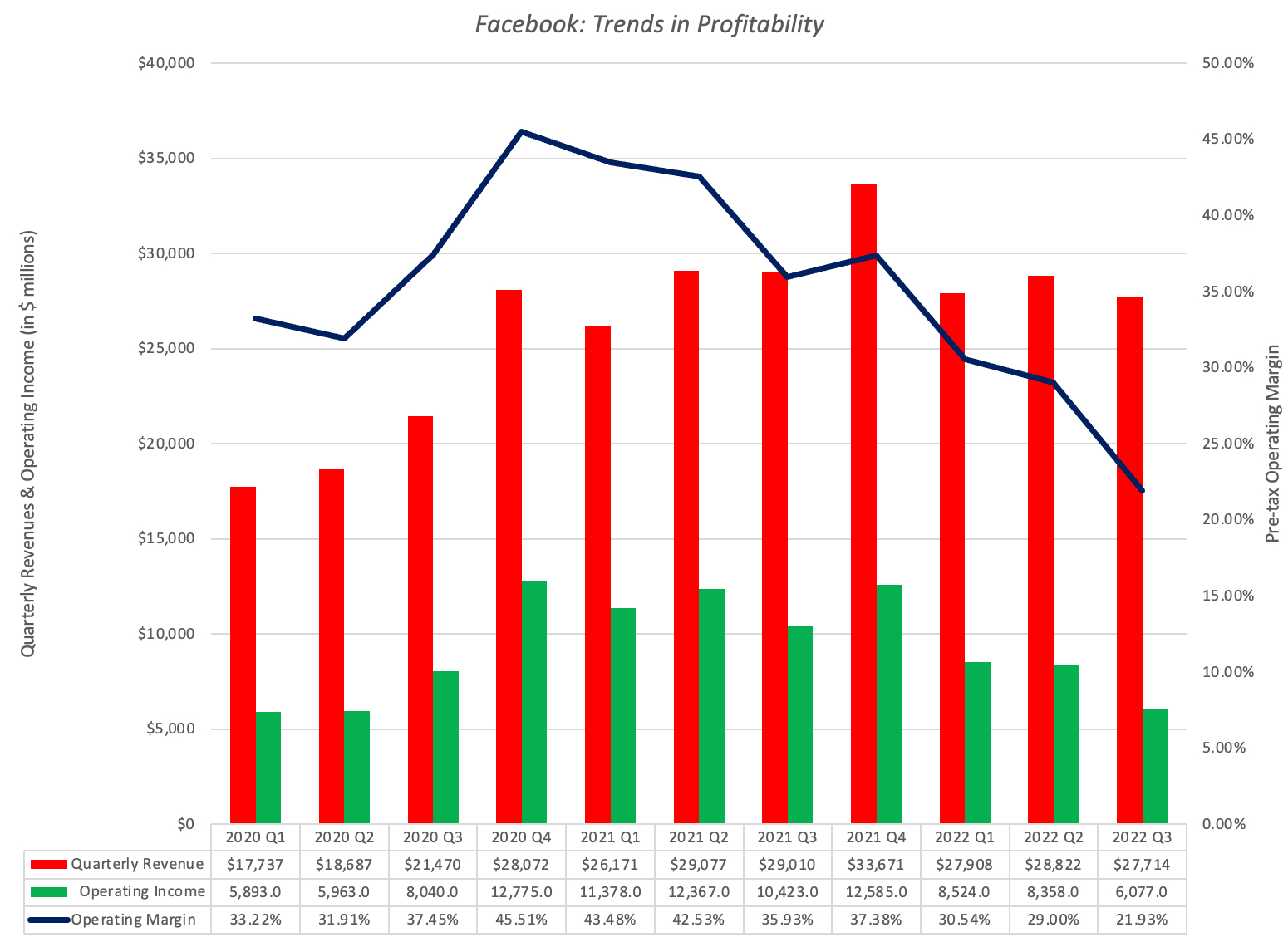
    The drop in Facebook's stock price that has occurred in 2022 is part of a larger story of a decline in tech companies during the year. For many value investors, the tech stock drop has been vindication that no sector, no matter how favored, can fight gravity in the long term, but they would be making a mistake if they bundle Facebook in with younger tech companies, many of which have unformed business models and an inability to be profitable. Through its entire life, one of Facebook's most impressive features has been its capacity not only to generate profits but very large profits, as you can see in the chart below:


Note that Facebook, then it went public, had revenues of only $3.7 billion, but it generated an operating margin of 47.3%, with its online advertising model. In the decade since, its has been able to scale up revenues dramatically, with revenues reach $118 billion in 2021, while preserving sky-high margins, close to 40% in 2021. In short, Facebook has been a profit and cash machine for its entire public market life, and there is more to this company than traders pushing up stock prices on momentum. 

    It is this historical context of high growth, albeit slowing as the company scales up, and consistently high operating margins, that should explain investor reactions to last week's earnings report. There were at least two negative surprises in the report that led to investor reassessment:

  1. Flat revenues: While revenue growth has been slowing in recent quarters, and investors would perhaps have lived with single digit growth, especially with advertising spending slowing, they were blindsided when the company reported its second consecutive year-on-year quarterly revenue decline . The company's contention was that the decline was driven by a slowing down in online advertising revenues at the firm, mirroring similar slowdowns at other online advertising platforms.

    That said, there is clearly more to it than an industry-wide slowdown, since the drop in revenues at Facebook has been larger than the drops seen across the sector; Google, for instance, reported a third quarter year-on-year revenue growth rate of 6% in October 2022.
  2. Drop in operating margins: The bigger shock in the most recent earnings report, in my view, was the collapse in operating margins.

    While the decline in operating income in the first two quarters of 2022 mirror drops in revenues in those quarters, the decline in the third quarter cannot be explained by lower revenues in that quarter. The company attributed the decline in operating income to its Reality Labs unit, which houses its VR headsets, with reported revenues of $285 million and an operating loss of $3.67 billion in the third quarter of 2022. 
It is undeniable that the third quarter numbers for Facebook were disappointing, but again taking a longer term perspective, most companies would gladly switch places with Facebook, with revenues of more than $100 billion, and operating margins of 20%-30%. The question that we face now, as prospective investors, is whether the market has overreacted to a quarter's bad numbers or whether this is the beginning of the end for the company's core business model. 

The Troubles

    While 2022 has been a particularly difficult year for Facebook, the troubles at the company date back to 2018, when it was revealed that Cambridge Analytica, a UK-based data service with political clients, had acquired and utilized Facebook data on tens of millions of users. In the aftermath, Facebook faced both political and investing backlash, with its stock price dropping by more than 10% and there were some doomsayers who argued that its business model was irretrievably broken, because of the privacy challenges. At the time, I pointed to the hypocrisy of critics complaining about Facebook's privacy lapses on their Facebook pages, and argued that the company would weather the scandal, albeit with scars. In the months after, that view was vindicated as Facebook spent billions on tightening security, while continuing to grow revenues and report sky-high margins, and the market responded by pushing up its stock price once again.

    While Facebook was able to deal with the privacy challenge, relatively unscathed in economic terms, there are three other problems that the company is facing that will not be as easily overcome:

  1. Online Ad Market Leveling off: Facebook is an online advertising company, and for much of its early years, it benefited from growth in the online advertising market, largely at the expense of traditional advertising (newspapers, television etc.). As online advertising approaches two-thirds of all advertising, that growth is now leveling off, and as one of the two largest players (and beneficiaries) of the market, Facebook is facing a growth crunch.
  2. Online advertising is cyclical: As online advertising has grown over the last decade, one of the questions has been whether it, like all advertising historically, is cyclical. Prior to this year, there were some who argued that online advertising would be more resilient than traditional advertising, in the face of economic shocks, but this year's developments have shown otherwise.  As economic growth has slowed and concerns about a recession have risen, revenue growth has dropped at all of the companies in this space has declined. The conclusion is that online advertising is cyclical, and if we are in the midst of an economic slowdown, the companies in this space will feel the pain.
  3. Reputation effects: While Facebook made it through the privacy challenges with revenue growth and profitability intact, it is undeniable that the company's reputation took a beating. In my view, this toxicity, as much as the desire to enter a new market in the Metaverse, explains why Facebook changed its name to Meta in November 2021. 

In fact, it is this trifecta of developments (a maturing online ad market, exposure to economic cyclicality and reputation damage), in conjunction with Facebook's disappointing operating numbers that has led investors to reassess its worth, and mark down its price. 

Corporate Governance

    As stock prices have dropped this year, not only is there an increased focus on earnings and cash flows, as I noted in my last post, but there seems to also be an reawakening among investors about the importance of corporate governance, as can be seen in this article about Facebook. Having seen these awakenings many times over the last 30 years, I am cynical that anything productive will come out of these discussions, since we seem to have lost sight of what corporate governance is and why it matters to investors.

The Stakeholders 

    To set the stage for understanding corporate governance, it is best to start with a recognition of the different stakeholders in a publicly traded company:


While all of these claim holders have stakes in the company, their interests will diverge, raising a key question of whose interests should be served by the managers of the company, when making business decisions, small or large. It is true that conventional corporate finance (and the Delaware courts) give primacy to shareholders, and it is not because shareholders are a special or protected group, but It is because they are the only claim holders that do not have a contractual claim on the firm; as shareholders you get what's left over after contractual claims (wages, interest expenses) have been met. Lenders can negotiate interest and principal payments and insert covenants to protect themselves, employees have employment contracts and sometimes unions to negotiate wages and benefits, and customers can choose to buy or not buy a company's products and services. 

    There is of course a notion that managers should be accountable to all stakeholders, not just stockholders, an idea that was born and nurtured in law schools, before finding a footing in business. In a 2019 post, I presented my arguments for why stakeholder wealth maximization is fanciful in its belief that it is management's job to juggle the divergent interests of different stakeholders and dangerous insofar as it makes managers accountable to everyone, and by extension, to no one. (Note that the G in ESG is about stakeholder governance, not shareholder governance, which may explain why CEOs have been so quick to jump on its bandwagon.)

Conflicts of Interests and Consequences
    If you are looking at a privately owned business, with a sole owner who also runs the business, the interests of owners and managers converge, but this is the exception, not the rule. Even in a family-owned business, where one family member runs the business, you can have other family members disagree about how it is run, leading to frictions and legal battles. (If you are a fan of Succession on HBO, you know exactly what I am talking about). As businesses seek external capital to grow, either from private hands (venture capitalists) or public equity, the divergence between the interests of those running businesses and the owners of these businesses will increase. That is the core challenge in corporate governance, and any discussion of the topic has to begin with answers to three questions:
  1. In what types of firms is this conflict of interest greatest? If the conflict of interest that is at the heart of corporate governance is that between the owners of a business and those who manage that business, it will begin when private businesses seek out capital from external sources, as founder and venture capital interests can diverge. These conflicts will expand, as companies go first go public, and the interests of insiders and founders, who run the firm, can be at odds with the interests of outside shareholders. As companies age, founders will move on and get replaced by professional managers, and these managerial interests can clearly be at odds with those of shareholders, with boards of directors, in theory, watching out for the latter. In short, conflicts of interest exist at almost all businesses, though the nature of the conflict will change as companies go from private to public, and as they age.
  2. When the interests of shareholders and corporate decision-makers diverge, what are the consequences for the company? When the interests of decision makers or managers at a business diverge from those of its owners, it is inevitable that there will be decisions made that advance the interests of the former at the expense of the latter. With private business that access venture capital, founders may make decisions (on product design, business models, marketing) that venture capitalists may not find to their liking. With public companies that are run by founders/insiders, the decisions made by inside shareholders to advance their interests may not align with the interests of outside shareholders. In older public companies, the investing, financing and dividend decisions that managers make may by in direct opposition to what shareholders would like them to do.
  3. What are the checks on these conflicts of interest? In each of the scenarios described above, it is true that there are mechanisms that exist to keep these conflicts in check. In private firms with venture capital investors, VC investors are often actively involved in management, and, if they have the power, have few compunctions about pushing out founder/managers who don’t serve their interests. In public companies, with insiders and founders in charge, the only recourse that outside shareholders often have, if they feel their interests are being ignored, is to sell and move on, hoping that the resulting drop in stock prices causes a change in course. In theory, the boards of directors at these companies are supposed to protect shareholder interests, but that protection is sporadic and often ineffective.
In short, while corporate governance is often framed as being entirely about the conflicts of interests between managers and shareholders at companies with dispersed shareholdings, its reach is much broader, and it is relevant at almost every business.

The Essence of Corporate Governance

    After five decades of research in corporate governance, my sense is that we have lost the forest for the trees, with the composition of boards of directors and rules on proxy voting receiving disproportionate attention, from both legislators and regulators, often at the expense of bigger and more consequential issues. In the aftermath of the Enron and Tyco scandals in the United States, where insider-dominated boards were negligent in their oversight responsibilities, the Sarbanes-Oxley Act was passed in 2002, with improved corporate governance as one of its objectives. At about the same time, you saw the advent of services that used the disclosures that companies were required to make on governance to estimate corporate governance scores. We were told at the time that the combination of independent boards, increased disclosure and governance scores would create a revolution in corporate governance, where managers would act to advance shareholder interests. It is clear that twenty years later that all that Sarbanes Oxley has accomplished is replacing ineffective insider-dominated boards with ineffective independent boards, while creating hundreds of pages of disclosure that no one reads and giving rise to scores that are close to useless in judging governance. With the push towards diversity in board composition now taking precedence, this process is hurtling even more into irrelevance, with the only positive being that the ineffective boards of the future will meet all our diversity criteria.

    I believe that for a true shift in corporate governance to happen, we have to reframe the meaning of good corporate governance, shifting away from a board-centered, check-box driven view to one that is centered on giving shareholders the power to change company management, if they choose to. In fact, good corporate governance is like a good democracy, where shareholders (voters) get the power to change management (governments), when they believe that their interests are not being served. As in a democracy, there is no guarantee that shareholders will make the right or even informed choices, sometimes choosing not to make changes, even when change is required, and sometimes deciding to replace good managers with bad ones. Good corporate governance is sometimes chaotic and often unsettling, and it is no surprise that there are many who are drawn to the benevolent dictatorship model, where "qualified, well-intentioned managers" are given lifetime tenure, with shareholders stripped of the power to challenge them. That latter model was the default for publicly traded companies in much of the world, for the twentieth century, and even in the US, you had managerial apologists like Marty Lipton and corporate strategists arguing that corporate management would be more effective, without shareholder oversight. 

The "Right" Management: A Corporate Life Cycle Perspective

    If corporate governance is about giving more power to business owners to change management at the companies that they are invested in, if they choose to, to understand it, we have to begin by looking at why management change may be needed in the first place. I will use the corporate life cycle, a structure that I have used in many other contexts, to set the stage for this discussion, by noting that the qualities that you will look for in "good" management will change as companies move through the life cycle, from start-up to growth to mature and then on to final decline. In the figure below, I have highlighted the role that top management play at a business, and how that role will change as companies age. 
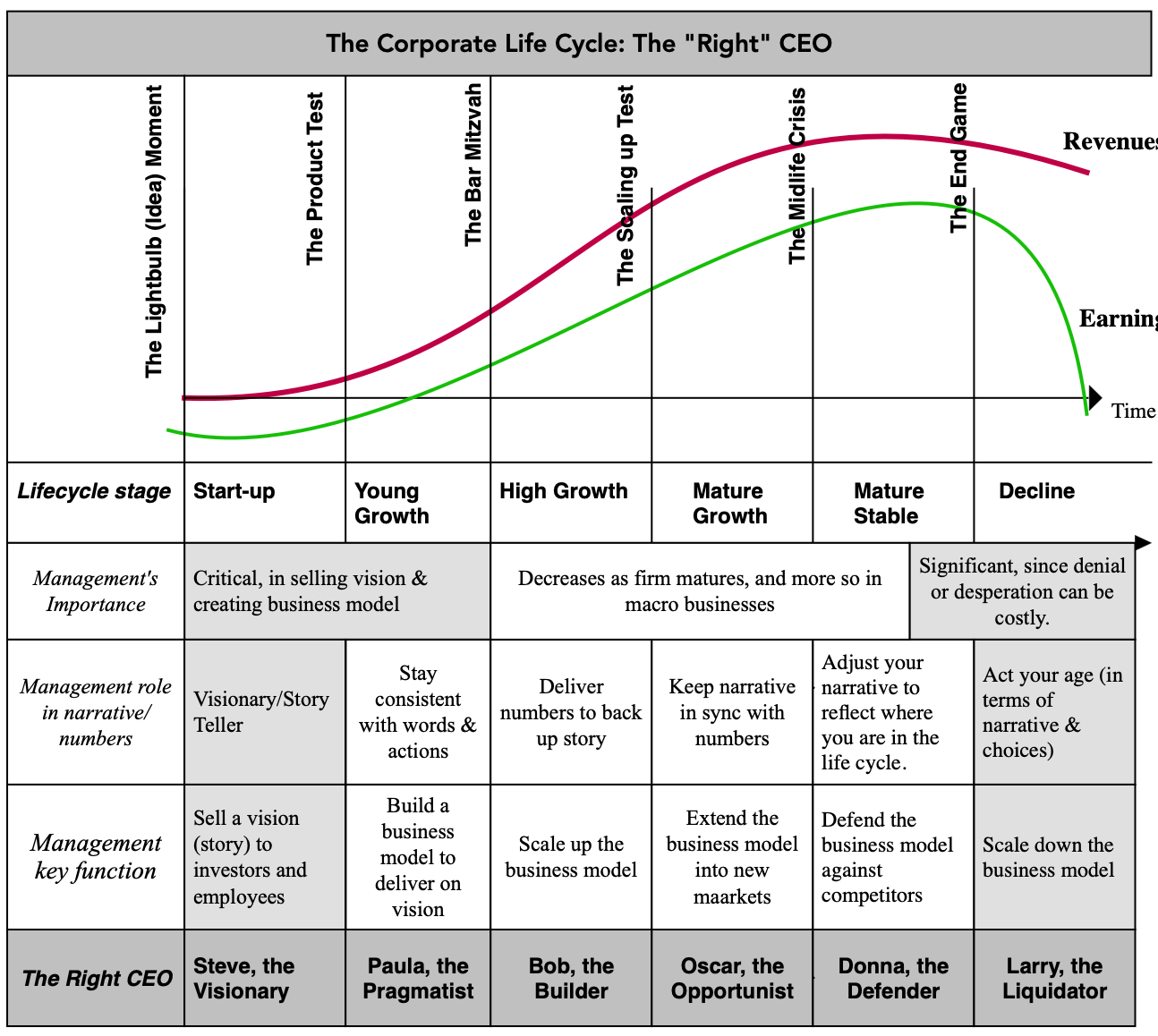
Early in the life cycle, as a start-up, the quality that you value most in your top management (and especially in your CEO) is vision, the capacity to tell the story of the business, and get investors and employees on board. As you move from idea to product, you still need vision, but it has been paired with pragmatism, and you would like the business to be run by someone who is willing to make compromises on design and strategy, to create a market for the product. The trash can of failed businesses is filled with purist founders who insisted on having their way, and refused to bend their dreams to meet reality. In the next phase, you need a CEO who is willing to do the work needed to build a business, an often unexciting job that requires attention to supply chains, marketing campaigns and product manufacturing. As businesses look to scale up, they are best led by opportunists who can seek out new markets that allow small businesses to become bigger, and once mature, you want an executive at the top who can play defense against competitors and disruptors. In decline, you need a realist who takes what the business has to offer, and does not try to overreach, in many ways the polar opposite of the visionary you sought out as a start-up.

Management Mismatches across the Life Cycle

    Understanding how the qualities that you look for in good management change, as the company changes, provides a framework for assessing why you can end up with management mismatches, where the managers running the firm are unsuited to running it. In some cases, it can happen because the business changes (from start up to young growth or from high growth to mature), but the person running it does not, will not or cannot change. In other cases, it can represent a hiring mistake, as is the case when the board of directors at a high growth firm seek out the CEO of a mature company, competent but risk-averse, to run their business.  In still others, it can just be hopeful thinking, where the board of directors at a declining firm seek out a visionary CEO, hoping that this hire can reverse aging and become young again. In the figure below, I have listed CEO/Company mismatches across the life cycle:

I also highlight the catalysts for management change at each stage.  In very young firms, it is disgruntled venture capitalists who pressure founders who, they believe, are not paying enough attention to business-building, to change their ways or even leave their positions. In publicly traded firms, the catalysts can be activist investors, who pressure businesses to change the way they are run or even who runs them, hostile acquirers, hoping for revamps, or private equity funds, with plans for liquidating or breaking up the firm.

Management Mismatch Consequences
    In most firms, even in the countries that are viewed as strong on corporate governance, there are barriers to change that are daunting, which explains why forced management changes are infrequent. Thus, venture capitalists may be stymied, when trying to replace founders, by the founders' controlling stakes. With high-growth firms that are publicly traded, insiders and founders holding large stakes can make it difficult for outside shareholders to push for charge, and as firms mature and age, it is the passivity of institutional investors that is the biggest impediment to change. 

    When a management mismatch persists, the consequences can range from the benign to very damaging:

In the most benign case, the mismatched manager recognizes his or her limitations and hires help to remedy them. In my view, the biggest difference between Steve Jobs in his first iteration at Apple, when his stubbornness damaged the company, and his legendary second stint at the company, was the presence of Tim Cook, as his chief operating officer. In an intermediate scenario, the board of directors eventually faces up to the reality of the mismatch, often because of poor stock price performance, and replaces the management, but not before serious damage has been done. In the most malignant scenario, the mismatched manager stays in place, destroying value and running the business into the ground, and perhaps into bankruptcy.

Corporate Governance at Technology Companies
    With that long lead-in on corporate governance, let's look at technology companies, partly because they are the largest sector in terms of market capitalization, and partly because this post is on Facebook, a large technology company. I will argue, using the life cycle structure, that tech companies age much faster than non-tech businesses, and are thus more exposed to management mismatches. Troublingly, it is precisely in these companies, where the need for corporate governance is greatest, that we (as investors) seem to have acquiesced to structures that give us the least power to push for change.

The Compressed Life Cycle

    A corporate life cycle resembles the human life cycle, in terms of its sequence, but there are two significant differences. The first is that the mortality rate is far higher in the corporate life cycle, as more than two thirds of businesses do not make it through the early stages, than it is for human beings, at least in the twenty first century. The second is that unlike the human life, the corporate life cycle does not follow chronological time. Kongo Gumi, a family-owned Japanese company in the business of constructing temples and shrines, lasted for almost 1500 years, before being acquired in 2006. In contrast, there are businesses that are shooting stars that survive for only 15 or 20 years, before liquidating or selling themselves. In the figure below, I look at the variables that determine  how quickly a business grows, how long it stays at the top and the speed of its decline:

Companies in businesses with low capital intensity and ease of access to the market and capital will grow much more quickly than businesses without these characteristics, but those same features will make it difficult for them to stay at the top for very long and accelerate their decline. That is the basis for a post that I wrote about why technology companies have compressed life cycles, relative to manufacturing or infrastructure companies:


Just to illustrate, the great companies of the twentieth century, such as Exxon Mobil, GE and Ford, might be looking at the declining phases of their life cycles now, but they have had extraordinarily long lives (Exxon was founded in 1859, GE in 1892 and Ford in 1903). In contrast, a company like Yahoo! was able to get from its founding in 1994 to a hundred-billion dollar market capitalization five years later, but its glory days lasted until 2004, when Google entered the game, and decline, once it started, was unstoppable, leading to its demise in 2017. (Marissa Mayer tried, but she never had a chance...)

    We believe that this compressed life cycle has consequences for management mismatches. With the long life-cycle companies that characterizes the twentieth century, companies and managers both aged over time, allowing for transitions to occur more naturally. To see, why consider how corporate governance played out at Ford, a twentieth century corporate success story. Henry Ford, undoubtedly a visionary, but a crank on some dimensions, was Ford's CEO from 1906 to 1945. His vision of making automobiles affordable to the masses, with the Model T (but only in black), was a catalyst in Ford's success, but by the end of his tenure in 1945, his management style was already out of sync with the company. With Ford, time and mortality solved the problem, and his grandson, Henry Ford II, was a better custodian for the firms in the decades that followed. Put simply, when a company lasts for a century, the progression of time naturally takes care of mismatches and succession. In contrast, consider how quickly Blackberry, as a company, soared, how short its stay at the top was, and how steep its descent was, as other companies entered the smartphone business. Mike Lazaridis, one of the co-founders of the company, and Jim Balsillie, the CEO he hired in 1992 to guide the company, presided over both its soaring success, gaining accolades for their management skills for doing so, as well as its collapse, drawing jeers from the same crowd. By the time, the change in top management happened in 2012, it was viewed as too little, too late. Put simply, if the companies that dominate the market today have compressed life cycles, relative to the companies of the last century, we should ready ourselves for far more cases of management mismatches.

The Investor Surrender

    If you accept my thesis that shorter corporate life cycles increase the likelihood of management mismatches at companies, it follows that we, as investors, need tools and processes that increase our power to change management at these firms. It is in this context that we have look back, with dismay at how willingly we have given away the power to create change at companies, and especially so at technology companies. While corporate governance measurement services and academics were obsessing over board composition and management compensation, companies have been changing the rules of the governance game, tilting power decisively away from shareholders, with little or no pushback. In the last two decades, US companies,  have increasingly turned to dual-class shares, with one class having significantly more voting rights than the other, and with founders/insiders holding these voting shares. You can see this phenomenon play out in the chart below, where I graph out the percentage of companies, going public with dual-class shares, each year from 1980 to 2021:
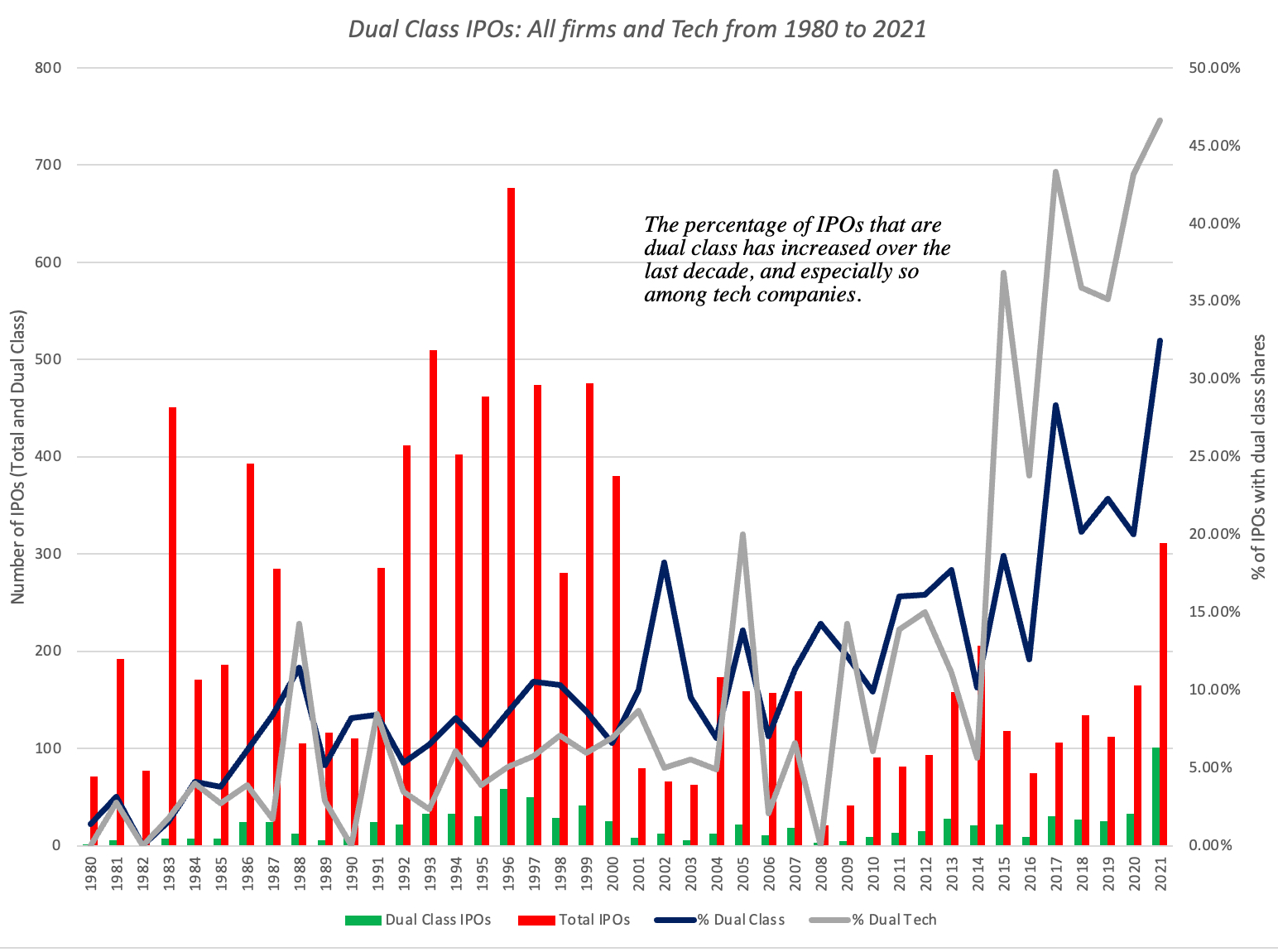
By 2021, almost a third of all companies going public had two classes of shares, with different voting rights, and that trend was even stronger at tech companies, where close to half of all companies, going public, had shares with different voting rights in 2021. 

    Facebook, which went public in 2012, followed this path when it issued class A shares to the public, with one voting right per share, while Zuckerberg and a few insiders kept class B shares, with ten voting rights per share. In the figure below, you see the breakdown of share holding in both class A and class B shares at Facebook:

Cutting to the chase, Zuckerberg controls 57% of the voting rights in the company, while owning only 13.52% of all outstanding shares, largely because he holds the bulk of the voting shares. Rather Han a corporate democracy, Facebook’s elections resemble those in authoritarian regimes, where you can vote for whoever you want, but the winner is pre-determined. (Just as an aside, I found a Facebook proposal to the SEC, thankfully stillborn, to create Class C shares with no voting rights, in 2017. That would have added insult to injury!)

    In short, shareholders have been disempowered at some of our largest and most valuable companies, and they have, for the most part, gone along. There is plenty of blame to go around, but the following culprits stand out:

  1. Market-share seeking Stock Exchanges: For much of the last century, starting with a de facto ban in 1926 and a rule in 1940, the New York Stock Exchange barred companies listed on the exchange from  from issuing shares with different voting rights, and with its dominance over US equity markets, that became the rule followed by most US companies. The American Stock Exchange adopted slightly looser rules, hoping to get market share from the NYSE, but it was the NASDAQ that threw caution to the winds entirely and removed all restrictions on voting and non-voting shares. That proved to be a great business decision, since the largest tech companies of this century have not only listed on the NASDAQ, but chosen to stay there, but it came at the expense of shareholder powers.
  2. Founder Worshippers: For the last few decades, we have glorified the founders of technology companies, and while there is much to admire in their accomplishments, there is a danger in putting them on pedestals and attributing to them heroic or superhuman qualities. In the case of companies like Google and Facebook, and especially so at the time of their public offerings, there were many investors, including some of the largest institutional players, that were willing to make the trade off of giving up power to change management in return for being invested in companies run by "young, tech geniuses". In fact, there are some researchers who were willing to argue that removing the threat of shareholder power made founder-run companies more valuable, because founders are smarter and think more long-term than investors. 
  3. Lazy Investors: Much as we would like to blame others for our misfortunes, the truth is that get the corporate governance we deserve. Most of us, as investors, chose to give away our voting rights willingly because we wanted shares of the "next big thing", and at the time we did so, we rationalized it by arguing it that we would not need that voting power any time soon. I have little sympathy for the hand wringing and complaints from investors, institutional or retail, in Facebook that management is not listening to them. Investing in Facebook and complaining that Mark Zuckerberg will not listen to you is like getting married to one of the Kardashians and complaining that your privacy is being invaded.
  4. Lax Regulators: For some of you reading this post, the villain is going to be the SEC and regulators, with the argument being that they could have protected you by banning dual class shares. I see your point, but remember that the inertia, laziness or me-tooism that led you to buy dual-class shares, will outlast the regulatory ban. Regulators cannot protect us from our own worst instincts!
There may not be much you can do about companies that have already adopted dual-class shares, but marking their prices down will make them pay attention. Who knows? Losing a chunk of their wealth may lead the founders who run some of these companies to reassess their positions on differential voting rights.

The Consequences

    If the essence of corporate governance is the giving shareholders the power to change management at companies, where there is a mismatch, and if those mismatches are more likely to occur at tech companies, where shareholders have unilaterally disarmed, there are predictable consequences:

  1. Chaotic Management Transitions: It is true that we have made it more difficult to change management at tech companies, even when that change is overdue. That said, there will be tech companies where change will occur, but my prediction is that this change will often be forced by either insider in-fighting (where co-founders and insiders turn on each other) or precipitated by a pricing collapse. While Elon Musk’s acquisition of Twitter is one of a kind, the chaos that you are observing at the company is a precursor to changes that you will see at other tech companies in the years to come.
  2. Locked-in Mismatches: There are other tech companies where the game has been so thoroughly tilted in favor of insiders and incumbent management that change is impossible. In these companies, as an outside investor, you have to build that reality into your valuations, leading to discounts to your value that reflect how much you trust management. In short, if management has adopted policies that are value-destructive, in the long term, there will be a much smaller chance of reversal at companies with locked-in management than at companies where change remains possible. In the case of Facebook, the company has clearly made a huge bet on the Metaverse, investing $15 billion in the most recent year and planning almost $100 billion in additional investments in the coming years. It is too early to pass judgment on whether these investments will pay off, but assume that the data that comes in over the next two years indicates that Facebook should scale back its investments and slow down. I would like to believe that Zuckerberg is too smart a businessman not to do the right thing, but the qualities that made him a successful founder (over confidence, stubbornness in the face of failure, arrogance) may very well keep him on his pre-determined path, and without checks and balances, Facebook will lose a lot more money over a longer period, before he gives in. 
  3. Voting Share/Non-voting Shares: In a paper on valuing control from a  few years ago, I argued that the differential in prices between voting and non-voting shares will reflect the value of expected control in a company, and will be higher at companies where management change is plausible than in firms where it is unlikely. When tech companies go public, it is entirely possible that there will be a honeymoon period, perhaps even an extended one, where investors are dazzled by scaling successes and are willing to overlook shortcoming, when shares with different voting rights trade at the similar prices. As disillusionment sets in, I would expect voting share premiums to rise, and to rise more at those firms where investors trust managers the least.
As investors, should you avoid investing in tech companies with dual-voting right shares? If I said yes, I would be violating one of my own precepts, which is that I will buy any company, no matter what its faults, at the right price. You should avoid investing in these companies when they are priced on the presumption that their founder-managers can do no wrong, but as fear overcomes greed in markets, investors in these companies will start pricing in the worst-case scenarios, where founders continue with dysfunctional behavior in perpetuity, and at those prices, you may be getting bargains.  That is what I see happening, in 2022, at Facebook, in particular, and large tech companies, in general. It is the reason that having lost money on Facebook, since buying it in April, I will continue to hold it and I did add to my holdings, when the stock hit $100/share. I know that my Facebook investment will ride and fall with Mark Zuckerberg's ego, and while I have no delusions about being able to influence him, I think that at today's prices, the odds are in my favor. Time will tell!

YouTube Video

Thursday, April 21, 2022

Elon's Twitter Play: Valuation and Corporate Governance Consequences

I am not a prolific user of social media platforms, completely inactive on Facebook and a casual lurker on LinkedIn, but I do use Twitter occasionally, and have done so for a long time, with my first tweet in April 2009, making me ancient by Twitter standards. That said, I tweet less than ten times a month and follow only three people (three of my four children) on the platform. I am also fascinated by Elon Musk, and even more so by his most prominent creation, Tesla, and I have valued and written about him and the company multiple times. When Musk made news a little over two weeks ago, with his announcement that he owned a major stake in Twitter, I could not stay away from the story, and what's happened since has only made it more interesting, as it casts light on just Musk and Twitter, but on broader issues of the social and economic value of social media platforms, corporate governance, investing and how politics has become part of almost every discussion.

The Twitter Story

To get a measure of Musk's bid for Twitter, you have to also understand the company's path to its current status. In this section, I will focus on the milestones in the company's history that shape it today, with an eye on how it may affect how this acquisition bid plays out.

Inception to IPO

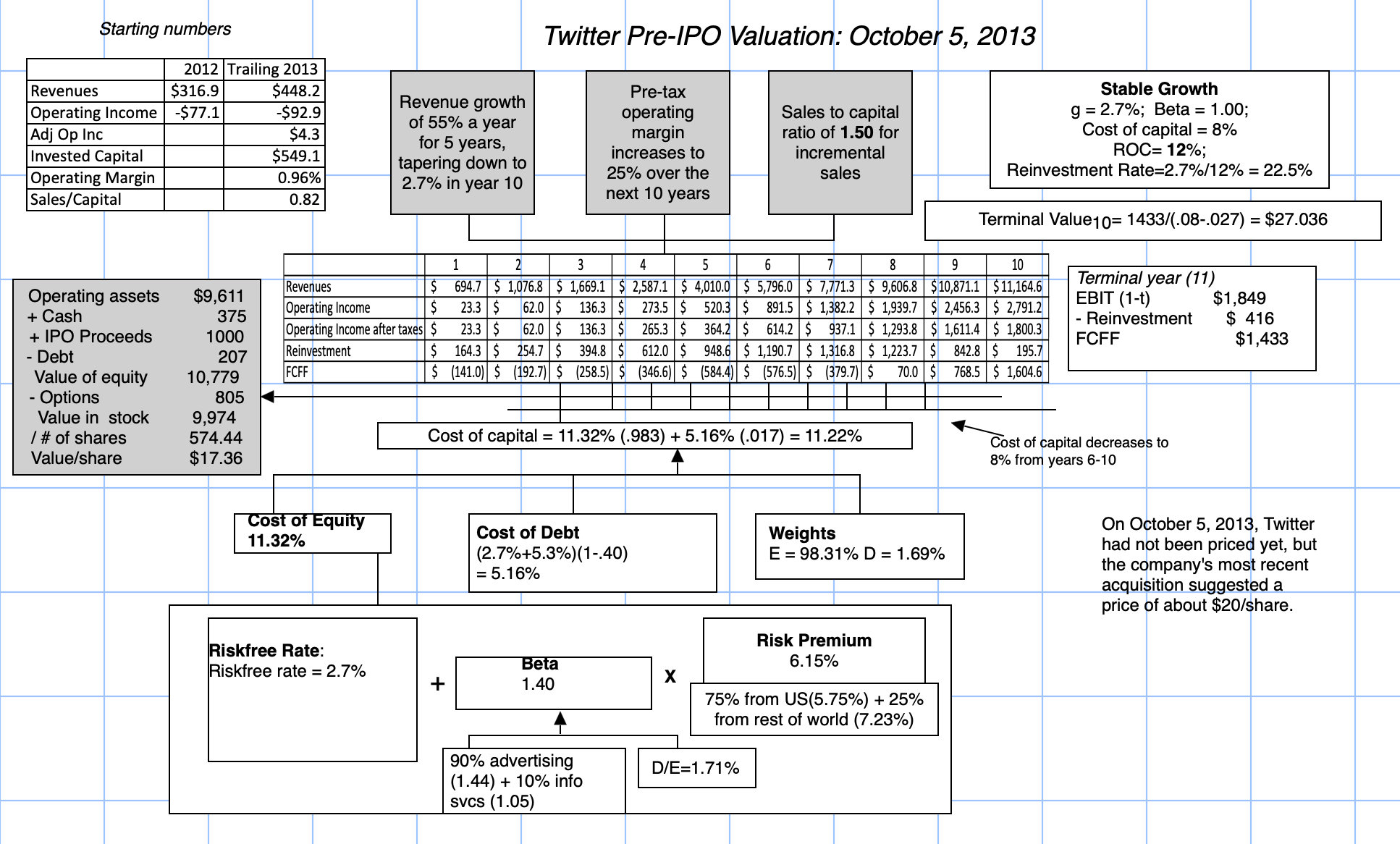
Twitter was founded in 2006 by Jack Dorsey, Noah Glass, Biz Stone and Evan Williams, and its platform was launched later that year. It succeeded spectacularly in attracting people to its platform, hitting a 100 million users in 2012, and then doubling those numbers again by 2013, when it went public ,with an initial public offering. In a post on this blog on October 5, 2013, I valued Twitter, based on the numbers in its prospectus:

Spreadsheet with valuation

In keeping with my belief that every valuation tells a story, my IPO valuation of Twitter in October 2013 reflected my story for the company, as a platform with lots of users, that had not yet figured out how to monetize them, but would do so over time. My forecasted revenues for 2023 of $11.2 billion and predicted operating margin of 25% in that year reflected my optimistic take for the company, with substantial reinvestment (in acquisitions and technology) needed along the way (as seen in my reinvestment). A few weeks later, the offering price for Twitter's shares was set at $26, by its bankers, and the stock debuted on November 7, 2013, at $45. In the weeks after, that momentum continued to carry the stock upwards, with the price reaching  $73.31 by December 26, 2013. 

If the story had ended then, the Twitter story would have been hailed as a success, and Jack Dorsey as a visionary. But the story continues...

The Rise and Fall of Jack Dorsey

In the years since its IPO, the Twitter story has developed in ways that none of its founders and very few of its investors would have predicted. On some measures of user engagement and influence, it has performed better than expected, but in the operating numbers measuring its success as a business, it has lagged, and the market has responded accordingly

Users: Numbers and Engagement

In terms of user numbers, Twitter came into the markets as a success, with 240 million people on its platform in November 2013, at the time of its public offering. In the years since, those user numbers have grown, as can be seen in the chart below:

In keeping with disclosure practices at other user-based companies, in 2017, Twitter also started tracking and reporting the users who were most active on its platform, by looking at daily usage, and counting daily active users (DAU). While total user numbers have leveled off in recent years, albeit with a jump in 2021, the daily active user count has continued to climb. 

Over the last decade, the company's platform, and the tweets that show up on it, became a ubiquitous part of news, culture and politics, as politicians used the platform to expand their reach and spread their ideas and celebrities built their personal brands around their followers. Looking at the list of the Twitter persona with the most followers provides some measure of its reach, with a mix of politicians (Barack Obama, Narendra Modi), musicians (Justin Bieber, Katy Perry, Taylor Swift, Ariana Grande), celebrities (Kim Kardashian) and sporting figures (Cristiano Ronaldo). Sprinkled in the list are brands/businesses (YouTube, CNN Breaking News), with millions of followers, though relatively few business people make the list, with Elon Musk being the exception.  It is worth noting that many of the people on top follower list tweet rarely, and that behavior is mimicked by many of the users on the platform, many of whom never tweet. The bulk of the tweets on the platform are delivered by a subset of users, with the top 10% of users delivering 80% of the tweets. 

While there are multiple reasons that Twitter users come to the platform, the demographics of its platform provides some clues, especially when contrasted with other social media platforms:

Pew Research

Twitter's user base skews younger, more male, more educated and more liberal than the US population, and especially so, when compared with Facebook, which has the biggest user base.

Revenues, Profits and Stock Prices

As Twitter user base and influence have grown, there has been one area where it has conspicuously failed, and that is on business metrics. The company's revenues have come primarily from advertising (90%) and while these revenues have grown, they have not kept up with user engagement, as can be seen in the chart below:

In the last few years, revenue growth has flattened, again with the exception of 2021, and while operating margins have finally turned positive in the last five years, there has been no sustained upward movement. To give a measure of Twitter's disappointing performance, note that the company's actual revenues in 2021 amounted to $5.1 billion, well below the $9.6 billion I estimated in 2021 (year 8 in my IPO valuation) as revenues in my IPO valuation of the company in November 2013, and its operating margin, even with generous assumptions on R&D, was 19.02% in 2021, still below my estimate of 19.76% in that year. 

The disappointments on the operating metric front has played out in markets, where Twitter's stock price dropped to below IPO levels in 2016 and its performance has lagged its social media counterparts:

Source: Bloomberg

In fact, Twitter's stock prices did not breach their December 2013 high of $73.31 until February 26, 2021, when the stock peaked at $77.06, before dropping back to 2013 levels again by the end of the year. The company that provides the best contrast to Twitter is Snapchat, another company that I valued at the time of its IPO in February 2017 at $14.4 billion, with a value per share of $10.91. Like Twitter, Snapchat had a rousing debut in the market, rising 40% to hit $24.48 on its first trading day, before falling on hard times, as Instagram undercut its appeal. The stock dropped below $6 in 2019, before mounting a comeback in 2021. While Snap is a younger company than Twitter, a comparison of the operating metrics and user numbers yields interesting results:

Looking at the 2021 numbers, Snap now has more daily active users than Twitter, but delivers less in revenues and is still losing money. That said, the market clearly either sees more value in Snap's story or has more confidence in Snap's management, since there is a wide gap in market capitalizations, with Snap trading at a premium of 60% over Twitter.

Corporate governance

While Twitter can be faulted on many of its actions leading into and after its IPO, there is one area where credit is due to the company. In a period when companies, especially in the tech sector, fixed the corporate governance game in favor of insiders and incumbents, by issuing shares with different voting classes, Twitter stuck to the more traditional model, with equal voting right shares.  It is also worth noting that Twitter came into its IPO, with a history of bloodletting at the top, with Jack Dorsey, who led the company at the start, getting pushed aside by Evan Williams, his co-founder, before reclaiming his place at the top. In fact, at the time of its IPO, Twitter's CEO was Dick Costolo, but he was replaced by Dorsey again, a couple of years later. Dorsey's founder status gave him cover, but his ownership stake of the company was not overwhelming enough to stop opposition. As disappointment mounted at the company, the murmuring of discontent became louder among Twitter shareholders, especially since Jack divided his top executive duties across two companies, Twitter and Square, both of which demanded his undivided attention.  

The corporate governance issues at Twitter came to a head in 2020, when Elliott Management, an activist hedge fund, purchased a billion dollars of Twitter stock, and demanded changes. While Dorsey was successful in fighting off their demands that he step down, he surprised investors and may company employees when he stepped down in November 2021, claiming that he was leaving of his own volition. That may be true, but it seemed clear that the relationship between Dorsey and his board of directors had ruptured, and that the departure might not have been completely voluntary. As a replacement, the board did stay within the firm in picking a successor, Parag Agrawal, who joined Twitter as a software engineer in 2011 and rose to become Chief Technology Officer in 2017.

The Musk Entree!

It is ironic that the threat to Twitter has come from Elon Musk, who has arguably used its platform to greater effect than perhaps anyone else on it. There are some Twitter personalities who have more followers than Musk, but most of them are either inactive or tweet pablum, but Musk has made Twitter his vehicle for selling both his corporate vision and his products, while engaging in distractions that sometimes frustrate his shareholders. While he has made veiled promises of alternative platforms for expression, it was a surprise to most when he announced on April 4, 2022, that he had acquired a 9.2% stake in the company. Stock prices initially soared on the announcement, but what has followed since has been one of the strangest corporate chronicles that I have ever witnessed, as you can see in the time line below:

This post is being written on April 19, and the only thing that is predictable is that everything is unpredictable, at the moment, and that should come as no surprise, when Musk is involved.

The Value Arguments: Status Quo and Potential

While Musk's acquisition bid is anything but conventional, the gaming that it initiated on the part of Twitter, the target company, and Musk, the potential acquirer, was completely predictable. The company's initial response was that it was worth great deal more than Musk's offering price, and that Twitter shareholders would be receiving too little for their shares if they sold. Musk's response was that the market clearly did not believe that current management could deliver that higher value, and that he would be able to do much better with the platform.

Twitter's argument that Musk was lowballing value, by offering $54.20 per share for the company,  and that the company was worth a lot more is not a novel one, and it is heard in almost every hostile acquisition, from target company management. That argument can sometimes be true, since markets can undervalue companies, but is it the case with Twitter? To answer that question, I valued Twitter on April 4, at about the time that Musk announced his 9.2% stake, updating my story to reflect a solid performance from the company in 2021, and with Parag Agrawal, its newly anointed CEO:

Spreadsheet with Twitter Status Quo Value

In my story, which I view as upbeat, given Twitter's inability to deliver on operating metrics in the last decade, I see continued growth in revenues, with revenues reaching almost $13 billion in 2033, and a continued increase in operating margins to 25%, not quite the levels you see at the dominant online advertising players (Facebook and Google), but about what you would expect for a successful, albeit secondary, online advertising platform. (Note that I am capitalizing R&D expenses to give the company healthier margins right now, to begin my valuation). The value per share that I obtained was about $46, $ 4 higher than the prevailing stock price, but below Musk's acquisition offer of $54.20.

To the critique that revenue growth could surprise and that margins could be higher, my answer is of course, and to incorporate the uncertainty in my inputs, I fell back on one of my favored devices for dealing with uncertainty, a Monte Carlo simulation. I picked three variables, the revenue growth over the next five years, the target operating margin and the initial cost of capital, to build distributions around, and the results of the simulation are below:

The median value in the simulation is $45.17, close to the base case valuation, but at least based on my estimates, Musk's offering price is at the 75th percentile of value. It is possible that the value could be higher but making that is not a particularly strong argument to make, if you are Twitter's board.

Competing Views: The Fight for Twitter

As a company that has lived its entire life on the promise of potential, it should come as no surprise if that is where the next phase of this argument heads. In particular, Twitter's management will claim that the company's platform has the potential to deliver significantly more value, either by changing the business model (and including subscriptions and other revenue sources) or fine tuning the advertising model. On this count, Musk will agree with the argument that Twitter has untapped potential, but counter that he (and only he) can make the changes to Twitter's business model to deliver this potential. In short, investors will get to choose not only between competing visions for Twitter's future, but also who they trust to deliver those visions.

The problem that Twitter's management will face in mounting a case that Twitter is worth more, if it is run differently, is that they have been the custodians of the company for the last decade, and have been unable or unwilling to deliver these changes. Shareholders in Twitter will welcome management's willingness to consider alternative business models, but the timing makes it feel more like a deathbed conversion rather than a well thought through plan. Elon Musk's problem, on the Twitter deal, is a different one. If you think Jack Dorsey was stretching the limits of his time by running two companies, I am not sure how to characterize what Musk will be doing, if he acquires Twitter, since he does have a trillion dollar company to run, in Tesla, not to mention SpaceX, the Boring company and a host of other ventures. In addition, Musk's unpredictability makes it difficult to judge what his end game is, at least with Twitter, since he could do anything from selling his position tomorrow to bulldozing his way through a poison pill, taking Twitter down with him. I know that there are question of how Musk  finance the deal and whether he can secure funding, but of all of the impediments to this takeover, those might be the easiest to overcome. The fact that Twitter's stock price has stayed stubbornly below Musk's offering price suggests that investors have their doubts about Musk's true intentions, and whether this deal will go through.

Alternate Endings

No matter what you think about Elon Musk and how his acquisition bid will play out, it is undeniable that he has put Twitter in play here, and that it is likely that the company that emerges from this episode will look different from the company that went into it. In particular, I see four possible outcomes for Twitter:

  1. Status Quo: It is possible that Twitter wins this round with Musk, and that the poison pill adopted by the board is sufficient to get him to walk away from the deal, perhaps selling his holdings along the way. The existing management go back to their plans for incremental change that they have already put in motion, and hope that the payoffs of higher revenue growth and profitability will unlock share value. 
  2. Musk takes Twitter private: Having spent more than a decade seeing Musk pull off what most market observers would view as impossible, I have learned not to underestimate the man. For Musk to succeed at this point, he has to be able to buy enough shares in a tender offer and/or convince other shareholders to put pressure on the board to remove the poison pill, and allow him to move forward with his plans. The odds are against success, but then again, this is Elon Musk.
  3. Independent, but with corporate governance changes: Even if Twitter is able to fend off Musk, the way that the company's management and board have handled the deal does not inspire confidence in their ability to run the company. In fact, having gone through five CEOs over Twitter's life, it is worth asking the question whether the dysfunction at the company lies with the board, and not just with the CEO. In this scenario, institutional investors will follow through by pushing for change in the company, translating into new board members and perhaps even a new CEO.
  4. Someone else acquires Twitter: There may be something to Musk's claim that the changes that are needed to make Twitter a functional business can only be made, if it is taken private. If so, it is  the board may be willing to sell the company to someone other than Musk, albeit at a slightly higher price (if for no other reason than to save face). The fact that the buyer may be Silver Lake, a firm that Musk has connections with, or another private equity investor, whose plans for change are similar to Musk's, will mean that Elon Musk will have accomplished much of what he set out to do, without spending $43 billion dollars along the way or having to deal with the distractions that owning Twitter will bring to his other, more valuable, ventures.
If I were to put these possibilities in terms of likelihood, I would put "staying independent with significant corporate governance changes" as most likely, followed by someone else acquiring Twitter, with the status quo and Musk succeeding getting the lowest odds.

Political Markets?

In this discussion, I have deliberately stayed away from the elephant in the room, which is that this is , at its core, a political story, not a financial one. To see why, consider a simple test. If you tell me which side of the political divide you fall on, I am fairly certain that I will be able to guess whether you favor or oppose Musk's takeover bid. As with most things political, you will provide an alternate, more reasoned, argument for why you are for or opposed, but you are deluding yourself, and hypocrisy is rampant on both sides.  

  • If you are opposed to the deal, and your argument is that billionaires should not control social media platforms, that outrage cannot be selective, and you should be just as upset about Jeff Bezos owning the Washington Post or a George Soros bid for Fox News. If it is Musk's personality that you feel is what makes him an unsuitable owner, I wonder whether we should be requiring full personality tests of the owners of other media companies.
  • If you are for the deal, and it is because you want Twitter to be a bastion of free speech, it is worth remembering that every social media platform is involved in some degree of censoring, for legal reasons and self preservation. It should also be noted that while those disaffected with Twitter have attempted to build their own social media platforms, they still get far more mileage from their presence on Twitter than from their posts on alternate platforms, and the complaints about Twitter not being balanced seem to end up being on Twitter.
The hand wringing from pundits about changes that may or may not be coming to Twitter, and the impact it will have on our collective consciousness, to be over wrought. In fact, some critics of Musk seem to have decided that Twitter, in its current form, is a national treasure that needs to be preserved or at least protected from money grubbing barbarians. I beg to differ. The brevity (of having to compress your thoughts into 280 characters) and timeliness of Twitter's platform has made it the place to go to get breaking news, but the notion that it is an educational platform shortchanges the meaning of learning, and the impulsiveness that it encourages from users is a recipe for tweeting remorse, or worse. I believe that while there are some who come to Twitter for news and witty repartee, many come to the platform for the same reasons that they slow down on highways to look at car crashes, i.e., to witness, and sometimes partake in, deranged arguments about trivial issues. Much as we like to complain about the ugliness and anger that we see on social media, it is exactly those forces that draw users to it, and arguing that Elon Musk will make it worse, misses the point that he symbolizes the strengths and weaknesses of the Twitter platform better than any other person walking the face of the earth. 

YouTube Video


Spreadsheets

Monday, September 21, 2020

Sounding good or Doing good? A Skeptical Look at ESG

In my time in corporate finance and valuation, I have seen many "new and revolutionary" ideas emerge, each one marketed as the solution to all of the problems that businesses face. Most of the time, these ideas start by repackaging an existing concept or measure and adding a couple of proprietary tweaks that are less improvement and more noise, then get acronyms, before being sold relentlessly. With each one, the magic fades once the limitations come to the surface, as they inevitably do, but not before consultants and bankers have been enriched. So, forgive me for being a cynic when it comes to the latest entrant in this game, where ESG (Environmental, Social and Governance), a measure of the environment and social impact of companies, has become one of the fastest growing movements in business and investing, and this time, the sales pitch is wider and deeper. Companies that improve their social goodness standing will not only become more profitable and valuable over time, we are told, but they will also advance society's best interests, thus resolving one of the fundamental conflicts of private enterprise, while also enriching investors. This week, the ESG debate has come back to take main stage, for three reasons. 

  • It is the fiftieth anniversary of one of the most influential opinion pieces in media history, where Milton Friedman argued that the focus of a company should be profitability, not social good. There have been many retrospectives published in the last week, with the primary intent of showing how far the business world has moved away from Friedman's views. 
  • There were multiple news stories about how "good" companies, with goodness measured on the social scale, have done better during the COVID crisis, and how much money was flowing into ESG funds, with some suggesting that the crisis could be a tipping point for companies and investors, who were on the fence about the added benefits of being socially conscious. 
  • In a more long standing story line, the establishment seems to have bought into ESG consciousness, with business leaders in the Conference Board signing on to a "stakeholder interest" statement last year and institutional investors shifting more money into ESG funds.
In the interests of openness, I took issue with the Conference Board last year on stakeholder interests, and I start from a position of skepticism, when presented with "new" ways of business thinking. If the debate about ESG had been about facts, data and common sense, and ESG had won, I would gladly incorporate that thinking into my views on corporate finance, investing and valuation. But that has not been the case, at least so far, simply because ESG has been posited by its advocates as good, and any dissent from the party line on ESG (that it is good for companies, investors and society) is viewed as a sign of moral deficiency. At the risk of being labeled a troglodyte (I kind of like that label), I will argue that many fundamental questions about ESG have remained unanswered or have been answered sloppily, and that it is in its proponents' best interests to stop overplaying the morality card, and to have an honest discussion about whether ESG is a net good for companies, investors and society.

Measures of Goodness
    We have spent decades measuring financial performance and output at companies, either at the operating level, as revenues, profits or capital invested, or at the investor level, as market cap and returns. Any attempts to measure environment and social goodness face two challenges. 
  • The first is that much of social impact is qualitative, and developing a numerical value for that impact is difficult to do. 
  • The second is even trickier, which is that there is little consensus on what social impacts to measure, and the weights to assign to them.  
If your counter is that there are multiple services now that measure ESG at companies, you are right, but the lack of clarity and consensus results in the companies being ranked very differently by different services. This shows up in low correlations across the ESG services on ESG scores, as indicated by this study:
Correlations across six ESG data providers

This low correlation often occurs even on high profile companies, as shown in a comprehensive analysis of ESG investing by Dimson, Marsh and Staunton, as part of their global investment returns update:
Source: CS Global Investment Returns Yearbook 2020, Dimson, Marsh and Staunton
Note the divergence in both the overall ratings and on the individual metrics (E, S and G) across the services, even for widely tracked companies like Facebook and Walmart. There are some who believe that this reflects  a measurement process that is still evolving, and that as companies provide more disclosure on ESG data and ESG measurement services mature, there will be consensus. I don't believe it! After all, what I find to be good or bad in a company will reflect my personal values and morality scales, and the choices I make will be different from your choices, and any notion that there will be consensus on these measures is a pipe dream.  

Even if you overlook disagreements on ESG as growing pains, there is one more component that adds noise to the mix and that is the direction of causality: Do companies perform better because they are socially conscious (good) companies, or do companies that are doing well find it easier to do good? Put simply, if ESG metrics are based upon actions/measures that companies that are doing better, either operationally and/or in markets, can perform/deliver more easily than companies that are doing badly, researchers will find that ESG and performance move together, but it is not ESG that is causing good performance, but good performance which is allowing companies to be socially good.

The ESG Sales Pitch - Promises and Contradictions
The power of the ESG sales pitch has always been that it offers something good to everyone involved, from companies adopting its practices, to investors in those companies, and more broadly, to all of society. 
  • For companies, the promise is that being "good" will generate higher profits for the company, at least in the long term, with lower risk, and thus make them more valuable businesses.
  • For investors in these companies, the promise is that investing in "good" companies will generate higher returns than investing in "bad" or middling companies. 
  • For society, the promise is that not only will good companies help fight problems directly related to ESG, like climate change and low wages, but also counter more general problems like income inequality and uneven healthcare.
Given that ESG has been marketed as all things good, to all people, it is no surprise that its usage has soared, with companies signing on in droves to social compacts, and investors pouring hundreds of billions of dollars into ESG funds and investments. In the process, though, its advocates have either glossed over, or mixed up, three separate questions that need to be answered, on ESG:


The reason it is useful to separate the three questions is that it opens up possibilities that are often missed in both debate and research. For instance, it is possible that ESG does nothing for value, but that it offers a sheen to companies that allows them to be priced more highly than their less socially conscious counterparts and enriches investors, who trade on its basis. Alternatively, it is also possible that ESG does increase value, but that markets adjust quickly to this and that investors do not benefit from investing in ESG stocks. It also illustrates the danger of overreach from ESG research. Much of the research on ESG is compartmentalized, where only one of these questions is addressed, but the researchers seem to use the results to draw conclusions about answers the other two. Thus, a research study that finds that investors make higher returns on companies that rank high on ESG often will go on to posit that this must mean that ESG increases value, a leap that is neither justified nor warranted. 

ESG and Value
The framework for answering the question of whether ESG affects value is no different from the framework for assessing whether acquisitions or financing or any other action affects value. It is both simple and universal, and I have captured the drivers of value for any business in the picture below:

Figure 1: The Drivers of Value
In fact, my favorite propositions in value is the "It Proposition", which posits that for "it" (investing, financing, dividends, ESG) to affect value, "it" has to affect either the cash flows (through revenue growth, operating margins and investment efficiency) or the risk in those cash flows (which plays out in the cost of equity and capital)

Goodness will be rewarded
Applying this proposition to ESG, the most direct way to induce companies to behave in a socially responsible manner is to make it in their financial best interests to do so. There is a plausible scenario, where being good creates a cycle of positive outcomes, which makes the company more valuable. Figure 2 describes this virtuous cycle:
In this story, being good benefits the company on multiple dimensions. Customers, attracted by the company's social mission, are more likely to buy its products and pay higher prices, increasing both growth and margins. The company is able to attract more loyal employees and suppliers, and build a model for investing that leads to more payoff from investments, i.e., more efficient growth. On the risk front, the company benefits from  investors who are willing to pay premium prices for their shares (thus lowering cost of equity), and lending that comes with lower rates and fewer covenants. Finally, by operating as a good corporate citizen, the company minimizes the chance of a scandal or a catastrophic event that could put its business model at risk. In the language of ESG, it creates a more “sustainable business”.  For proponents of corporate social responsibility, this is the best-case setting for their cause, because being good and doing well financially converge. This scenario holds, though, only because customers, employees, investors, and lenders all put their money where their convictions lie, and are willing to make sacrifices along the way, and it is more likely in some companies/businesses than others:
  1. Smaller, rather than larger: While it is not impossible for a large company to hit all the high notes in the virtuous cycle, it is far easier for a small company than a large one, because even a small subset of all investors (consumers) can provide the capital (revenues) at the favorable terms needed for this scenario to unfold. 
  2. Niche business, with a more socially conscious customer base: Adding to the smallness theme, it is easier for a company that serves a small customer base to attract customers with its ‘good company’ mantle than a company that seeks to reach a mass market. A company like Patagonia, with revenues of $750 million, can more easily make the compromises to stay socially responsible than a company like Nike, with revenues of $34 billion, which will be forced to make compromises that will undercut its goodness.
  3. A privately held company or a public company with an investor base that values corporate goodness and prices it in: Being a private company can help, especially if the payoff to corporate goodness is long term, another point working in Patagonia’s favor. A public company that is closely held or controlled by its founders can also make choices that may not be feasible for a widely held company with a vocal stockholder base. 
It is worth noting that the companies that tend to be most vociferous about their social consciences tend to meet these criteria, at least early in their corporate lives. However, they will face a challenge, if they are successful and want to grow, because growth will bring in customers and investors not so committed to ESG. The acid test of social consciousness occurs when a company scales up and must decide whether to continue to grow or accept a lower ceiling on growth, and perhaps lower value, in order to preserve it good company status.

Badness will be punished
There is an alternate story that can be used to argue that companies should try to be socially responsible, but it is a more punitive one, where it is not good companies that get rewarded, but bad ones that get punished. This less upbeat scenario is described below:


Here, the punishment for bad companies is meted out from every direction, with customers refusing to buy their products, even if they are lower priced. These companies face higher operating expenses (and lower margins) in the long term, as they have trouble holding on to employees and finding suppliers. Equity investors avoid buying their shares, leading to higher costs of equity, and lenders are leery about lending money to these companies, leading to higher costs of debt. Finally, these companies risk exposure to grievous, or even catastrophic events, arising from operating with too little consideration of societal costs. It is often these events, such as the Union Carbide gas leak in Bhopal, Vale’s dam bursting in Brazil and BP’s oil spill in the Gulf of Mexico, that highlight shortcomings and create long term problems for the company. 

The Bad Guys win!
With regard to promoting social responsibility, the "bad behavior gets punished" scenario is not as good as the virtuous cycle, because it will tend to scare companies away from being “bad”, rather than induce them to be “good", but it is still better than a third and potentially devastating scenario for ESG advocates, where bad companies are rewarded for being bad, and become more valuable than good ones:
In this scenario, bad companies mouth platitudes about social responsibility and environmental consciousness without taking any real action, but customers buy their products and services, either because they are cheaper or because of convenience, employees continue to work for them because they can earn more at these companies or have no options, and investors buy their shares because they deliver higher profits. As a result, bad companies may score low on corporate responsibility scales, but they will score high on profitability and stock price performance. 

The Evidence
The question of which of these three scenarios is the right one is not one that can be settled by logic or with anecdotal evidence, but with data. For more than two decades now, researchers have examined the link, with the following conclusions:
  1. A Weak Link to Profitability: There are meta studies (summaries of all other studies) that  summarize hundreds of ESG research papers, and find a small positive link between ESG and profitability, but one that is very sensitive to how profits are measured and over what period, leading one of these studies to conclude that “citizens looking for solutions from any quarter to cure society’s pressing ills ought not appeal to financial returns alone to mobilize corporate involvement”. Breaking down ESG into its component parts, some studies find that environment (E) offered the strongest positive link to performance and social (S) the weakest, with governance (G) falling in the middle. 
  2. A Stronger Link to Funding Costs: Studies of “sin” stocks, i.e., companies involved in businesses such as producing alcohol, tobacco, and gaming, find that these stocks are less commonly held by institutions, and that they face higher costs for funding, from equity and debt). The evidence for this is strongest in sectors like tobacco (starting in the 1990s) and fossil fuels (especially in the last decade), but these findings come with a troubling catch. While these companies face higher costs, and have lower value, investors in these companies will generate higher returns from holding these stocks.
  3. And a link to Failure/Disaster Risk: An alternate reason why companies would want to be “good” is that “bad” companies are exposed to disaster risks, where a combination of missteps by the company, luck, and a failure to build in enough protective controls (because they cost too much) can cause a disaster, either in human or financial terms. That disaster can not only cause substantial losses for the company, but the collateral reputation damage created can have long term consequences. One study created a value-weighted portfolio of controversial firms that had a history of violating ESG rules, and reported negative excess returns of 3.5% on this portfolio, even after controlling for risk, industry, and company characteristics. The conclusion in this study was that these lower excess returns are evidence that being socially irresponsible is costly for firms, and that markets do not fully incorporate the consequences of bad corporate behavior. The push back from skeptics is that not all firms that behave badly get embroiled in controversy, and it is possible that looking at just firms that are controversial creates a selection bias that explains the negative returns.

In summary, based upon the studies so far, the strongest evidence in support of ESG seems to be that "bad" companies face higher funding costs (from debt and equity), whereas the evidence on ESG paying off as higher profits and growth is elusive. There is some evidence supporting the proposition that being socially responsible (or at least not being socially irresponsible) can protect companies from damaging disasters, but selection bias is a problem.

ESG and Returns
To begin with, the notion that adding an ESG constraint to investing increases expected returns is counter intuitive. After all, a constrained optimum can, at best, match an unconstrained one, and most of the time, the constraint will create a cost. In one of the few cases where honesty seems to have prevailed over platitudes, the TIAA-CREF Social Choice Equity Fund explicitly acknowledges this cost and uses it to explain its underperformance, stating that “The CREF Social Choice Account returned 13.88 percent for the year [2017] compared with the 14.34 percent return of its composite benchmark … Because of its ESG criteria, the Account did not invest in a number of stocks and bonds ... the net effect was that the Account underperformed its benchmark.”  In fact, there is an inherent contradiction, at least on the surface, between the argument that ESG leads to higher value and stock prices, made to CEOs and CFOs of companies, and a simultaneous argument that investors in ESG stocks will earn higher (positive excess) returns, by investing in these companies.

Value, Price and Returns: The Interplay
Whatever your beliefs may be on whether ESG increases or decreases value, you have to start with a fresh slate, and incorporate market behavior, to make judgments on whether investors will benefit from ESG investing, as can be seen in the table below:


Consider the first outcome, where ESG increases the value of a company, but markets overreact to the goodness of the company, pushing up the price too much: investors in good companies will earn lower returns (negative excess) returns over the long term. Flipped around, this table also yields the counter intuitive result that studies that conclude that ESG investing earns positive (or negative) returns tell us nothing or very little about the underlying benefits of ESG, since the market acts as the intervening variable. 

The Evidence on ESG and Returns
It should come as no surprise then, that the research on the link between ESG and investor returns comes to split results:
  • Invest in bad companies: There are the studies that we referenced earlier as backing for good firms having lower discount rates, including the ones that showed that sin stocks deliver higher returns than socially conscious companies. A comparison of two Vanguard Index funds, the Vice fund (invested in tobacco, gambling, and defense companies) and the FTSE Social Index fund (invested in companies screened for good corporate behavior on multiple dimensions) and note that a dollar invested in the former in August 2002 would have been worth almost 20% more by 2015 than a dollar invested in the latter.
  • Invest in good companies: At the other end of the spectrum, there are studies that seem to indicate that there are positive excess returns to investing in good companies. A study showed that stocks in the Anno Domini Index (of socially conscious companies) outperformed the market, but that the outperformance was more due to factor and industry tilts than to social responsiveness. In a different study,  researchers looked at the payoff to socially responsible investing by comparing the returns on two portfolios, created based upon eco-efficiency scores, and concluded that companies that are more eco-efficient generate higher returns. Some of the strongest links between returns and ESG come from the governance portion, which, as we noted earlier, is ironic, because the essence of governance, at least as measured in most of these studies, is fealty to shareholder rights, which is at odds with the current ESG framework that pushes for a stakeholder perspective. 
  • ESG has no effect: Splitting the difference, there are other studies that find little or no differences in returns between good and bad companies. A Morningstar Quantitative study of ESG stocks in 2020 found that companies that scored high on ESG generated mildly lower returns than companies that scored poorly, though the difference was statistically insignificant. In fact, studies that more broadly look at factors that have driven stock returns for the last few decades find that much of the positive payoff attributed to ESG comes from its correlation with momentum and growth.
In steady state, it is internally inconsistent to argue that good companies will benefit from lower funding  costs (lower costs of equity) and that investors can also earn higher returns at the same time. 

Glimmers of Hope for ESG Investing
There are two possible scenarios where being good may benefit both the company (by increasing its value) and investors in the company (by delivering higher returns).
  1. Transition Period Payoff: The first scenario requires an adjustment period, where being good increases value, but investors are slow to price in this reality. During the adjustment period the highly rated ESG stocks will outperform the low ESG stocks, as markets slowly incorporate ESG effects, but that is a one-time adjustment. Once prices reach equilibrium, highly rated ESG stocks will have greater values, but investors will have to be satisfied with lower expected returns. The presence of a transition period, where markets learn about ESG and price them in can also explain why there may be a payoff to more disclosure and transparency on social and environmental issues, by speeding the adjustment. It is perhaps this hope of transition period excess returns that that has driven some institutional investors to become more activist on ESG issues and can explain why some have been able to show excess returns from increasing (reducing) their holdings in good (bad) companies. It is not just the large players like Blackrock and Vanguard that have jumped on this bandwagon, but also pure return-focused investors like Elliott Management and Third Point which recently targeted utility companies about their excessive carbon footprints. Their activism goes well beyond jawboning management and includes efforts that range from stopping mergers to proxy fights to altering boards of directors. This study examined 613 public firms that were targeted by an activist institutional investor focused on improving ESG practices and found positive excess returns in the 18% of engagements where the activism succeeded. 
  2. Limit Downside: The other scenario where incorporating ESG into investing may yield a payoff is when investors are concerned about limiting downside risk. To the extent that socially responsible companies are less likely to be caught up in controversy and to court disaster, the argument is that they will also have less downside risk than their counterparts who are less careful. There is some evidence of this in this paper that finds that companies that adopt better ESG practices are less likely to see large drops in value. 
If there is an investing lesson embedded here, it is the unsurprising one that investors who hope to benefit from ESG cannot do so by investing mechanically in companies that already identified as good (or bad), but have to adopt a more dynamic strategy built around either aspects of corporate social responsibility that are not easily measured and captured in scores, or from getting ahead of the market in recognizing aspects of corporate behavior that will hurt the company in the long term.

The COVID effect
The last few months have been a test of ESG investing, and while the consensus view seems to be that ESG has passed the test, it is worth separating the facts from what is debatable. 
  • Fund Flows (not debatable): It is not debatable that investors, whatever their reasons, have been investing more in ESG funds, both passively (through index funds) and actively (through ESG funds that contend that they can do better than the market). By early September 2020, impact investing index funds had risen to $250 billion in the US and more than a trillion dollars globally, with both numbers rising over the course of the COVID months. 

  • Performance (debatable): The question of whether ESG funds have outperformed during the COVID crisis is more debatable. Early in the crisis, Blackrock asserted that sustainable investing had shown its value added, pointing to the fact that ESG indices were outperforming their market counterparts during the crisis months. The problem, though, is that Blackrock is not a neutral commenter on this issue, partly because Larry Fink has been a vocal salesman for ESG and  partly because Blackrock has ESG products to sell. It is true that Morningstar seems to provide backing for this proposition, when they presented the results on ESG funds during the first half of 2020:

    Morningstar noted that ESG funds in all 26 categories that they track outperformed their conventional index fund counterparts. The consensus view that ESG investing outperformed the  market is now getting push back, with this paper arguing that once you control for the sector tilt of ESG funds (they tend to be more heavily invested in tech companies), ESG, by itself, provided no added payoff during the down period of the crisis (February and  March 2020) and pushed returns down during the recovery phase.
If success in active investing is defined as attracting investor money, ESG has had a successful run during COVID, but if it is defined as delivering returns, it is far too early to be doing victory dances in the end zone.

The Bottom Line
In many circles, ESG is being marketed as not only good for society, but good for companies and for investors. In my view,  the hype regarding ESG has vastly outrun the reality of both what it is, and what it can deliver, and the buzzwords are not helpful. That is the reason I have tried to under use words like sustainability and resilience, two standouts in the ESG advocates lexicon, in writing this post. I believe that the potential to make money on ESG for consultants, bankers and investment managers has made at least some of them cheerleaders for the concept, with claims of the payoffs based on research that is ambiguous and inconclusive, if not outright inconsistent. The evidence as I see it is nuanced, and can be summarized as follows:
  • There is a weak link between ESG and operating performance (growth and profitability), and while some firms benefit from being good, many do not. Telling firms that being socially responsible will deliver higher growth, profits and value is false advertising. The evidence is stronger that bad firms get punished, either with higher funding costs or with a greater incidence of disasters and shocks. ESG advocates are on much stronger ground telling companies not to be bad, than telling companies to be good. In short, expensive gestures by publicly traded companies to make themselves look “good” are futile, both in terms of improving performance and delivering returns.
  • The evidence that investors can generate positive excess returns with ESG-focused investing is weak, and there is no evidence that active ESG investing does any better than passive ESG investing, echoing a finding in much of active investing literature. Even the most favorable evidence on ESG investing fails to solve the causation problem. Based on the evidence, it appears to me that just as likely that successful firms adopt the ESG mantle, as it is that adopting the ESG mantle makes firms successful.
  • If there is a hopeful note for ESG investing, it is in the payoff to being early to the ESG game. Investors who are ahead of markets in assessing how corporate behavior, good or bad, will play out in performance or priced, will be able to earn excess returns, and if they can affect the change, by being activist, can benefit even more.
Much of the ESG literature starts with an almost perfunctory dismissal of Milton Friedman’s thesis that companies should focus on delivering profits and value to their shareholders, rather than play the role of social policy makers. The more that I examine the arguments that advocates for ESG make for why companies should expand mission statements, and the evidence that they offer for the proposition, the more I am inclined to side with Friedman. After all, if ESG proponents are right, and being good makes companies more profitable and valuable, they are on the same page as Friedman. If, on the other hand, adopting ESG practices makes companies less valuable, the onus is on ESG’s proponents to show that societal benefits exceed that lost value.

The ESG bandwagon may be gathering speed and getting companies and investors on board, but when all is said and done, a lot of money will have been spent, a few people (consultants, ESG experts, ESG measurers) will have benefitted, but companies will not be any more socially responsible than they were before ESG entered the business lexicon. What is needed is an open, frank, and detailed dialogue concerning ESG-related corporate policies, with an acceptance that being good can add value at some companies and may destroy value at others, and that in the long term, investing in good companies can pay off during transition periods but will often translate into lower returns in the long term, rather than higher returns. 

YouTube Video


Paper on ESG (with Brad Cornell)
My blog posts on stakeholder wealth maximization