I was planning to finish my last two data updates for 2024, but decided to take a break and look at the seven stocks (Apple, Amazon, Alphabet, Meta, Microsoft, Nvidia and Tesla) which carried the market in 2023. While I will use the "Magnificent Seven" moniker attached by these companies by investors and the media, my preference would have been to call them the Seven Samurai. After all, like their namesakes in that legendary Kurosawa movie, who saved a village and its inhabitants from destruction, these seven stocks saved investors from having back-to-back disastrous years in the stock market.
The What?
It is worth remembering that the Magnificent Seven (Mag Seven) had their beginnings in the FANG (Facebook, Amazon, Netflix and Google) stocks, in the middle of the last decade, which morphed into the FANGAM (with the addition of Apple and Microsoft to the group) and then to the Mag Seven, with the removal of Netflix from the mix, and the addition of Tesla and Nvidia to the group. There is clearly hindsight bias in play here, since bringing in the best performing stocks of a period into a group can always create groups that have supernormal historical returns. That bias notwithstanding, these seven companies have been extraordinary investments, not just in 2023, but over the last decade, and there are lessons that we can learn from looking at the past.
First, let's look at the performance of these seven stocks in 2023, when their collective market capitalization increased by a staggering $5.1 trillion during the course of the year. In a group of standout stocks, Nvidia and Meta were the best performers, with the former more than and the later almost tripling in value over the period. In terms of dollar value added, Microsoft and Apple each added a trillion dollars to their market capitalizations, during the year.
To understand how much these stocks meant for overall market performance, recognize that these seven companies accounted for more than 50% of the increase in market capitalization of the the entire US equity market (which included 6658 listed companies in 2023). With them, US equities had price appreciation of 23.25% for the year, but without them, the year would have been an average one, with returns on 12.6%.
While these seven stocks had an exceptional year in 2023, their outperformance stretches back for a much longer period. In the graph below, I look at the cumulated market capitalization of the Mag Seven stocks, and the market capitalization of all of the remaining US stocks from 2012 to 2023:
Over the eleven-year period, the cumulative market capitalization of the seven companies has risen from $1.1 trillion in 2012 to $12 trillion in 2023, rising from 7.97% of overall US market cap in 2012 to 24.51% of overall market cap at the end of 2023. To put these numbers in perspective, the Mag Seven companies now have a market capitalization larger than that of all listed stocks in China, the second largest market in the world in market capitalization terms.
Another way to see how much owning or not owning these stocks meant for investors, I estimated the cumulated value of $100 invested in December 2012 in a market-cap weighted index of US stocks at the end of 2023, first in US equities , and then in US equities, without the Mag Seven stocks:
It is striking that removing seven stocks from a portfolio of 6658 US stocks, investing between 2012 and 2023, creates a 17.97% shortfall in the end value. In effect, this would suggest that any portfolio that did not include any of these seven stocks during the last decade would have faced a very steep, perhaps even insurmountable, climb to beat the market. That may go a long way in explaining why both value and small cap premium have essentially disappeared over this period.
In all of the breathless coverage of the Mag Seven (and FANG and FANGAM) before it, there seems to be the implicit belief that their market dominance is unprecedented, but it is not. In fact, equity markets have almost always owed their success to their biggest winners, and Henrik Bessimbinder highlighted this reality by documenting that of the $47 trillion in increase in market capitalization between 1926 and 2019, five companies accounted for 22% of the increase in market value. I will wager that at the end of the next decade, looking back, we will find that a few companies accounted for the bulk of the rise in market capitalization during the decade, and another acronym will be created.
The Why?
When stocks soar as much as the Mag Seven stocks have in recent years, they evoke two responses. One is obviously regret on the part of those who did not partake in the rise, or sold too soon. The other is skepticism, and a sense that a correction is overdue, leading to what I call knee-jerk contrarianism, where your argument that these stocks are over priced is that they have gone up too much in the past. With these stocks, in particular, that reaction would have been costly over much of the last decade, since other than in 2022, these stocks have found ways to deliver positive surprises. In this section, we will look at the plausible explanations for the Mag Seven outperformance in 2023, starting with a correction/momentum story, where 2023 just represented a reversal of the losses in 2022, moving on to a profitability narrative, where the market performance of these companies can be related to superior profitability and operating performance, and concluding with an examination of whether the top-heavy performance (where a few large companies account for the bulk of market performance can explained by winner-take-all economics,
1. Correction/Momentum Story: One explanation for the Mag Seven's market performance in 2023 is that they were coming off a catastrophic year in 2022, where they collectively lost $4.8 trillion in market cap, and that 2023 represented a correction back to a level only slightly above the value at the end of 2021. There is some truth to this statement, but to see whether it alone can explain the Mag Seven 2023 performance, I broke all US stocks into deciles, based upon 2022 stock price performance, with the bottom decile including the stocks that went down the most in 2022 and the top decile the stocks that went up the most in 2022, and looked at returns in 2023:
As you can see in the first comparison, the worst performing stocks in 2022 saw their market capitalizations increase by 35% in 2023, while the best performing stocks saw little change in market capitalization. Since all of the MAG 7 stocks fell into the bottom decile, I compared the performance of those stocks against the rest of the stocks in that decile, and th difference is start. While Mag Seven stocks saw their market capitalizations increase by 74%, the rest of the stocks in the bottom decile had only a 19% increase in market cap. In short, a portion of the Mag Seven stock performance in 2023 can be explained by a correction story, aided and abetted by strong momentum, but it is not the whole story.
2. Operating Performance/Profitability Narrative: While it is easy to attribute rising stock prices entirely to mood and momentum, the truth is that momentum has its roots in truth. Put differently, there are some good business reasons why the Mag Seven dominated markets in 2023:
Pricing power and Economic Resilience: Coming into 2023, market and the Mag Seven stocks were battered, down sharply in 2022, largely because of rising inflation and concerns about an economic downturn. There were real concerns about whether the big tech companies that had dominated markets for the prior decade had pricing power and how well they would weather a recession. During the course of 2023, the Mag Seven set those fears to rest at least for the moment on both dimensions, increasing prices (with the exception of Tesla) on their products/services and delivering growth. In fact, if you are a Netflix subscriber or Amazon Prime member (and I would be surprised if any reader has neither, indicating their ubiquity), you saw prices increase on both services, and my guess is that you did not cancel your subscription/membership. With Alphabet and Meta, which make their money on online advertising, the rates for that advertising, measures in costs per click, rose through much of the year, and as an active Apple customer, I can guarantee that Apple has been passing through inflation into their prices all year.
Money Machines: The pricing power and product demand resilience exhibited by these companies have manifested as strong earnings for the companies. In fact, both Alphabet and Meta have laid off thousands of employees, without denting revenues, and their profits in 2023 reflect the cost savings:
Safety Buffers: As interest rates, for both governments and corporates, has risen sharply over the last two years, it is prudent for investors to worry about companies with large debt burdens, since old debt on the books, at low rates, will have to get refinanced at higher rates. With the Mag Seven, those concerns are on the back burner, because these companies have debt loads so low that they are almost non-existent. In fact, six of the seven firms in the Mag Seven grouping have cash balances that exceed their debt loads, giving them negative net debt levels.
Put simply, there are good business reasons for why the seven companies in the Mag Seven have been elevated to superstar status.
3. Winner take all economics: It is undeniable that as the global economy has shifted away from its manufacturing base in the last century to a technology base, it has unleashed more "winner-take-all (or most" dynamics in many industries. In advertising, which was a splintered business where even the biggest players (newspapers, broadcasting companies) commanded small market shares of the overall market, Alphabet and Meta have acquired dominant market shares of online advertising, driven by easy scaling and network benefits (where advertising flows to the platforms with the most customers). Over the last two decades, Amazon has set in motion similar dynamics in retail and Microsoft's stranglehold on application and business software has been in existence even longer. In fact, it is the two newcomers into this group, Nvidia and Tesla, where questions remain about what the end game will look like, in terms of market share. Historically, neither the chip nor car businesses have been winner-take-all businesses, but investors are clearly pricing in the possibility that the changing economics of AI chips and electric cars could alter these businesses.
This may seem like a cop out, but I think all three factors contributed to the success of the Mag Seven stocks in 2023. There was clearly a bounce back effect, as these firms recovered from a savage beatdown in 2022, but that bounce back occurred only because they were able to deliver strong profits and solid cash flows. And looking across the decade, I don't think it is debatable that investors have not only bought into the dominant player story (coming from the winner-take-all economics), but have also anointed these seven companies as leaders in the race to dominance in each of their businesses.
The What Next?
At the risk of stating the obvious, investing is always about the future, and a company's past market history, no matter how glorious, has little or no effect on whether it is a good investment today. I have long argued that investors need to separate what they think about the quality of a company (great, good or awful) from its quality as an investment (cheap or expensive). In fact, investing is about finding mismatches between what you think of a company and what investors have already priced in:
I think that most of you will agree that the seven companies in the Mag Seven all qualify as very good to awesome, as businesses, and the last section provides backing, but the question that remains is whether our perceptions are shared by other investors, and already priced in.
The tool that most investors use in making this assessment is pricing, and specifically, pricing multiples. In the table below, I compute pricing metrics for the Mag Seven, and compare them to that of the S&P 500:
Trailing 12-month operating metrics used
On every pricing metric, the Mag Seven stocks trade at a premium over the rest of the stocks in the S&P 500, and therein lies the weakest link in pricing. That premium can be justified by pointing to higher growth and margins at the Mag Seven stocks, but that is followed by a great deal of hand waving, since how much of a premium is up for grabs. Concocting growth-adjusted pricing multiples like PEG ratios is one solution, but the PEG ratio is an absolutely abysmal measuring of pricing, making assumptions about PE and growth that are untenable. The pricing game becomes even more unstable, when analysts replace current with forward earnings, with bias entering at every step.
I know that some of you don't buy into intrinsic valuation and note quite correctly that there are lots of assumptions that you have to make about growth, profitability and risk to arrive at a value and that no matter how hard you try, you will be wrong. I agree, but I remain a believer that intrinsic valuation is the only tool that I have for assessing whether the market is incorporating what I see in a company (awful to awesome). I have valued every company in the Mag Seven multiple times over the last decade, and based my judgments on investing in these companies on a comparison of my value estimates and price. With the operating numbers (revenues, earnings) coming in for the 2023 calendar year, I have updated my valuations, and here are my summary estimates:
* NVidia and Tesla were valued as the sum of the valuations of their different businesses. The growth and margins reported are for the consolidated company.
First, while all of the companies in the Mag Seven have values that exceed their prices, Tesla and Meta look close to fairly valued, at current prices, Alphabet, Apple and Amazon are within striking distance of value, and Microsoft and Nvidia look over valued, with the latter especially so. It may be coincidence, but these are the two companies that have benefited most directly from the AI buzz, and my findings of over valuation may just reflect my lack of imagination on how big AI can get as a business. Just to be clear, though, I have built in substantial value from AI in my valuation of Nvidia, and given Microsoft significantly higher growth because of it, but it is plausible that I have not done enough. If intrinsic value is not your cup of tea, you can look at the internal rates of return that you would earn on these companies, at current market prices, and with my expected cash flows. For perspective, the median cost of capital for a US company at the start of 2024 was 8.60%, and while only Tesla delivers an expected return higher than that number, the test, with the exception of Nvidia, are close.
I own all seven of these companies, which may strike you as contradictory, but with the exception of Tesla that I bought just last week, my acquisitions of the other seven companies occurred well in the past, and reflected my judgments that they were undervalued (at the time). To the question of whether I should be selling, which would be consistent with my current assessment that these stocks are overvalued, I hesitate for three reasons: The first is that my assessments of value come with error, and for at least five of the companies, the price is well within my range of value. The second is that I will have to pay a capital gains tax that will amount to close to 30%, with state taxes included. The third is psychological, since selling everything or nothing would leave me with regrets either way. Last summer, when I valued Nvidia in this post, I found it over valued at a price of $450, and sold half my holdings, choosing to hold the other half. Now that the price has hit $680, I plan to repeat that process, and sell half of my remaining holdings.
Conclusion
As I noted at the start of this post, the benefit of hindsight allows us to pick the biggest winners in the market, bundle them together in a group and then argue that the market would be lost without them. That is true, but it is neither original nor unique to this market. The Mag Seven stocks have had a great run, but their pricing now reflects, in my view, the fact that they are great companies, with business models that deliver growth, at scale, with profitability. If you have never owned any of these companies, your portfolio will reflect that choice, and jumping on to the bandwagon now will not bring back lost gains. You should bide your time, since in my experience, even the very best companies deliver disappointments, and that markets over react to these disappointments, simply because expectations have been set so high. It is at those times that you will find that the price is right!
As we get deeper into earnings season for the third quarter of 2022, the biggest negative surprises are coming from technology companies, with the tech giants leading the way. Investors, used to a decade of better-than-expected earnings and rising stock prices at these companies, have been blindsided by unexpected bad news in earnings reports, and have knocked down the market capitalization of these companies by hundreds of billions of dollars in the last few weeks. Facebook (or Meta, if you prefer its new name), in particular, has been in the eye of the storm, down more than 75% from the trillion-dollar market capitalization that it enjoyed just over a year ago. In its last earnings report, the company managed to disappoint almost every segment of the market, shocking growth investors with a drop in quarterly revenues, and value investors with a sharp decline in earnings and cash flows. In the days after the report, the reaction has predictably fallen into the extremes, with one group arguing that this is the beginning of the end for the company's business and the other suggesting that this is the time to buy the stock, as it prepares for a new growth spurt.
Having valued and invested in Facebook multiple times in the last decade, I will throw my two cents in, but rather than make the earnings report the center of attention, I will use the company's recent travails to talk about three issues that I think are big issues not only at Facebook, but for the entire market. In this first post, I will use the investor debate about Facebook to talk about corporate governance, what it is, why it matters and how I think governance disclosure research, rules and scoring services have lost the script in the last two decades. In the next post, I will use Facebook's most recent earnings surprise to talk about inconsistencies in how accountants categorize corporate spending, and why these inconsistencies can skew investors perceptions of corporate profitability and financial health. In the third and final post, I will argue that Facebook's troubles with the market have as much to do with a failure of narrative, as they are about disappointing numbers, and present a template for what the company needs to do, to reclaim the high ground.
Facebook: Filling in the Background
It is worth noting that in good times, when earnings are rising and stock prices are upward bound, investors do not seem to have much interest in corporate governance, and it is only when the numbers start to move against them, that they rediscover the importance of the topic. To understand why talk about corporate governance at Facebook has been muted for much of its corporate life, and why it is a prime topic of conversation now, let's retrace Facebook's journey, over the last decade, from a young VC-backed private company to a high-profile public company.
The Market Journey
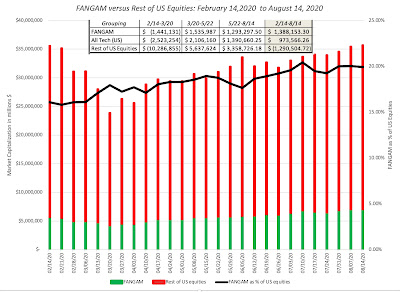
Facebook is a young company, at least in chronological time, having been public for just over a decade. I have written about the firm many times, over that period, starting with a valuation that I did of the company in 2012, just ahead of it going public. On May 12, 2012, Facebook's debuted in financial markets, with a capitalization of $104 billion, making it one of the most valuable IPOs of all time. After a rough start, with its stock price halving by August 2012, the company embarked on an extraordinary run in markets, adding almost $900 billion to its market capitalization to briefly breach a trillion dollars in July 2021. In a post in 2020, I highlighted how much of the increase in US equity values in the 2010-2019 decade was because of the FANGAM stocks (Facebook, Amazon, Netflix, Google, Apple and Microsoft):
Since July 2021, Facebook's market standing has fallen precipitously, with its market capitalization down to less than $250 billion (down more than 75% from its high) on October 27, after its most recent earnings report. As Facebook's market capitalization has collapsed, it is worth stepping back and gaining perspective about its market performance in the long term.
Buy and hold returns: If you had bought shares in Facebook on its first trading day, you would have paid $38.12, and if you had held the stock through October 27, 2022, when it was trading at $93/share, that would have translated into a cumulative return of 144%. That would have left you lagging the 181% price appreciation that you would have earned on the S&P 500 during the period, and even more so, if you consider the fact that you would have earned no dividends on Facebook, while generating about a 2% dividend yield, every year on the index.
Current standing: At a roughly $250 billion market capitalization, Facebook is a large market-cap company, but it has lost its standing among the largest market cap companies in the world that if occupied for an extended period during the last decade.
Trader's game: Along the way, Facebook has had its ups and downs, and a savvy trader who was able to time entry and exit into the stock at the right times, would have made a killing on the stock. I know that can be said of any stock, but the swings in fortune are much greater at companies like Facebook, making them them the preferred habitat for traders of all stripes.
In sum, the investor experience with Facebook over the last decade should be a cautionary note on passing judgment on companies after short periods, where the stock soars or sinks, sometimes for no good reasons.
The Operating Journey
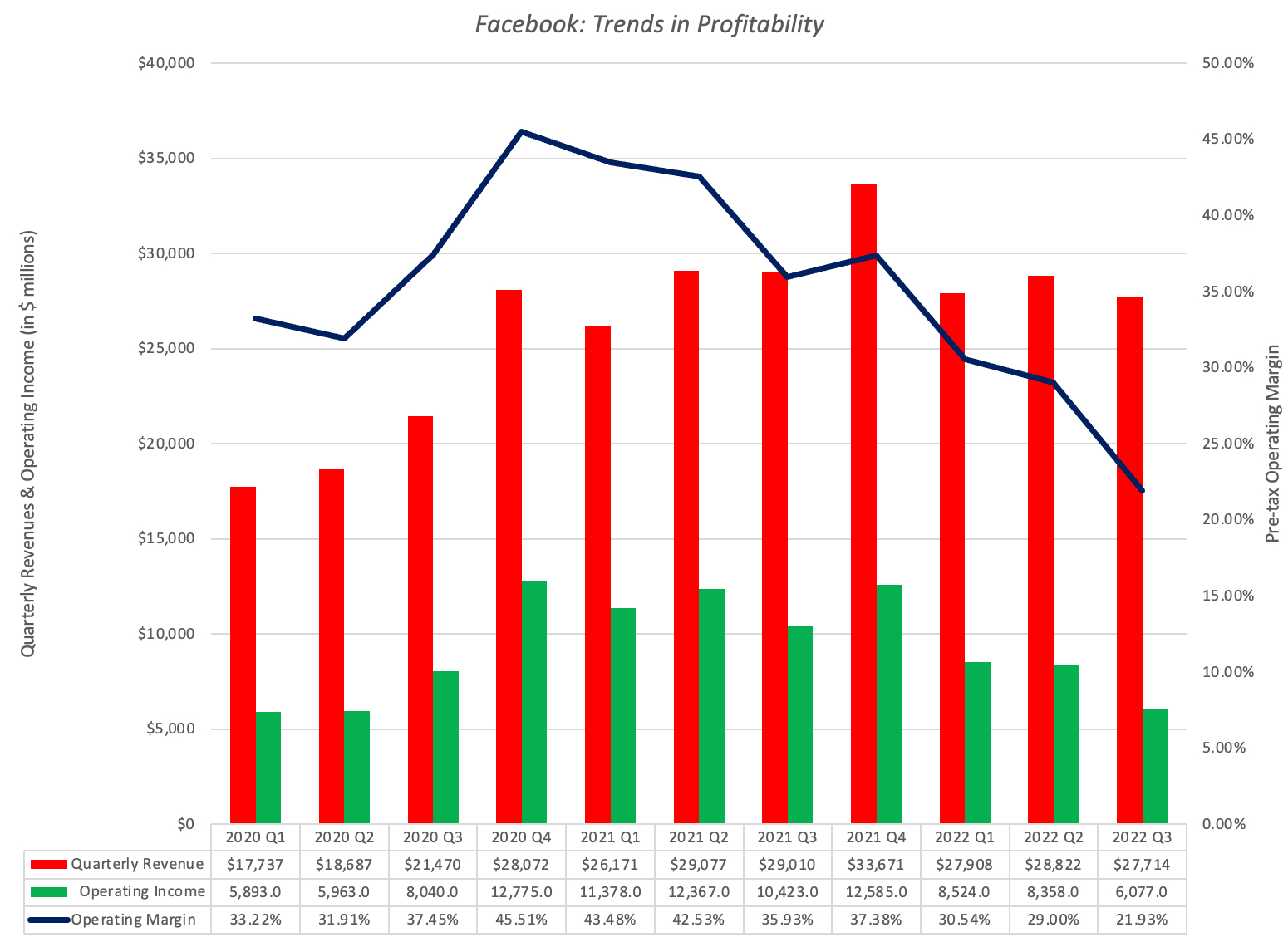
The drop in Facebook's stock price that has occurred in 2022 is part of a larger story of a decline in tech companies during the year. For many value investors, the tech stock drop has been vindication that no sector, no matter how favored, can fight gravity in the long term, but they would be making a mistake if they bundle Facebook in with younger tech companies, many of which have unformed business models and an inability to be profitable.Through its entire life, one of Facebook's most impressive features has been its capacity not only to generate profits but very large profits, as you can see in the chart below:
Note that Facebook, then it went public, had revenues of only $3.7 billion, but it generated an operating margin of 47.3%, with its online advertising model. In the decade since, its has been able to scale up revenues dramatically, with revenues reach $118 billion in 2021, while preserving sky-high margins, close to 40% in 2021. In short, Facebook has been a profit and cash machine for its entire public market life, and there is more to this company than traders pushing up stock prices on momentum.
It is this historical context of high growth, albeit slowing as the company scales up, and consistently high operating margins, that should explain investor reactions to last week's earnings report. There were at least two negative surprises in the report that led to investor reassessment:
Flat revenues: While revenue growth has been slowing in recent quarters, and investors would perhaps have lived with single digit growth, especially with advertising spending slowing, they were blindsided when the company reported its second consecutive year-on-year quarterly revenue decline . The company's contention was that the decline was driven by a slowing down in online advertising revenues at the firm, mirroring similar slowdowns at other online advertising platforms.
That said, there is clearly more to it than an industry-wide slowdown, since the drop in revenues at Facebook has been larger than the drops seen across the sector; Google, for instance, reported a third quarter year-on-year revenue growth rate of 6% in October 2022.
Drop in operating margins: The bigger shock in the most recent earnings report, in my view, was the collapse in operating margins.
While the decline in operating income in the first two quarters of 2022 mirror drops in revenues in those quarters, the decline in the third quarter cannot be explained by lower revenues in that quarter. The company attributed the decline in operating income to its Reality Labs unit, which houses its VR headsets, with reported revenues of $285 million and an operating loss of $3.67 billion in the third quarter of 2022.
It is undeniable that the third quarter numbers for Facebook were disappointing, but again taking a longer term perspective, most companies would gladly switch places with Facebook, with revenues of more than $100 billion, and operating margins of 20%-30%. The question that we face now, as prospective investors, is whether the market has overreacted to a quarter's bad numbers or whether this is the beginning of the end for the company's core business model.
The Troubles
While 2022 has been a particularly difficult year for Facebook, the troubles at the company date back to 2018, when it was revealed that Cambridge Analytica, a UK-based data service with political clients, had acquired and utilized Facebook data on tens of millions of users. In the aftermath, Facebook faced both political and investing backlash, with its stock price dropping by more than 10% and there were some doomsayers who argued that its business model was irretrievably broken, because of the privacy challenges. At the time, I pointed to the hypocrisy of critics complaining about Facebook's privacy lapses on their Facebook pages, and argued that the company would weather the scandal, albeit with scars. In the months after, that view was vindicated as Facebook spent billions on tightening security, while continuing to grow revenues and report sky-high margins, and the market responded by pushing up its stock price once again.
While Facebook was able to deal with the privacy challenge, relatively unscathed in economic terms, there are three other problems that the company is facing that will not be as easily overcome:
Online Ad Market Leveling off: Facebook is an online advertising company, and for much of its early years, it benefited from growth in the online advertising market, largely at the expense of traditional advertising (newspapers, television etc.). As online advertising approaches two-thirds of all advertising, that growth is now leveling off, and as one of the two largest players (and beneficiaries) of the market, Facebook is facing a growth crunch.
Online advertising is cyclical: As online advertising has grown over the last decade, one of the questions has been whether it, like all advertising historically, is cyclical. Prior to this year, there were some who argued that online advertising would be more resilient than traditional advertising, in the face of economic shocks, but this year's developments have shown otherwise. As economic growth has slowed and concerns about a recession have risen, revenue growth has dropped at all of the companies in this space has declined. The conclusion is that online advertising is cyclical, and if we are in the midst of an economic slowdown, the companies in this space will feel the pain.
Reputation effects: While Facebook made it through the privacy challenges with revenue growth and profitability intact, it is undeniable that the company's reputation took a beating. In my view, this toxicity, as much as the desire to enter a new market in the Metaverse, explains why Facebook changed its name to Meta in November 2021.
In fact, it is this trifecta of developments (a maturing online ad market, exposure to economic cyclicality and reputation damage), in conjunction with Facebook's disappointing operating numbers that has led investors to reassess its worth, and mark down its price.
Corporate Governance
As stock prices have dropped this year, not only is there an increased focus on earnings and cash flows, as I noted in my last post, but there seems to also be an reawakening among investors about the importance of corporate governance, as can be seen in this article about Facebook. Having seen these awakenings many times over the last 30 years, I am cynical that anything productive will come out of these discussions, since we seem to have lost sight of what corporate governance is and why it matters to investors.
The Stakeholders
To set the stage for understanding corporate governance, it is best to start with a recognition of the different stakeholders in a publicly traded company:
While all of these claim holders have stakes in the company, their interests will diverge, raising a key question of whose interests should be served by the managers of the company, when making business decisions, small or large. It is true that conventional corporate finance (and the Delaware courts) give primacy to shareholders, and it is not because shareholders are a special or protected group, but It is because they are the only claim holders that do not have a contractual claim on the firm; as shareholders you get what's left over after contractual claims (wages, interest expenses) have been met. Lenders can negotiate interest and principal payments and insert covenants to protect themselves, employees have employment contracts and sometimes unions to negotiate wages and benefits, and customers can choose to buy or not buy a company's products and services.
There is of course a notion that managers should be accountable to all stakeholders, not just stockholders, an idea that was born and nurtured in law schools, before finding a footing in business. In a 2019 post, I presented my arguments for why stakeholder wealth maximization is fanciful in its belief that it is management's job to juggle the divergent interests of different stakeholders and dangerous insofar as it makes managers accountable to everyone, and by extension, to no one. (Note that the G in ESG is about stakeholder governance, not shareholder governance, which may explain why CEOs have been so quick to jump on its bandwagon.)
Conflicts of Interests and Consequences
If you are looking at a privately owned business, with a sole owner who also runs the business, the interests of owners and managers converge, but this is the exception, not the rule. Even in a family-owned business, where one family member runs the business, you can have other family members disagree about how it is run, leading to frictions and legal battles. (If you are a fan of Succession on HBO, you know exactly what I am talking about). As businesses seek external capital to grow, either from private hands (venture capitalists) or public equity, the divergence between the interests of those running businesses and the owners of these businesses will increase. That is the core challenge in corporate governance, and any discussion of the topic has to begin with answers to three questions:
In what types of firms is this conflict of interest greatest? If the conflict of interest that is at the heart of corporate governance is that between the owners of a business and those who manage that business, it will begin when private businesses seek out capital from external sources, as founder and venture capital interests can diverge. These conflicts will expand, as companies go first go public, and the interests of insiders and founders, who run the firm, can be at odds with the interests of outside shareholders. As companies age, founders will move on and get replaced by professional managers, and these managerial interests can clearly be at odds with those of shareholders, with boards of directors, in theory, watching out for the latter. In short, conflicts of interest exist at almost all businesses, though the nature of the conflict will change as companies go from private to public, and as they age.
When the interests of shareholders and corporate decision-makers diverge, what are the consequences for the company? When the interests of decision makers or managers at a business diverge from those of its owners, it is inevitable that there will be decisions made that advance the interests of the former at the expense of the latter. With private business that access venture capital, founders may make decisions (on product design, business models, marketing) that venture capitalists may not find to their liking. With public companies that are run by founders/insiders, the decisions made by inside shareholders to advance their interests may not align with the interests of outside shareholders. In older public companies, the investing, financing and dividend decisions that managers make may by in direct opposition to what shareholders would like them to do.
What are the checks on these conflicts of interest? In each of the scenarios described above, it is true that there are mechanisms that exist to keep these conflicts in check. In private firms with venture capital investors, VC investors are often actively involved in management, and, if they have the power, have few compunctions about pushing out founder/managers who don’t serve their interests. In public companies, with insiders and founders in charge, the only recourse that outside shareholders often have, if they feel their interests are being ignored, is to sell and move on, hoping that the resulting drop in stock prices causes a change in course. In theory, the boards of directors at these companies are supposed to protect shareholder interests, but that protection is sporadic and often ineffective.
In short, while corporate governance is often framed as being entirely about the conflicts of interests between managers and shareholders at companies with dispersed shareholdings, its reach is much broader, and it is relevant at almost every business.
The Essence of Corporate Governance
After five decades of research in corporate governance, my sense is that we have lost the forest for the trees, with the composition of boards of directors and rules on proxy voting receiving disproportionate attention, from both legislators and regulators, often at the expense of bigger and more consequential issues. In the aftermath of the Enron and Tyco scandals in the United States, where insider-dominated boards were negligent in their oversight responsibilities, the Sarbanes-Oxley Act was passed in 2002, with improved corporate governance as one of its objectives. At about the same time, you saw the advent of services that used the disclosures that companies were required to make on governance to estimate corporate governance scores. We were told at the time that the combination of independent boards, increased disclosure and governance scores would create a revolution in corporate governance, where managers would act to advance shareholder interests. It is clear that twenty years later that all that Sarbanes Oxley has accomplished is replacing ineffective insider-dominated boards with ineffective independent boards, while creating hundreds of pages of disclosure that no one reads and giving rise to scores that are close to useless in judging governance. With the push towards diversity in board composition now taking precedence, this process is hurtling even more into irrelevance, with the only positive being that the ineffective boards of the future will meet all our diversity criteria.
I believe that for a true shift in corporate governance to happen, we have to reframe the meaning of good corporate governance, shifting away from a board-centered, check-box driven view to one that is centered on giving shareholders the power to change company management, if they choose to. In fact, good corporate governance is like a good democracy, where shareholders (voters) get the power to change management (governments), when they believe that their interests are not being served. As in a democracy, there is no guarantee that shareholders will make the right or even informed choices, sometimes choosing not to make changes, even when change is required, and sometimes deciding to replace good managers with bad ones. Good corporate governance is sometimes chaotic and often unsettling, and it is no surprise that there are many who are drawn to the benevolent dictatorship model, where "qualified, well-intentioned managers" are given lifetime tenure, with shareholders stripped of the power to challenge them. That latter model was the default for publicly traded companies in much of the world, for the twentieth century, and even in the US, you had managerial apologists like Marty Lipton and corporate strategists arguing that corporate management would be more effective, without shareholder oversight.
The "Right" Management: A Corporate Life Cycle Perspective
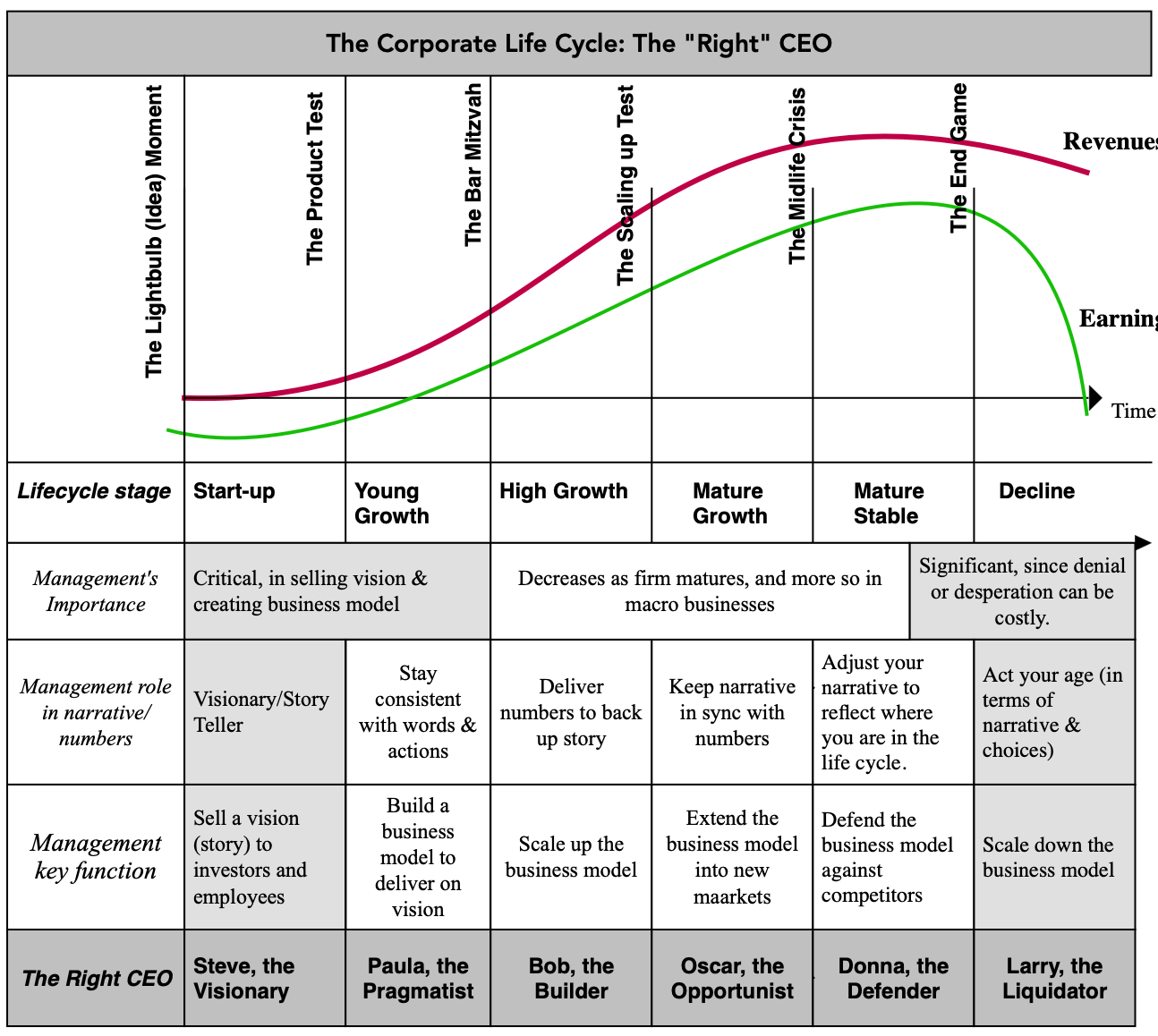
If corporate governance is about giving more power to business owners to change management at the companies that they are invested in, if they choose to, to understand it, we have to begin by looking at why management change may be needed in the first place. I will use the corporate life cycle, a structure that I have used in many other contexts, to set the stage for this discussion, by noting that the qualities that you will look for in "good" management will change as companies move through the life cycle, from start-up to growth to mature and then on to final decline. In the figure below, I have highlighted the role that top management play at a business, and how that role will change as companies age.
Early in the life cycle, as a start-up, the quality that you value most in your top management (and especially in your CEO) is vision, the capacity to tell the story of the business, and get investors and employees on board. As you move from idea to product, you still need vision, but it has been paired with pragmatism, and you would like the business to be run by someone who is willing to make compromises on design and strategy, to create a market for the product. The trash can of failed businesses is filled with purist founders who insisted on having their way, and refused to bend their dreams to meet reality. In the next phase, you need a CEO who is willing to do the work needed to build a business, an often unexciting job that requires attention to supply chains, marketing campaigns and product manufacturing. As businesses look to scale up, they are best led by opportunists who can seek out new markets that allow small businesses to become bigger, and once mature, you want an executive at the top who can play defense against competitors and disruptors. In decline, you need a realist who takes what the business has to offer, and does not try to overreach, in many ways the polar opposite of the visionary you sought out as a start-up.
Management Mismatches across the Life Cycle
Understanding how the qualities that you look for in good management change, as the company changes, provides a framework for assessing why you can end up with management mismatches, where the managers running the firm are unsuited to running it. In some cases, it can happen because the business changes (from start up to young growth or from high growth to mature), but the person running it does not, will not or cannot change. In other cases, it can represent a hiring mistake, as is the case when the board of directors at a high growth firm seek out the CEO of a mature company, competent but risk-averse, to run their business. In still others, it can just be hopeful thinking, where the board of directors at a declining firm seek out a visionary CEO, hoping that this hire can reverse aging and become young again. In the figure below, I have listed CEO/Company mismatches across the life cycle:
I also highlight the catalysts for management change at each stage. In very young firms, it is disgruntled venture capitalists who pressure founders who, they believe, are not paying enough attention to business-building, to change their ways or even leave their positions. In publicly traded firms, the catalysts can be activist investors, who pressure businesses to change the way they are run or even who runs them, hostile acquirers, hoping for revamps, or private equity funds, with plans for liquidating or breaking up the firm.
Management Mismatch Consequences
In most firms, even in the countries that are viewed as strong on corporate governance, there are barriers to change that are daunting, which explains why forced management changes are infrequent. Thus, venture capitalists may be stymied, when trying to replace founders, by the founders' controlling stakes. With high-growth firms that are publicly traded, insiders and founders holding large stakes can make it difficult for outside shareholders to push for charge, and as firms mature and age, it is the passivity of institutional investors that is the biggest impediment to change.
When a management mismatch persists, the consequences can range from the benign to very damaging:
In the most benign case, the mismatched manager recognizes his or her limitations and hires help to remedy them. In my view, the biggest difference between Steve Jobs in his first iteration at Apple, when his stubbornness damaged the company, and his legendary second stint at the company, was the presence of Tim Cook, as his chief operating officer. In an intermediate scenario, the board of directors eventually faces up to the reality of the mismatch, often because of poor stock price performance, and replaces the management, but not before serious damage has been done. In the most malignant scenario, the mismatched manager stays in place, destroying value and running the business into the ground, and perhaps into bankruptcy.
Corporate Governance at Technology Companies
With that long lead-in on corporate governance, let's look at technology companies, partly because they are the largest sector in terms of market capitalization, and partly because this post is on Facebook, a large technology company. I will argue, using the life cycle structure, that tech companies age much faster than non-tech businesses, and are thus more exposed to management mismatches. Troublingly, it is precisely in these companies, where the need for corporate governance is greatest, that we (as investors) seem to have acquiesced to structures that give us the least power to push for change.
The Compressed Life Cycle
A corporate life cycle resembles the human life cycle, in terms of its sequence, but there are two significant differences. The first is that the mortality rate is far higher in the corporate life cycle, as more than two thirds of businesses do not make it through the early stages, than it is for human beings, at least in the twenty first century. The second is that unlike the human life, the corporate life cycle does not follow chronological time. Kongo Gumi, a family-owned Japanese company in the business of constructing temples and shrines, lasted for almost 1500 years, before being acquired in 2006. In contrast, there are businesses that are shooting stars that survive for only 15 or 20 years, before liquidating or selling themselves. In the figure below, I look at the variables that determine how quickly a business grows, how long it stays at the top and the speed of its decline:
Companies in businesses with low capital intensity and ease of access to the market and capital will grow much more quickly than businesses without these characteristics, but those same features will make it difficult for them to stay at the top for very long and accelerate their decline. That is the basis for a post that I wrote about why technology companies have compressed life cycles, relative to manufacturing or infrastructure companies:
Just to illustrate, the great companies of the twentieth century, such as Exxon Mobil, GE and Ford, might be looking at the declining phases of their life cycles now, but they have had extraordinarily long lives (Exxon was founded in 1859, GE in 1892 and Ford in 1903). In contrast, a company like Yahoo! was able to get from its founding in 1994 to a hundred-billion dollar market capitalization five years later, but its glory days lasted until 2004, when Google entered the game, and decline, once it started, was unstoppable, leading to its demise in 2017. (Marissa Mayer tried, but she never had a chance...)
We believe that this compressed life cycle has consequences for management mismatches. With the long life-cycle companies that characterizes the twentieth century, companies and managers both aged over time, allowing for transitions to occur more naturally. To see, why consider how corporate governance played out at Ford, a twentieth century corporate success story. Henry Ford, undoubtedly a visionary, but a crank on some dimensions, was Ford's CEO from 1906 to 1945. His vision of making automobiles affordable to the masses, with the Model T (but only in black), was a catalyst in Ford's success, but by the end of his tenure in 1945, his management style was already out of sync with the company. With Ford, time and mortality solved the problem, and his grandson, Henry Ford II, was a better custodian for the firms in the decades that followed. Put simply, when a company lasts for a century, the progression of time naturally takes care of mismatches and succession. In contrast, consider how quickly Blackberry, as a company, soared, how short its stay at the top was, and how steep its descent was, as other companies entered the smartphone business. Mike Lazaridis, one of the co-founders of the company, and Jim Balsillie, the CEO he hired in 1992 to guide the company, presided over both its soaring success, gaining accolades for their management skills for doing so, as well as its collapse, drawing jeers from the same crowd. By the time, the change in top management happened in 2012, it was viewed as too little, too late. Put simply, if the companies that dominate the market today have compressed life cycles, relative to the companies of the last century, we should ready ourselves for far more cases of management mismatches.
The Investor Surrender
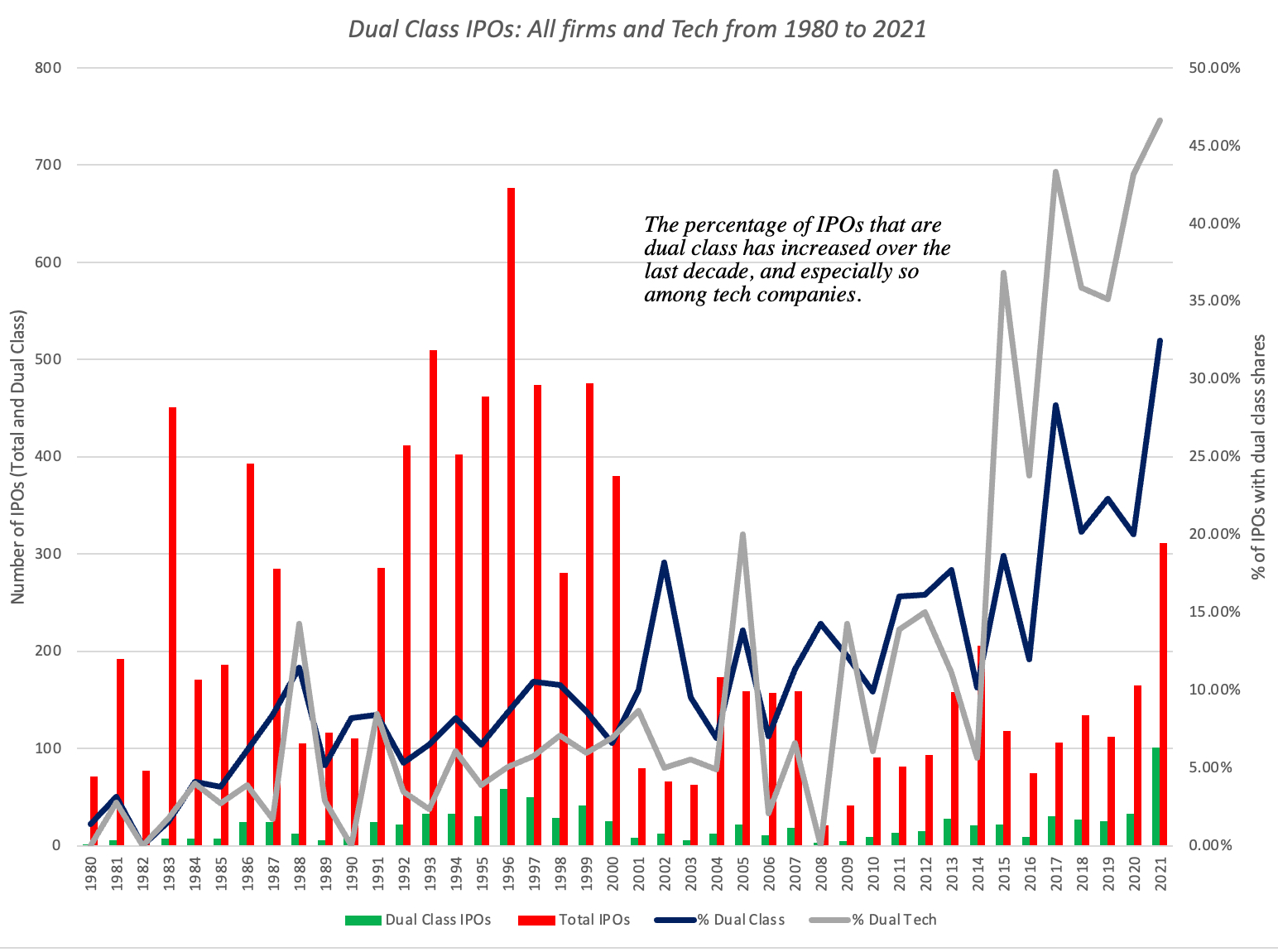
If you accept my thesis that shorter corporate life cycles increase the likelihood of management mismatches at companies, it follows that we, as investors, need tools and processes that increase our power to change management at these firms. It is in this context that we have look back, with dismay at how willingly we have given away the power to create change at companies, and especially so at technology companies. While corporate governance measurement services and academics were obsessing over board composition and management compensation, companies have been changing the rules of the governance game, tilting power decisively away from shareholders, with little or no pushback. In the last two decades, US companies, have increasingly turned to dual-class shares, with one class having significantly more voting rights than the other, and with founders/insiders holding these voting shares. You can see this phenomenon play out in the chart below, where I graph out the percentage of companies, going public with dual-class shares, each year from 1980 to 2021:
By 2021, almost a third of all companies going public had two classes of shares, with different voting rights, and that trend was even stronger at tech companies, where close to half of all companies, going public, had shares with different voting rights in 2021.
Facebook, which went public in 2012, followed this path when it issued class A shares to the public, with one voting right per share, while Zuckerberg and a few insiders kept class B shares, with ten voting rights per share. In the figure below, you see the breakdown of share holding in both class A and class B shares at Facebook:
Cutting to the chase, Zuckerberg controls 57% of the voting rights in the company, while owning only 13.52% of all outstanding shares, largely because he holds the bulk of the voting shares. Rather Han a corporate democracy, Facebook’s elections resemble those in authoritarian regimes, where you can vote for whoever you want, but the winner is pre-determined. (Just as an aside, I found a Facebook proposal to the SEC, thankfully stillborn, to create Class C shares with no voting rights, in 2017. That would have added insult to injury!)
In short, shareholders have been disempowered at some of our largest and most valuable companies, and they have, for the most part, gone along. There is plenty of blame to go around, but the following culprits stand out:
Market-share seeking Stock Exchanges: For much of the last century, starting with a de facto ban in 1926 and a rule in 1940, the New York Stock Exchange barred companies listed on the exchange from from issuing shares with different voting rights, and with its dominance over US equity markets, that became the rule followed by most US companies. The American Stock Exchange adopted slightly looser rules, hoping to get market share from the NYSE, but it was the NASDAQ that threw caution to the winds entirely and removed all restrictions on voting and non-voting shares. That proved to be a great business decision, since the largest tech companies of this century have not only listed on the NASDAQ, but chosen to stay there, but it came at the expense of shareholder powers.
Founder Worshippers: For the last few decades, we have glorified the founders of technology companies, and while there is much to admire in their accomplishments, there is a danger in putting them on pedestals and attributing to them heroic or superhuman qualities. In the case of companies like Google and Facebook, and especially so at the time of their public offerings, there were many investors, including some of the largest institutional players, that were willing to make the trade off of giving up power to change management in return for being invested in companies run by "young, tech geniuses". In fact, there are some researchers who were willing to argue that removing the threat of shareholder power made founder-run companies more valuable, because founders are smarter and think more long-term than investors.
Lazy Investors: Much as we would like to blame others for our misfortunes, the truth is that get the corporate governance we deserve. Most of us, as investors, chose to give away our voting rights willingly because we wanted shares of the "next big thing", and at the time we did so, we rationalized it by arguing it that we would not need that voting power any time soon. I have little sympathy for the hand wringing and complaints from investors, institutional or retail, in Facebook that management is not listening to them. Investing in Facebook and complaining that Mark Zuckerberg will not listen to you is like getting married to one of the Kardashians and complaining that your privacy is being invaded.
Lax Regulators: For some of you reading this post, the villain is going to be the SEC and regulators, with the argument being that they could have protected you by banning dual class shares. I see your point, but remember that the inertia, laziness or me-tooism that led you to buy dual-class shares, will outlast the regulatory ban. Regulators cannot protect us from our own worst instincts!
There may not be much you can do about companies that have already adopted dual-class shares, but marking their prices down will make them pay attention. Who knows? Losing a chunk of their wealth may lead the founders who run some of these companies to reassess their positions on differential voting rights.
The Consequences
If the essence of corporate governance is the giving shareholders the power to change management at companies, where there is a mismatch, and if those mismatches are more likely to occur at tech companies, where shareholders have unilaterally disarmed, there are predictable consequences:
Chaotic Management Transitions: It is true that we have made it more difficult to change management at tech companies, even when that change is overdue. That said, there will be tech companies where change will occur, but my prediction is that this change will often be forced by either insider in-fighting (where co-founders and insiders turn on each other) or precipitated by a pricing collapse. While Elon Musk’s acquisition of Twitter is one of a kind, the chaos that you are observing at the company is a precursor to changes that you will see at other tech companies in the years to come.
Locked-in Mismatches: There are other tech companies where the game has been so thoroughly tilted in favor of insiders and incumbent management that change is impossible. In these companies, as an outside investor, you have to build that reality into your valuations, leading to discounts to your value that reflect how much you trust management. In short, if management has adopted policies that are value-destructive, in the long term, there will be a much smaller chance of reversal at companies with locked-in management than at companies where change remains possible. In the case of Facebook, the company has clearly made a huge bet on the Metaverse, investing $15 billion in the most recent year and planning almost $100 billion in additional investments in the coming years. It is too early to pass judgment on whether these investments will pay off, but assume that the data that comes in over the next two years indicates that Facebook should scale back its investments and slow down. I would like to believe that Zuckerberg is too smart a businessman not to do the right thing, but the qualities that made him a successful founder (over confidence, stubbornness in the face of failure, arrogance) may very well keep him on his pre-determined path, and without checks and balances, Facebook will lose a lot more money over a longer period, before he gives in.
Voting Share/Non-voting Shares: In a paper on valuing control from a few years ago, I argued that the differential in prices between voting and non-voting shares will reflect the value of expected control in a company, and will be higher at companies where management change is plausible than in firms where it is unlikely. When tech companies go public, it is entirely possible that there will be a honeymoon period, perhaps even an extended one, where investors are dazzled by scaling successes and are willing to overlook shortcoming, when shares with different voting rights trade at the similar prices. As disillusionment sets in, I would expect voting share premiums to rise, and to rise more at those firms where investors trust managers the least.
As investors, should you avoid investing in tech companies with dual-voting right shares? If I said yes, I would be violating one of my own precepts, which is that I will buy any company, no matter what its faults, at the right price. You should avoid investing in these companies when they are priced on the presumption that their founder-managers can do no wrong, but as fear overcomes greed in markets, investors in these companies will start pricing in the worst-case scenarios, where founders continue with dysfunctional behavior in perpetuity, and at those prices, you may be getting bargains. That is what I see happening, in 2022, at Facebook, in particular, and large tech companies, in general. It is the reason that having lost money on Facebook, since buying it in April, I will continue to hold it and I did add to my holdings, when the stock hit $100/share. I know that my Facebook investment will ride and fall with Mark Zuckerberg's ego, and while I have no delusions about being able to influence him, I think that at today's prices, the odds are in my favor. Time will tell!
It has been a rocky year so far, in 2022, with worries about inflation competing with hopes about recovery for the market's attention. In the midst of all the action, to no one's surprise, have been six stocks (Facebook, Amazon, Netflix, Google, Apple and Microsoft or FANGAM) that have largely driven US equities for the last decade, roiling the market with their most recent earnings reports. Netflix and Facebook saw drops of 20% or more in market capitalization, following negative earnings reports, but Amazon and Google beat market expectations. In this post, I will be valuing each of these companies, both to assess whether to invest in them individually, and to examine whether there are lessons for the market in their price entrails.
My September 2020 Valuations
If you tally the winners and losers in the stock market sweepstakes between 2010 and 2019, it is undeniable that the decade belonged to the FANGAM stocks, as can be seen in the graph, where I chart the collective market cap of these six companies against the collective market cap of all US equities, and report on their percentage share:
Over the course of the decade (2010-2019), the FANGAM stocks increased in collective market capitalization from $719 billion from $5.07 trillion, and their share of the overall equity value of all US stocks also surged from 6.5% to 14.9%. It is not hyperbole that without these stocks, the last decade would not have been a great one for US equities. Coming into 2020 in a position of strength, these companies got stronger, as COVID rocked economies and markets in 2020, which became the headline for one of my posts on COVID:
Between February 14, 2020 and August 14, 2020, as markets first collapsed and then recovered just as strongly, the FANGAM companies collectively added $1.39 trillion in market cap, accounting for all of the recovery in US stocks during that period. I have valued each of FANGAM multiple times in the past, but my most recent attempt to value each of them was in September 2020, as one of a series of posts highlighting how COVID was playing out in markets. I wanted to see if that surge, added on to the trillions in the market cap of US equities between 2010 and 2019, had left them in nosebleed territory, in terms of value. I must admit I was surprised by my own valuations, since, given the low riskfree rates prevailing at the time, only one stock (Apple) looked significant over valued. Of the rest, Microsoft and Amazon were over valued, albeit by modest most amounts, and Facebook was the most undervalued, and Netflix and Google were close to fairly valued.
At the end of that post, I disclosed that I owned Facebook, Microsoft and Apple, and that I would continue to hold the first two, and would sell my Apple shares. Clearly, much has happened since these valuations. The market has continued its march upwards, these companies have had multiple earnings reports and each of them has had newsworthy events occur.
Updating the Numbers
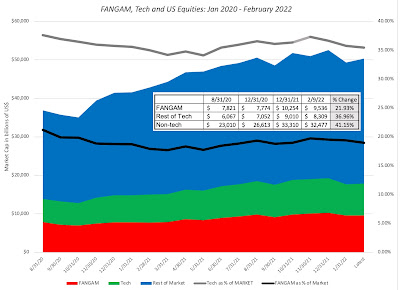
In the eighteen months since I valued these companies, much has happened, to the economy, to US equities collectively, and to these six companies, in specific. In the graph below, I report on the collective market capitalization of US equities, broken down into three groupings, the FANGAM stocks, all other US tech companies and the rest of the US equity market, from August 31, 2020 to February 9, 2022:
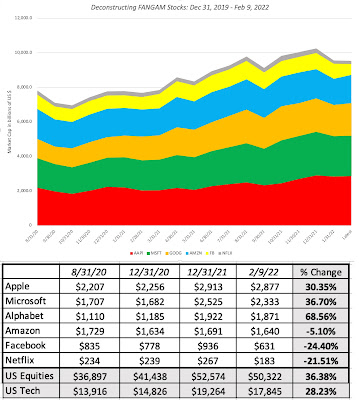
During the period, the collective market capitalization of FANGAM stocks increased by 21.9%, but they lagged the rest of the US tech sector (up 37%) and non-tech US equities (41.1%). For the first time in more than a decade, the FANGAM stocks are running behind the rest of the market. Breaking the FANGAM stocks into their constituent parts and charting their performance between August 31, 2020 and February 2022, here is what I get:
During this period (8/31/20-2/9/22), three of the FANGAM stocks (Apple, Microsoft and Alphabet) were up strongly, and three (Amazon, Facebook, Netflix) were down. In summary, the FANGAM stocks were up collectively between August 31, 2020, and February 9, 2022, but they lagged the rest of the US equity market, with that underperformance isolated to Amazon, Facebook and Netflix.
The Numbers
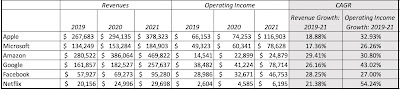
Since I last valued the FANGAM stocks in September 2020, there have been six quarterly earnings reports from each of these companies, and I report on two key operating measures, revenues and operating income, in the table below, for the last three fiscal years for each of the companies. (Note that four of these companies have calendar year-ends, and two have fiscal years that end mid-year. For the latter, I am reporting on the trailing 12-month numbers, to ensure that I have the calendar year numbers.)
Looking at the percentage changes in revenues and operating income between 2019 and 2021 gives us a measure of how well each of these companies have navigated the currents of the last two years, and they seem to have turned the troubles to their advantage, posting strong compounded annual growth rates in revenues and operating income. These consolidated growth numbers, though, don't reflect the trend lines over the three years at these companies. Facebook and Netflix stumbled in their most recent earnings releases, losing more than a fifth of their market capitalization. With both companies, the user numbers were the basis for the negative surprises, with Facebook reporting its first drop in user number on a quarter-to-quarter basis as a public company and Netflix reporting underwhelming subscriber growth. Amazon and Google reported stronger than expected growth in both revenues and operating income, in the most recent quarter, and Microsoft and Apple delivered close to expected numbers.
The News
The FANGAM six, by virtue of their market capitalizations and their presence in our daily lives, have been also among the newsworthy of companies, and a significant portion of the news stories have are only mildly connected to current operating numbers. If I were to summarize the news about these companies in the last eighteen months:
Facebook and Google found themselves in the midst of both the data privacy and political partisanship debates, as politicians and regulators argued about how best to restrict the social media platforms of these companies. Google, notwithstanding a few storms around YouTube, escaped relatively unscathed, but Facebook continued to draw fire from all directions. It is worth noting, though, that Facebook's loss of half a million users in the most recent quarter may have been more attributable to Apple tightening privacy protections on its devices than government action. The most revealing news story about Facebook, though, was its decision to rename itself "Meta", in late October, and it framed the decision as readying itself for business in the Metaverse. I argued then that the name change was a reflection of management at Facebook coming to the conclusion that its name had become too toxic, from a business perspective, and I did sell my shares in the aftermath. In hindsight, of course, this was a fortuitous decision, since it allowed me to evade the post-earnings collapse in the stock price, but it was definitely more luck than skill.
The big stories affecting Netflix were less about the company and more about its competitors, and one of them, in particular, Disney. During this two-year period, Disney doubled down on Disney Plus, its streaming platform, and on content production, spending more than $25 billion on content in 2021. Netflix continued its traditional path of spending immense amounts on content, with content costs reaching $17.7 billion in 2021, but its cost of acquiring users climbed, as the US and European markets matured, and new subscribers in Asia and Latin America, the two geographical areas with the most user growth potential, delivered less revenues per subscriber.
Apple and Microsoft, ancient companies by tech standards, continued for the most part to keep their heads down, and stay out of public controversies. In fact, Apple managed to reframe itself as a protector of privacy, putting itself on the right side of that debate, while also inflicting pain on its competitors (see Facebook above). Its new iPhone models rolled out smoothly and to generally positive reviews, a source of immense relief to a company that lives on the revenues from that product. Microsoft continued its long term path of consolidating its core product franchises (Windows and Office) and converting them to subscription businesses (with Office 365), while increasing its cloud business exposure. In the last month, the company made a splash with its announcement of the acquisition of Activision Blizzard for $68.7 billion, in an all-cash deal. While I am not a fan of acquisitions, especially big ones of publicly traded companies, there are some reasons to believe that this deal has a better chance than most of succeeding. First, at close to $70 billion, the deal looks big in absolute terms, but relative to Microsoft's market cap (of $ 2.2 trillion), it is a small deal. Second, I have to weigh in the fact that Microsoft has not been trigger-happy, when it comes to deals, and Satya Nadella has not struck me as an ego-driven CEO, at least in his public interactions. Third, I think that this deal plays into a much bigger end game, for Microsoft, than getting market share in the conventional game platform business. Finally, Activision own internal troubles had led to marking down of its stock price in the months leading into this deal, effectively reducing the actual premium paid. I know that there are some who see this acquisition as an attempt by Microsoft to squeeze Sony and Nintendo, but while that may be a side-product of this deal, I think that Microsoft has a much bigger gaming market, in mind, with much of it online, where it is competing against the other social media giants (Facebook and Google) and online game platform companies (Roblox).
Of the six companies in the group, Amazon is most used to being targeted, for political and social reasons, over its entire lifetime. In addition to the stories about worker exploitation, with anecdotes about drivers not able to take bathroom breaks and overworked warehouse workers, there were questions about its competitive practices, albeit often planted by competitors whose only hope of stopping Amazon has become the government. While Jeff Bezos officially stepped down as CEO of the company in 2021, his status as one of the richest men in the world, his messy divorce and newfound standing as a globe-trotting celebrity all became news stories about Amazon. It is a testimonial to the succession team that Bezos built at Amazon that the company continued its march towards global dominance, notwithstanding all these distractions.
Valuing these FANGAM stocks reinforces the truth that valuing companies can never just be based upon the financials, since all of this news will play out eventually in the valuation stories (and valuations) of these companies.
The FANGAM Valuations: February 2022
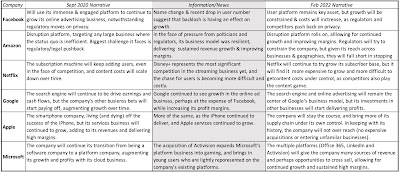
In the trading game, where pricing is driven by mood and momentum, earnings reports and news stories are scanned for incremental news, information that ultimately will have little effect on value, but can move prices substantially. That explains the fixation with earnings per share expectations, and why seemingly trivial surprises, where a company beats or falls short of earnings expectations by a few cents can cause the market capitalization of a company to increase or decrease significantly. If you have been reading my posts, it should come as no surprise to you that I believe in intrinsic value, but I also believe that intrinsic value is driven by narrative. To me, the value effect of earnings reports and news stories comes from how they change (or don't change) the core narratives for companies. In keeping with that belief, I revisited my narratives for the FANGAM stocks, with the intent of revising these narratives, based upon what we have learned about these companies in the last two years:
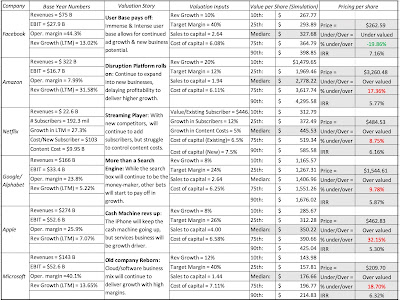
Converting these stories into numbers, I revalued the six companies. You can download the full valuations by clicking here (Facebook, Amazon, Netflix, Google, Apple, Microsoft), but the summary of my key assumptions and valuations are below:
At the risk of repeating some of what I have said before, here is what the valuations tell me about these companies, as investments.
Facebook looks the most under valued of the six companies, but one reason is that it seems to have lost its story script. For a decade whether you liked or hated the company, the story that drove its valuation was a simple one: a platform of billions of users, about whom Facebook knew a great deal, and they then used that knowledge to deliver focused advertising. In short, this is a company that has built its business on accessing and using private data, and the privacy backlash seems to have finally led the company to try to redefine itself, first by renaming itself (Meta), and then muddying the waters about its business model. I think that the company is still a profit-generating behemoth, with some of the highest operating margins in American business, but I think that until it finds a cohesive story line, the price recovery will be stilted.
Netflix is the most overvalued company in the mix, even after its major price knock down, after the last earnings report. The company has upended the entertainment business and made everyone else in the business play the game their way, but it has always been on a hamster wheel, where its primary sales pitch to investors is its capacity to keep growing its subscriber base, and the only way it can keep doing this is by spending ever-increasing amounts of money of new content. The question of how the company would get off this hamster wheel has always been there, and now that user numbers are starting to slow, and new users are becoming more costly to acquire, the challenge of doing so has become larger.
Microsoft and Apple have kept their heads low, as the rest of the FANGAM stocks have been buffeted by controversy and blowback. Apple seems to have found a way to be one of the good guys in the privacy battle, and in the process, intentionally or not, it has helped deliver punishment to others (like Facebook) in this rarefied group. For Microsoft, buying Activision advances them further towards becoming a premier platform business, and the company's diverse platforms (Office 365, LinkedIn and now Activision) offer the potential for growth and sustained high margins.
Google surprised me the most, delivering high growth and increased margins, suggesting that Facebook’s problems are its own, and that Google continues to steamroll its online advertising competition. The other bets at Google continue to be cash-draining investments that deliver little in value, and after six years, I am not sure that they will be ever be big value creators, but that search box is the gift that keeps on giving.
Amazon has, for much of its life, been a Field of Dreams company, offering investors a promise of revenues now, and if they wait patiently, profits in the future. For the first decades of its existence, all that investors saw was revenue growth, but margins remained slim to non-existent. In the last five years, Amazon’s margins have climbed and the company is solidifying its profit pathway, and while regulators and governments will try to rein it in, its mix of businesses and geographies will make it difficult to legislate against.
I came into the analysis holding Microsoft, and I will continue to hold it, though it is mildly over valued. If I still had Apple in my portfolio, I would also hold it, but since I don’t own it now, I have to wait for a price dip, and when it comes, I will buy it. I used to own Facebook, and while I sold it on its name-change, I will be getting back into the stock, at current prices, notwithstanding its muddled story line and near-term troubles, simply because of its cheapness. On Amazon, a stock that I have bought and sold four times over the last twenty years, I am glad to add it back to my portfolio. As for Google, I have never held it, to my regret, and don't plan to add it on, at the current stock price. Finally, I just don’t like Netflix, even at depressed prices, since I believe that scaling down content costs, key to the company's future success, has become more difficult, not less, after the entry of Disney into the streaming wars. Needless to say, there is the broader question of the overall market, and how inflation will play out this year, but the answer to that question has a bigger effect on my overall asset allocation than on my judgment on whether to buy any of these stocks.