Showing posts with label Control. Show all posts

Friday, November 4, 2022

META Lesson 1: Corporate Governance

As we get deeper into earnings season for the third quarter of 2022, the biggest negative surprises are coming from technology companies, with the tech giants leading the way. Investors, used to a decade of better-than-expected earnings and rising stock prices at these companies, have been blindsided by unexpected bad news in earnings reports, and have knocked down the market capitalization of these companies by hundreds of billions of dollars in the last few weeks. Facebook (or Meta, if you prefer its new name), in particular, has been in the eye of the storm, down more than 75% from the trillion-dollar market capitalization that it enjoyed just over a year ago. In its last earnings report, the company managed to disappoint almost every segment of the market, shocking growth investors with a drop in quarterly revenues, and value investors with a sharp decline in earnings and cash flows. In the days after the report, the reaction has predictably fallen into the extremes, with one group arguing that this is the beginning of the end for the company's business and the other suggesting that this is the time to buy the stock, as it prepares for a new growth spurt. 

Having valued and invested in Facebook multiple times in the last decade, I will throw my two cents in, but rather than make the earnings report the center of attention, I will use the company's recent travails to talk about three issues that I think are big issues not only at Facebook, but for the entire market. In this first post, I will use the investor debate about Facebook to talk about  corporate governance, what it is, why it matters and how I think governance disclosure research, rules and scoring services have lost the script in the last two decades. In the next post, I will use Facebook's most recent earnings surprise to talk about inconsistencies in how accountants categorize corporate spending, and why these inconsistencies can skew investors perceptions of corporate profitability and financial health. In the third and final post, I will argue that Facebook's troubles with the market have as much to do with a failure of narrative, as they are about disappointing numbers, and present a template for what the company needs to do, to reclaim the high ground.

Facebook: Filling in the Background

   It is worth noting that in good times, when earnings are rising and stock prices are upward bound, investors do not seem to have much interest in corporate governance, and it is only when the numbers start to move against them, that they rediscover the importance of the topic. To understand why talk about corporate governance at Facebook has been muted for much of its corporate life, and why it is a prime topic of conversation now, let's retrace Facebook's journey, over the last decade, from a young VC-backed private company to a high-profile public company.

The Market Journey

    Facebook is a young company, at least in chronological time, having been public for just over a decade. I have written about the firm many times, over that period, starting with a valuation that I did of the company in 2012, just ahead of it going public. On May 12, 2012, Facebook's debuted in financial markets, with a capitalization of $104 billion, making it one of the most valuable IPOs of all time. After a rough start, with its stock price halving by August 2012, the company embarked on an extraordinary run in markets, adding almost $900 billion to its market capitalization to briefly breach a trillion dollars in July 2021. In a post in 2020, I highlighted how much of the increase in US equity values in the 2010-2019 decade was because of the FANGAM stocks (Facebook, Amazon, Netflix, Google, Apple and Microsoft):

Since July 2021, Facebook's market standing has fallen precipitously, with its market capitalization down to less than $250 billion (down more than 75% from its high) on October 27, after its most recent earnings report. As Facebook's market capitalization has collapsed, it is worth stepping back and gaining perspective about its market performance in the long term. 

  • Buy and hold returns: If you had bought shares in Facebook on its first trading day, you would have paid $38.12, and if you had held the stock through October 27, 2022, when it was trading at $93/share, that would have translated into a cumulative return of 144%. That would have left you lagging the 181% price appreciation that you would have earned on the S&P 500 during the period, and even more so, if you consider the fact that you would have earned no dividends on Facebook, while generating about a 2% dividend yield, every year on the index.
  • Current standing: At a roughly $250 billion market capitalization, Facebook is a large market-cap company, but it has lost its standing among the largest market cap companies in the world that if occupied for an extended period during the last decade. 
  • Trader's game: Along the way, Facebook has had its ups and downs, and a savvy trader who was able to time entry and exit into the stock at the right times, would have made a killing on the stock. I know that can be said of any stock, but the swings in fortune are much greater at companies like Facebook, making them them the preferred habitat for traders of all stripes.
In sum, the investor experience with Facebook over the last decade should be a cautionary note on passing judgment on companies after short periods, where the stock soars or sinks, sometimes for no good reasons. 

The Operating Journey

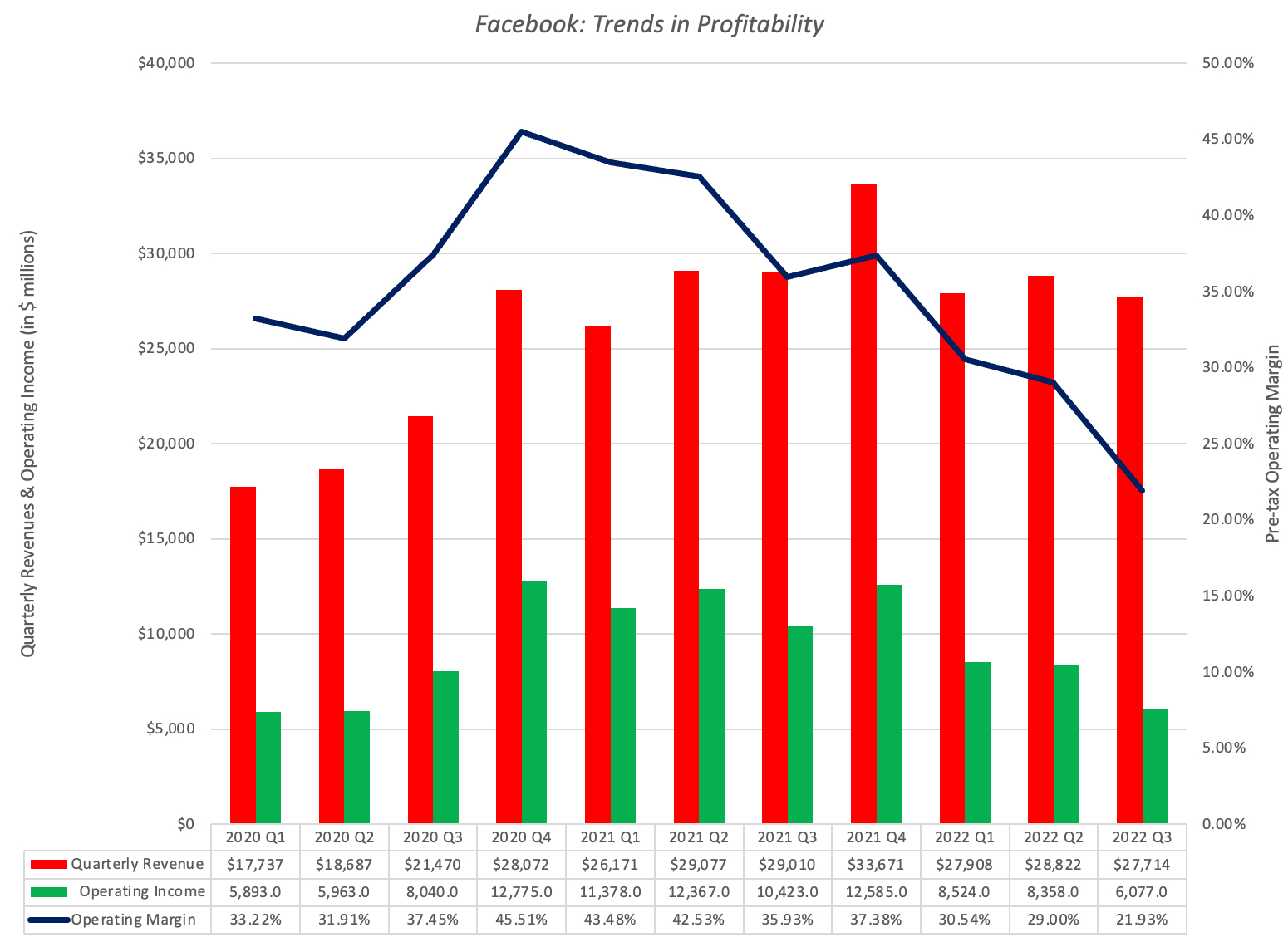
    The drop in Facebook's stock price that has occurred in 2022 is part of a larger story of a decline in tech companies during the year. For many value investors, the tech stock drop has been vindication that no sector, no matter how favored, can fight gravity in the long term, but they would be making a mistake if they bundle Facebook in with younger tech companies, many of which have unformed business models and an inability to be profitable. Through its entire life, one of Facebook's most impressive features has been its capacity not only to generate profits but very large profits, as you can see in the chart below:


Note that Facebook, then it went public, had revenues of only $3.7 billion, but it generated an operating margin of 47.3%, with its online advertising model. In the decade since, its has been able to scale up revenues dramatically, with revenues reach $118 billion in 2021, while preserving sky-high margins, close to 40% in 2021. In short, Facebook has been a profit and cash machine for its entire public market life, and there is more to this company than traders pushing up stock prices on momentum. 

    It is this historical context of high growth, albeit slowing as the company scales up, and consistently high operating margins, that should explain investor reactions to last week's earnings report. There were at least two negative surprises in the report that led to investor reassessment:

  1. Flat revenues: While revenue growth has been slowing in recent quarters, and investors would perhaps have lived with single digit growth, especially with advertising spending slowing, they were blindsided when the company reported its second consecutive year-on-year quarterly revenue decline . The company's contention was that the decline was driven by a slowing down in online advertising revenues at the firm, mirroring similar slowdowns at other online advertising platforms.

    That said, there is clearly more to it than an industry-wide slowdown, since the drop in revenues at Facebook has been larger than the drops seen across the sector; Google, for instance, reported a third quarter year-on-year revenue growth rate of 6% in October 2022.
  2. Drop in operating margins: The bigger shock in the most recent earnings report, in my view, was the collapse in operating margins.

    While the decline in operating income in the first two quarters of 2022 mirror drops in revenues in those quarters, the decline in the third quarter cannot be explained by lower revenues in that quarter. The company attributed the decline in operating income to its Reality Labs unit, which houses its VR headsets, with reported revenues of $285 million and an operating loss of $3.67 billion in the third quarter of 2022. 
It is undeniable that the third quarter numbers for Facebook were disappointing, but again taking a longer term perspective, most companies would gladly switch places with Facebook, with revenues of more than $100 billion, and operating margins of 20%-30%. The question that we face now, as prospective investors, is whether the market has overreacted to a quarter's bad numbers or whether this is the beginning of the end for the company's core business model. 

The Troubles

    While 2022 has been a particularly difficult year for Facebook, the troubles at the company date back to 2018, when it was revealed that Cambridge Analytica, a UK-based data service with political clients, had acquired and utilized Facebook data on tens of millions of users. In the aftermath, Facebook faced both political and investing backlash, with its stock price dropping by more than 10% and there were some doomsayers who argued that its business model was irretrievably broken, because of the privacy challenges. At the time, I pointed to the hypocrisy of critics complaining about Facebook's privacy lapses on their Facebook pages, and argued that the company would weather the scandal, albeit with scars. In the months after, that view was vindicated as Facebook spent billions on tightening security, while continuing to grow revenues and report sky-high margins, and the market responded by pushing up its stock price once again.

    While Facebook was able to deal with the privacy challenge, relatively unscathed in economic terms, there are three other problems that the company is facing that will not be as easily overcome:

  1. Online Ad Market Leveling off: Facebook is an online advertising company, and for much of its early years, it benefited from growth in the online advertising market, largely at the expense of traditional advertising (newspapers, television etc.). As online advertising approaches two-thirds of all advertising, that growth is now leveling off, and as one of the two largest players (and beneficiaries) of the market, Facebook is facing a growth crunch.
  2. Online advertising is cyclical: As online advertising has grown over the last decade, one of the questions has been whether it, like all advertising historically, is cyclical. Prior to this year, there were some who argued that online advertising would be more resilient than traditional advertising, in the face of economic shocks, but this year's developments have shown otherwise.  As economic growth has slowed and concerns about a recession have risen, revenue growth has dropped at all of the companies in this space has declined. The conclusion is that online advertising is cyclical, and if we are in the midst of an economic slowdown, the companies in this space will feel the pain.
  3. Reputation effects: While Facebook made it through the privacy challenges with revenue growth and profitability intact, it is undeniable that the company's reputation took a beating. In my view, this toxicity, as much as the desire to enter a new market in the Metaverse, explains why Facebook changed its name to Meta in November 2021. 

In fact, it is this trifecta of developments (a maturing online ad market, exposure to economic cyclicality and reputation damage), in conjunction with Facebook's disappointing operating numbers that has led investors to reassess its worth, and mark down its price. 

Corporate Governance

    As stock prices have dropped this year, not only is there an increased focus on earnings and cash flows, as I noted in my last post, but there seems to also be an reawakening among investors about the importance of corporate governance, as can be seen in this article about Facebook. Having seen these awakenings many times over the last 30 years, I am cynical that anything productive will come out of these discussions, since we seem to have lost sight of what corporate governance is and why it matters to investors.

The Stakeholders 

    To set the stage for understanding corporate governance, it is best to start with a recognition of the different stakeholders in a publicly traded company:


While all of these claim holders have stakes in the company, their interests will diverge, raising a key question of whose interests should be served by the managers of the company, when making business decisions, small or large. It is true that conventional corporate finance (and the Delaware courts) give primacy to shareholders, and it is not because shareholders are a special or protected group, but It is because they are the only claim holders that do not have a contractual claim on the firm; as shareholders you get what's left over after contractual claims (wages, interest expenses) have been met. Lenders can negotiate interest and principal payments and insert covenants to protect themselves, employees have employment contracts and sometimes unions to negotiate wages and benefits, and customers can choose to buy or not buy a company's products and services. 

    There is of course a notion that managers should be accountable to all stakeholders, not just stockholders, an idea that was born and nurtured in law schools, before finding a footing in business. In a 2019 post, I presented my arguments for why stakeholder wealth maximization is fanciful in its belief that it is management's job to juggle the divergent interests of different stakeholders and dangerous insofar as it makes managers accountable to everyone, and by extension, to no one. (Note that the G in ESG is about stakeholder governance, not shareholder governance, which may explain why CEOs have been so quick to jump on its bandwagon.)

Conflicts of Interests and Consequences
    If you are looking at a privately owned business, with a sole owner who also runs the business, the interests of owners and managers converge, but this is the exception, not the rule. Even in a family-owned business, where one family member runs the business, you can have other family members disagree about how it is run, leading to frictions and legal battles. (If you are a fan of Succession on HBO, you know exactly what I am talking about). As businesses seek external capital to grow, either from private hands (venture capitalists) or public equity, the divergence between the interests of those running businesses and the owners of these businesses will increase. That is the core challenge in corporate governance, and any discussion of the topic has to begin with answers to three questions:
  1. In what types of firms is this conflict of interest greatest? If the conflict of interest that is at the heart of corporate governance is that between the owners of a business and those who manage that business, it will begin when private businesses seek out capital from external sources, as founder and venture capital interests can diverge. These conflicts will expand, as companies go first go public, and the interests of insiders and founders, who run the firm, can be at odds with the interests of outside shareholders. As companies age, founders will move on and get replaced by professional managers, and these managerial interests can clearly be at odds with those of shareholders, with boards of directors, in theory, watching out for the latter. In short, conflicts of interest exist at almost all businesses, though the nature of the conflict will change as companies go from private to public, and as they age.
  2. When the interests of shareholders and corporate decision-makers diverge, what are the consequences for the company? When the interests of decision makers or managers at a business diverge from those of its owners, it is inevitable that there will be decisions made that advance the interests of the former at the expense of the latter. With private business that access venture capital, founders may make decisions (on product design, business models, marketing) that venture capitalists may not find to their liking. With public companies that are run by founders/insiders, the decisions made by inside shareholders to advance their interests may not align with the interests of outside shareholders. In older public companies, the investing, financing and dividend decisions that managers make may by in direct opposition to what shareholders would like them to do.
  3. What are the checks on these conflicts of interest? In each of the scenarios described above, it is true that there are mechanisms that exist to keep these conflicts in check. In private firms with venture capital investors, VC investors are often actively involved in management, and, if they have the power, have few compunctions about pushing out founder/managers who don’t serve their interests. In public companies, with insiders and founders in charge, the only recourse that outside shareholders often have, if they feel their interests are being ignored, is to sell and move on, hoping that the resulting drop in stock prices causes a change in course. In theory, the boards of directors at these companies are supposed to protect shareholder interests, but that protection is sporadic and often ineffective.
In short, while corporate governance is often framed as being entirely about the conflicts of interests between managers and shareholders at companies with dispersed shareholdings, its reach is much broader, and it is relevant at almost every business.

The Essence of Corporate Governance

    After five decades of research in corporate governance, my sense is that we have lost the forest for the trees, with the composition of boards of directors and rules on proxy voting receiving disproportionate attention, from both legislators and regulators, often at the expense of bigger and more consequential issues. In the aftermath of the Enron and Tyco scandals in the United States, where insider-dominated boards were negligent in their oversight responsibilities, the Sarbanes-Oxley Act was passed in 2002, with improved corporate governance as one of its objectives. At about the same time, you saw the advent of services that used the disclosures that companies were required to make on governance to estimate corporate governance scores. We were told at the time that the combination of independent boards, increased disclosure and governance scores would create a revolution in corporate governance, where managers would act to advance shareholder interests. It is clear that twenty years later that all that Sarbanes Oxley has accomplished is replacing ineffective insider-dominated boards with ineffective independent boards, while creating hundreds of pages of disclosure that no one reads and giving rise to scores that are close to useless in judging governance. With the push towards diversity in board composition now taking precedence, this process is hurtling even more into irrelevance, with the only positive being that the ineffective boards of the future will meet all our diversity criteria.

    I believe that for a true shift in corporate governance to happen, we have to reframe the meaning of good corporate governance, shifting away from a board-centered, check-box driven view to one that is centered on giving shareholders the power to change company management, if they choose to. In fact, good corporate governance is like a good democracy, where shareholders (voters) get the power to change management (governments), when they believe that their interests are not being served. As in a democracy, there is no guarantee that shareholders will make the right or even informed choices, sometimes choosing not to make changes, even when change is required, and sometimes deciding to replace good managers with bad ones. Good corporate governance is sometimes chaotic and often unsettling, and it is no surprise that there are many who are drawn to the benevolent dictatorship model, where "qualified, well-intentioned managers" are given lifetime tenure, with shareholders stripped of the power to challenge them. That latter model was the default for publicly traded companies in much of the world, for the twentieth century, and even in the US, you had managerial apologists like Marty Lipton and corporate strategists arguing that corporate management would be more effective, without shareholder oversight. 

The "Right" Management: A Corporate Life Cycle Perspective

    If corporate governance is about giving more power to business owners to change management at the companies that they are invested in, if they choose to, to understand it, we have to begin by looking at why management change may be needed in the first place. I will use the corporate life cycle, a structure that I have used in many other contexts, to set the stage for this discussion, by noting that the qualities that you will look for in "good" management will change as companies move through the life cycle, from start-up to growth to mature and then on to final decline. In the figure below, I have highlighted the role that top management play at a business, and how that role will change as companies age. 
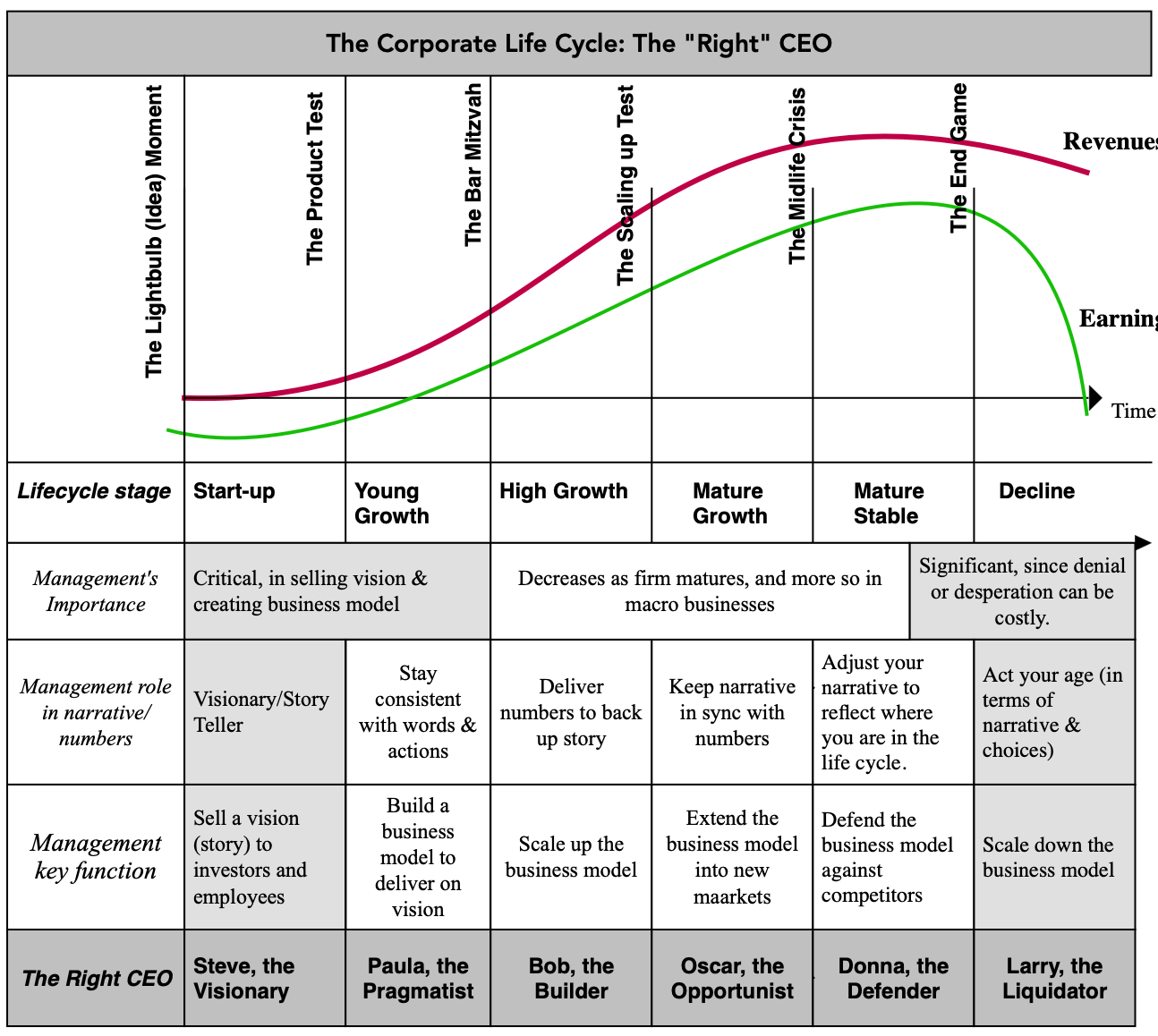
Early in the life cycle, as a start-up, the quality that you value most in your top management (and especially in your CEO) is vision, the capacity to tell the story of the business, and get investors and employees on board. As you move from idea to product, you still need vision, but it has been paired with pragmatism, and you would like the business to be run by someone who is willing to make compromises on design and strategy, to create a market for the product. The trash can of failed businesses is filled with purist founders who insisted on having their way, and refused to bend their dreams to meet reality. In the next phase, you need a CEO who is willing to do the work needed to build a business, an often unexciting job that requires attention to supply chains, marketing campaigns and product manufacturing. As businesses look to scale up, they are best led by opportunists who can seek out new markets that allow small businesses to become bigger, and once mature, you want an executive at the top who can play defense against competitors and disruptors. In decline, you need a realist who takes what the business has to offer, and does not try to overreach, in many ways the polar opposite of the visionary you sought out as a start-up.

Management Mismatches across the Life Cycle

    Understanding how the qualities that you look for in good management change, as the company changes, provides a framework for assessing why you can end up with management mismatches, where the managers running the firm are unsuited to running it. In some cases, it can happen because the business changes (from start up to young growth or from high growth to mature), but the person running it does not, will not or cannot change. In other cases, it can represent a hiring mistake, as is the case when the board of directors at a high growth firm seek out the CEO of a mature company, competent but risk-averse, to run their business.  In still others, it can just be hopeful thinking, where the board of directors at a declining firm seek out a visionary CEO, hoping that this hire can reverse aging and become young again. In the figure below, I have listed CEO/Company mismatches across the life cycle:

I also highlight the catalysts for management change at each stage.  In very young firms, it is disgruntled venture capitalists who pressure founders who, they believe, are not paying enough attention to business-building, to change their ways or even leave their positions. In publicly traded firms, the catalysts can be activist investors, who pressure businesses to change the way they are run or even who runs them, hostile acquirers, hoping for revamps, or private equity funds, with plans for liquidating or breaking up the firm.

Management Mismatch Consequences
    In most firms, even in the countries that are viewed as strong on corporate governance, there are barriers to change that are daunting, which explains why forced management changes are infrequent. Thus, venture capitalists may be stymied, when trying to replace founders, by the founders' controlling stakes. With high-growth firms that are publicly traded, insiders and founders holding large stakes can make it difficult for outside shareholders to push for charge, and as firms mature and age, it is the passivity of institutional investors that is the biggest impediment to change. 

    When a management mismatch persists, the consequences can range from the benign to very damaging:

In the most benign case, the mismatched manager recognizes his or her limitations and hires help to remedy them. In my view, the biggest difference between Steve Jobs in his first iteration at Apple, when his stubbornness damaged the company, and his legendary second stint at the company, was the presence of Tim Cook, as his chief operating officer. In an intermediate scenario, the board of directors eventually faces up to the reality of the mismatch, often because of poor stock price performance, and replaces the management, but not before serious damage has been done. In the most malignant scenario, the mismatched manager stays in place, destroying value and running the business into the ground, and perhaps into bankruptcy.

Corporate Governance at Technology Companies
    With that long lead-in on corporate governance, let's look at technology companies, partly because they are the largest sector in terms of market capitalization, and partly because this post is on Facebook, a large technology company. I will argue, using the life cycle structure, that tech companies age much faster than non-tech businesses, and are thus more exposed to management mismatches. Troublingly, it is precisely in these companies, where the need for corporate governance is greatest, that we (as investors) seem to have acquiesced to structures that give us the least power to push for change.

The Compressed Life Cycle

    A corporate life cycle resembles the human life cycle, in terms of its sequence, but there are two significant differences. The first is that the mortality rate is far higher in the corporate life cycle, as more than two thirds of businesses do not make it through the early stages, than it is for human beings, at least in the twenty first century. The second is that unlike the human life, the corporate life cycle does not follow chronological time. Kongo Gumi, a family-owned Japanese company in the business of constructing temples and shrines, lasted for almost 1500 years, before being acquired in 2006. In contrast, there are businesses that are shooting stars that survive for only 15 or 20 years, before liquidating or selling themselves. In the figure below, I look at the variables that determine  how quickly a business grows, how long it stays at the top and the speed of its decline:

Companies in businesses with low capital intensity and ease of access to the market and capital will grow much more quickly than businesses without these characteristics, but those same features will make it difficult for them to stay at the top for very long and accelerate their decline. That is the basis for a post that I wrote about why technology companies have compressed life cycles, relative to manufacturing or infrastructure companies:


Just to illustrate, the great companies of the twentieth century, such as Exxon Mobil, GE and Ford, might be looking at the declining phases of their life cycles now, but they have had extraordinarily long lives (Exxon was founded in 1859, GE in 1892 and Ford in 1903). In contrast, a company like Yahoo! was able to get from its founding in 1994 to a hundred-billion dollar market capitalization five years later, but its glory days lasted until 2004, when Google entered the game, and decline, once it started, was unstoppable, leading to its demise in 2017. (Marissa Mayer tried, but she never had a chance...)

    We believe that this compressed life cycle has consequences for management mismatches. With the long life-cycle companies that characterizes the twentieth century, companies and managers both aged over time, allowing for transitions to occur more naturally. To see, why consider how corporate governance played out at Ford, a twentieth century corporate success story. Henry Ford, undoubtedly a visionary, but a crank on some dimensions, was Ford's CEO from 1906 to 1945. His vision of making automobiles affordable to the masses, with the Model T (but only in black), was a catalyst in Ford's success, but by the end of his tenure in 1945, his management style was already out of sync with the company. With Ford, time and mortality solved the problem, and his grandson, Henry Ford II, was a better custodian for the firms in the decades that followed. Put simply, when a company lasts for a century, the progression of time naturally takes care of mismatches and succession. In contrast, consider how quickly Blackberry, as a company, soared, how short its stay at the top was, and how steep its descent was, as other companies entered the smartphone business. Mike Lazaridis, one of the co-founders of the company, and Jim Balsillie, the CEO he hired in 1992 to guide the company, presided over both its soaring success, gaining accolades for their management skills for doing so, as well as its collapse, drawing jeers from the same crowd. By the time, the change in top management happened in 2012, it was viewed as too little, too late. Put simply, if the companies that dominate the market today have compressed life cycles, relative to the companies of the last century, we should ready ourselves for far more cases of management mismatches.

The Investor Surrender

    If you accept my thesis that shorter corporate life cycles increase the likelihood of management mismatches at companies, it follows that we, as investors, need tools and processes that increase our power to change management at these firms. It is in this context that we have look back, with dismay at how willingly we have given away the power to create change at companies, and especially so at technology companies. While corporate governance measurement services and academics were obsessing over board composition and management compensation, companies have been changing the rules of the governance game, tilting power decisively away from shareholders, with little or no pushback. In the last two decades, US companies,  have increasingly turned to dual-class shares, with one class having significantly more voting rights than the other, and with founders/insiders holding these voting shares. You can see this phenomenon play out in the chart below, where I graph out the percentage of companies, going public with dual-class shares, each year from 1980 to 2021:
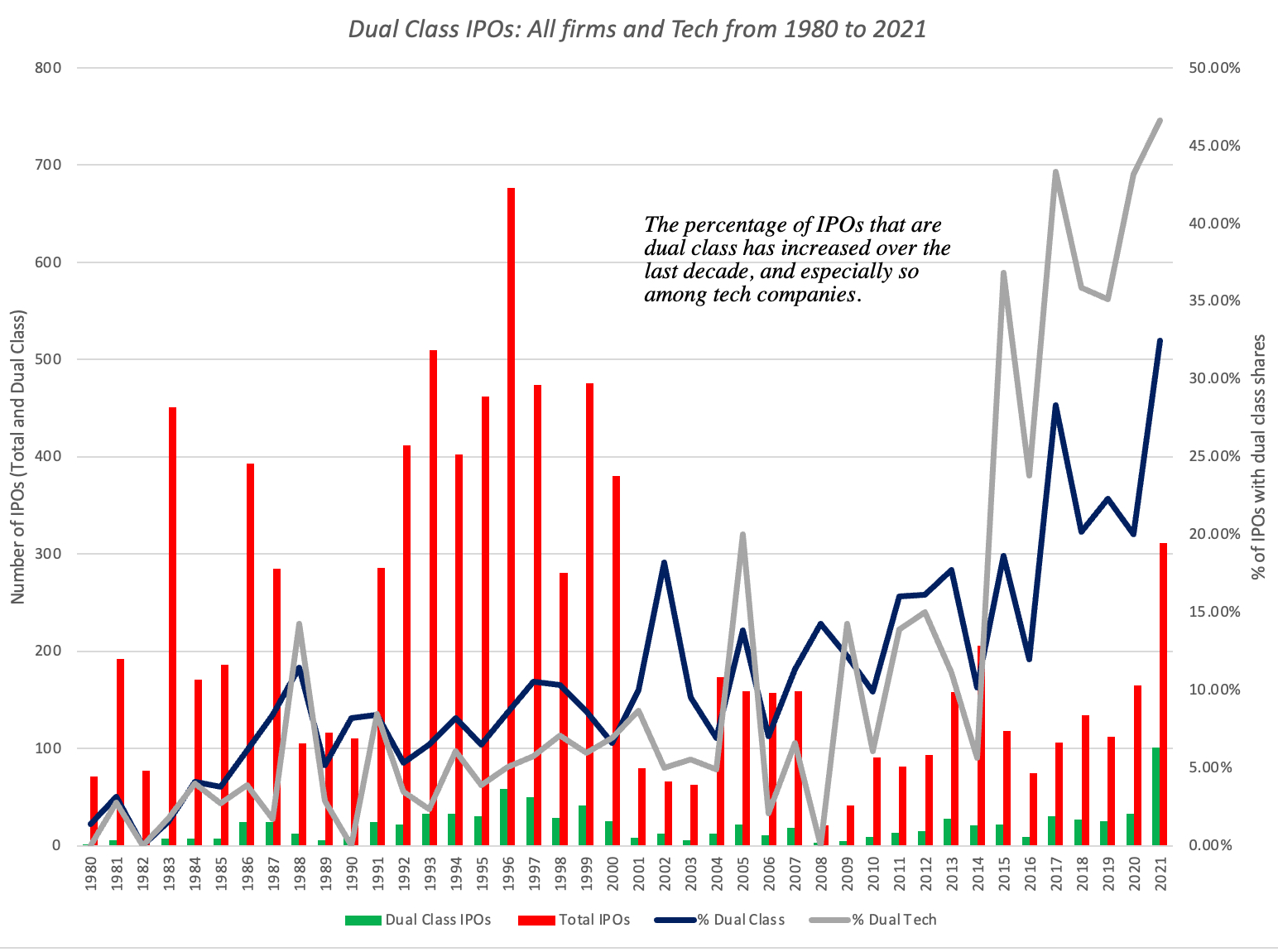
By 2021, almost a third of all companies going public had two classes of shares, with different voting rights, and that trend was even stronger at tech companies, where close to half of all companies, going public, had shares with different voting rights in 2021. 

    Facebook, which went public in 2012, followed this path when it issued class A shares to the public, with one voting right per share, while Zuckerberg and a few insiders kept class B shares, with ten voting rights per share. In the figure below, you see the breakdown of share holding in both class A and class B shares at Facebook:

Cutting to the chase, Zuckerberg controls 57% of the voting rights in the company, while owning only 13.52% of all outstanding shares, largely because he holds the bulk of the voting shares. Rather Han a corporate democracy, Facebook’s elections resemble those in authoritarian regimes, where you can vote for whoever you want, but the winner is pre-determined. (Just as an aside, I found a Facebook proposal to the SEC, thankfully stillborn, to create Class C shares with no voting rights, in 2017. That would have added insult to injury!)

    In short, shareholders have been disempowered at some of our largest and most valuable companies, and they have, for the most part, gone along. There is plenty of blame to go around, but the following culprits stand out:

  1. Market-share seeking Stock Exchanges: For much of the last century, starting with a de facto ban in 1926 and a rule in 1940, the New York Stock Exchange barred companies listed on the exchange from  from issuing shares with different voting rights, and with its dominance over US equity markets, that became the rule followed by most US companies. The American Stock Exchange adopted slightly looser rules, hoping to get market share from the NYSE, but it was the NASDAQ that threw caution to the winds entirely and removed all restrictions on voting and non-voting shares. That proved to be a great business decision, since the largest tech companies of this century have not only listed on the NASDAQ, but chosen to stay there, but it came at the expense of shareholder powers.
  2. Founder Worshippers: For the last few decades, we have glorified the founders of technology companies, and while there is much to admire in their accomplishments, there is a danger in putting them on pedestals and attributing to them heroic or superhuman qualities. In the case of companies like Google and Facebook, and especially so at the time of their public offerings, there were many investors, including some of the largest institutional players, that were willing to make the trade off of giving up power to change management in return for being invested in companies run by "young, tech geniuses". In fact, there are some researchers who were willing to argue that removing the threat of shareholder power made founder-run companies more valuable, because founders are smarter and think more long-term than investors. 
  3. Lazy Investors: Much as we would like to blame others for our misfortunes, the truth is that get the corporate governance we deserve. Most of us, as investors, chose to give away our voting rights willingly because we wanted shares of the "next big thing", and at the time we did so, we rationalized it by arguing it that we would not need that voting power any time soon. I have little sympathy for the hand wringing and complaints from investors, institutional or retail, in Facebook that management is not listening to them. Investing in Facebook and complaining that Mark Zuckerberg will not listen to you is like getting married to one of the Kardashians and complaining that your privacy is being invaded.
  4. Lax Regulators: For some of you reading this post, the villain is going to be the SEC and regulators, with the argument being that they could have protected you by banning dual class shares. I see your point, but remember that the inertia, laziness or me-tooism that led you to buy dual-class shares, will outlast the regulatory ban. Regulators cannot protect us from our own worst instincts!
There may not be much you can do about companies that have already adopted dual-class shares, but marking their prices down will make them pay attention. Who knows? Losing a chunk of their wealth may lead the founders who run some of these companies to reassess their positions on differential voting rights.

The Consequences

    If the essence of corporate governance is the giving shareholders the power to change management at companies, where there is a mismatch, and if those mismatches are more likely to occur at tech companies, where shareholders have unilaterally disarmed, there are predictable consequences:

  1. Chaotic Management Transitions: It is true that we have made it more difficult to change management at tech companies, even when that change is overdue. That said, there will be tech companies where change will occur, but my prediction is that this change will often be forced by either insider in-fighting (where co-founders and insiders turn on each other) or precipitated by a pricing collapse. While Elon Musk’s acquisition of Twitter is one of a kind, the chaos that you are observing at the company is a precursor to changes that you will see at other tech companies in the years to come.
  2. Locked-in Mismatches: There are other tech companies where the game has been so thoroughly tilted in favor of insiders and incumbent management that change is impossible. In these companies, as an outside investor, you have to build that reality into your valuations, leading to discounts to your value that reflect how much you trust management. In short, if management has adopted policies that are value-destructive, in the long term, there will be a much smaller chance of reversal at companies with locked-in management than at companies where change remains possible. In the case of Facebook, the company has clearly made a huge bet on the Metaverse, investing $15 billion in the most recent year and planning almost $100 billion in additional investments in the coming years. It is too early to pass judgment on whether these investments will pay off, but assume that the data that comes in over the next two years indicates that Facebook should scale back its investments and slow down. I would like to believe that Zuckerberg is too smart a businessman not to do the right thing, but the qualities that made him a successful founder (over confidence, stubbornness in the face of failure, arrogance) may very well keep him on his pre-determined path, and without checks and balances, Facebook will lose a lot more money over a longer period, before he gives in. 
  3. Voting Share/Non-voting Shares: In a paper on valuing control from a  few years ago, I argued that the differential in prices between voting and non-voting shares will reflect the value of expected control in a company, and will be higher at companies where management change is plausible than in firms where it is unlikely. When tech companies go public, it is entirely possible that there will be a honeymoon period, perhaps even an extended one, where investors are dazzled by scaling successes and are willing to overlook shortcoming, when shares with different voting rights trade at the similar prices. As disillusionment sets in, I would expect voting share premiums to rise, and to rise more at those firms where investors trust managers the least.
As investors, should you avoid investing in tech companies with dual-voting right shares? If I said yes, I would be violating one of my own precepts, which is that I will buy any company, no matter what its faults, at the right price. You should avoid investing in these companies when they are priced on the presumption that their founder-managers can do no wrong, but as fear overcomes greed in markets, investors in these companies will start pricing in the worst-case scenarios, where founders continue with dysfunctional behavior in perpetuity, and at those prices, you may be getting bargains.  That is what I see happening, in 2022, at Facebook, in particular, and large tech companies, in general. It is the reason that having lost money on Facebook, since buying it in April, I will continue to hold it and I did add to my holdings, when the stock hit $100/share. I know that my Facebook investment will ride and fall with Mark Zuckerberg's ego, and while I have no delusions about being able to influence him, I think that at today's prices, the odds are in my favor. Time will tell!

YouTube Video

Friday, October 23, 2015

Winning at a Loser's Game? Control, Synergy and the ABInBev/SABMiller Merger!

I have been a long time investor in ABInBev, though I became one indirectly and accidentally, through a stake I took a long time ago in Brahma, a Brazilian beverage company . That company became Ambev in 1999, which in turn was merged with Interbrew, the Belgian brewer, in 2004, and expanded to include Anheuser Busch, the US beer maker, in 2008 to become the largest beer manufacturer in the world.  I made the bulk of my money early in my holding life, but Amber has remained in my portfolio, a place holder that provides me exposure to both the beverage business and Latin America, while delivering mostly positive returns. It was thus with trepidation that I read the news report in mid-September that ABInBev (which owns 62% of Ambev) had approached SABMiller about a takeover at a still-to-be-specified premium over the the latter's market value. While it is entirely possible to create value from acquisitions, I have argued that creating growth through acquisitions is difficult to do, and doubly so when the acquisition is of a large public company. Since ABInBev's control rests with 3G Capital, a group that I respect for its investment acumen, it would be unfair to prejudge this deal without looking at the numbers. So, here we go!

The Fog of Deal Making: Breaking down an acquisition
The first casualty in deal making is good sense, as the fog of the deal, created by bankers, managers, consultants and journalists, clouds the numbers. Not only do you see "control" and "synergy", two words that I include in my weapons of mass distraction, thrown around casually to justify billions of dollars in premiums, but you also see them used interchangeably. When you acquire a company, there are three (and only three possible) motives that are consistent with intrinsic value
  1. Undervaluation: You buy a target company because you believe that the market is mispricing the company and that you can buy it for less than its "fair" value. In effect, you are behaving like any value investor would in the market and there is no need for you to either change the way the target company is run or look for synergy benefits. 
  2. Control: You buy a company that you believe is badly managed, with the intent of changing the way it is run. If you are right on the first count and can make the necessary changes, the value of the firm should increase under your management. If you can pay less than the "changed" value, you can claim the difference for yourself (and your stockholders). 
  3. Synergy: You buy a company that you believe, when combined with a business (or resource) that you already own, will be able to do things that you could not have done as separate entities. Broadly speaking, you can break synergy down into "offensive synergies" (where you are able to grow faster in existing or new markets than you would have as standalone businesses and/or charge higher prices for your products), "defensive synergies" (where you are able to reduce costs or slow down/prevent decline in your businesees) and "tax synergies" (where you directly take advantage of tax clauses or indirectly by being able to borrow more money). 
The key distinction between synergy and control is that control does not require another entity or even a change in managers. It can be accomplished by the target company's management, if they put their minds to it and perhaps hire some help. Synergy requires two entities coming together and stems from the combined entity's capacity to do something that the individual entities would not have been able to deliver. Note that these motives can co-exist in the same acquisition and are not mutually exclusive.  To assess whether these motives apply (or make sense), there are four numbers that you need to track: 
  1. Acquisition Price: This is the price at which you can acquire the target company. If it is a private business, it will be negotiated and probably based on what others are paying for similar businesses. If it is a public company, it will be at a premium over the market price, with the premium a function of the state of the M&A market and whether you have other potential bidders. 
  2. Status Quo Value: This is the value of the target company, run by existing management and based on existing investing, financing and dividend policies. 
  3. Restructured Value: This is the value of the target company, with changes to investing, financing and dividend policies. 
  4. Synergy value: This can be estimated by valuing the combined company (with the synergy benefits built in) and subtracting out the value of the acquiring company, as a stand alone entity, and the restructured value of the target company. 
Connecting these numbers to the motives, here are the conditions you would need for each motive to make sense (by itself).

MotiveTest
UndervaluationAcquisition Price < Status Quo Value
ControlAcquisition Price < Restructured Value (Status Quo Value + Value of Control
SynergyAcquisition Price < Restructured Value + (Value of Combined company with synergy - Value of Combined company without synergy)

Which of these motives, if any, is driving ABInBev's acquisition of SABMiller, and whatever the motive or motives, is the premium being paid justified? To make that assessment, I will compute each of the four numbers for this deal.

Setting up the ABInBev Deal
The first news stories on ABInBev’s intent to buy SABMiller came out on September 15, 2015, though there may have been inklings among some who are more connected than I am. While no price was specified, the market’s initial reaction was positive, with both ABInBev and SABMiller’s stock prices increasing on the story. The picture below captures the key details of the deal, including both possible rationale and consequences:


There were two key reasons provided to rationalize the potential deal. The first is geographic complementarity, since these two companies overlap in surprisingly few parts of the world, given their size. ABInBev is the largest player in Latin America, with Brazil at its center, and SABMiller is the biggest brewer in Africa. SABMiller’s Latin American operations are outside of Brazil, for the most part and while ABInBev has significant North American operations, SABMiller's North American exposure is entirely through its Coors Joint Venture. While no specifics are provided, the basis for synergy seems to be that after this deal, ABInBev will be able to expand sales in the fastest growing market in the world (Africa) and that SABMiller will be able to increase its revenues in the most profitable market in the world (Latin America). The second is consolidation, a vastly over used term that often means nothing, but  if it tied to specifics, relates to potential costs savings and economies of scale. While the absence of geographic overlap may reduce the potential for cost cutting, ABInBev can use the template that it has used so successfully on prior deals (especially the Grupo Modelo acquisition) to cut costs in this acquisition as well.

There are also negative consequences that follow from this deal. The first is that when anti trust regulators in different parts of the world will be paying close attention to this deal, and it seems likely that SABMiller will be forced to sell its 58% stake in MillerCoors and that Molson Coors, the other JV partner, will be the beneficiary. The second, and this adds to the pressure, ABInBev has agreed to pay $3 billion to SABMiller if the deal falls through.  In summary, though, the challenge is a simple one. ABInBev is paying a $29 billion premium to acquire SABMiller. Is there enough value added to ABInBev's stockholders that they will be able to walk away as winners?

The Players in the Deal
To make a value judgment of this deal, we have to begin by looking at ABInBev and SABMiller, as stand alone companies, prior to this deal. In the picture below, I start with a snapshot of ABInBev:

Capital MixOperating MetricsGeographical Mix
Interest-bearing Debt$51,504Revenues$45,762Latin America$18,849.00 42.03%
Lease Debt$1,511Operating Income (EBIT)$14,772Africa$- 0.00%
Market Capitalization$173,760Operating Margin32.28%Asia Pacific$5,040.00 11.24%
Debt to Equity ratio30.51%Effective tax rate18.00%Europe$4,865.00 10.85%
Debt to Capital ratio23.38%After-tax return on capital12.10%North America$16,093.00 35.88%
Bond RatingA2Reinvestment Rate =50.99%Total$44,847.00 100.00%
Looking past the numbers, it is worth noting that not only does ABInBev has a history of growing successfully through acquisitions but that its lead stockholder, 3G Capital, is considered a shrewd allocator and steward of capital.

On the other other side of the deal stands SABMiller, and the picture below provides a sense of the company's standing at the time of the deal:

Capital MixOperating MetricsGeographical Mix
Interest-bearing Debt$12,550Revenues$22,130Latin America$7,81235.30%
Lease Debt$368Operating Income (EBIT)$4,420Africa$6,85330.97%
Market Capitalization$75,116Operating Margin19.97%Asia Pacific$3,13614.17%
Debt to Equity ratio17.20%Effective tax rate26.40%Europe$4,18618.92%
Debt to Capital ratio14.67%After-tax return on capital10.32%North America$1430.65%
Bond RatingA3Reinvestment Rate =16.02%Total$22,130100.00%

This table, though, misses SAB's holdings in the MillerCoors JV and its other minority holdings in associates around the world, and the numbers for SAB's shares of these are summarized below:
SAB Share of Other Associates
Operating MetricsGeographical Mix
Revenues$6,099.00Latin America$- 0.00%
Operating Income (EBIT)$654.00Africa (mostly South Africa)$2,221 36.42%
Operating Margin10.72%Asia Pacific$2,203 36.12%
Effective tax rate25.00%Europe$1,675 27.46%
After-tax return on capital11.00%North America$- 0.00%
Invested Capital$4,459Total$6,099100.00%
SAB Share of MillerCoors JV
Operating MetricsGeographical Mix
Revenues$5,201.00Latin America$- 0.00%
Operating Income (EBIT)$800.00Africa (mostly South Africa)$- 0.00%
Operating Margin15.38%Asia Pacific$- 0.00%
Effective tax rate25.00%Europe$- 0.00%
After-tax return on capital11.05%North America$5,201 100.00%
Invested Capital$5,428Total$5,201100.00%
The numbers reinforce my earlier point about geographic complementarity at least at the parent company level, with ABInBev getting a large percent of its Latin American sales in Brazil and SABMiller getting most of its Latin American sales from countries other than Brazil.

Is SABMiller a bargain?
The first step in this analysis to a valuation of SABMiller, as a stand alone company and with its existing management in place. Based on the numbers, this is a conservatively run company (both in terms of use of debt and reinvestment for growth) and the valuation reflects that:

SAB Miller+ 58% of Coors JV+ Share of AssociatesSAB Miller Consolidated
Revenues$22,130.00$5,201.00$6,099.00
Operating Margin19.97%15.38%10.72%
Operating Income (EBIT)$4,420.00$800.00$654.00
Invested Capital$31,526.00$5,428.00$4,459.00
Beta0.79770.68720.6872
ERP8.90%6.00%7.90%
Cost of Equity =9.10%6.12%7.43%
After-tax cost of debt =2.24%2.08%2.24%
Debt to Capital Ratio14.67%0.00%0.00%
Cost of capital =8.09%6.12%7.43%
After-tax return on capital =10.33%11.05%11.00%
Reinvestment Rate =16.02%40.00%40.00%
Expected growth rate=1.65%4.42%4.40%
Number of years of growth555
Value of firm
PV of FCFF in high growth =$11,411.72$1,715.25$1,351.68
Terminal value =$47,711.04$15,094.36$9,354.28
Value of operating assets today =$43,747.24$12,929.46$7,889.56$64,566.26
+ Cash$1,027.00
- Debt$12,918.00
- Minority Interests$1,183.00
Value of equity$51,492.26
 I am adding in my estimated values for SAB's share of the Coor's JV and other associates to arrive at the total value of the operating assets. In valuing each piece, I have estimated equity risk premiums that reflect where each one operates, using a 6% mature market premium for the Coors JV, since it generates most of its revenues in North America, and much higher premiums for the other two parts. At least based on my estimates, the value of equity is $51.5 billion, well below the market capitalization of $75 billion on September 15. (This may be cynical of me, but if used (wrongly in my view) a 6% equity risk premium for SABMiller, based on its UK incorporation, I get a value of $76 billion for its equity.)
Bottom line: To me, SABMiller does not look like it is priced to be a bargain, even at the pre-deal price, and definitely not at the deal price.

The Value of Control
Is SABMiller ripe for a restructuring? It is tough to tell from the outside but one way to measure room for improvement is to compare the company on key corporate finance measures against both the acquirer (InBev) and the rest of the alcholic beverage sector:
SABMillerABInBevGlobal Alcoholic Beverage Sector
Pre-tax Operating Margin19.97%32.28%19.23%
Effective Tax Rate26.36%18.00%22.00%
Pre-tax ROIC14.02%14.76%17.16%
ROIC10.33%12.10%13.38%
Reinvestment Rate16.02%50.99%33.29%
Debt to Capital14.67%23.38%18.82%
This comparison may be simplistic, but it looks like SABMiller lags the sector is in its reinvestment rate and return on capital, and that it earns a profit margin that match up to the sector. It also has a debt ratio that is not far off from the sector average. ABInBev has a much higher profit margin than the rest of the sector and pays a lower tax rate. I revalued SABMiller with the return on capital, debt ratio and reinvestment rate set equal to the industry average. (I considered using ABInBev's operating margin but much of that comes from Brazil and it is unlikely that SABMiller can match it in South Africa or the rest of Latin America.

Status Quo ValueRestructuredChanges made
Cost of Equity =9.10%9.37%Increases with debt ratio
After-tax cost of debt =2.24%2.24%Left unchanged
Debt to Capital Ratio14.67%18.82%Set to industry average
Cost of capital =8.09%8.03%Due to debt ratio change
Pre-tax return on capital14.02%17.16%Set to industry average
After-tax return on capital =10.33%12.64%Result of pre-tax ROIC change
Reinvestment Rate =16.02%33.29%Set to industry average
Expected growth rate=1.65%4.21%Result of reinvestment/ROIC
Value of firm
PV of FCFF in high growth =$11,411.72$9,757.08
Terminal value =$47,711.04$56,935.06
Value of operating assets today =$43,747.24$48,449.42
+ Cash$1,027.00$1,027.00
+ Minority Holdings$20,819.02$20,819.02
- Debt$12,918.00$12,918.00
- Minority Interests$1,183.00$1,183.00Value of Control
Value of equity$51,492.26$56,194.44$4,702.17
Bottom line: Changing the way SABMiller is run adds about $4.7 billion to the value, but even with that addition, the equity value of $56.2 billion is still far below what ABInBev paid on October 15. That suggests that control was not the primary rationale either.

The Value of Synergy
This leaves us with only one option, synergy, and to value synergy, I valued ABInBev as a standalone company and put it together with the restructured value of SABMiller to get a combined company value, with no synergy. I then assumed that the synergy (from geographic complementarity and consolidation) would manifest itself in a higher operating margin, higher reinvestment and a higher growth rate for the combined company:

InbevSABMillerCombined firm (no synergy)Combined firm (synergy)Actions
Cost of Equity =8.93%9.37%9.12%9.12%
After-tax cost of debt =2.10%2.24%2.10%2.10%
Cost of capital =7.33%8.03%7.51%7.51%No changes expected
Operating Margin32.28%19.97%28.27%30.00%Cost cutting & Economies of scale
After-tax return on capital =12.10%12.64%11.68%12.00%Cost cutting also improves return on capital
Reinvestment Rate =50.99%33.29%43.58%50.00%More aggressive reinvestment in shared markets
Expected growth rate=6.17%4.21%5.09%6.00%Higher growth because of reinvestment
Value of firm
PV of FCFF in high growth =$28,732.57$9,806.49$38,539.06$39,150.61
Terminal value =$260,981.86$58,735.57$319,717.43$340,174.63Value of Synergy
Value of operating assets =$211,952.80$50,065.35$262,018.16$276,609.92$14,591.76
It is possible that I have been too pessimistic about the potential cost savings or growth possibilities, but given the history of synergy in big deals, I think that I am being optimistic. Based on my estimates at least, the value of synergy in this deal is $14.6 billion (and that is assuming it is delivered instantaneously).
Bottom line: If synergy is the motive for this deal, a great deal has to go right for ABInBev to break even on this deal, let alone create value.

The Disconnect
The history of 3G Capital as successful value creators predisposed me to give them the benefit of the doubt, when I started assessing the deal. After looking at the numbers, though, I don't see the value in this deal that would justify the premium paid. It is possible, perhaps even likely, that there is some aspect of the deal, perhaps taxes or other benefits, that I am not grasping. If so, I would encourage you to use my template, change the numbers that you think need to be changed, make your own assessment and enter them in this shared Google spreadsheet. It is also possible that even the smartest investors in the world can sometimes let over confidence drive them to over react. Time will tell!

YouTube version


Data Attachments
  1. ABInBev Annual Report (2014)
  2. SABMiller Annual Report (2015)

Spreadsheets
  1. SABMiller: Status Quo and Control Value
  2. Value of Synergy 
  3. Google Shared Spreadsheet for Deal Analysis